
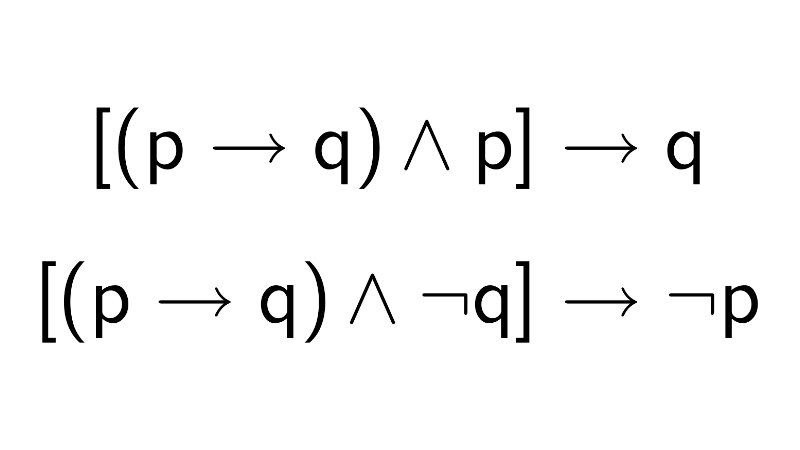
Law of Non-Contradiction
The law of non-contradiction is a fundamental principle in classical logic stating that a proposition and its negation cannot both be true at the same time. In other words, it is impossible for a statement and its logical opposite to have the same truth value within the same context and at the exact same moment.
This concept is expressed symbolically by the formula ¬(p ∧ ¬p), which negates the conjunction between a proposition p and its negation ¬p, ensuring that the conjunction "p and not-p" is always false.
An everyday example is the statement "it is raining." According to this law, it cannot be true that "it is raining and it is not raining" at the same time and in the same place; both conditions cannot coexist in reality.
Table of Contents
Proof
The formula ¬(p ∧ ¬p) is a tautology, meaning its truth value is always true, regardless of the truth value assigned to proposition p. The following truth table proves this property:
| p | ¬p | (p ∧ ¬p) | ¬(p ∧ ¬p) |
|---|---|---|---|
| T | F | F | T |
| F | T | F | T |
As shown, the final column ¬(p ∧ ¬p) yields a true value for all possible truth assignments.
The principle of non-contradiction is one of the three fundamental laws of classical logic, along with the law of identity (which states that every proposition is identical to itself, p → p) and the law of excluded middle (which states that for any proposition p, either p is true or ¬p is true, p ∨ ¬p).
Examples
A helpful way to visualize this principle is to consider a light switch: it is impossible for a bulb to be both on and off at the exact same moment. The state of being "on" and the state of being "off" are mutually exclusive; asserting that both are simultaneously true is necessarily false.
Other examples illustrating this principle include:
- The statement "the door is open and closed at the same time" is contradictory, because "open" and "closed" negate each other under the same conditions.
- The statement "today is Tuesday and it is not Tuesday" violates the law, as a day cannot simultaneously belong and not belong to the set of Tuesdays.
- The statement "the food at this restaurant is excellent and terrible" is contradictory, since the value judgments "excellent" and "terrible" are mutually exclusive within the same evaluation.
- An integer cannot be both even and odd at the same time, making the statement "the number 7 is even and not even" a logical contradiction.
- In geometry, a geometric figure cannot be a square and fail to have four equal sides, making any claim asserting both false.
Applications
The law of non-contradiction serves as the foundation for an essential mathematical method: proof by contradiction (reductio ad absurdum). This method relies directly on the principle that because a formal contradiction (p ∧ ¬p) is always false, any line of valid reasoning that yields one must contain a false premise.
The procedure works as follows: to prove that a proposition p is true, one begins by temporarily assuming the opposite—that p is false (¬p). This assumption is introduced into the set of known true premises. From there, a chain of deductive reasoning is developed.
If this process leads to an explicit contradiction, it proves that the conjunction between the true premises and the assumption ¬p is impossible. Because the initial premises are established facts, the only source of error must be the initial assumption. Therefore, ¬p must be false. By the law of excluded middle, if ¬p is false, then p must necessarily be true.
Did you find this useful? Rate it!
0.0 / 5 — 0 votes

HOW TO CITE THIS ARTICLE
Machado, D. (2026, September 30). Law of Non-Contradiction. Flamath. https://en.flamath.com/law-of-non-contradiction
Propositional Logic Practice Problems
Propositional Variables
Translating Statements into Symbolic Form
Simple and Compound Statements
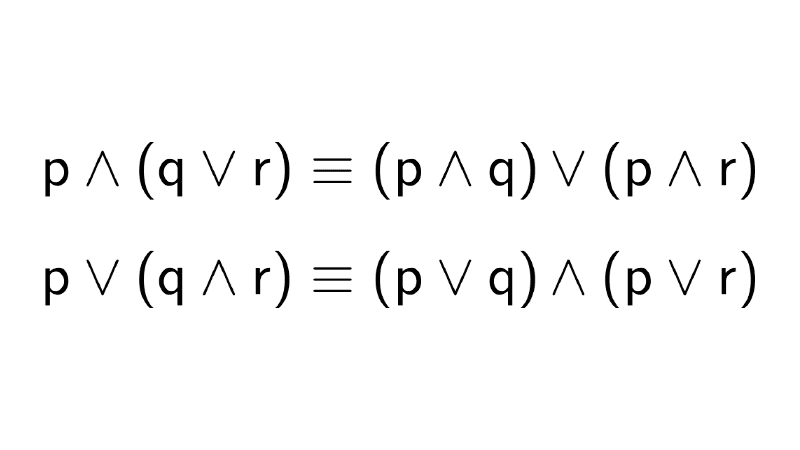
Distributive Laws in Logic
Leave a Reply
Related Articles