
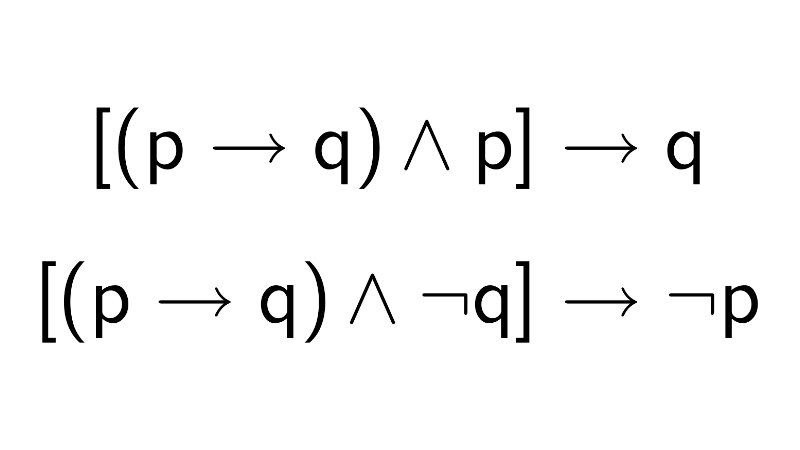
Propositional Variables
A propositional variable (or sentential variable) is a symbol that represents an atomic proposition—that is, a complete declarative statement that can be either true or false.
Just as we use symbols to represent numbers in algebra, in propositional logic we use letters to represent complete statements with a definite truth value. These variables serve as placeholders for logical assertions and are the fundamental building blocks used to construct more complex formulas.
Table of Contents
Notation
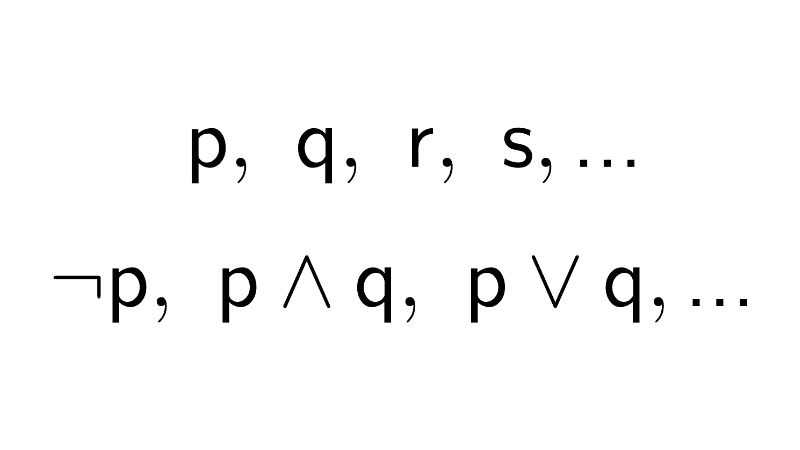
In propositional logic, there is a standard convention for representing variables. We generally use lowercase letters starting with "p," which derives directly from "proposition." Thus, the most common variables are p, q, r, s, and so on.
When more variables are needed, we can use subscripts: p1, p2, p3, etc. Although lowercase letters are reserved for atomic propositions, you will often see uppercase letters such as A, B, C, ..., P, Q, R used to represent compound formulas.
Unlike a real algebraic variable that can take on infinitely many numerical values, a propositional variable can take only two possible values: true (T) or false (F). This property is known as bivalence and is a cornerstone of classical logic.
Furthermore, each variable represents a single atomic proposition—that is, an indivisible assertion. If we have a compound statement such as "it is raining and it is cold," we need two distinct variables to represent each atomic component, joined by a conjunction.
Examples
Here are several examples of how propositional variables are assigned to specific statements:
- p: "5 is an even number." (False).
- q: "Canada is in North America." (True).
- r: "Water boils at 100°C at sea level." (True).
- s: "Madrid is the capital of France." (False).
In each case, the variable represents a complete statement with a definite truth value. When working in logic, we manipulate these variables without focusing on their specific real-world meaning, concentrating instead on their logical behavior.
It is essential to understand that we cannot assign propositional variables to sentences that are not statements. For instance, questions ("What time is it?"), commands ("Close the door"), or exclamations ("What a surprise!") cannot be represented by propositional variables because they have no truth value.
The true utility of propositional variables emerges when we combine them using logical connectives to construct compound statements. For example, let:
p: "Today is Monday."
q: "It is raining."
From these atomic variables, we can construct expressions such as:
- p ∧ q: "Today is Monday and it is raining" (conjunction).
- p ∨ q: "Today is Monday or it is raining" (disjunction).
- ¬p: "Today is not Monday" (negation).
- p → q: "If today is Monday, then it is raining" (conditional).
- p ↔ q: "Today is Monday if and only if it is raining" (biconditional).
Each of these compound expressions is itself a new statement with its own truth value, determined entirely by the truth values of the component variables and the logical connectives used.
Translating into Symbolic Form
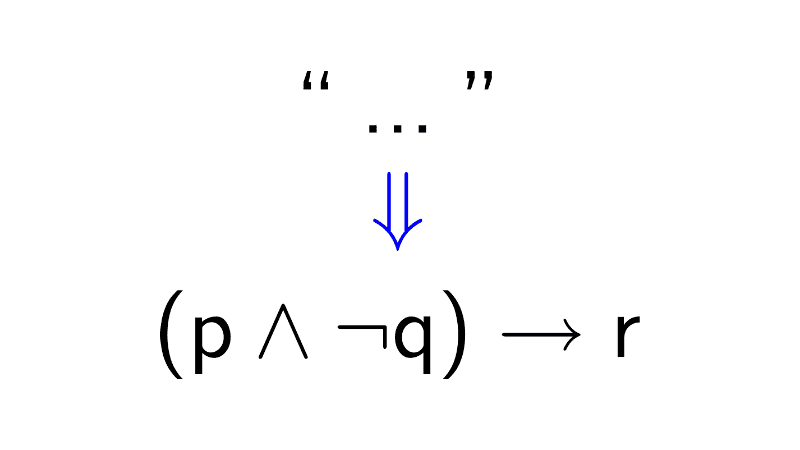
The process of translating natural language statements into the symbolic language of logic is called translating into symbolic form (or symbolization). For example, to translate the statement "if I study, then I pass the exam," we first identify the atomic statements:
p: "I study."
q: "I pass the exam."
The symbolic form is: p → q
The practical value of propositional variables lies in their capacity for abstraction. By separating logical form from specific content, we can analyze universally valid argument patterns regardless of the underlying topic.
Propositional logic does not depend on whether variables refer to the weather, economics, or geometry; it evaluates only their logical structure and truth values. This level of abstraction is precisely what makes propositional logic a formal system.
Finally, it is important to distinguish between a propositional variable and a propositional function (or predicate). While a propositional variable represents a complete statement with a fixed truth value, a propositional function is an expression containing variables that becomes a statement only when those variables are replaced by specific values or bound by quantifiers. For example, "x is an even number" is a propositional function that becomes a proposition only once a concrete value is substituted for x.
Did you find this useful? Rate it!
0.0 / 5 — 0 votes

HOW TO CITE THIS ARTICLE
Machado, D. (2026, October 1). Propositional Variables. Flamath. https://en.flamath.com/propositional-variables
Propositional Logic Practice Problems
Translating Statements into Symbolic Form
Simple and Compound Statements
Distributive Laws in Logic
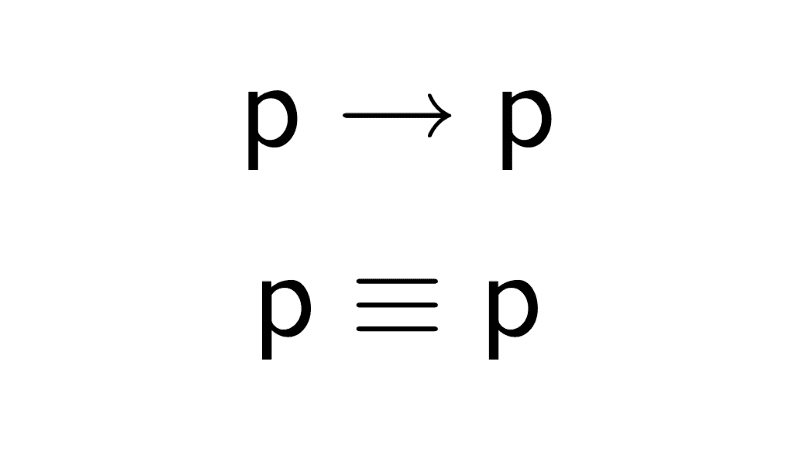
Law of Identity
Leave a Reply
Related Articles