
Set Theory Practice Problems
Below, we solve step-by-step a series of set theory practice problems: roster and set-builder form, element and subset relations, fundamental set operations, Venn diagrams, and word problems, among others.
Table of Contents
Foundations
The following articles cover the fundamental concepts of set theory upon which these exercises are based.
Set-Builder Notation and Roster Form
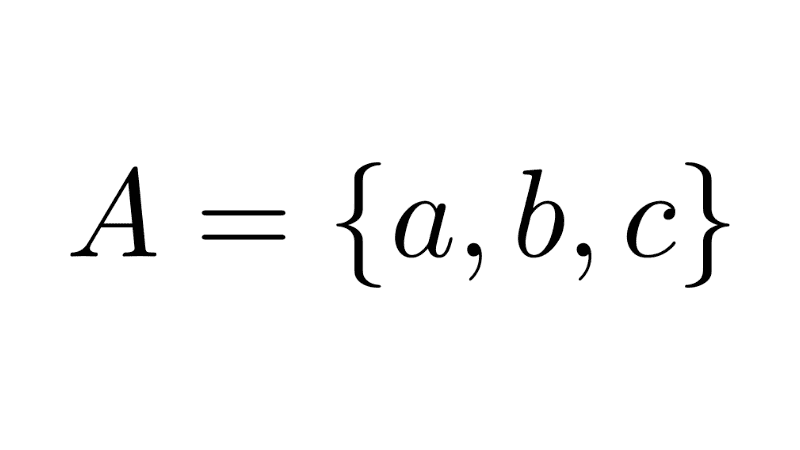
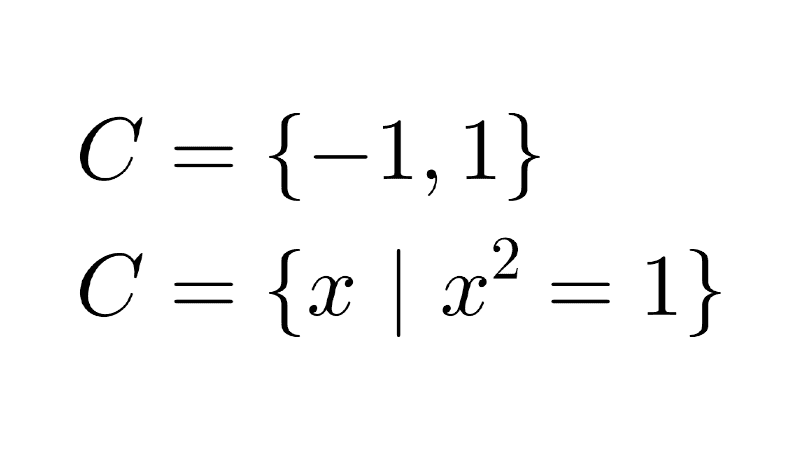
A set can be specified in two main ways. It is written in roster form when all its elements are listed individually inside braces, separated by commas. It is defined using set-builder notation when a common property or algebraic condition is stated that uniquely characterizes the elements belonging to the collection.
From Set-Builder to Roster Form
To convert a set from set-builder notation to roster form, we solve the given conditions, equations, or inequalities over the specified replacement set and list the resulting values.
Problem 1
Write each of the following sets defined in set-builder notation in roster form:
- A = {x ∈ ℕ / x2 − 5x − 6 = 0}
- B = {x / x is a letter in the word "vector"}
- C = {x ∈ ℤ / x2 − 9 = 0 ∨ 2x − 1 = 9}
- D = {x ∈ ℕ / 2 ≤ x < 7}
- E = {x ∈ ℤ / |x| < 3}
Solution 1
To find the elements of set A, we solve the quadratic equation by factoring the trinomial:
x2 − 5x − 6 = (x − 6)(x + 1) = 0
The roots are x = 6 and x = −1. Since the initial condition requires that x ∈ ℕ, we discard the negative value. Therefore:
A = {6}
Solution 2
We list the individual letters that make up the word "vector", omitting duplicates to follow the definition of a set:
The letters are v, e, c, t, o, r. None are repeated within the word, so the set in roster form is:
B = {c, e, o, r, t, v}
Solution 3
The logical connective "∨" (or) indicates that we must include values that satisfy the first equation, the second equation, or both simultaneously within the set of integers ℤ:
Solving the first equation: x2 − 9 = 0 ⇒ x2 = 9 ⇒ x = 3 or x = −3.
Solving the second equation: 2x − 1 = 9 ⇒ 2x = 10 ⇒ x = 5.
Collecting all integer solutions:
C = {−3, 3, 5}
Solution 4
The compound inequality 2 ≤ x < 7 restricts x to natural numbers greater than or equal to 2 and strictly less than 7. Listing all integers satisfying this condition:
D = {2, 3, 4, 5, 6}
Solution 5
The absolute value inequality |x| < 3 is equivalent to the open interval −3 < x < 3. Looking for solutions within the set of integers ℤ, we take the values between both bounds:
E = {−2, −1, 0, 1, 2}
From Roster to Set-Builder Form
To express a set in set-builder notation from its list of elements, we identify the governing pattern or mathematical rule shared by all elements, specifying the domain of reference.
Problem 2
Write the following sets given in roster form using set-builder notation:
- F = {2, 4, 6, 8, 10}
- G = {1, 4, 9, 16, 25}
- H = {..., −6, −3, 0, 3, 6,...}
- I = {1, 3, 5, 7, 9, 11}
Solution 1
The elements are the first positive even integers less than or equal to 10. One algebraic way to express this is:
F = {x ∈ ℕ / x is even ∧ 2 ≤ x ≤ 10}
Solution 2
Notice that each term is the square of a consecutive natural number: 12, 22, 32, 42, and 52. We express this rule by setting the range for the base:
G = {x2 / x ∈ ℕ ∧ 1 ≤ x ≤ 5}
Solution 3
The elements are all integer multiples of 3, extending indefinitely in both positive and negative directions. Therefore, the property is defined over ℤ:
H = {3k / k ∈ ℤ}
Or alternatively:
H = {x ∈ ℤ / x = 3k ∧ k ∈ ℤ}
Solution 4
The collection contains positive odd integers less than 12. The corresponding set-builder expression is:
I = {x ∈ ℕ / x is odd ∧ x < 12}
Or using the standard formula for an odd integer:
I = {2k − 1 / k ∈ ℕ ∧ 1 ≤ k ≤ 6}
Membership and Subset Relations
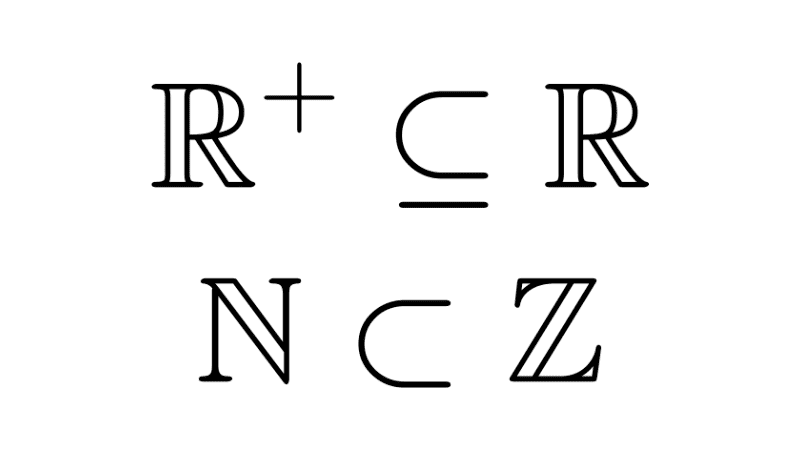
The membership relation (∈) directly relates an individual element to the set containing it. In contrast, the subset relation (⊂ or ⊆) connects two sets when every element of the first set is also an element of the second.
Confusing an element with a subset is one of the most common mistakes when dealing with sets whose elements are themselves sets or the empty set.
Problem 3
Let E = {a, {a}, ∅}. Determine whether the following statements are true or false:
- a ∈ E
- {a} ∈ E
- a ⊆ E
- {a} ⊆ E
- {{a}} ⊆ E
- ∅ ∈ E
- ∅ ⊆ E
- {∅} ⊆ E
Solutions
- True: The letter a is explicitly listed as an element of E.
- True: The object {a} is treated here as an individual element that belongs directly to E.
- False: The symbol a represents an element without braces; therefore, it cannot establish a subset relation between sets.
- True: Since the element a belongs to E, the singleton set {a} is a subset of E.
- True: Because {a} ∈ E, the set containing that element, which is {{a}}, is a subset of E.
- True: The empty set ∅ is explicitly listed as an element of E.
- True: The empty set is, by definition, a subset of every set.
- True: Since ∅ is an element of E, forming a set with it creates the singleton set {∅}, which is a subset of E.
Fundamental Set Operations
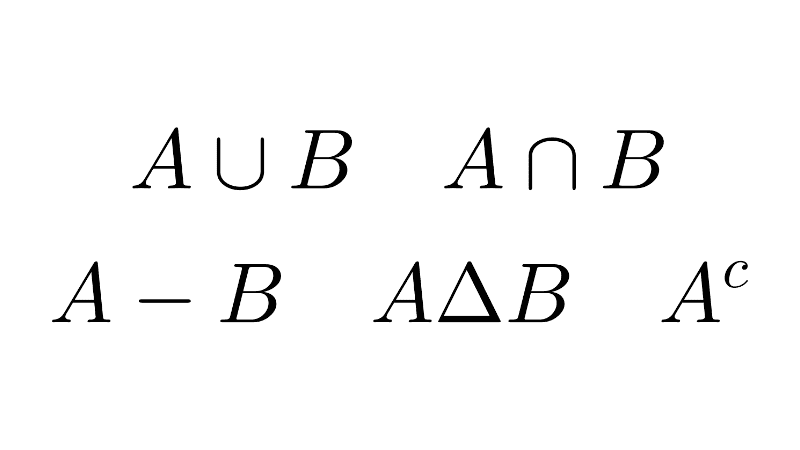
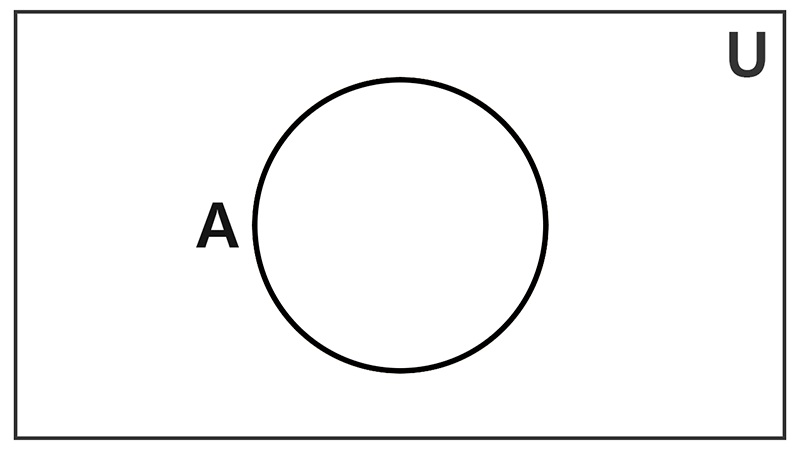
Set operations allow us to construct new sets from existing ones using well-defined logical rules. When performing these operations, a universal set U serves as the reference frame that contains all possible elements under consideration.
The primary set operations and their definitions are:
- Union (A ∪ B): contains all elements that belong to set A, set B, or both.
- Intersection (A ∩ B): selects only the common elements that belong to both A and B simultaneously.
- Difference / Relative Complement (A − B): contains elements that belong to A but do not belong to B.
- Symmetric Difference (A Δ B): groups elements that belong to A or B, excluding those shared by both.
- Complement (A'): contains all elements of the universal set U that do not belong to set A.
Problem 4
Given the universal set U = {1, 2, 3, 4, 5, 6, 7, 8, 9, 10} and subsets A = {1, 2, 3, 4, 5, 6}, B = {4, 5, 6, 7, 8}, and C = {2, 4, 6, 8, 10}, determine the roster form of each of the following operations:
- A ∪ B
- A ∩ B
- A − B
- B − A
- A'
- A Δ B
- (A ∪ B) ∩ C
- A − (B ∩ C)
- (A ∩ B)'
- (A − C) ∪ (B − C)
Solution 1
The union combines all elements present in A or B, listing shared elements only once:
A ∪ B = {1, 2, 3, 4, 5, 6, 7, 8}
Solution 2
The intersection retains only the elements found in both sets at the same time. Comparing the lists, the common numbers are 4, 5, and 6:
A ∩ B = {4, 5, 6}
Solution 3
The difference A − B takes the elements of A and removes any that also belong to B (the values 4, 5, and 6):
A − B = {1, 2, 3}
Solution 4
The difference B − A starts with the elements of B and subtracts those shared with A. This shows that set difference is not commutative:
B − A = {7, 8}
Solution 5
The complement A' gathers all elements in the universal set U that do not belong to A:
A' = U − A = {7, 8, 9, 10}
Solution 6
The symmetric difference is obtained by uniting the elements unique to each set, namely (A − B) ∪ (B − A):
A Δ B = {1, 2, 3, 7, 8}
Solution 7
We first evaluate the operation inside parentheses and then take the intersection with C:
We know that A ∪ B = {1, 2, 3, 4, 5, 6, 7, 8}. Comparing this with C = {2, 4, 6, 8, 10} to identify the common elements:
(A ∪ B) ∩ C = {2, 4, 6, 8}
Solution 8
We first determine the intersection B ∩ C by identifying the elements shared by B and C, which are 4, 6, and 8:
B ∩ C = {4, 6, 8}
Next, we subtract these elements from set A = {1, 2, 3, 4, 5, 6}, removing 4 and 6:
A − (B ∩ C) = {1, 2, 3, 5}
Solution 9
Using the intersection calculated previously, A ∩ B = {4, 5, 6}, the complement of this set collects all elements from U except 4, 5, and 6:
(A ∩ B)' = {1, 2, 3, 7, 8, 9, 10}
Solution 10
We perform each set subtraction separately before uniting the results:
For A − C, we remove from A any elements present in C (2, 4, and 6):
A − C = {1, 3, 5}
For B − C, we remove from B the elements shared with C (4, 6, and 8):
B − C = {5, 7}
Uniting both resulting sets:
(A − C) ∪ (B − C) = {1, 3, 5, 7}
Representation Using Venn Diagrams
Venn diagrams allow us to represent set relationships and operations geometrically using closed planar regions. Each region formed by intersecting circles corresponds to a specific membership condition for the participating sets.
Problem 5
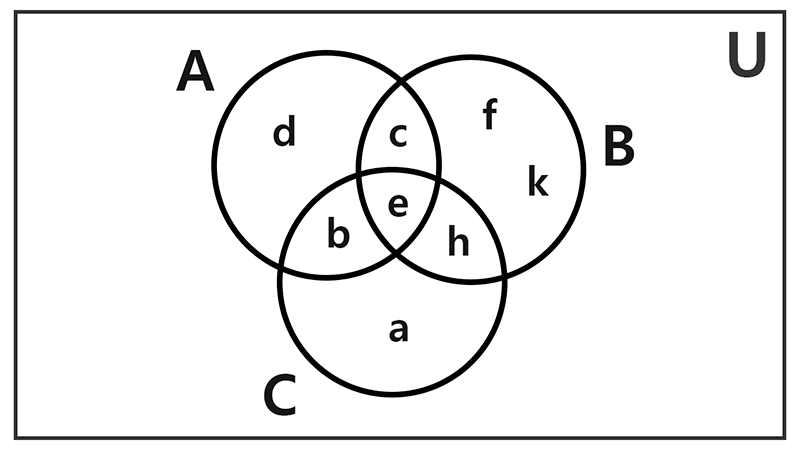
Using the reference Venn diagram, identify the region to shade for each given operation and write the resulting set in roster form:
- A ∩ B
- B ∩ C
- A ∩ B ∩ C
- (A ∩ B) − C
- A − (B ∪ C)
- (A ∪ B) ∩ C
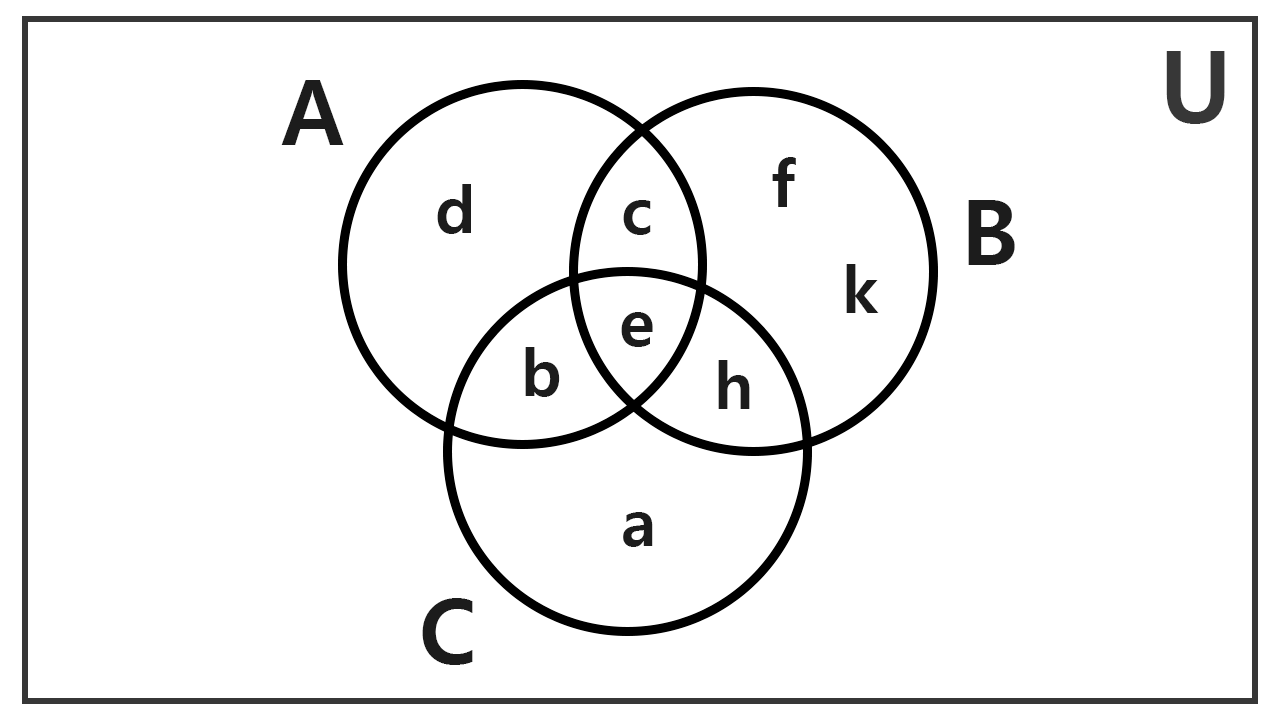
Solution 1
The intersection A ∩ B corresponds to the entire overlap between circles A and B, including the central region that also overlaps with C. Shading the common area between both circles:
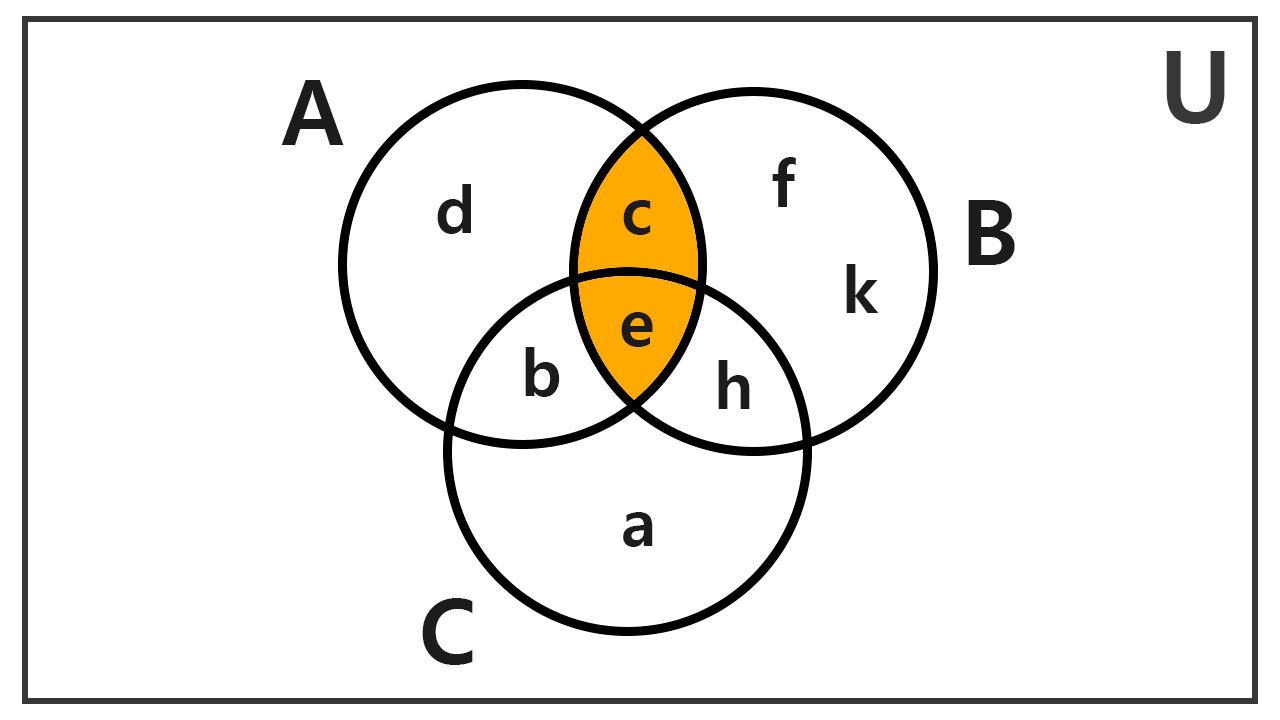
Identifying the elements in the shaded area confirms our result analytically:
A ∩ B = {c, e}
Solution 2
To represent B ∩ C, we identify the overlapping region between circles B and C. This region includes both the area exclusive to B and C as well as the center shared with A:
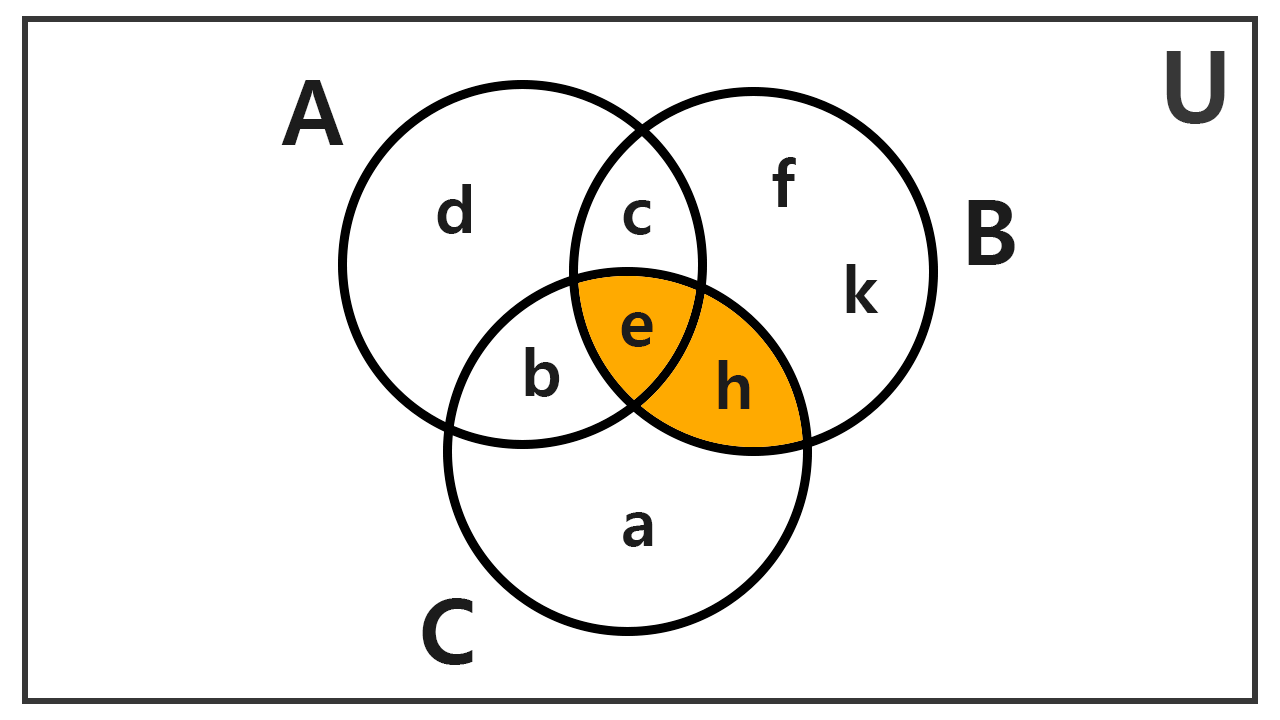
The elements within the shaded region form the resulting set:
B ∩ C = {e, h}
Solution 3
The operation A ∩ B ∩ C represents the triple intersection. Geometrically, it corresponds to the central region where all three circles overlap simultaneously:
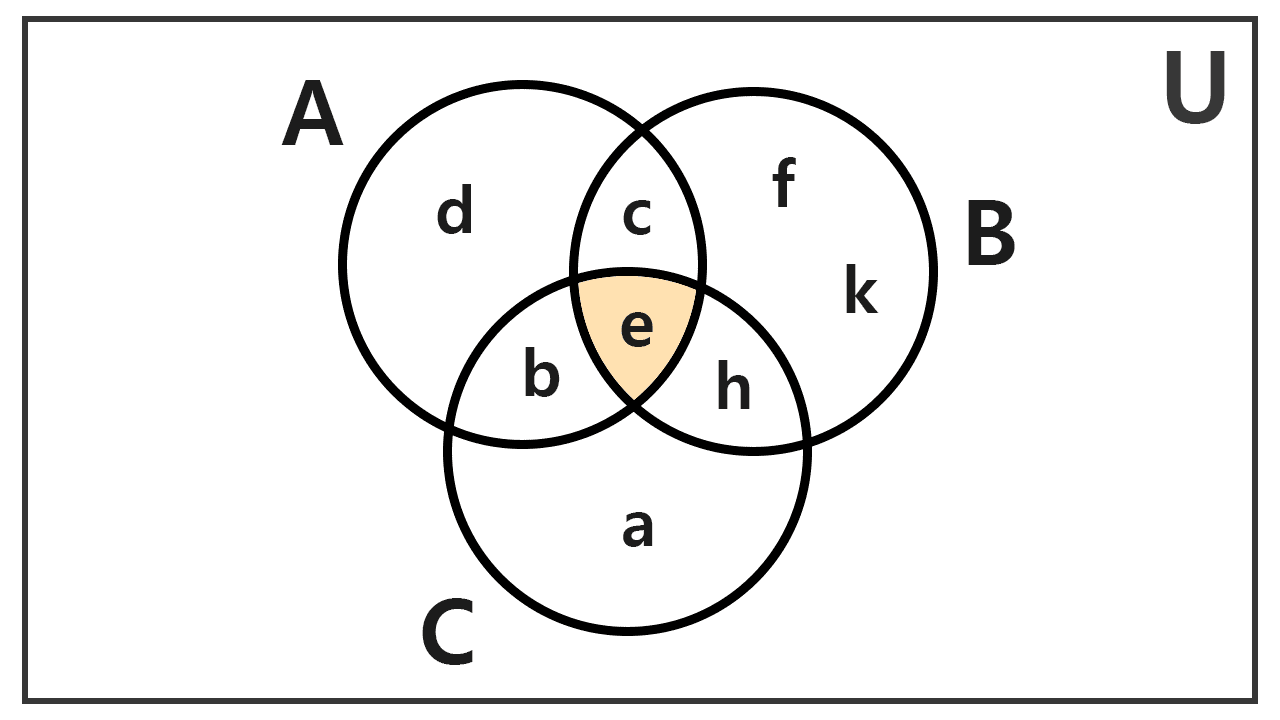
The single element contained in this central region defines the set:
A ∩ B ∩ C = {e}
Solution 4
For the operation (A ∩ B) − C, we begin with the intersection of A and B and remove the portion that lies inside circle C. Only the upper sector of the intersection remains shaded:
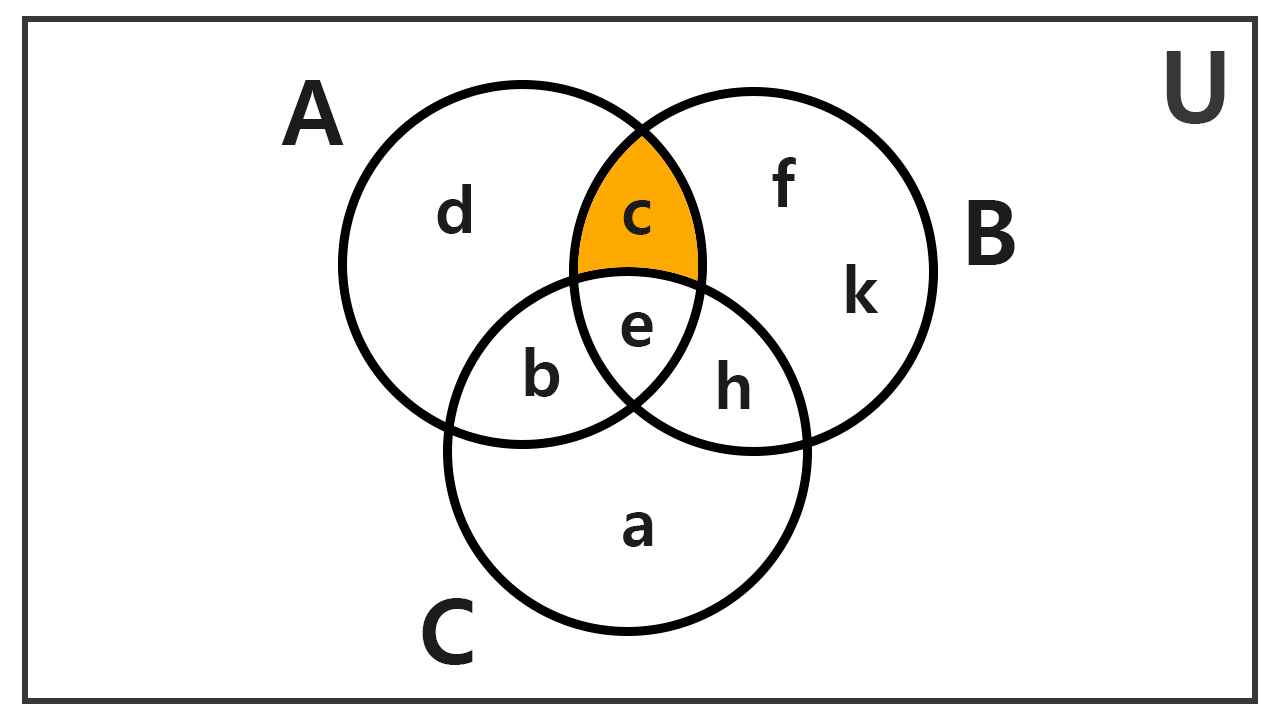
Identifying the letter contained in the shaded region:
(A ∩ B) − C = {c}
Solution 5
For the difference A − (B ∪ C), we take circle A and subtract any area covered by B or C. Only the region exclusive to A remains shaded:
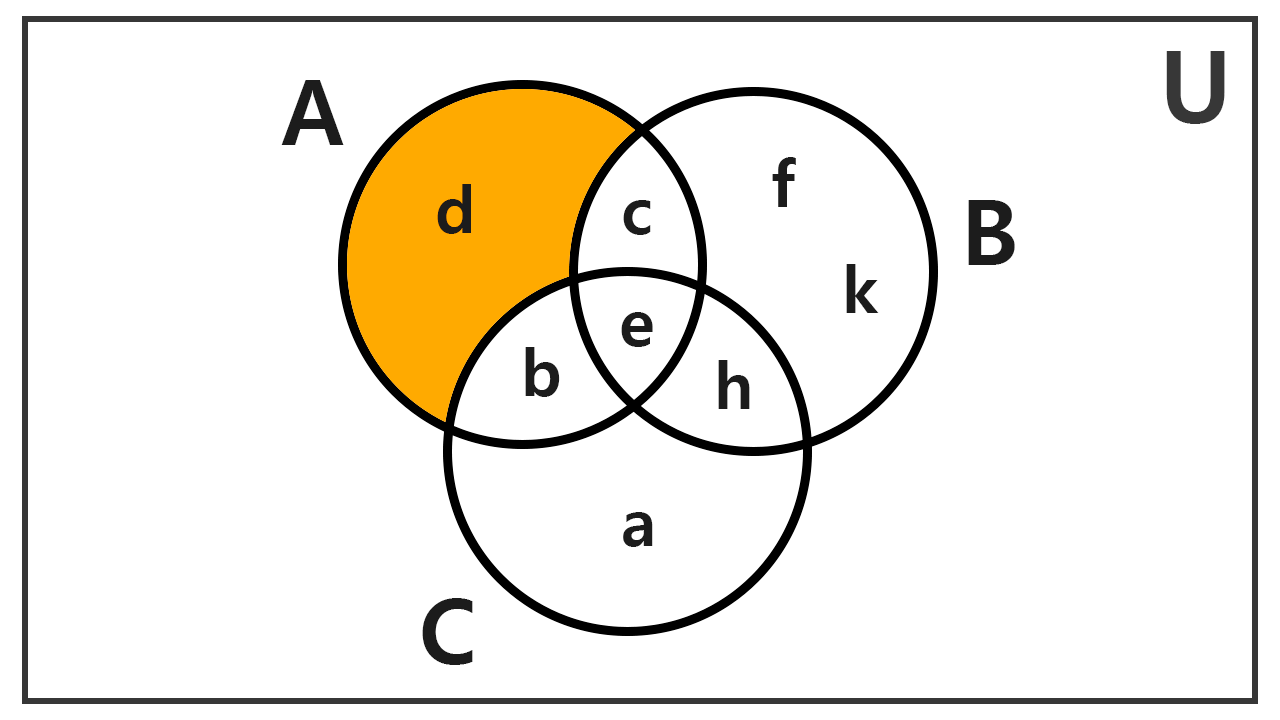
The element located in this exclusive region is:
A − (B ∪ C) = {d}
Solution 6
To evaluate (A ∪ B) ∩ C, we consider the entire combined area of A and B, but keep only the portions that also lie inside circle C. This shades both lateral intersections and the central region overlapping C:
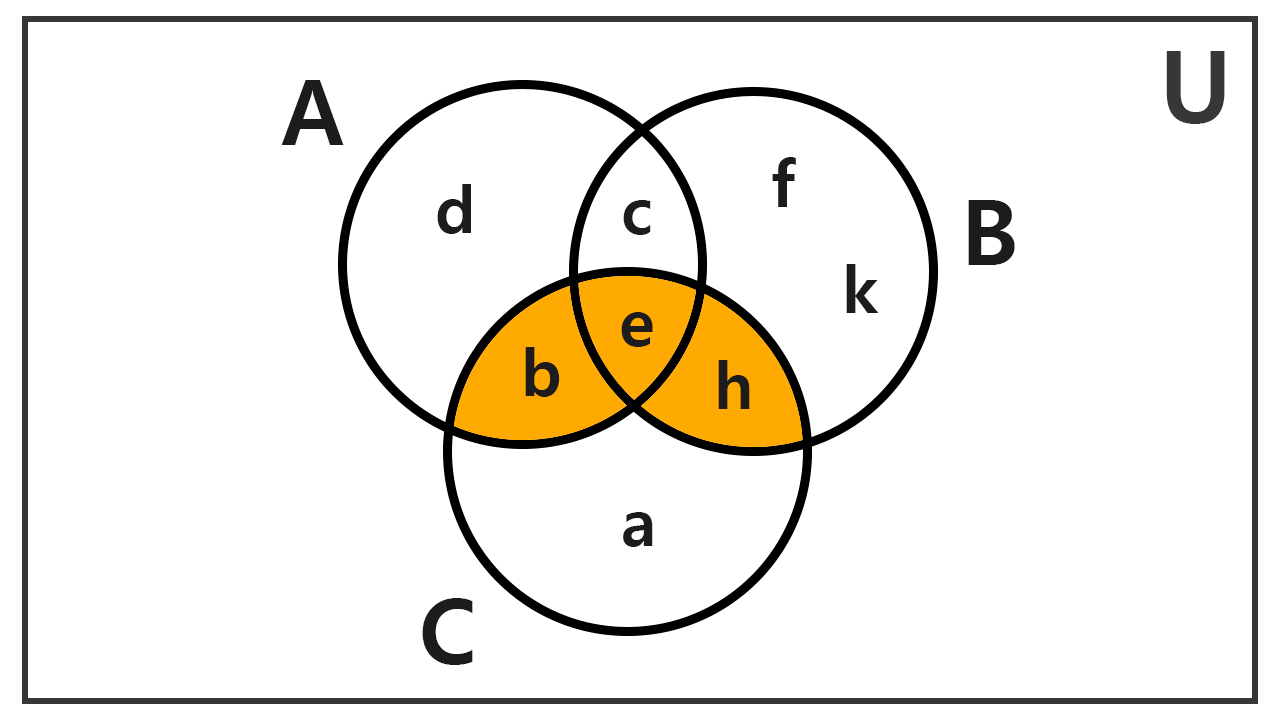
Collecting the elements located across the three shaded subregions, we get:
(A ∪ B) ∩ C = {b, e, h}
Subsets and Power Sets
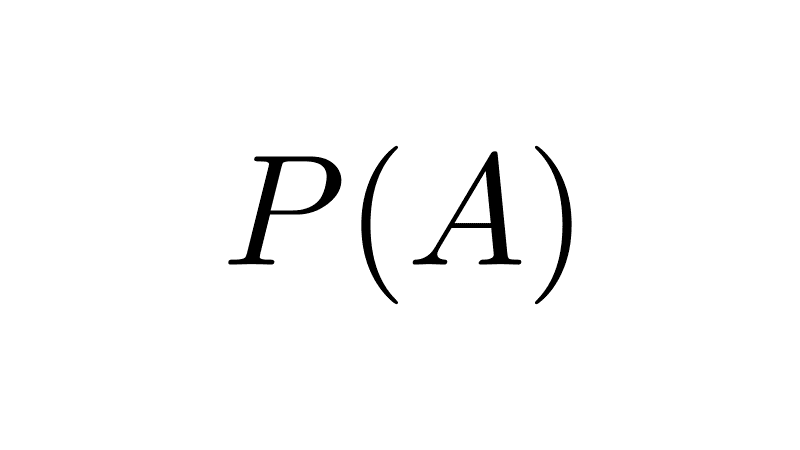
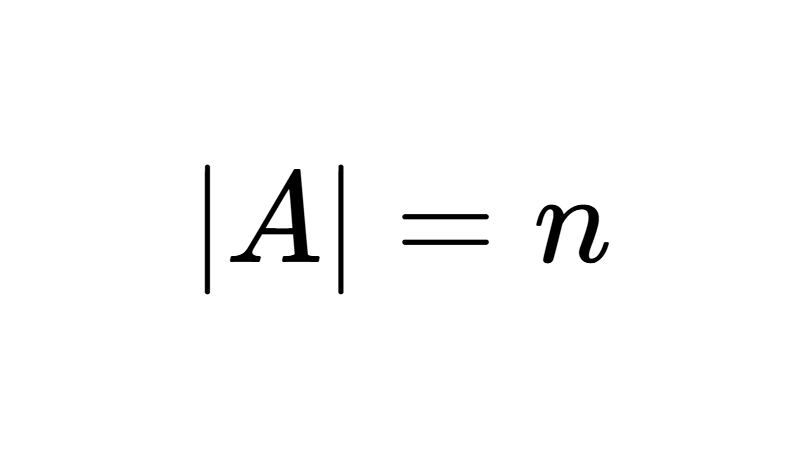
The power set of a set A, denoted by P(A), is the set of all subsets of A. If a finite set has cardinality |A| = n, the total number of subsets that can be formed is |P(A)| = 2n.
This collection always includes two trivial subsets: the empty set ∅ and the set A itself. When all subsets except the original set A are considered, they are called proper subsets, and their total count is given by 2n − 1.
Problem 6
Given the set M = {1, 2, 3}, determine the power set P(M) by listing all its elements in roster form.
Solution
Set M has cardinality |M| = 3. Therefore, the total number of subsets in P(M) is 23 = 8.
To ensure no subsets are missed, we list them systematically by size:
- 0-element subset: ∅
- 1-element subsets: {1}, {2}, {3}
- 2-element subsets: {1, 2}, {1, 3}, {2, 3}
- 3-element subset: {1, 2, 3}
Combining all subsets into one collection, we obtain:
P(M) = {∅, {1}, {2}, {3}, {1, 2}, {1, 3}, {2, 3}, {1, 2, 3}}
Problem 7
Let A = {x ∈ ℕ / x is prime ∧ x < 10}. Determine the cardinality |A| and find the total number of subsets it contains.
Solution
First, we write set A in roster form by listing the prime natural numbers less than 10:
A = {2, 3, 5, 7}
Counting its elements, we find that its cardinality is |A| = 4. Applying the formula for the cardinality of the power set:
|P(A)| = 2|A| = 24 = 16
Therefore, set A has exactly 16 subsets.
Problem 8
Let A and B be two sets such that |A| = 4, |B| = 5, and the cardinality of their intersection is |A ∩ B| = 3. Find the total number of subsets of the union A ∪ B.
Solution
To find the number of subsets of A ∪ B, we first compute the cardinality of the union using the Principle of Inclusion-Exclusion for two sets:
|A ∪ B| = |A| + |B| − |A ∩ B|
Substituting the given values:
|A ∪ B| = 4 + 5 − 3 = 6
Knowing the cardinality of the union, we calculate the number of subsets using base 2 exponentiation:
|P(A ∪ B)| = 26 = 64
Set A ∪ B has 64 subsets in total.
Problem 9
A finite set K satisfies the condition |P(K)| = 128. Find the number of elements in K and the number of proper subsets that can be formed from it.
Solution
We set up the relationship between the number of subsets and the cardinality n of set K:
2n = 128
Expressing 128 as a power of 2:
128 = 27
Equating powers with the same base gives n = 7, meaning set K has 7 elements.
To determine the number of proper subsets, we subtract 1 (the set K itself) from the total count of subsets:
Proper subsets = 2n − 1 = 128 − 1 = 127
Consequently, K has 7 elements and has 127 proper subsets.
Set Theory Word Problems (Cardinality)
The principles of set theory help organize and solve practical counting problems involving collections of people or objects sharing specific attributes. When sets overlap, we apply the Principle of Inclusion-Exclusion to determine the total count without double counting shared elements.
For two sets A and B within a universal set U, their cardinalities are related by the equation:
|A ∪ B| = |A| + |B| − |A ∩ B|
From this relation, we can determine the number of elements belonging exclusively to one set, as well as those outside both sets by subtracting from the universal set.
Problem 10
In a language school with 50 students enrolled in the evening program, a survey was conducted regarding workshop attendance. It was found that 32 students take Spanish, 28 take French, and 6 take neither of these two languages. Answer the following questions:
- How many students take both languages?
- How many students take only Spanish?
- How many take exactly one language?
Solution to Question 1
Let S be the set of students taking Spanish and F be the set of students taking French within the universal set U of 50 students.
Since 6 students take neither course, we subtract this count from the universal set to find the cardinality of the union—that is, students taking at least one language:
|S ∪ F| = |U| − 6 = 50 − 6 = 44
Applying the Principle of Inclusion-Exclusion for two sets:
|S ∪ F| = |S| + |F| − |S ∩ F|
Substituting the given values:
44 = 32 + 28 − |S ∩ F|
44 = 60 − |S ∩ F|
Solving for the intersection:
|S ∩ F| = 60 − 44 = 16
Therefore, 16 students take both language workshops.
Solution to Question 2
To find the number of students taking only Spanish, we take the total of set S and subtract the students who also take French, represented by the intersection S ∩ F:
|S − F| = |S| − |S ∩ F|
Substituting the values found:
|S − F| = 32 − 16 = 16
Exactly 16 students take only Spanish.
Solution to Question 3
To determine how many students take only one language, we first calculate the group taking French only, following the same procedure:
|F − S| = |F| − |S ∩ F| = 28 − 16 = 12
Having determined both disjoint regions, we add the students taking only Spanish to those taking only French:
Total = |S − F| + |F − S| = 16 + 12 = 28
In total, 28 students take exactly one language.
Did you find this useful? Rate it!
0.0 / 5 — 0 votes

HOW TO CITE THIS ARTICLE
Machado, D. (2026, October 1). Set Theory Practice Problems. Flamath. https://en.flamath.com/set-theory-practice-problems
Leave a Reply
Related Articles