
Mathematical Logic
Mathematical logic is a subfield of mathematics dedicated to the study and formalization of reasoning using rigorous rules and symbols. Its primary goal is to eliminate the ambiguity inherent in natural language, enabling the precise analysis of argument validity and structure.
An argument is valid (or soundly structured) when its conclusion follows necessarily from its premises. That is, if we accept that the premises are true, the truth of the conclusion is strictly guaranteed by the logical structure of the reasoning itself. Mathematical logic provides the formal framework and rules required to derive valid conclusions from given premises, serving as the foundation for formal mathematical proofs.
Unlike philosophical or informal logic, which frequently concerns itself with the material truth of assertions about the physical world, mathematical logic focuses almost exclusively on the formal structure of arguments. Its objective is not to establish factual truth, but to determine whether, within a given formal syntax, a conclusion necessarily follows from a set of hypotheses. This abstraction from specific content allows us to replace words with symbols representing propositions and connectives, transforming everyday language into precise, unambiguous formal systems.
The purpose of this guide is to provide a comprehensive overview of mathematical logic to understand its core scope, significance, and role across mathematics and computer science. We will explore its foundational principles, primary goals, major branches, logical systems, and fundamental components.
Table of Contents
Scope and Purpose
The primary subject matter of mathematical logic consists of formal systems and valid deductive inference. It does not study how the human mind actually thinks—which is the domain of cognitive psychology—but rather the objective structure of arguments, evaluating whether deductions are sound regardless of the specific subject matter being discussed.
Its primary objectives include:
- Language Formalization: Translating natural language expressions and mathematical statements into precise, symbolic notation. This process defines an explicit alphabet of symbols, syntactic formation rules for well-formed formulas (WFFs), and semantic rules to assign truth values, allowing the underlying logical skeleton of any claim to be systematically examined.
- Rigor in Mathematical Proofs: Providing an unambiguous framework to distinguish correct deductions from fallacies. By establishing explicit inference rules, any mathematical proof can be broken down into elementary, verifiable steps, eliminating reliance on intuition, heuristic reasoning, or persuasive rhetoric.
- Computability and Complexity Analysis: A modern and vital pillar of mathematical logic—deeply linked to theoretical computer science—is defining the theoretical limits of computation. It formalizes which problems are effectively computable (decidable by an algorithm) and which are fundamentally undecidable, establishing what automated computing machines can and cannot achieve.
- Foundations of Mathematics: Driven historically by logicians such as Gottlob Frege, Bertrand Russell, and David Hilbert, this program aimed to place all of mathematics on solid, self-consistent logical foundations. It sought to demonstrate that all mathematical truths could be derived purely from a minimal set of logical axioms through formal deduction alone.
Note: Kurt Gödel's Incompleteness Theorems, published in 1931, established fundamental limitations on formal axiomatic systems. Gödel demonstrated two landmark results for any formal system strong enough to encompass basic arithmetic: first, that the system is incomplete, meaning there will always exist true mathematical statements that cannot be proven within the system itself; and second, that the system cannot prove its own consistency using only its internal machinery.
Main Branches of Mathematical Logic
Contemporary mathematical logic is organized into four core foundational areas: set theory, model theory, proof theory, and computability theory (or recursion theory).
Set Theory
Set theory investigates the properties, operations, and relationships of abstract collections of objects, known as sets, which serve as the foundational language for virtually all modern mathematics. Core areas of study include set operations, relations and orderings, cardinal and ordinal numbers, and the formal structure of infinity.
Its formalization as a mathematical discipline began in the late 19th century through the groundbreaking work of Georg Cantor. Before Cantor, the concept of "infinity" was viewed with skepticism by mainstream mathematicians, often dismissed as a potential or purely philosophical abstraction. Between the 1870s and 1890s, Cantor revolutionized the discipline by treating infinite sets as complete, well-defined mathematical objects that could be rigorously measured, classified, and compared.
Cantor's most famous discovery established that not all infinities are the same size. While the set of natural numbers possesses a cardinality he denoted as Aleph-null (ℵ₀), the set of real numbers is strictly larger—an uncountably infinite continuum that cannot be placed into a one-to-one correspondence with the integers. This initial phase of development is known as naive set theory, as it operated on the assumption that any well-defined property could freely define a valid set.
However, as Cantor's ideas gained widespread recognition, philosopher and mathematician Bertrand Russell discovered an inherent flaw in naive set theory in 1901. If any arbitrary property can define a set, one can define the "set of all sets that do not contain themselves." Asking whether this set contains itself yields a direct contradiction: if it does, it violates the defining criterion and must not contain itself; if it does not, it meets the criterion and must contain itself.
To communicate this technical paradox intuitively, Russell introduced the famous barber paradox: "In a town, there is a male barber who shaves all men, and only those men, who do not shave themselves." Does the barber shave himself? If he does, he violates his own rule by shaving a man who shaves himself; if he does not, he must shave himself according to his mandate.
To resolve this foundational crisis, mathematicians replaced intuitive formulations with a formal axiomatic system designed to prevent pathological set constructions. Between 1908 and the 1920s, Ernst Zermelo and Abraham Fraenkel, supplemented by the Axiom of Choice, formulated the standard ZFC (Zermelo-Fraenkel with Choice) axiomatic framework.
The ZFC axioms delineate precise rules governing how sets are formed and manipulated, forbidding unconstrained constructions. Among the primary axioms preventing Russell's paradox are:
- Axiom of Specification (or Separation): Dictates that a new set cannot be created out of thin air simply by declaring an arbitrary property. Instead, one must start with an already existing set and separate out the elements satisfying the specified condition. When attempting to construct Russell's paradoxical collection, ZFC requires specifying the parent set containing these elements. Because a universal "set of all sets" does not exist in ZFC, the paradox cannot be formulated.
- Axiom of Regularity (or Foundation): Asserts that no set can contain itself, eliminating circular references and infinite descending membership chains. This fundamentally closes the question of whether a set belongs to itself, as self-membership is structurally prohibited under ZFC.
Following the consolidation of ZFC, another foundational discovery emerged: there exist fundamental questions about sets that ZFC cannot settle. The most famous example is Cantor's Continuum Hypothesis, which asks whether there exists a set whose cardinality is strictly between that of the natural numbers and that of the real numbers.
In 1940, Kurt Gödel proved that the Continuum Hypothesis cannot be disproved within ZFC. In 1963, Paul Cohen proved that it cannot be proven from ZFC either. This established the Continuum Hypothesis as an undecidable (independent) statement within standard set theory: mathematicians can accept it or its negation as an independent postulate, yielding alternative, fully consistent mathematical frameworks in both cases.
Model Theory
Model theory investigates the relationship between formal languages, defined by explicit syntactic rules and proofs (syntax), and the mathematical structures that interpret them and assign them concrete meaning (semantics). Key topics include formal truth, logical consistency, theory completeness, and classifying the mathematical structures that satisfy a given set of axioms.
Syntax refers strictly to the formal, symbolic components of a language: its vocabulary, the rules used to construct well-formed formulas, and the formal deduction rules applied to derive theorems from axioms without attributing meaning to those symbols. In formal arithmetic, for instance, syntax permits the construction of the string "∀x (x + 0 = x)" purely as a valid sequence of characters.
Semantics, by contrast, provides the interpretation: it maps abstract symbols onto concrete mathematical structures. That same formula "∀x (x + 0 = x)", when evaluated within the structure of natural numbers, asserts that adding zero to any natural number leaves it unchanged—a statement that evaluates to true under that specific interpretation.
The modern field of model theory was established during the mid-20th century, largely shaped by Kurt Gödel's work on completeness and Alfred Tarski's mathematical formalization of truth for formalized languages within relational structures.
A classic application is group theory, which is defined syntactically by a handful of axioms (closure, associativity, identity, and inverse elements). The models of this theory are the concrete structures satisfying those axioms: such as the integers under addition, or the non-zero real numbers under multiplication. Model theory examines which properties are universally shared across all such models and which properties isolate specific subclasses.
A foundational milestone is Gödel's Completeness Theorem for first-order logic, which builds an explicit bridge between syntax and semantics: it states that a formula is formally provable from an axiom set (syntactic consequence) if and only if it is true in every possible model satisfying those axioms (semantic consequence).
Another central cornerstone is the Compactness Theorem, which establishes that if every finite subset of a first-order theory has a model, the entire theory has a model. Consequently, if a first-order theory admits arbitrarily large finite models, it must necessarily admit an infinite model. This theorem demonstrates structural limitations, such as the impossibility of characterizing the concept of finiteness using first-order axioms alone.
Much like set theory, model theory highlights fundamental limits in formal axiomatization. Gödel's Incompleteness Theorems imply that sufficiently expressive theories, such as first-order Peano arithmetic, cannot completely capture their intended structures. Through the lens of model theory, this guarantees the existence of non-standard models of arithmetic: structures that satisfy every Peano axiom yet contain infinite, non-standard integers beyond the standard natural numbers.
Proof Theory
Proof theory treats mathematical proofs themselves as formal mathematical objects. It studies the syntactic structure, properties, and constraints of deductive systems, analyzing what it formally means to establish a theorem from axioms via mechanical inference rules. Its major subjects include consistency analysis, relative proof strength, proof normalization, and the limits of derivability.
While model theory bridges syntax with semantic structures, proof theory focuses almost entirely on syntactic manipulations. Its primary interest is not whether a formula is true in a given interpretation, but whether it is provable within a formal calculus. Under this framework, a formal proof is defined as a finite sequence of statements where each line is an axiom or follows from previous statements via an accepted rule of inference.
Proof theory originated primarily within Hilbert's Program in the early 20th century. David Hilbert sought to safeguard mathematics against paradoxes by proving that formal mathematical systems, such as arithmetic and analysis, were both consistent and complete using strictly finitary, combinatorial reasoning applied directly to the symbols of proofs.
However, Gödel's Second Incompleteness Theorem in 1931 proved that any consistent formal system capable of expressing elementary arithmetic cannot prove its own consistency through its own deductive machinery, permanently reshaping Hilbert's original vision.
Despite this boundary, proof theory expanded into an independent discipline with foundational structural discoveries. To prove the consistency of Peano arithmetic (using extensions beyond Hilbert's finitary methods), logician Gerhard Gentzen developed the sequent calculus and proved the famous Cut-Elimination Theorem (Hauptsatz). This theorem guarantees that any provable statement can be established via a direct, analytic proof without needing to introduce intermediate lemmas containing unrelated concepts.
Computability Theory (Recursion Theory)
Computability theory, traditionally known as recursion theory, investigates the fundamental limits of what can be computed or decided through an effective mechanical procedure. Its core focus includes formally defining algorithms, classifying problems as decidable or undecidable, and analyzing computational complexity hierarchies.
The origins of computability theory are tied directly to the Entscheidungsproblem (decision problem) formulated by David Hilbert in 1928. Hilbert asked whether there could exist an effective, universal algorithmic procedure capable of determining the truth or falsity of any given first-order mathematical statement. Addressing this question required mathematicians to formally define the intuitive notion of an "algorithm."
This challenge was solved independently in the 1930s by Alonzo Church (via the lambda calculus) and, most famously, by Alan Turing. In 1936, Turing introduced an elegant, abstract model of mechanical calculation: the Turing machine. This hypothetical device features an infinite memory tape divided into discrete cells, a read/write head, and a finite state transition table instructing the head to read, write, shift, or halt based on its current internal state.
The widely accepted Church-Turing Thesis posits that any function that can be calculated by an intuitive, mechanical algorithm can also be computed by a standard Turing machine, establishing this model as the universal benchmark for computability. A mathematical problem is defined as decidable if there exists a Turing machine that halts on every possible input and returns a correct binary "yes" or "no" answer.
The most profound insight from this discipline is the existence of absolute algorithmic boundaries. At the center of these limits lies the Halting Problem: given an arbitrary computer program (or Turing machine description) and its input, can an algorithm determine whether the program will eventually finish running or execute forever in an infinite loop?
Turing used his model to provide a definitive negative resolution to Hilbert's Entscheidungsproblem: he proved that the Halting Problem is undecidable. There is no general algorithm capable of correctly deciding whether arbitrary computer programs halt.
Turing demonstrated this using a diagonalization and self-reference argument analogous to Russell's paradox: assuming such a decision program exists, one can easily construct an adversarial program that behaves in the exact opposite manner of the analyzer's output (looping if the analyzer predicts termination, and halting if it predicts an infinite loop), creating an unavoidable logical contradiction.
This result proved that there exist well-defined mathematical problems that are fundamentally undecidable. Computational limitations are not merely engineering constraints; they are structural boundaries embedded within the fabric of formal mathematics.
Types of Logic in Mathematics
The phrase types of logic refers to the distinct formal deductive systems developed to model and evaluate logical reasoning. These systems are broadly divided into two major classifications: classical logic, which forms the deductive backbone of standard mathematics, and non-classical logics, which revise or extend classical axioms to address specialized contexts in computer science, philosophy, and linguistics.
Classical Logic
Classical logic is the standard formal framework underpinning traditional mathematics. It governs deductive validity according to fundamental principles that determine the behavior of truth and falsity.
Its core principles include:
- Principle of Bivalence: Every declarative proposition has exactly one truth value: it is either true (T) or false (F). No intermediate truth value or third status is permitted.
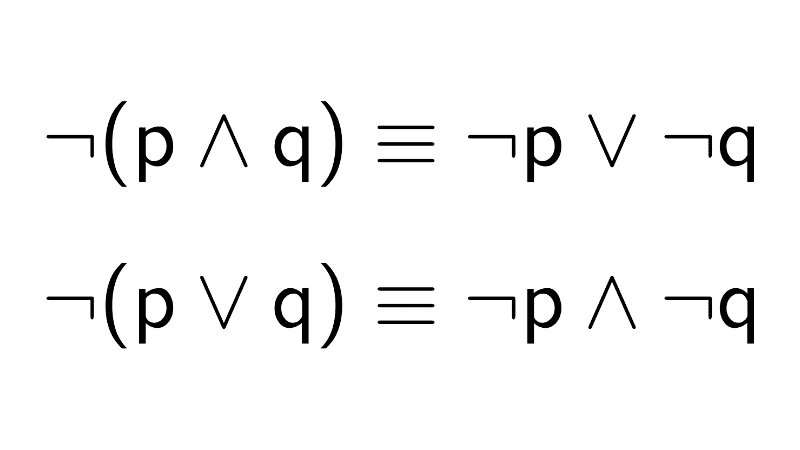
- Law of Non-Contradiction: A statement and its negation cannot be simultaneously true within the same context. Formally, for any proposition p, it is impossible for both p and not-p to hold: ¬(p ∧ ¬p).
- Law of Excluded Middle: For any proposition, either that proposition is true, or its negation is true. There is no middle ground. Expressed symbolically: p ∨ ¬p.
- Monotonicity of Entailment: If a conclusion is validly deduced from a set of premises, adding additional premises will never invalidate that conclusion.
Classical logic is structured hierarchically based on its expressive power: propositional logic (zero-order), first-order logic, and higher-order logics.
Propositional Logic (Zero-Order Logic)
Propositional logic, also referred to as sentential logic or the propositional calculus, studies propositions: complete declarative statements that can be definitively evaluated as either true (T) or false (F), adhering to the principle of bivalence.
Examples of declarative propositions include:
- "The sky is blue" (true)
- "2 + 2 = 4" (true)
- "3 is an even number" (false)
A defining characteristic of propositional logic is that it does not evaluate the internal grammatical structure of statements. Instead, it treats propositions as indivisible atomic units, focusing entirely on how their overall truth values are affected when combined with logical connectives.
The basic components of this calculus are propositional variables (conventionally denoted by lowercase letters such as p, q, and r), which stand for atomic propositions. The system builds compound (molecular) propositions by connecting these variables using logical operators.
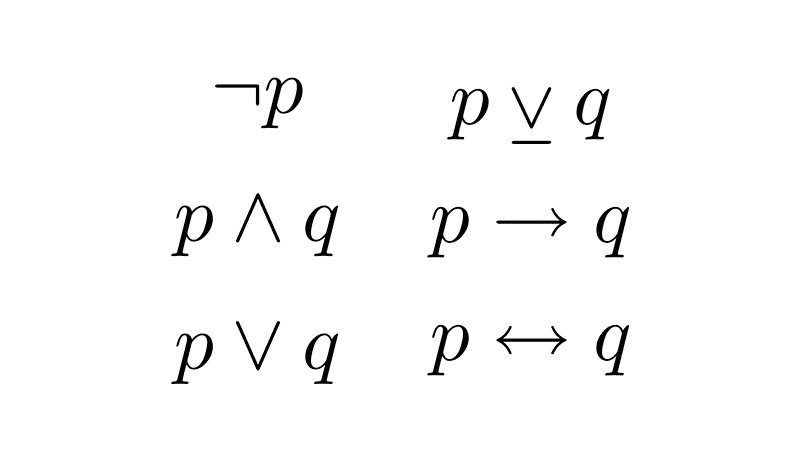
The standard propositional connectives are:
- Negation (¬): Reverses the truth value of a proposition (not p).
- Conjunction (∧): Evaluates to true only if both constituent propositions are true (p and q).
- Disjunction (∨): Evaluates to true if at least one of the propositions is true; it is inclusive (p or q).
- Conditional (→): Denotes material implication; it is false only when the antecedent is true and the consequent is false (if p, then q).
- Biconditional (↔): Evaluates to true when both propositions share the exact same truth value (p if and only if q).
Example
Let p: "The sky is blue", q: "2 + 2 = 4", and r: "3 is an even number". Using our connectives, we can construct the following compound propositions:
¬p: "The sky is not blue"
q ∧ r: "2 + 2 = 4 and 3 is an even number"
p ∨ q: "The sky is blue or 2 + 2 = 4"
p → q: "If the sky is blue, then 2 + 2 = 4"
q ↔ r: "2 + 2 = 4 if and only if 3 is an even number"
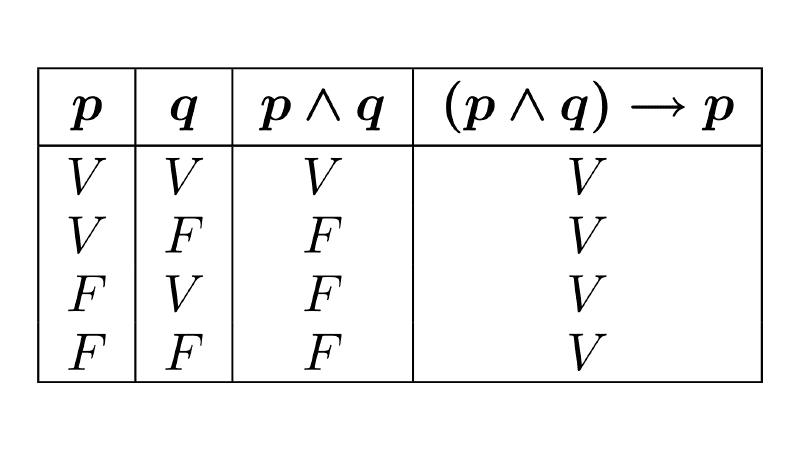
To systematically evaluate the truth value of a compound proposition, logicians construct a truth table. A truth table enumerates every possible truth combination (T or F) for the atomic variables involved. This analysis classifies any compound formula into one of three categories: a tautology (true under all possible assignments), a contingency (true under some assignments and false under others), or a contradiction (false under all possible assignments).
The ultimate goal of propositional logic is to evaluate the validity of deductive arguments. An argument is an ordered set of premises leading to a conclusion. An argument form is formally valid if and only if it is impossible for all premises to be true while the conclusion is false.
Classic examples of valid argument forms include:
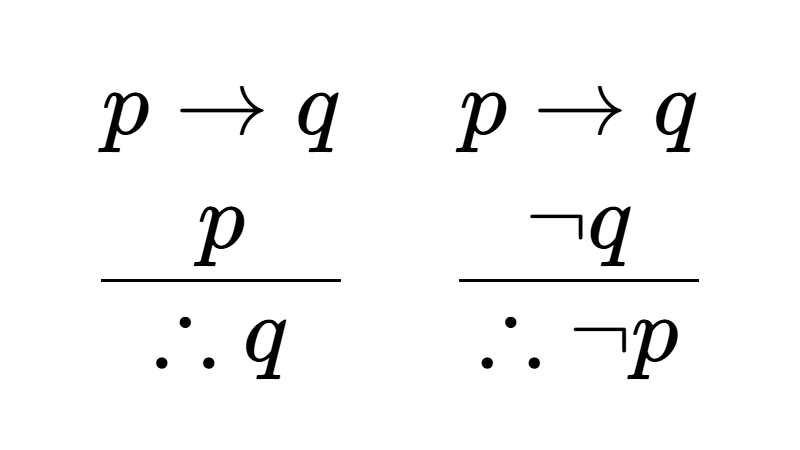
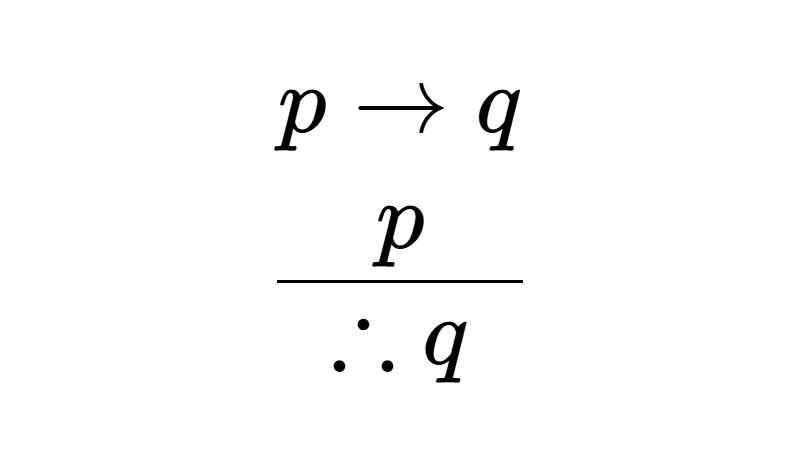
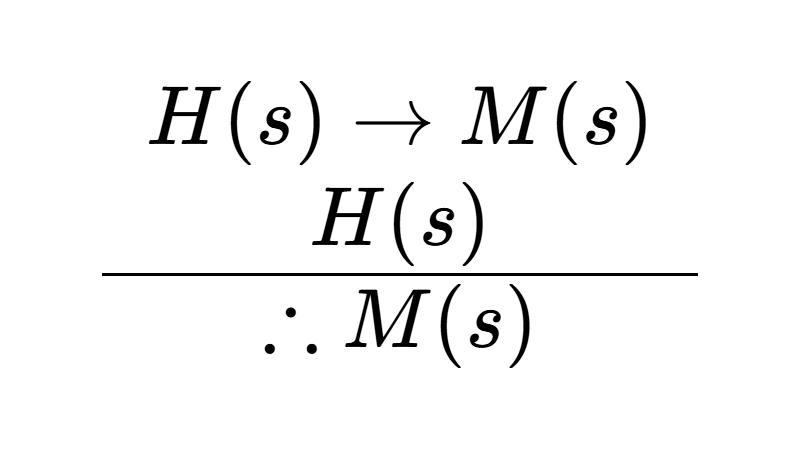
- If it rains, then the ground gets wet. It is raining. Therefore, the ground gets wet.
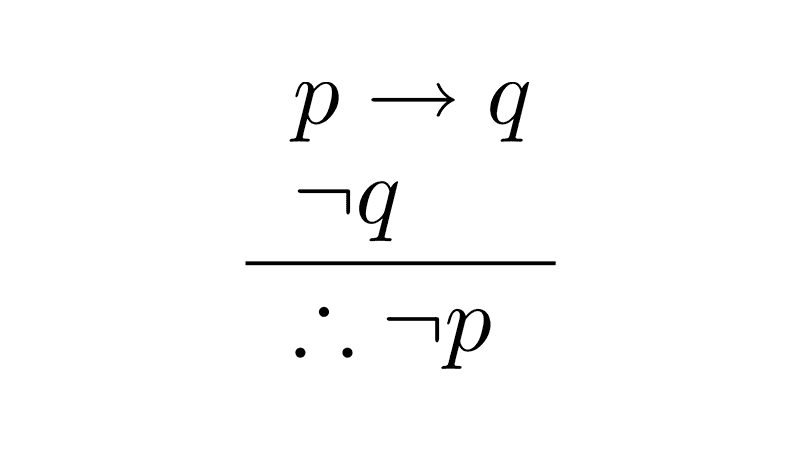
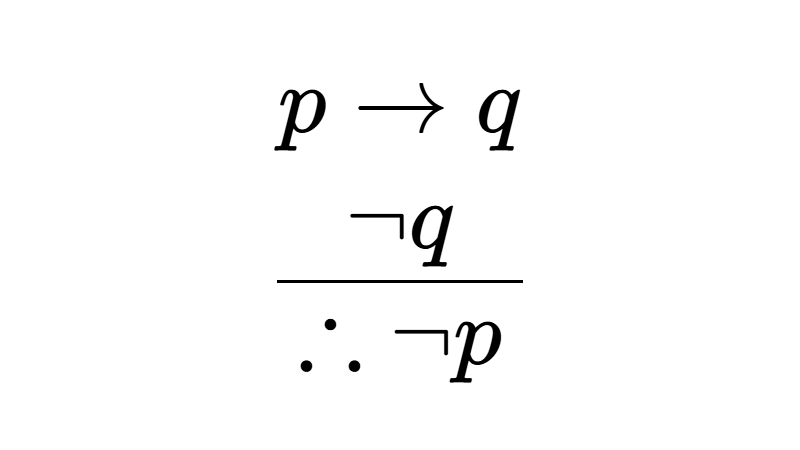
- If there is sunlight, then it is daytime. It is not daytime. Therefore, there is no sunlight.
- If the alarm does not ring, I wake up late. If I wake up late, I miss the bus. Therefore, if the alarm does not ring, I miss the bus.
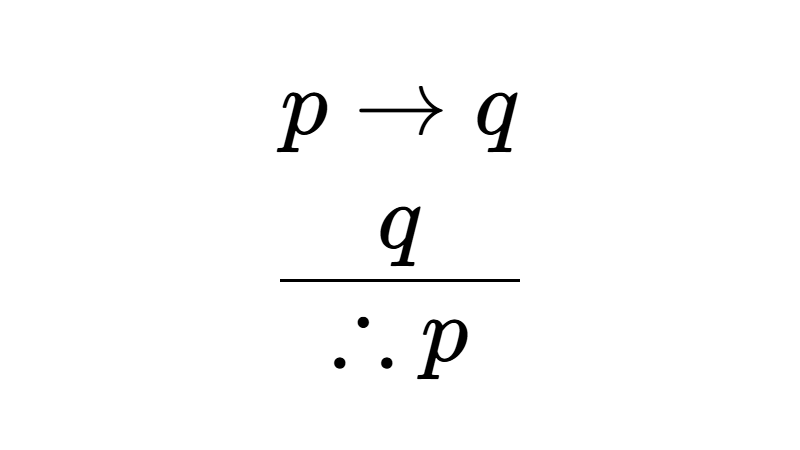
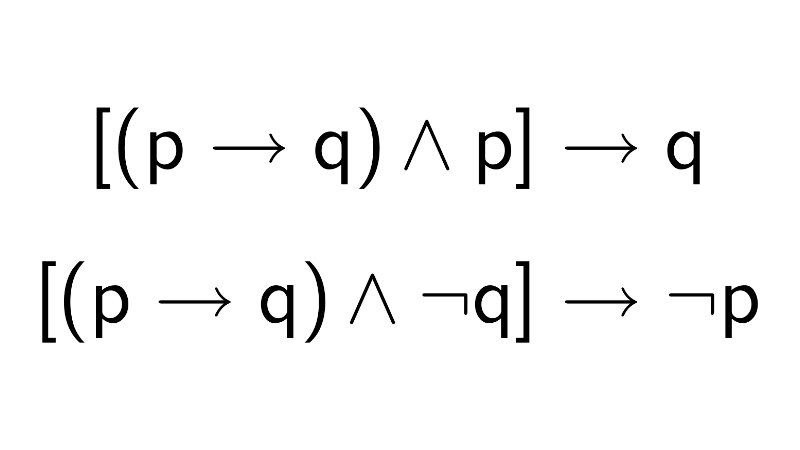
These valid forms correspond directly to standard rules of inference: modus ponens, modus tollens, and the hypothetical syllogism. Their symbolic structures are:
- Modus ponens: [(p → q) ∧ p] → q
- Modus tollens: [(p → q) ∧ ¬q] → ¬p
- Hypothetical syllogism: [(p → q) ∧ (q → r)] → (p → r)
Despite its strength in managing compound statements, propositional logic has an expressive limitation: it cannot examine the internal structure of individual statements. Because it treats propositions as atomic black boxes, it cannot represent subjects, predicates, properties, or quantifiers like "all" or "some."
For instance, consider the classical syllogism: "All humans are mortal" and "Socrates is human." Propositional logic views these statements as two unrelated variables (p and q). Lacking the ability to decompose them and recognize that "Socrates" belongs to the category "humans," it cannot formally deduce the conclusion that "Socrates is mortal."
Within this system, these premises remain disconnected statements. Overcoming this limitation requires moving up to a more expressive logical framework: first-order predicate logic.
First-Order Logic (Predicate Logic)
First-order logic (FOL), also known as first-order predicate calculus, extends propositional logic by analyzing the internal components of propositions. It separates subjects from predicates to reason about individual objects, their properties, relations, and quantifiers ("all" or "there exists") over a defined domain of discourse.
Rather than treating statements as indivisible atoms (p, q, r), first-order logic introduces structured mathematical machinery:
- Terms: Refer to specific objects within the domain of discourse. They can be individual constants (such as a, b, or s), which name specific entities (e.g., s for Socrates), or individual variables (such as x, y), which act as placeholders.
- Predicates: Represent properties of an individual object or relations between multiple objects. Predicates are denoted by capital letters (e.g., M for "is mortal") and take terms as arguments. For example, "Socrates is mortal" is symbolized as M(s).
- Propositional Functions: Formulas containing free variables, such as G(x): "x is Greek." A propositional function is neither true nor false on its own; it becomes a proposition with an assigned truth value once its variable is replaced by an individual constant or bound by a quantifier.
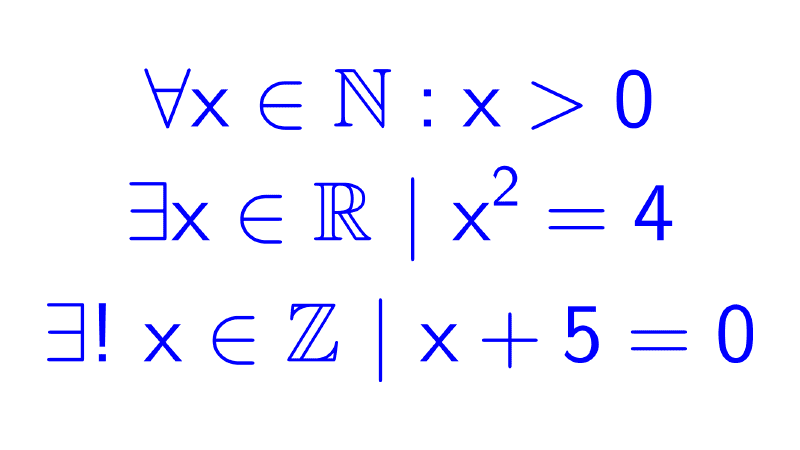
To convert propositional functions into quantified propositions, logicians introduce quantifiers. The universal quantifier (∀) represents "for all x", while the existential quantifier (∃) denotes "there exists at least one x."
This allows statements to be translated into formal notation:
- ∀x G(x): "For all x, x is Greek" or "Everyone is Greek."
- ∃x G(x): "There exists an x such that x is Greek" or "Someone is Greek."
- ∀n ∈ N, ∃m ∈ N (m = n + 1): "For every natural number n, there exists a natural number m such that m equals n + 1"—formally asserting that every natural number has a successor.
A fundamental deductive rule in first-order reasoning is universal instantiation (or universal specification): if a property holds for every element in a domain, it holds for any specific member of that domain. Formally, from ∀x P(x), we can validly infer P(a), where a is an arbitrary constant. This allows the deduction that "Socrates is mortal" from the universal premise that "All humans are mortal," given that Socrates is a human.
Instantiation rules remove quantifiers so that logicians can manipulate the underlying statements using the standard deductive rules of propositional logic.
Additional first-order inference rules include:
- Existential Generalization: If a property is verified for a specific individual constant a, one can validly conclude that there exists at least one element with that property. Formally, P(a) entails ∃x P(x). For example, knowing that "Plato is a philosopher" allows the valid conclusion that "There exists at least one philosopher."
- Universal Generalization: If a property P can be proven for an arbitrary, generic element c without relying on any special assumptions regarding c, one may deduce that P holds universally: P(c) implies ∀x P(x). For example, if a geometer proves that an arbitrary, unconstrained triangle has an interior angle sum of 180°, that conclusion extends to all triangles.
Important: Universal generalization does not permit inferring a universal truth from an isolated, specific instance. For this rule to be valid, the chosen element must be completely arbitrary and representative of the entire domain. Proving that "Garfield is an orange cat" does not justify the inference that "all cats are orange," because Garfield is a specific, restricted entity.
Second-Order and Higher-Order Logic
Second-order logic (SOL) is an expressive extension of first-order logic that permits quantification not only over individual objects, but also over properties, predicates, relations, and sets.
In first-order logic, quantifiers can only bind variables that represent individual entities within the domain. In second-order logic, quantifiers can also bind variables representing predicates or sets, enabling statements about properties themselves.
For example, while first-order logic can express "for all x, x is red," second-order logic can express "there exists a property P such that for all x, P(x) holds," treating P as a variable subject to formal quantification. Quantifying over predicates and sets allows second-order logic to fully formalize sophisticated mathematical principles that cannot be completely characterized in first-order systems.
A prime example is the Principle of Mathematical Induction: for any property P of natural numbers, if P(0) is true, and whenever P(n) is true it follows that P(n+1) is true, then P(n) is true for every natural number n. In second-order logic, this is expressed directly as a single formula: ∀P [(P(0) ∧ ∀n (P(n) → P(n+1))) → ∀n P(n)], where P is a second-order variable ranging over all predicates.
Note: Systems can be generalized into even higher-order logics, such as third-order logic, which allows quantification over properties of properties. However, higher-order logics are rarely employed in practical mathematical pedagogy due to their extreme semantic complexity, lack of deductive completeness, and failure of compactness.
Non-Classical Logics
As outlined above, classical logic rests upon core foundational principles including bivalence, non-contradiction, the excluded middle, and monotonicity. A logical framework is classified as a non-classical logic when it modifies, relaxes, or rejects at least one of these pillars, providing specialized formalisms for contexts that traditional logic cannot easily model.
Prominent non-classical logics include:
- Many-Valued Logics: These systems reject the principle of bivalence by introducing more than two truth values. A classic formulation is Łukasiewicz's three-valued logic, which supplements "true" and "false" with a third intermediate value (such as "undetermined" or "possible") to model contingent or indeterminate future events.
- Fuzzy Logic: Also rejects strict bivalence, replacing discrete truth states with a continuous interval of truth values between 0 (completely false) and 1 (completely true). Rather than assigning statements to binary or discrete buckets, fuzzy logic handles degrees of truth. For example, an automated climate control system evaluates continuous criteria such as "it is slightly warm" and modulates cooling output proportionally (e.g., at 25% or 75%) rather than functioning purely as an on/off switch.
- Intuitionistic Logic: Explicitly rejects the Law of the Excluded Middle. In intuitionistic mathematics, establishing that a statement is true requires a constructive proof; demonstrating that its negation leads to a contradiction is insufficient. For instance, arguing that "it is not the case that it is not raining" is not accepted as sufficient proof that "it is raining"—an explicit constructive demonstration is required.
- Paraconsistent Logic: Modifies the strict Law of Non-Contradiction to eliminate the classical "principle of explosion" (ex falso quodlibet), which dictates that any arbitrary statement can be derived from a contradiction. Paraconsistent logics isolate local inconsistencies without collapsing the entire deductive system. This is invaluable in distributed databases and sensor networks where contradictory inputs can coexist (such as one sensor reporting 68°F and another reporting 72°F) without invalidating the entire knowledge base.
- Non-Monotonic Logics: These reject the monotonicity of entailment, allowing new evidence or premises to retract or invalidate earlier conclusions. Under non-monotonic reasoning, inferences are provisional and subject to revision. A classic example is the default heuristic "all birds fly," which supports the initial inference that an observed bird flies; upon learning that the bird is a penguin, that conclusion is formally withdrawn. This is widely used in medical diagnosis and artificial intelligence systems where updated information alters working hypotheses.
- Modal Logic: While modal logic generally preserves the classical axioms, it extends classical syntax and semantics by introducing modal operators such as "it is possible that" (◇) and "it is necessary that" (□). This modification shifts truth from an absolute, static condition to a truth evaluated relative to possible worlds or contextual states. It allows formal reasoning about necessity, epistemic knowledge, and temporal states, distinguishing between statements such as "it is possible that the patient has the flu" and "it is necessary that the patient has the flu."
References
- Epp, S. (2020). Discrete Mathematics with Applications (5th ed.). Cengage.
- Gallier, J., & Quaintance, J. (2025). Mathematical foundations and aspects of discrete mathematics.
- Haggard, G., Schlipf, J., & Whitesides, S. (2006). Discrete mathematics for computer science. Thomson Brooks/Cole.
- Hunter, D. (2017). Essentials of discrete mathematics (3rd ed.). Jones & Bartlett Learning.
- Johnsonbaugh, R. (2018). Discrete Mathematics (8th ed.). Pearson.
- Levin, O. (2024). Discrete mathematics: An open introduction (4th ed.).
- Lipschutz, S., & Lipson, M. (2007). Theory and problems of discrete mathematics (3rd ed.). McGraw-Hill.
Mathematical Logic Topics
Did you find this useful? Rate it!
5.0 / 5 — 1 votes

HOW TO CITE THIS ARTICLE
Machado, D. (2026, October 3). Mathematical Logic. Flamath. https://en.flamath.com/mathematical-logic
Leave a Reply