
Formal Fallacies
A formal fallacy is an invalid deductive reasoning pattern whose flaw lies entirely in the logical structure of its premises and conclusion, rather than in the truth or falsity of its empirical content. It is an argument that appears to follow a legitimate inference rule, but whose syntactic form violates the laws of formal deduction.
In propositional logic, a valid argument is expressed as a conditional tautology by connecting the conjunction of the premises to the conclusion through a conditional statement (→). In a valid deduction, the conclusion is necessarily true whenever all premises are simultaneously true.
Conversely, the conditional formula associated with a formal fallacy is never a tautology. When evaluated using truth-functional methods, the argument results in a contingency or a contradiction, proving the existence of at least one truth assignment where the premises are true and the conclusion is false.
Within propositional calculus, the most common formal fallacies are affirming the consequent, denying the antecedent, affirming a disjunct (the false disjunctive syllogism), and denying a conjunct.
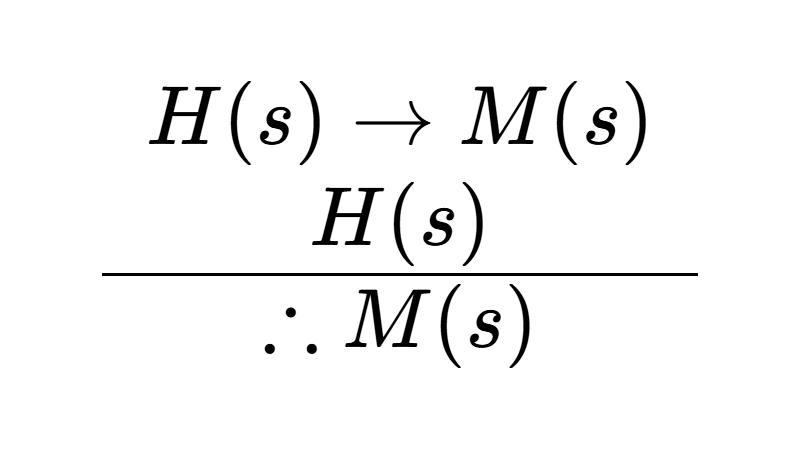
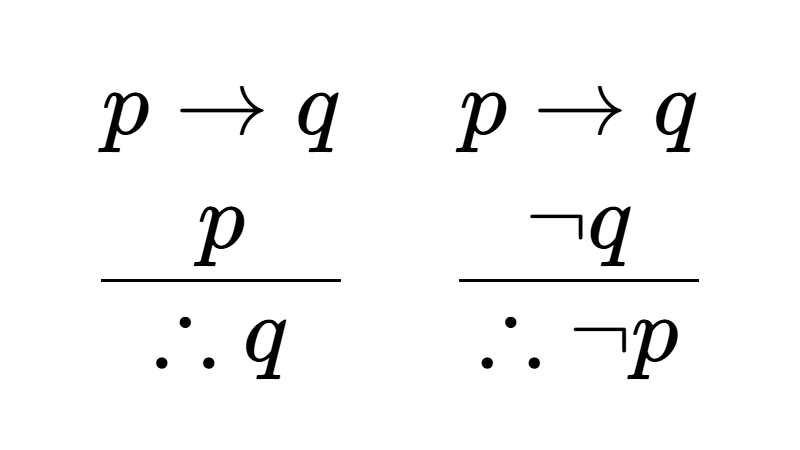
These errors typically arise from distorting valid patterns of deductive reasoning. For instance, affirming the consequent incorrectly mimics the structure of modus ponens, while denying the antecedent stems from a faulty application of modus tollens.
Table of Contents
Common Formal Fallacies
The most frequent formal fallacies arise from reversing the logical direction of conditional statements or misinterpreting connectives such as disjunction and conjunction. Below, we examine the most common invalid structures along with their conditional notation and representative examples in natural language and mathematics.
Affirming the Consequent
Affirming the consequent occurs when one assumes that the truth of the consequent necessarily implies the truth of the antecedent. This line of reasoning confuses a sufficient condition with a necessary condition, mistakenly imitating the structure of modus ponens.
Its conditional structure is formalized by the proposition [(p → q) ∧ q] → p. Because the consequent can be true due to factors unrelated to p, the argument does not guarantee the validity of the conclusion.
Example 1
- Premise 1: If it rains heavily, the street gets wet.
- Premise 2: The street is wet.
- Conclusion: Therefore, it is raining heavily.
The argument is invalid because the street could be wet for other reasons, such as a street sweeper passing by or a burst water pipe.
Example 2
- Premise 1: If a student earns a perfect GPA, they receive an honors scholarship.
- Premise 2: The student received an honors scholarship.
- Conclusion: Therefore, they earned a perfect GPA.
This deduction is fallacious because the academic institution may award honors scholarships for athletic, artistic, or research achievements.
Example 3
- Premise 1: If a quadrilateral is a square, then its diagonals are perpendicular.
- Premise 2: The diagonals of this quadrilateral are perpendicular.
- Conclusion: Therefore, the quadrilateral is a square.
In this geometric case, the conclusion does not necessarily follow, as the figure in question could be a non-equilateral rhombus or a kite.
Denying the Antecedent
Denying the antecedent consists of assuming that the falsity of the antecedent forces the consequent to be false as well. This pattern makes the mistake of improperly imitating the modus tollens rule.
The conditional notation of this fallacy is expressed as [(p → q) ∧ ¬p] → ¬q. The fact that the sufficient condition p does not occur does not prevent q from being true due to other causes.
Example 1
- Premise 1: If a person lives in Chicago, then they live in Illinois.
- Premise 2: John does not live in Chicago.
- Conclusion: Therefore, John does not live in Illinois.
The conclusion is formally invalid because John could easily reside in cities such as Springfield, Peoria, or Naperville without ever setting foot in Chicago.
Example 2
- Premise 1: If the vehicle runs out of gas, the engine shuts off.
- Premise 2: The vehicle did not run out of gas.
- Conclusion: Therefore, the engine will not shut off.
The argument fails because the vehicle could stall due to multiple independent mechanical issues, such as a dead battery or a faulty alternator.
Example 3
- Premise 1: If an integer n is divisible by 6, then n is an even number.
- Premise 2: The number 8 is not divisible by 6.
- Conclusion: Therefore, the number 8 is not an even number.
The reasoning is invalid because 8 is indeed an even number, even though it does not satisfy the preliminary condition of being divisible by 6.
Affirming a Disjunct
Affirming a disjunct (or the false disjunctive syllogism) occurs when one rejects a proposition after verifying the truth of another with which it shares an inclusive disjunction (∨). The logical error lies in treating an inclusive disjunction as if it were an exclusive disjunction (⊻).
Formally, its conditional formula is represented as [(p ∨ q) ∧ p] → ¬q. Because both disjuncts can be simultaneously true, affirming one does not disprove the other.
Example 1
- Premise 1: To apply for the position, an applicant must have a college degree or speak fluent English.
- Premise 2: The applicant has a college degree.
- Conclusion: Therefore, the applicant does not speak fluent English.
The argument is fallacious because the disjunction is inclusive: the applicant can possess a college degree and also be fluent in English.
Example 2
- Premise 1: The restaurant offers delivery service or dine-in service.
- Premise 2: The restaurant offers dine-in service.
- Conclusion: Therefore, the restaurant does not offer delivery service.
The deduction does not hold because both service options can operate simultaneously at the same establishment.
Example 3
- Premise 1: A real number x satisfies x > 0 or x < 5.
- Premise 2: For x = 3, it is true that x > 0.
- Conclusion: Therefore, it is not true that x < 5.
The inference is false because the value x = 3 satisfies both inequalities on the real number line simultaneously.
Denying a Conjunct
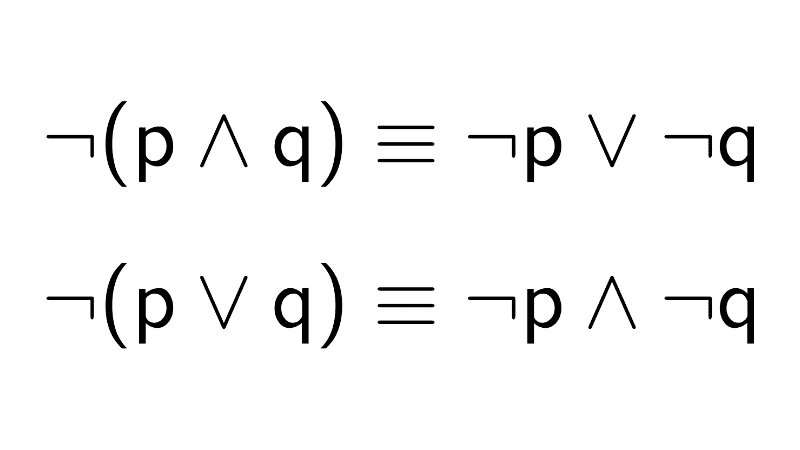
Denying a conjunct is a formal fallacy where, knowing that a conjunction is false and that one of its components is false, one mistakenly concludes that the other component must be true. This flaw stems from misapplying De Morgan’s laws to a negated conjunction.
The conditional structure corresponds to [¬(p ∧ q) ∧ ¬p] → q. Since the negation of a conjunction is equivalent to ¬p ∨ ¬q, it is entirely possible for both propositions to be false at the same time.
Example 1
- Premise 1: It is impossible for a phone to be powered off and transmitting data at the same time.
- Premise 2: The phone is not powered off.
- Conclusion: Therefore, the phone is transmitting data.
The deduction is invalid because the phone could be turned on in standby mode without transmitting any data.
Example 2
- Premise 1: It is not true that the suspect was at the bank and at the airport at 10:00 AM.
- Premise 2: The suspect was not at the bank at 10:00 AM.
- Conclusion: Therefore, the suspect was at the airport at 10:00 AM.
The argument commits a formal fallacy, as the suspect could have been at home or anywhere else at that time.
Example 3
- Premise 1: For a point in the plane, it is not simultaneously true that x = 0 and y = 0.
- Premise 2: It is verified that x ≠ 0.
- Conclusion: Therefore, it necessarily follows that y = 0.
The conclusion is false because a point with coordinates (2, 4) satisfies the initial premise without requiring its y-coordinate to be zero.
Summary Table of Propositional Logic Fallacies
The following table summarizes the most common formal fallacies, their symbolic structure in conditional and vertical formats, and the deductive error made with respect to the valid rule they imitate.
| Formal Fallacy | Conditional Form | Vertical Form | Error Committed |
|---|---|---|---|
| Affirming the consequent | [(p → q) ∧ q] → p | $$\begin{matrix} p \rightarrow q \\ q \\ \hline \therefore p \end{matrix}$$ | Confuses a sufficient condition with a necessary one. Incorrectly mimics modus ponens. |
| Denying the antecedent | [(p → q) ∧ ¬p] → ¬q | $$\begin{matrix} p \rightarrow q \\ \neg p \\ \hline \therefore \neg q \end{matrix}$$ | Assumes that denying the sufficient condition negates the result. Incorrectly mimics modus tollens. |
| Affirming a disjunct | [(p ∨ q) ∧ p] → ¬q | $$\begin{matrix} p \lor q \\ p \\ \hline \therefore \neg q \end{matrix}$$ | Treats an inclusive disjunction as exclusive. Improperly mimics disjunctive syllogism. |
| Denying a conjunct | [¬(p ∧ q) ∧ ¬p] → q | $$\begin{matrix} \neg(p \land q) \\ \neg p \\ \hline \therefore q \end{matrix}$$ | Misapplies De Morgan's laws by assuming that ruling out one term affirms the other. |
Proving Invalidity with Truth Tables
The logical invalidity of any formal fallacy can be conclusively demonstrated by constructing its truth table. Unlike valid rules of inference whose associated conditional yields a tautology, formal fallacies result in a contingency or contradiction.
To prove that a deductive argument form is invalid, it is sufficient to find at least one combination of truth values where all premises are simultaneously true but the conclusion is false. This assignment serves as a formal counterexample that breaks the argument's validity.
Truth Table for Affirming the Consequent
To analyze the fallacy of affirming the consequent, we evaluate the conditional structure [(p → q) ∧ q] → p. In this formula, we join the two premises using a conjunction and set the propositional variable p as the conclusion of the argument.
| p | q | p → q | (p → q) ∧ q | [(p → q) ∧ q] → p |
|---|---|---|---|---|
| T | T | T | T | T |
| T | F | F | F | T |
| F | T | T | T | F |
| F | F | T | F | T |
The structural flaw is exposed in the third row of the table, corresponding to the truth values p = F and q = T. In this row, the conditional premise p → q is true and the second premise q is also true, making the entire antecedent (p → q) ∧ q true.
However, the conclusion p is false. Because a conditional with a true antecedent and a false consequent evaluates to false, the main column yields a false value (F), proving that affirming the consequent is not a valid rule of inference.
Truth Table for Denying the Antecedent
In the case of denying the antecedent, we examine the formal expression [(p → q) ∧ ¬p] → ¬q. We evaluate the impact that negating the initial sufficient condition has on the truth value of the negated consequent.
| p | q | ¬p | ¬q | p → q | (p → q) ∧ ¬p | [(p → q) ∧ ¬p] → ¬q |
|---|---|---|---|---|---|---|
| T | T | F | F | T | F | T |
| T | F | F | T | F | F | T |
| F | T | T | F | T | T | F |
| F | F | T | T | T | T | T |
Just as before, the logical breakdown occurs in the third row, where p = F and q = T. Under this assignment, the conditional p → q is true and the negation of the antecedent ¬p is also true, making the conjunction of the premises entirely true.
Despite this, the expected conclusion ¬q is false. The presence of this false value in the final column confirms that the argument results in a contingency and therefore lacks deductive validity.
Formal Fallacies in Predicate Logic
In predicate calculus, deductive errors arise not only from propositional connectives but also from the improper handling of universal (∀) and existential (∃) quantifiers. When we reverse the order of quantified variables or distribute these operators incorrectly across relations, we generate invalid arguments in first-order logic.
Unlike propositional fallacies, these patterns violate the syntactic rules of instantiation and generalization over the elements of a domain. Below, we examine the most common invalid structures along with their formal expressions and representative counterexamples.
Quantifier Shift Fallacy
The quantifier shift fallacy occurs when the positions of a universal quantifier and an existential quantifier are illicitly swapped in a relational statement. The error consists of deducing that a single element is uniformly related to all members of the domain, simply because each element has some individual correspondence.
This invalid deduction has the following argument form:
$$\begin{matrix} \forall x \, \exists y \, R(x, y) \\ \hline \therefore \exists y \, \forall x \, R(x, y) \end{matrix}$$
To verify the invalidity of this inference, consider the following examples:
Example 1
- Premise: Every person has a biological mother.
- Conclusion: Therefore, there is a person who is the biological mother of every person.
The deduction is fallacious because each person's mother is different; there is no single individual who serves that role for all of humanity.
Example 2
- Premise: For every integer x, there exists an integer y such that y > x.
- Conclusion: Therefore, there exists an integer y such that for every integer x, y > x.
The argument is invalid because the set of integers has no maximum element that is greater than all others.
Illicit Universal Generalization
Illicit universal generalization consists of attributing a property to all elements of a domain based solely on the fact that a specific individual possesses that property. For a universal generalization to be sound, the evaluated element must be completely arbitrary and free of prior conditions.
Formally, the structure of this fallacious argument is defined as:
$$\begin{matrix} P(a) \\ \hline \therefore \forall x \, P(x) \end{matrix}$$
We can see how this deductive flaw operates through two concrete situations:
Example 1
- Premise: John's car runs on an electric motor.
- Conclusion: Therefore, all cars run on electric motors.
The conclusion lacks formal justification, as an observation made about an individual instance cannot be universally extended to all automobiles.
Example 2
- Premise: The number 2 is prime and it is an even number.
- Conclusion: Therefore, all prime numbers are even numbers.
The inference fails immediately because there are other prime numbers, such as 3 and 5, that are odd.
Illicit Existential Generalization
The illicit existential generalization (or fallacious conjunction of existentials) occurs when two independent existential statements are merged into a single conjunctive proposition. The error lies in assuming that because two properties have witnesses in the domain, there must be a single individual that satisfies both properties simultaneously.
The structure of this fallacy is expressed as follows:
$$\begin{matrix} \exists x \, P(x) \\ \exists x \, Q(x) \\ \hline \therefore \exists x \, (P(x) \land Q(x)) \end{matrix}$$
Consider two cases where this error manifests:
Example 1
- Premise 1: There are animals that breathe through gills.
- Premise 2: There are animals that have feathers.
- Conclusion: Therefore, there exists an animal that breathes through gills and has feathers.
The reasoning is invalid because the individuals satisfying the first condition are not the same individuals that satisfy the second.
Example 2
- Premise 1: There exists an integer x such that x is even.
- Premise 2: There exists an integer x such que x is odd.
- Conclusion: Therefore, there exists an integer x such that x is both even and odd simultaneously.
The deduction is false and contradictory, as the sets of even and odd integers are mutually exclusive.
Illicit Distribution of Universal over Disjunction
The illicit distribution of a universal quantifier over disjunction occurs when one assumes that a universal disjunction forces every member of the domain to uniformly satisfy the same alternative. This mistake overlooks the fact that different elements can satisfy different disjuncts without violating the overall universal statement.
The formulation of this invalid pattern is:
$$\begin{matrix} \forall x \, (P(x) \lor Q(x)) \\ \hline \therefore \forall x \, P(x) \lor \forall x \, Q(x) \end{matrix}$$
We can observe the logical failure in the following examples:
Example 1
- Premise: Every registered person is an adult or a minor.
- Conclusion: Therefore, all registered persons are adults, or all registered persons are minors.
The argument is formally invalid because the universal disjunction of possibilities does not rule out the coexistence of both groups within the population.
Example 2
- Premise: For every integer n, n is even or n is odd.
- Conclusion: Therefore, all integers are even, or all integers are odd.
The inference fails because the set of integers contains elements of both categories without reducing to just one of them.
Undistributed Middle Fallacy
In quantified logic, the undistributed middle fallacy occurs when two properties share a common necessary condition, and one erroneously infers that one property is included within the other. This schema transfers propositional affirmation of the consequent into the realm of categorical statements.
The argument form is structured as follows:
$$\begin{matrix} \forall x \, (A(x) \rightarrow C(x)) \\ \forall x \, (B(x) \rightarrow C(x)) \\ \hline \therefore \forall x \, (B(x) \rightarrow A(x)) \end{matrix}$$
We examine how this defective syllogism operates through two cases:
Example 1
- Premise 1: All canines are vertebrates.
- Premise 2: All reptiles are vertebrates.
- Conclusion: Therefore, all reptiles are canines.
The argument is formally invalid because sharing a general property does not imply an inclusion relationship between the subsets belonging to it.
Example 2
- Premise 1: If an integer n is a multiple of 6, then n is divisible by 2.
- Premise 2: If an integer n is a multiple of 4, then n is divisible by 2.
- Conclusion: Therefore, if an integer n is a multiple of 4, then n is a multiple of 6.
The conclusion is false; consider the counterexample n = 8, which is a multiple of 4 and divisible by 2, but is not a multiple of 6.
Summary Table of Predicate Logic Fallacies
The following table summarizes the most common quantifier fallacies, their vertical argument form, and the corresponding deductive error:
| Formal Fallacy | Vertical Form | Error Committed |
|---|---|---|
| Quantifier shift | $$\begin{matrix} \forall x \, \exists y \, R(x, y) \\ \hline \therefore \exists y \, \forall x \, R(x, y) \end{matrix}$$ | Swaps quantifier order, invalidly deducing a single uniform relation from individual relations. |
| Illicit universal generalization | $$\begin{matrix} P(a) \\ \hline \therefore \forall x \, P(x) \end{matrix}$$ | Extends a property of a particular constant or individual to the entire domain without arbitrary justification. |
| Illicit existential generalization | $$\begin{matrix} \exists x \, P(x) \\ \exists x \, Q(x) \\ \hline \therefore \exists x \, (P(x) \land Q(x)) \end{matrix}$$ | Assumes that two independent existences guarantee the simultaneous concurrence of both conditions in the same element. |
| Illicit distribution of universal | $$\begin{matrix} \forall x \, (P(x) \lor Q(x)) \\ \hline \therefore \forall x \, P(x) \lor \forall x \, Q(x) \end{matrix}$$ | Splits a universal disjunction, forcing all elements to adopt exactly one of the options. |
| Undistributed middle | $$\begin{matrix} \forall x \, (A(x) \rightarrow C(x)) \\ \forall x \, (B(x) \rightarrow C(x)) \\ \hline \therefore \forall x \, (B(x) \rightarrow A(x)) \end{matrix}$$ | Concludes an inclusion relation between two categories merely because they share a common necessary condition. |
Formal Fallacies vs. Informal Fallacies
To understand the nature of deductive errors, it is essential to distinguish between flaws attributable to logical structure and those arising from the semantic content of the argument.
A formal fallacy occurs purely at the syntactic level. The flaw does not depend on the meaning of words or the empirical truth of facts, but on an invalid inference scheme that violates the rules of deductive logic.
In contrast, an informal fallacy (or material fallacy) features an argument form that may seem persuasive, but its flaw stems from ambiguous language, false premises, irrelevant data, or pragmatic discourse errors.
Among the most well-known informal fallacies are:
- Ad hominem fallacy: attacks the person making the argument rather than refuting the claim itself.
- Straw man fallacy: distorts or oversimplifies an opponent's position to attack an easier, fabricated version.
- Ad populum fallacy (bandwagon): argues that a claim is true simply because a large number of people believe it.
- False cause fallacy: assumes that one event is the direct cause of another simply because it happened first.
Consider a comparative example to illustrate this difference. If we state, "If it rains, the ground gets wet; the ground is wet, therefore it is raining," we have committed a formal fallacy because the structure [(p → q) ∧ q] → p is invalid in every deductive system.
On the other hand, if we say, "That mathematical theorem must be false because I dislike the mathematician who proposed it," the error is not algebraic or structural; it is a direct personal attack that constitutes an informal fallacy.
The following comparison table summarizes the fundamental criteria separating both types of fallacies.
| Criterion | Formal Fallacies | Informal Fallacies |
|---|---|---|
| Source of error | Syntactic structure and deductive rules. | Semantic content, context, and ambiguity. |
| Field of study | Propositional and formal mathematical logic. | Rhetoric, pragmatics, and informal logic. |
| Detection method | Truth tables and formal proof rules. | Contextual and textual analysis of claims. |
| Content independence | Completely independent of empirical meaning. | Directly dependent on content and context. |
Did you find this useful? Rate it!
0.0 / 5 — 0 votes

HOW TO CITE THIS ARTICLE
Machado, D. (2026, September 30). Formal Fallacies. Flamath. https://en.flamath.com/formal-fallacies

Leave a Reply
Related Articles