
Modus Tollens
Modus tollens is a fundamental rule of inference in propositional logic and formal mathematical deduction. This rule establishes that if a conditional statement is accepted as true and its consequent is simultaneously shown to be false, the falsity of its antecedent necessarily follows.
Its full formal name is modus tollendo tollens, a Latin phrase that translates to "the mode that by denying, denies." Through this mechanism, refuting the expected outcome of an implication compels us to reject the initial hypothesis.
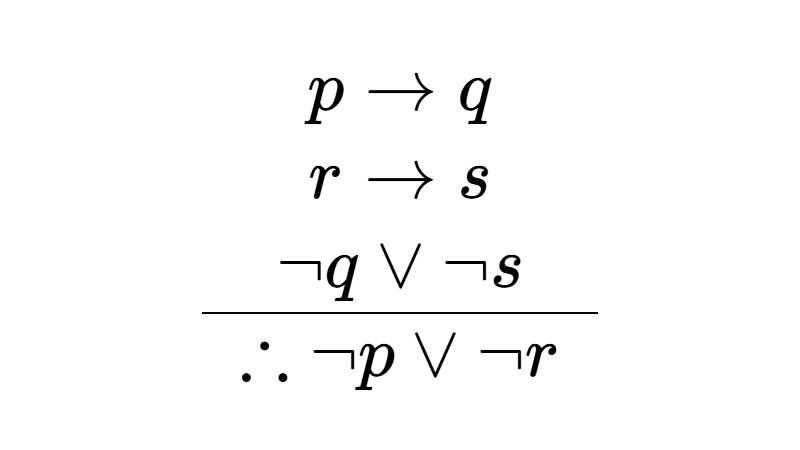
In the language of propositional logic, its horizontal structure or associated conditional statement is formulated as:
[(p → q) ∧ ¬q] → ¬p
In formal deductive systems, the argument is represented vertically using ordered premises and a conclusion preceded by the deduction symbol:
$$ \begin{array}{cl} p \to q \\ \neg q \\ \hline \therefore \neg p \end{array} $$
The validity of this syllogism guarantees that truth is preserved throughout the inference. If the conditional relationship p → q is true, it is impossible for the antecedent p to hold while the consequent q is false; therefore, verifying ¬q inescapably forces the conclusion ¬p.
This rule is grounded directly in the law of contraposition, the logical principle establishing the formal equivalence (p → q) ≡ (¬q → ¬p). By transforming the original implication into its contrapositive form, applying modus tollens is completely equivalent to executing a modus ponens on that equivalent structure.
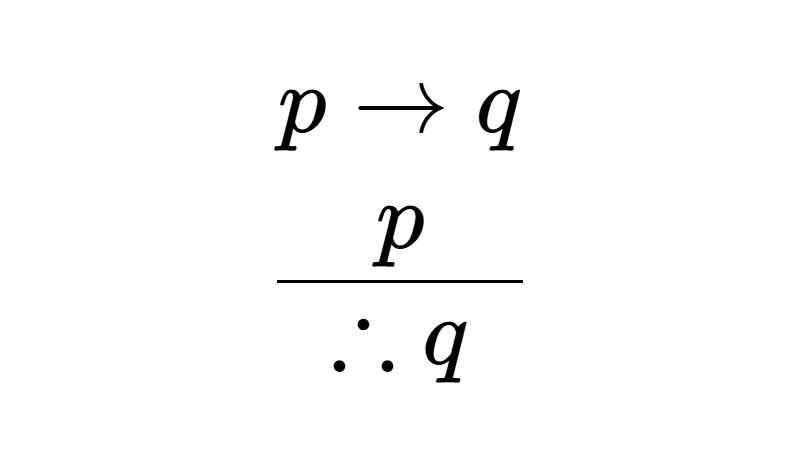
It is important not to confuse this method with modus ponens (or modus ponendo ponens), whose formulation is [(p → q) ∧ p] → q. While modus ponens affirms the antecedent to validate the consequent, modus tollens denies the consequent to invalidate the antecedent.
Table of Contents
Examples
To understand how this rule of inference operates across different contexts, we analyze below a series of practical cases ranging from everyday scenarios to formal deductions and variants with negations.
Example 1
Premise 1: If the bank alarm is triggered, then the security guard locks the entrance doors (p → q).
Premise 2: The security guard does not lock the entrance doors (¬q).
Conclusion: Therefore, the bank alarm was not triggered (¬p).
In this first case, we observe the classic structure of the rule. By empirically verifying that the expected action in the consequent did not occur, we necessarily conclude that the initial triggering condition did not take place either.
Example 2
Premise 1: If an integer is a multiple of four, then it is an even number (p → q).
Premise 2: The number 27 is not an even number (¬q).
Conclusion: Therefore, the number 27 is not a multiple of four (¬p).
In this arithmetic example, parity is a necessary condition for a number to be divisible by four. By verifying that 27 is odd, we immediately and categorically rule out that it can be a multiple of four.
Example 3
Premise 1: If two non-vertical lines in the plane are parallel, then they have the same slope (p → q).
Premise 2: Lines L1 and L2 do not have the same slope (¬q).
Conclusion: Therefore, lines L1 and L2 are not parallel (¬p).
In analytic geometry, having equal slopes is required for parallelism. Upon verifying that the slopes differ, we deduce with absolute certainty that the lines intersect at some point in the plane.
Example 4
Premise 1: If a real number is not negative, then it is greater than or equal to zero (¬p → q).
Premise 2: The given real number is not greater than or equal to zero (¬q).
Conclusion: Therefore, the given real number is negative (p).
In this variant, the original antecedent is a formally negated proposition, ¬p. Denying the consequent yields ¬(¬p), which by the double negation law simplifies directly into the affirmative statement p.
Example 5
Premise 1: If a polygon is a triangle, then it has no interior diagonals (p → ¬q).
Premise 2: The given figure does have interior diagonals (q).
Conclusion: Therefore, the given figure is not a triangle (¬p).
Here, the consequent of the conditional contains an explicit negation. The second premise denies that consequent by stating an affirmative proposition, since ¬(¬q) ≡ q, allowing us to conclude the negation of the antecedent without altering the validity of the deduction.
Example 6
Premise 1: If a quadrilateral is not a parallelogram, then its opposite sides are not equal in length (¬p → ¬q).
Premise 2: The given quadrilateral does have opposite sides of equal length (q).
Conclusion: Therefore, the given quadrilateral is a parallelogram (p).
This final case illustrates the application of modus tollendo tollens when both components of the implication contain negations.
Formal Proof
To formally prove the validity of modus tollens, we can rely on two complementary approaches: deduction via logical equivalence and exhaustive semantic analysis using truth tables.
From the first perspective, this rule is derived directly from modus ponens by applying the law of contraposition. Every implication p → q is logically equivalent to ¬q → ¬p. Replacing the original implication with its contrapositive within the premise set gives us ¬q → ¬p alongside the premise ¬q. Applying a standard modus ponens to this structure affirms the antecedent ¬q and immediately yields the consequent ¬p, demonstrating that both rules share the same deductive foundation.
Alternatively, the universal validity of this argument form is verified by evaluating its associated conditional statement: [(p → q) ∧ ¬q] → ¬p. An inference pattern is valid in propositional logic if and only if its corresponding conditional is a tautology.
We construct the truth table by evaluating each connective step by step across all possible truth-value assignments:
| p | q | ¬p | ¬q | p → q | (p → q) ∧ ¬q | [(p → q) ∧ ¬q] → ¬p |
|---|---|---|---|---|---|---|
| T | T | F | F | T | F | T |
| T | F | F | T | F | F | T |
| F | T | T | F | T | F | T |
| F | F | T | T | T | T | T |
Examining the final column reveals that the compound statement is true under all possible input combinations. Because there is no case in which all premises are true while the conclusion is false, modus tollens is formally proven to be a valid rule of inference.
Denying the Antecedent Fallacy
The fallacy of denying the antecedent (also known as the inverse error) is a formal reasoning fallacy that occurs when a sufficient condition is mistakenly treated as a necessary condition within a conditional statement. This flawed argument assumes that if the initial condition is not satisfied, the outcome cannot occur either. Its associated formal structure is expressed as [(p → q) ∧ ¬p] → ¬q.
Unlike modus tollens, where denying the consequent guarantees the falsity of the antecedent, denying the antecedent provides no definitive information about the truth value of the consequent.
Examples of the Fallacy
Example 1
Premise 1: If the bank alarm is triggered, then the security guard locks the entrance doors (p → q).
Premise 2: The bank alarm was not triggered (¬p).
Erroneous conclusion: Therefore, the security guard does not lock the entrance doors (¬q).
This everyday case clearly exposes the deductive flaw. The security guard might lock the doors for various reasons other than the alarm being triggered, such as the end of business hours or a scheduled emergency drill.
Example 2
Premise 1: If an integer is a multiple of four, then it is an even number (p → q).
Premise 2: The number 18 is not a multiple of four (¬p).
Erroneous conclusion: Therefore, the number 18 is not an even number (¬q).
This arithmetic counterexample decisively demonstrates the invalidity of the argument form. Although both premises are formally true, the resulting conclusion is demonstrably false, as 18 is indeed an even number.
Truth Table Proof of Invalidity
To verify that this argument structure lacks deductive validity, we evaluate the conditional formula [(p → q) ∧ ¬p] → ¬q using its truth table.
| p | q | ¬p | ¬q | p → q | (p → q) ∧ ¬p | [(p → q) ∧ ¬p] → ¬q |
|---|---|---|---|---|---|---|
| T | T | F | F | T | F | T |
| T | F | F | T | F | F | T |
| F | T | T | F | T | T | F |
| F | F | T | T | T | T | T |
Inspecting the final column shows a false value in the third row, corresponding to the scenario where p is false and q is true. The presence of this false value confirms that the expression is not a tautology, but a contingency, invalidating this pattern as a deductive rule of inference.
Did you find this useful? Rate it!
0.0 / 5 — 0 votes

HOW TO CITE THIS ARTICLE
Machado, D. (2026, September 30). Modus Tollens. Flamath. https://en.flamath.com/modus-tollens
Leave a Reply
Related Articles