
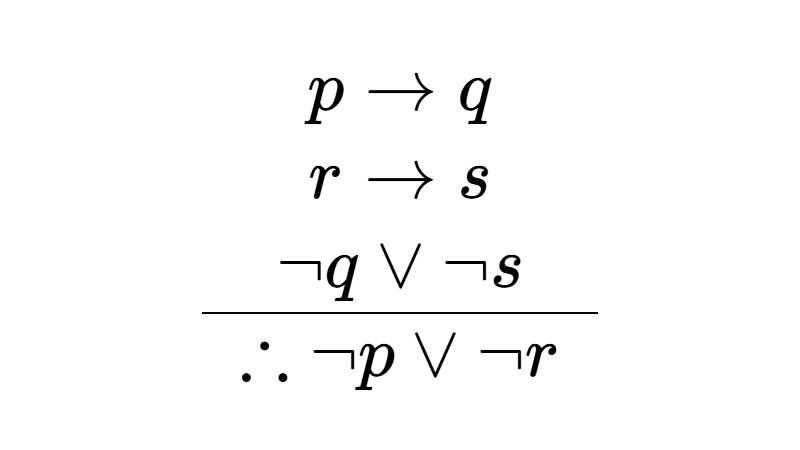
Disjunctive Syllogism
The disjunctive syllogism is an elementary rule of inference within propositional logic and formal deduction systems. This rule establishes that if one begins with a disjunction between two propositions and denies one of them, the affirmation of the other is validly and necessarily concluded.
This deductive pattern traditionally carries the Latin name modus tollendo ponens, which translates to "the mode that by denying, affirms". The designation describes its operational mechanism: eliminating or refuting one of the alternatives establishes the truth of the remaining disjunct.
In the formal language of propositional calculus, the rule can be presented in two symmetric forms depending on which term is initially negated. In its horizontal formulation or associated conditional, it is expressed as follows:
[(p ∨ q) ∧ ¬p] → q
Equivalently, if the term negated in the second premise is the second disjunct, the structure takes the form:
[(p ∨ q) ∧ ¬q] → p
In vertical formal deductions, both variants are structured by arranging the premises sequentially above the deduction line:
$$ \begin{array}{cl} p \lor q \\ \neg p \\ \hline \therefore q \end{array} \qquad\qquad \begin{array}{cl} p \lor q \\ \neg q \\ \hline \therefore p \end{array} $$
The semantic foundation of this rule lies in the nature of the inclusive logical disjunction. Stating that the compound statement p ∨ q is true guarantees that at least one of its components must be true. Therefore, if subsequent information rules out the viability of one component (rendering it false), the only way to preserve the truth of the overall statement is for the other component to be true.
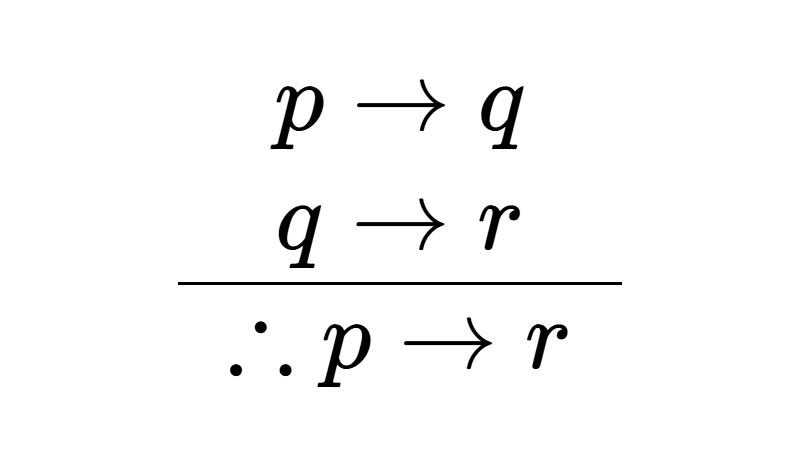
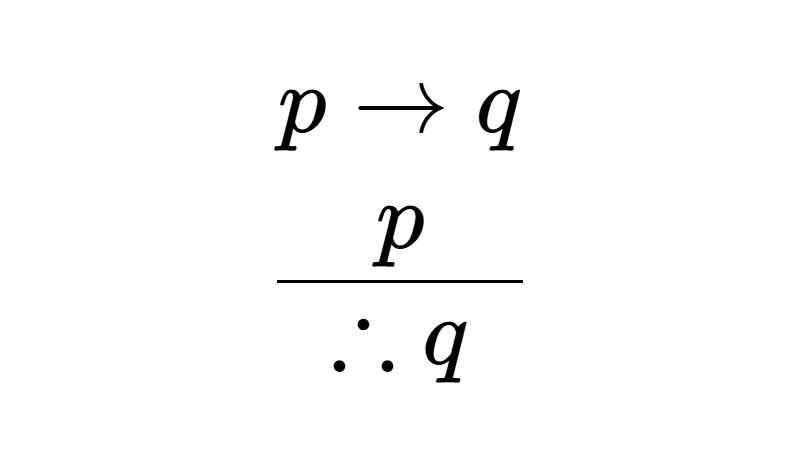
It is essential not to confuse the disjunctive syllogism with the hypothetical syllogism, as their deductive structures and logical operators are entirely different. While the hypothetical syllogism works exclusively through chaining conditional statements of the form [(p → q) ∧ (q → r)] → (p → r), the disjunctive syllogism operates by eliminating alternatives within a disjunction to isolate a direct conclusion.
Table of Contents
Examples
To understand how the disjunctive syllogism operates across different contexts, we analyze below a series of practical cases ranging from everyday situations to proofs in arithmetic and algebra.
Example 1
Premise 1: The meeting will be held via videoconference or in person (p ∨ q).
Premise 2: The meeting will not be held in person (¬q).
Conclusion: Therefore, the meeting will be held via videoconference (p).
In this first case, we start with two possible scenarios stated in the disjunction. Upon observing the falsity of the in-person option in the second premise, we discard that alternative and immediately deduce the virtual option.
Example 2
Premise 1: The integer n is even or it is odd (p ∨ q).
Premise 2: The integer n is not even (¬p).
Conclusion: Therefore, the integer n is odd (q).
Here we apply the rule to the classification of integers. Since parity completely partitions this numerical set, denying one of the alternatives forces us to conclude the truth of the other.
Example 3
Premise 1: In the equation a · b = 0, either a = 0 or b = 0 (p ∨ q).
Premise 2: The coefficient a is not equal to zero, that is, a ≠ 0 (¬p).
Conclusion: Therefore, the value of b is equal to zero, b = 0 (q).
In elementary algebra, the zero-product property establishes a necessary disjunction between factors. By establishing the condition that the first factor is nonzero, we logically guarantee that the remaining variable must vanish.
Example 4
Premise 1: Two distinct coplanar lines are parallel or they intersect (p ∨ q).
Premise 2: The two coplanar lines are not parallel (¬p).
Conclusion: Therefore, the two coplanar lines intersect (q).
In Euclidean plane geometry, the relative positions of two distinct lines form a disjunctive system. Upon verifying that the lines do not maintain a constant distance (they are not parallel), we validly infer that they must intersect at a point.
Example 5
Premise 1: The root of the function is negative, zero, or positive (p ∨ (q ∨ r)).
Premise 2: The root of the function is not negative (¬p).
Premise 3: The root of the function is not zero (¬q).
Conclusion: Therefore, the root of the function is positive (r).
This final example illustrates the successive application of the rule to compound disjunctions. Applying the disjunctive syllogism with the first negation reduces the options to q ∨ r, and contrasting that with the next negative premise conclusively isolates alternative r.
Truth Table Proof
To verify the universal validity of the disjunctive syllogism, we analyze the semantic behavior of its associated conditional: [(p ∨ q) ∧ ¬p] → q.
In propositional calculus, a rule of inference is formally valid if and only if the conditional structure relating its premises to its conclusion is a tautology.
With two simple propositional variables (p and q), we evaluate the 22 = 4 possible combinations of truth values. We construct the truth table:
| p | q | p ∨ q | ¬p | (p ∨ q) ∧ ¬p | [(p ∨ q) ∧ ¬p] → q |
|---|---|---|---|---|---|
| T | T | T | F | F | T |
| T | F | T | F | F | T |
| F | T | T | T | T | T |
| F | F | F | T | F | T |
Examining the final column reveals that the compound statement takes the value true (T) across every single row without exception.
Notice that the only scenario where the premise set (p ∨ q) ∧ ¬p evaluates to true corresponds to the third row (where p is false and q is true). In that row, the conclusion q is also true.
There is no truth-value assignment where the premises are simultaneously true and the conclusion is false. Consequently, it is rigorously proven that the disjunctive syllogism is a formally valid rule of inference.
Fallacious Disjunctive Syllogism
The fallacious disjunctive syllogism, also known as the fallacy of affirming a disjunct, is a formal logical error that occurs when an inclusive disjunction is confused with an exclusive disjunction.
This fallacy arises when, given a disjunctive premise and the confirmation of the truth of one of its members, one incorrectly attempts to deduce that the other term must necessarily be false.
In propositional calculus notation, the associated conditional formula for this invalid reasoning is expressed as follows:
[(p ∨ q) ∧ p] → ¬q
The source of this invalidity lies in the semantic behavior of the disjunction operator ∨. In classical logic, disjunction is inclusive by default, meaning that the compound statement remains true even when both simple propositions, p and q, are true simultaneously.
For this reason, verifying that proposition p is true does not rule out the possibility that q is also true. The argument would only be formally valid if the initial premise explicitly used an exclusive disjunction (p ⊻ q), where the occurrence of one alternative strictly precludes the other.
To illustrate this logical flaw, consider the following everyday scenario. Suppose the premise is: "Martin is a mathematics teacher or Martin is a web developer" (p ∨ q). If we confirm Premise 2: "Martin is a mathematics teacher" (p), it would be completely fallacious to conclude: "Therefore, Martin is not a web developer" (¬q).
These two professional activities are not mutually exclusive; Martin can validly perform both roles simultaneously without contradicting the initial disjunction. Consequently, the deductive step lacks logical validity.
Evaluating this structure using a truth table immediately provides a counterexample in the row where both p and q are true (T). In that scenario, the conjunction of the premises (p ∨ q) ∧ p evaluates to true, but the conclusion ¬q evaluates to false, resulting in an implication with a true antecedent and a false consequent (T → F ≡ F).
| p | q | p ∨ q | (p ∨ q) ∧ p | ¬q | [(p ∨ q) ∧ p] → ¬q |
|---|---|---|---|---|---|
| T | T | T | T | F | F |
| T | F | T | T | T | T |
| F | T | T | F | F | T |
| F | F | F | F | V | T |
Because the statement form does not yield a tautology, it is formally proved that affirming a disjunct does not preserve truth and constitutes an invalid inference pattern.
Formal Validity and the False Dilemma Fallacy
When applying the disjunctive syllogism outside pure mathematical systems, it is essential to distinguish between the formal validity of the deductive structure and the factual truth of the premises involved.
Syntactically, the rule is formally infallible regardless of the content assigned to the propositions. However, for the final conclusion to be factually true in reality, the disjunctive premise p ∨ q must be exhaustive and account for all actual possibilities in the scenario under consideration.
When a disjunction arbitrarily restricts the scope of options to only two alternatives while ignoring viable third possibilities, one commits the false dilemma (or false dichotomy) fallacy.
If someone argues that a project must be either canceled immediately or approved immediately, and then denies cancellation to force approval, the reasoning maintains a formally correct deductive structure. Nonetheless, the argument lacks soundness if in practice there was an option to postpone review or request preliminary revisions.
In rigorous mathematical reasoning, this issue is resolved by ensuring that the disjuncts form a complete partition of the sample space or evaluated set. A clear example of this is the trichotomy property of real numbers, where for any real value x it holds necessarily and exhaustively that x < 0 ∨ x = 0 ∨ x > 0.
Did you find this useful? Rate it!
0.0 / 5 — 0 votes

HOW TO CITE THIS ARTICLE
Machado, D. (2026, September 30). Disjunctive Syllogism. Flamath. https://en.flamath.com/disjunctive-syllogism
Leave a Reply
Related Articles