
Hypothetical Syllogism
The hypothetical syllogism (also widely known in formal logic and geometry as the law of syllogism) is a fundamental rule of inference within propositional calculus and formal deductive systems. This rule establishes that from two chained conditional statements where the consequent of the first matches the antecedent of the second, a new valid conditional statement can be deduced connecting the first antecedent directly to the last consequent.
In classical logic and mathematical literature, this principle is also referred to as a pure hypothetical syllogism or the transitive property of implication. The term "pure" is used to distinguish it from rules such as modus ponens or modus tollens, since in this argument form all premises involved and the final conclusion remain strictly conditional statements.
In the horizontal notation of propositional logic, its formula or associated conditional is expressed as:
[(p → q) ∧ (q → r)] → (p → r)
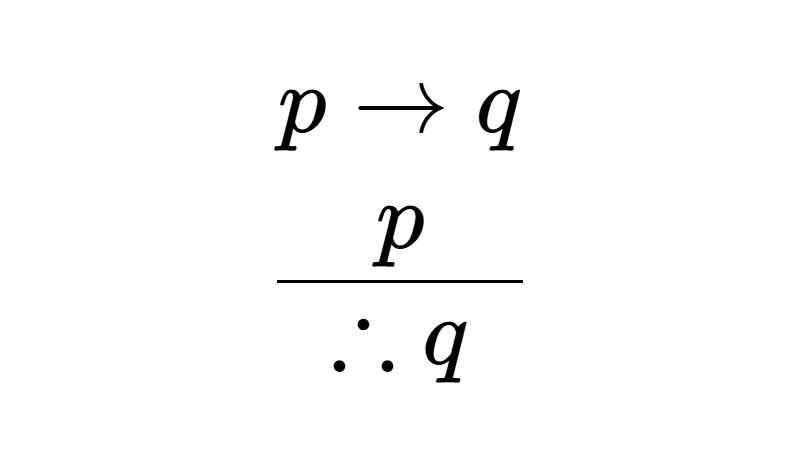
In natural deduction systems, the argument is structured vertically through the sequential arrangement of its premises and a conclusion preceded by the deduction symbol:
$$ \begin{array}{cl} p \to q \\ q \to r \\ \hline \therefore p \to r \end{array} $$
The logical validity of this rule relies on the transitive property of implication. If the occurrence of the initial hypothesis p necessarily guarantees the truth of the intermediate state q, and in turn the presence of q ensures the fulfillment of the outcome r, the satisfaction of p triggers an inevitable sequence validating the truth of r.
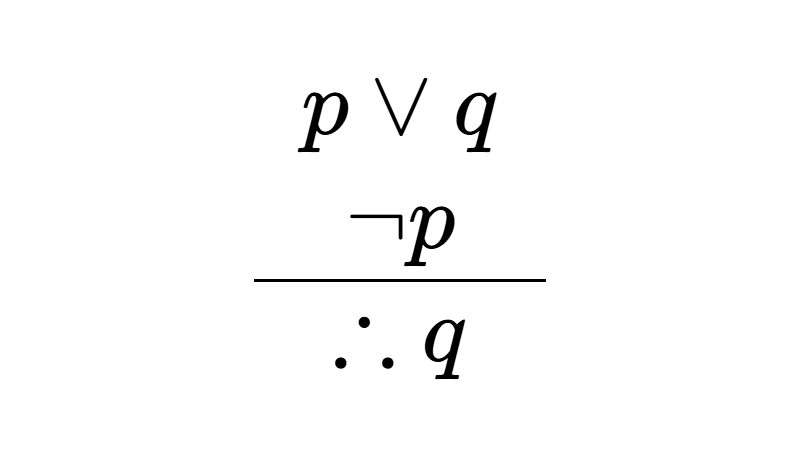
This principle should not be confused with the disjunctive syllogism, as the latter operates from a disjunction and the negation of one of its disjuncts to affirm the remaining one via the structure [(p ∨ q) ∧ ¬p] → q, whereas the hypothetical syllogism works exclusively through chaining conditional statements.
Table of Contents
Examples
To understand how the hypothetical syllogism operates across various mathematical and everyday contexts, we analyze a series of practical examples below.
Example 1
Premise 1: If it rains heavily, then the patio floor gets wet (p → q).
Premise 2: If the patio floor gets wet, then the surface becomes slippery (q → r).
Conclusion: Therefore, if it rains heavily, then the surface becomes slippery (p → r).
In this first case, we observe a direct chain of two cause-and-effect relationships. The intermediate statement "the patio floor gets wet" acts as a logical bridge transferring truth from the initial condition to the final outcome.
Example 2
Premise 1: If an integer is a multiple of 12, then it is divisible by 6 (p → q).
Premise 2: If an integer is divisible by 6, then it is an even number (q → r).
Conclusion: Therefore, if an integer is a multiple of 12, then it is an even number (p → r).
Here we apply the rule to basic arithmetic properties. Since belonging to the set of multiples of 12 guarantees divisibility by 6, and that in turn ensures parity, we directly derive the implication between the extreme terms.
Example 3
Premise 1: If a plane figure is a square, then it is a rhombus (p → q).
Premise 2: If a plane figure is a rhombus, then its diagonals are perpendicular (q → r).
Conclusion: Therefore, if a plane figure is a square, then its diagonals are perpendicular (p → r).
In geometric definitions, subset inclusion allows us to connect structural properties. The conclusion validly inherits the perpendicularity of the diagonals without needing to evaluate intermediate figures.
Example 4
Premise 1: If a real number x is strictly greater than 5, then x is greater than 0 (p → q).
Premise 2: If a real number x is greater than 0, then its square x2 is a positive number (q → r).
Conclusion: Therefore, if a real number x is strictly greater than 5, then its square x2 is a positive number (p → r).
In this real line ordering example, the condition x > 5 immediately ensures that x belongs to the positive real numbers. Chaining this fact with the quadratic property yields a direct, valid deduction for any value greater than 5.
Example 5
Premise 1: If an integer is a multiple of 20, then it is a multiple of 10 (p → q).
Premise 2: If an integer is a multiple of 10, then its last digit is zero (q → r).
Premise 3: If the last digit of an integer is zero, then it is divisible by 5 (r → s).
Conclusion: Therefore, if an integer is a multiple of 20, then it is divisible by 5 (p → s).
This final example illustrates the scalability of the hypothetical syllogism. Applying the rule successively to the first two premises yields p → r, and pairing this intermediate result with the third premise derives the final relationship p → s.
Truth Table Proof
To verify the universal validity of the hypothetical syllogism, we analyze the semantic behavior of its associated conditional: [(p → q) ∧ (q → r)] → (p → r). In propositional logic, an inference rule is formally valid if and only if its corresponding conditional formula is a tautology.
Having three simple propositional variables (p, q, and r), we evaluate all 23 = 8 possible combinations of truth values. We construct the truth table by analyzing each logical connective sequentially:
| p | q | r | p → q | q → r | (p → q) ∧ (q → r) | p → r | [(p → q) ∧ (q → r)] → (p → r) |
|---|---|---|---|---|---|---|---|
| T | T | T | T | T | T | T | T |
| T | T | F | T | F | F | F | T |
| T | F | T | F | T | F | T | T |
| T | F | F | F | T | F | F | T |
| F | T | T | T | T | T | T | T |
| F | T | F | T | F | F | T | T |
| F | F | T | T | T | T | T | T |
| F | F | F | T | T | T | T | T |
Examining the final column reveals that the truth value is true (T) across every row without exception. This formally proves that the compound statement is a tautology.
There is no truth-value assignment where the joint premises evaluate to true while the conclusion evaluates to false. Consequently, it is rigorously established that the hypothetical syllogism is a formally valid rule of inference.
Did you find this useful? Rate it!
0.0 / 5 — 0 votes

HOW TO CITE THIS ARTICLE
Machado, D. (2026, September 30). Hypothetical Syllogism. Flamath. https://en.flamath.com/hypothetical-syllogism
Leave a Reply
Related Articles