
Modus Ponens
Modus ponens (also widely known in formal logic and geometry as the law of detachment) is a fundamental rule of inference in propositional logic and mathematical deduction. This rule establishes that if a conditional statement is accepted as true and its antecedent is simultaneously affirmed to be true, the truth of its consequent necessarily follows. Its full formal name is modus ponendo ponens, a Latin phrase that translates to "the mode that by affirming, affirms."
In the language of propositional logic, its horizontal structure or associated conditional statement is formulated as:
[(p → q) ∧ p] → q.
In formal deductive systems, the argument is represented vertically using ordered premises and a conclusion preceded by the derivation symbol:
$$ \begin{array}{cl} p \to q \\ p \\ \hline \therefore q \end{array} $$
The validity of this syllogism guarantees that truth is preserved throughout the inference. Whenever the conditional relationship is true and the antecedent actually occurs, it is impossible for the consequent to be false.
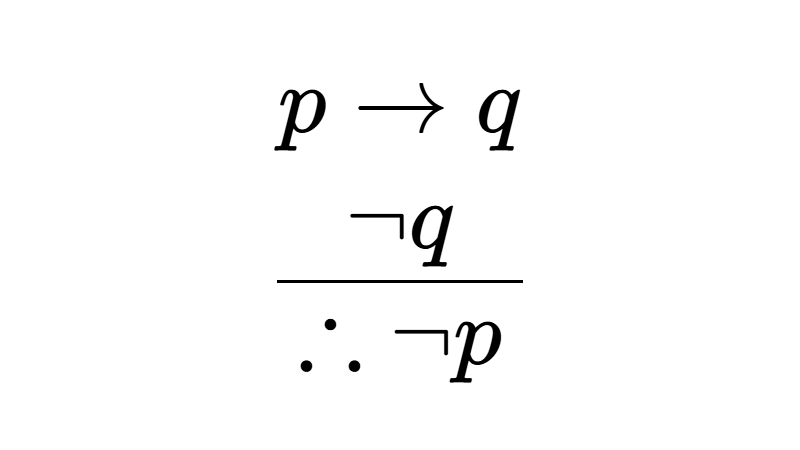
It is important not to confuse this rule with another fundamental valid inference known as modus tollendo tollens (or simply modus tollens), whose conditional structure is [(p → q) ∧ ¬q] → ¬p. Unlike modus ponens, this method states that denying the consequent of a true conditional statement necessarily implies the negation of its antecedent.
Table of Contents
Examples
To understand how this rule of inference operates across different contexts, we examine below a series of practical cases ranging from everyday scenarios to formal mathematical deductions and structural variants.
Example 1
Premise 1: If it rains heavily in the city, the street pavement gets wet (p → q).
Premise 2: It is raining heavily in the city (p).
Conclusion: Therefore, the street pavement gets wet (q).
In this everyday scenario, we identify the antecedent p as the occurrence of heavy rain. Upon empirically verifying that it is indeed raining, the consequent q is deduced directly and necessarily.
Example 2
Premise 1: If the last digit of an integer is zero, then the number is divisible by ten (p → q).
Premise 2: The last digit of the number 750 is zero (p).
Conclusion: Therefore, the number 750 is divisible by ten (q).
Here we see a classic application in elementary arithmetic. By verifying that the numerical value 750 satisfies the condition set forth in the antecedent, the divisibility property in the consequent is automatically established.
Example 3
Premise 1: If a triangle is equilateral, then the measure of each of its three interior angles is sixty degrees (p → q).
Premise 2: The given triangle is equilateral (p).
Conclusion: Therefore, the measure of each of its three interior angles is sixty degrees (q).
In Euclidean geometry, the hypothesis of side congruence immediately triggers the required conclusion regarding its interior angles.
Example 4
Premise 1: If a real number is not positive, then it is less than or equal to zero (¬p → q).
Premise 2: The given real number is not positive (¬p).
Conclusion: Therefore, the given real number is less than or equal to zero (q).
In this variant, the antecedent is a formally negated proposition, ¬p. Modus ponendo ponens applies completely standardly because the second premise directly affirms the content of that original antecedent.
Example 5
Premise 1: If an integer is a prime number greater than two, then it is not divisible by two (p → ¬q).
Premise 2: The number 17 is a prime number greater than two (p).
Conclusion: Therefore, the number 17 is not divisible by two (¬q).
In this case, the consequent of the conditional is a negative proposition. By affirming the antecedent, the deduction directly inherits the negation present in the consequent.
Example 6
Premise 1: If a quadratic equation has no real solutions, then its discriminant is not greater than or equal to zero (¬p → ¬q).
Premise 2: The given quadratic equation has no real solutions (¬p).
Conclusion: Therefore, its discriminant is not greater than or equal to zero (¬q).
This case illustrates the presence of negations in both the antecedent and the consequent. We see that modus ponens functions strictly at a structural level, guaranteeing the conclusion regardless of the negative signs within the constituent propositions.
Formal Proof
To demonstrate the logical validity of modus ponens, we examine the semantic behavior of its associated conditional: [(p → q) ∧ p] → q. A deductive argument form is valid if and only if its corresponding conditional statement is a tautology.
Recall that a tautology is a compound statement that evaluates to true under all possible combinations of truth values for its propositional variables. By constructing a truth table to evaluate each component, we exhaustively verify that there is no scenario in which all premises are true while the conclusion is false.
| p | q | p → q | (p → q) ∧ p | [(p → q) ∧ p] → q |
|---|---|---|---|---|
| T | T | T | T | T |
| T | F | F | F | T |
| F | T | T | F | T |
| F | F | T | F | T |
Because the final column contains exclusively true values across every row assignment, it is formally proved that modus ponens is a valid argument form.
Affirming the Consequent Fallacy
The fallacy of affirming the consequent (often called the converse error) is one of the most common formal fallacies encountered when reasoning with conditional statements. It occurs when one confuses the logical direction of an implication, attempting to deduce the antecedent simply from the presence of the consequent.
Unlike modus ponens, whose valid structure is [(p → q) ∧ p] → q, this fallacious pattern takes the form [(p → q) ∧ q] → p. The underlying error lies in mistakenly assuming that a necessary condition is equivalent to a sufficient condition.
Example 1
Premise 1: If it rains heavily in the city, the street pavement gets wet (p → q).
Premise 2: The street pavement is wet (q).
Erroneous conclusion: Therefore, it rained heavily in the city (p).
In this everyday reasoning, the structural flaw is apparent. The pavement could be wet for various reasons unrelated to rain, such as a garden hose or municipal street cleaning; thus, the conclusion does not necessarily follow.
Example 2
Premise 1: If an integer ends in zero, then it is divisible by five (p → q).
Premise 2: The number 35 is divisible by five (q).
Erroneous conclusion: Therefore, the number 35 ends in zero (p).
This arithmetic counterexample highlights the invalidity of the argument form. Even though both premises are independently true, the reached conclusion is categorically false.
Truth Table Proof of Invalidity
To formally verify that this argument lacks deductive validity, we construct the truth table for its associated conditional formula: [(p → q) ∧ q] → p.
| p | q | p → q | (p → q) ∧ q | [(p → q) ∧ q] → p |
|---|---|---|---|---|
| T | T | T | T | T |
| T | F | F | F | T |
| F | T | T | T | F |
| F | F | T | F | T |
Observing the final column, we identify a false value in the third row, corresponding to the case where the antecedent is false and the consequent is true. This proves that the statement form is not a tautology, but a contingency.
The presence of at least one false assignment confirms conclusively that affirming the consequent is an invalid rule of inference in deductive logic.
Did you find this useful? Rate it!
0.0 / 5 — 0 votes

HOW TO CITE THIS ARTICLE
Machado, D. (2026, September 30). Modus Ponens. Flamath. https://en.flamath.com/modus-ponens
Leave a Reply
Related Articles