
Simple and Compound Statements
Recall that logical statements (or propositions) are declarative sentences that have the property of being either true or false, but never both simultaneously. In propositional logic, we classify these statements based on their internal structure into two broad categories: simple statements (or atomic propositions) and compound statements (or molecular propositions).
A simple statement represents a single, indivisible assertion, whereas a compound statement combines two or more simple statements using connecting words known as logical connectives. Understanding the difference between the two is essential for constructing truth tables and analyzing complex logical arguments.
Table of Contents
Simple Statements
Also called atomic statements, these are statements that cannot be broken down into smaller statements. They lack logical connectives (such as "not," "and," "or," "if... then," "if and only if") and express a single, straightforward idea. Grammatically, a simple statement usually corresponds to a basic sentence with a subject and a predicate.
The truth value of such a statement depends directly on its correspondence with reality or a specific axiomatic system. To represent simple statements symbolically, we use lowercase letters, typically starting with p, followed by q, r, s, and so on.
Some examples of simple statements include:
- p: "The number 7 is a prime number." (True statement).
- q: "Earth is a star." (False statement).
- r: "Paris is the capital of France." (True statement).
- s: "3 + 5 = 10." (False statement).
- t: "The square root of 16 is 4." (True statement).
Compound Statements
Compound statements, or molecular statements, are formed by combining simple statements using logical connectives, or by negating a simple statement. Unlike simple statements, their truth value does not depend solely on real-world facts, but rather on the truth values of their component statements and the specific connective used.
If a statement contains words such as "and," "or," "not," "if... then," or "if and only if," it is a compound statement. Here are several examples based on the connective applied:
- "It is not true that a triangle has four sides." (Here, the statement becomes compound through negation, highlighted in bold).
- "The number 2 is even and the number 3 is odd." (In this case, two ideas are joined using conjunction).
- "I will study algebra or I will study geometry." (This presents an alternative between two options using disjunction).
- "If it rains, then the ground gets wet." (This sentence establishes a conditional relationship using implication).
- "A triangle is equilateral if and only if its sides are equal." (Here, the logical relationship works in both directions thanks to the biconditional).
To determine the truth value of a compound statement, we use a truth table. This table lists all possible combinations of truth values (true or false) for the component simple statements and shows the resulting truth value of the compound statement in each case, following the rules of the logical connectives.
Main Logical Connectives
Connectives are the operators that allow us to construct compound statements from simple ones. Each connective has a specific symbol and a logical rule that determines the truth value of the resulting statement. The most important connectives are summarized in the table below.
| Connective | Symbol | Everyday Language | Example | Truth Value Rule |
|---|---|---|---|---|
| Negation | ¬ | "not" "it is not true that" | "It is not true that all prime numbers are odd." | Reverses the truth value of the original statement. |
| Conjunction | ∧ | "and" | "The Sun is a star and the Moon is a satellite." | True only when both components are true. |
| Inclusive Disjunction | ∨ | "or" | "We can solve the equation by factoring or by using the quadratic formula." | True when at least one of the components is true. |
| Conditional | → | "if… then…" | "If a number ends in an even digit, then it is divisible by two." | True in all cases except when the first component is true and the second is false. |
| Biconditional | ↔ | "if and only if" | "A year is a leap year if and only if it has 366 days." | True when both components are true or both are false. |
Translating Statements into Symbolic Form
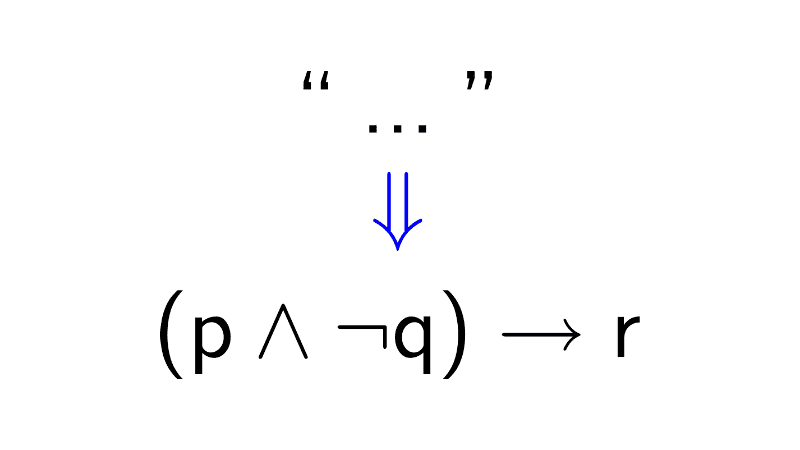
The process of converting natural language into formal logic is called translation. It involves identifying the simple statements, assigning each a variable (p, q, r), and representing the relationships using the appropriate logical symbols.
Example 1
Statement: "Mars is a planet and the Sun is a star."
- Identify the first simple component (p): "Mars is a planet."
- Identify the second simple component (q): "The Sun is a star."
- Identify the connective: "and" (∧).
- Symbolic form: p ∧ q
Example 2
Statement: "If I do not pass the exam, then I will repeat the course."
Breaking down the parts:
- Simple statement (p): "I pass the exam." Notice the statement says "do not pass," so we use the negation ¬p.
- Simple statement (q): "I will repeat the course."
- Main connective: "If... then" (→).
- Symbolic form: ¬p → q
Practice Problems
Determine whether each of the following statements is simple or compound, and translate it into symbolic form.
- "The number 15 is an odd number."
- "The number 4 is even, but it is not a prime number."
- "It is false that the number -5 is a natural number."
- "The fraction is proper, or its numerator is greater than its denominator."
- "If I study hard and get adequate rest, then I will pass."
- "A number is even if and only if it is divisible by 2."
Solution 1
Consider the statement "the number 15 is an odd number." This is a simple statement because it expresses a single assertion about a numerical property that can be directly verified (it is true). It contains no connectives, so we simply assign it a single variable.
Symbolic form: p
Solution 2
Consider the statement "the number 4 is even, but it is not a prime number." This is a compound statement containing two logical operations. In logic, the word "but" functions as a conjunction (∧), indicating that both assertions hold simultaneously. Additionally, the second part includes a negation (¬).
Let p: "The number 4 is even" and q: "The number 4 is prime." We symbolize this conjunction between p and the negation of q.
Symbolic form: p ∧ ¬q
Solution 3
The statement "it is false that the number -5 is a natural number" is a compound statement. The primary operator is negation (¬), expressed by the phrase "it is false that," which reverses the truth value of the underlying statement. If we define p as "the number -5 is a natural number," we write the expression by placing the negation symbol before the variable.
Symbolic form: ¬p
Solution 4
Analyzing "the fraction is proper, or its numerator is greater than its denominator," we find a compound statement joined by a disjunction (∨), indicated by the word "or." Let p: "The fraction is proper" and q: "The numerator is greater than the denominator." Since both simple statements are linked directly by the disjunction operator, we write p or q.
Symbolic form: p ∨ q
Solution 5
The statement "if I study hard and get adequate rest, then I will pass" is a compound statement whose main connective is the conditional (→). The hypothesis (antecedent) is itself a conjunction (∧). Let p: "I study hard," q: "I get adequate rest," and r: "I will pass." We group the conjunction in parentheses to show that both conditions are required to imply the conclusion r.
Symbolic form: (p ∧ q) → r
Solution 6
Finally, "a number is even if and only if it is divisible by 2" is a compound statement that uses the biconditional connective (↔), signaled by the key phrase "if and only if." This operator indicates a two-way logical equivalence between both statements. Letting p: "A number is even" and q: "It is divisible by 2," the symbolic representation links p and q with the biconditional symbol.
Symbolic form: p ↔ q
Did you find this useful? Rate it!
0.0 / 5 — 0 votes

HOW TO CITE THIS ARTICLE
Machado, D. (2026, October 1). Simple and Compound Statements. Flamath. https://en.flamath.com/simple-and-compound-statements
Propositional Logic Practice Problems
Propositional Variables
Translating Statements into Symbolic Form
Distributive Laws in Logic
Law of Identity
Leave a Reply
Related Articles