
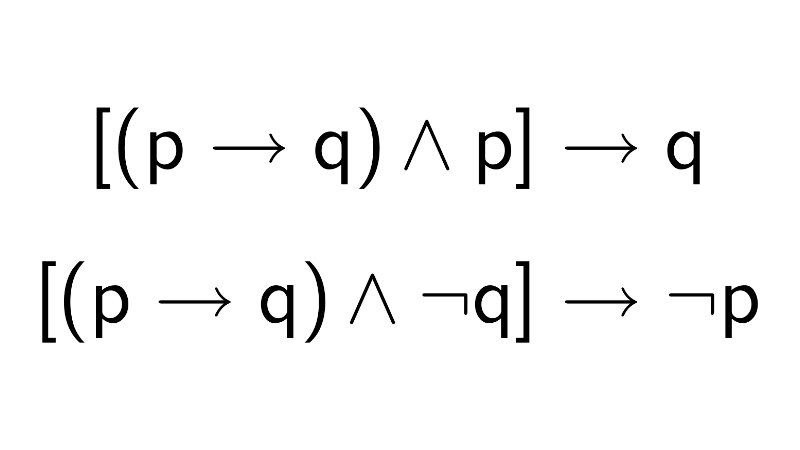
Law of Identity
The law of identity is a fundamental axiom of classical logic stating that every proposition is identical to itself. It is formally expressed as a logical implication or as an equivalence:
p → p
p ≡ p
The formula is read: "if p, then p," or "p is equivalent to p." This means that the truth value of proposition p is exactly the same as that of p, leaving no possibility for change or ambiguity within the same context.
Proof
The formula p → p is a tautology. Its truth is independent of the specific content of proposition p, as confirmed by its truth table:
| p | p → p |
|---|---|
| T | T |
| F | T |
As shown, the column p → p is always true (T).
The law of identity is one of the three pillars of classical propositional logic, alongside:
- The law of non-contradiction: ¬(p ∧ ¬p)
- The law of excluded middle: p ∨ ¬p
Although seemingly simple and even trivial, this principle provides the foundation that ensures stability and consistency in reasoning. It establishes a fixed point of reference: any well-formed proposition maintains its truth value within a given context, enabling the construction of coherent arguments.
Examples
This principle appears in everyday and formal reasoning:
- In factual statements: "If today is Monday, then today is Monday." The truth of the antecedent necessarily entails the truth of the identical consequent.
- In mathematical properties: "If the number 4 is even, then the number 4 is even." The property of being even applies identically to the subject of the statement.
- In physical states: "If the door is closed, then the door is closed." The described state is self-referential.
- In value judgments: "If this painting is beautiful, then this painting is beautiful."
- In logical relations: "If A equals B, then A equals B."
Did you find this useful? Rate it!
0.0 / 5 — 0 votes

HOW TO CITE THIS ARTICLE
Machado, D. (2026, September 30). Law of Identity. Flamath. https://en.flamath.com/law-of-identity
Propositional Logic Practice Problems
Propositional Variables
Translating Statements into Symbolic Form
Simple and Compound Statements
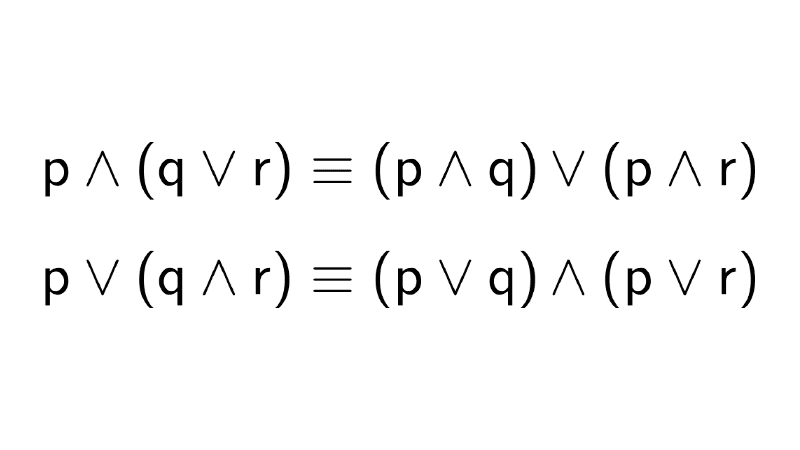
Distributive Laws in Logic
Leave a Reply
Related Articles