
Distributive Laws in Logic
The distributive laws in propositional logic are rules that allow rewriting a compound proposition by distributing one of its main connectives. These laws establish that conjunction (∧) distributes over disjunction (∨) and, conversely, disjunction also distributes over conjunction.
This is expressed by the following formulas, where the symbol ≡ denotes logical equivalence:
p ∧ (q ∨ r) ≡ (p ∧ q) ∨ (p ∧ r)
p ∨ (q ∧ r) ≡ (p ∨ q) ∧ (p ∨ r)
There is an analogy with the distributive property in algebra, where multiplication distributes over addition, as in a ⋅ (b + c) = a ⋅ b + a ⋅ c. However, in algebra addition does not distribute over multiplication, whereas in logic disjunction and conjunction distribute over each other mutually.
Table of Contents
Proofs
The logical equivalence of the distributive laws can be verified using truth tables.
For the distributivity of conjunction over disjunction, p ∧ (q ∨ r) ≡ (p ∧ q) ∨ (p ∧ r), we construct the truth table:
| p | q | r | p ∧ q | p ∧ r | q ∨ r | p ∧ (q ∨ r) | (p ∧ q) ∨ (p ∧ r) |
|---|---|---|---|---|---|---|---|
| T | T | T | T | T | T | T | T |
| T | T | F | T | F | T | T | T |
| T | F | T | F | T | T | T | T |
| T | F | F | F | F | F | F | F |
| F | T | T | F | F | T | F | F |
| F | T | F | F | F | T | F | F |
| F | F | T | F | F | T | F | F |
| F | F | F | F | F | F | F | F |
The columns for p ∧ (q ∨ r) and (p ∧ q) ∨ (p ∧ r) are identical, which proves the equivalence.
For the distributivity of disjunction over conjunction, p ∨ (q ∧ r) ≡ (p ∨ q) ∧ (p ∨ r), the truth table is:
| p | q | r | p ∨ q | p ∨ r | q ∧ r | p ∨ (q ∧ r) | (p ∨ q) ∧ (p ∨ r) |
|---|---|---|---|---|---|---|---|
| T | T | T | T | T | T | T | T |
| T | T | F | T | T | F | T | T |
| T | F | T | T | T | F | T | T |
| T | F | F | T | T | F | T | T |
| F | T | T | T | T | T | T | T |
| F | T | F | T | F | F | F | F |
| F | F | T | F | T | F | F | F |
| F | F | F | F | F | F | F | F |
Again, the final columns match across all rows.
Applications
The distributive laws are practically useful for manipulating and simplifying logical formulas. They are primarily applied in two directions: to expand an expression or, conversely, to simplify it by factoring out a logical "common factor."
Example 1
We start with the expression ¬p ∧ (q ∨ ¬r).
We observe that the main connective outside the parentheses is conjunction (∧). To expand the expression, we distribute ¬p using conjunction. The inner connective (∨) becomes the main operator of the result. Thus, applying the law yields:
¬p ∧ (q ∨ ¬r) ≡ (¬p ∧ q) ∨ (¬p ∧ ¬r)
Example 2
We start with the expression (p ∨ q) ∧ (p ∨ ¬r).
Here we identify that the variable p and the disjunction connective repeat on both sides of the main conjunction. We can factor out this common element p. Applying the distributive law in reverse gives:
(p ∨ q) ∧ (p ∨ ¬r) ≡ p ∨ (q ∧ ¬r)
It is important not to confuse this property with associativity. If the connectives joining the components are the same, as in p ∨ (q ∨ r), we cannot apply distribution; instead, we use the associative property to write (p ∨ q) ∨ r.
Distributivity in Set Theory
The distributive laws of propositional logic extend naturally to set theory, since the conjunction (∧) and disjunction (∨) operators directly correspond to intersection (∩) and union (∪) operations, respectively.
Given three sets A, B, and C, the following hold:
- Intersection distributes over union: A ∩ (B ∪ C) = (A ∩ B) ∪ (A ∩ C).
- Union distributes over intersection: A ∪ (B ∩ C) = (A ∪ B) ∩ (A ∪ C).
Did you find this useful? Rate it!
0.0 / 5 — 0 votes

HOW TO CITE THIS ARTICLE
Machado, D. (2026, September 30). Distributive Laws in Logic. Flamath. https://en.flamath.com/distributive-laws-in-logic
Propositional Logic Practice Problems
Propositional Variables
Translating Statements into Symbolic Form
Simple and Compound Statements
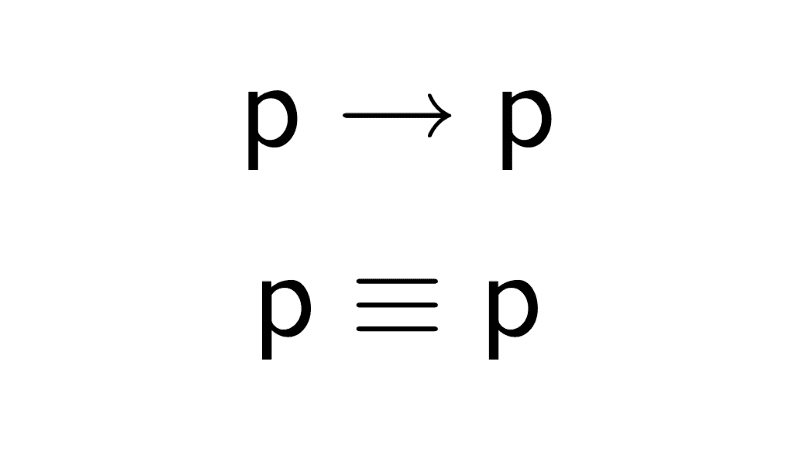
Law of Identity
Leave a Reply
Related Articles