
Disjoint Sets
Two sets are disjoint (also called mutually exclusive or non-overlapping) if they share no elements in common. Formally, two sets A and B are disjoint if and only if their intersection is equal to the empty set; that is:
A ∩ B = Ø
In advanced mathematical literature, two collections can also be denoted as disjoint using the perpendicularity or disjunction symbol, written as A ⟂ B. However, the standard and most widespread notation remains the absence of elements in their intersection.
Conversely, when two sets share at least one element, they are called non-disjoint, intersecting, or overlapping sets. In such cases, it is formally established that A ∩ B ≠ Ø, indicating the existence of a non-empty shared region between them.
Graphically, the disjoint relation is visualized using a Venn diagram. Inside the rectangular region that bounds the universal set U, sets A and B are represented as two completely separate circular or oval regions, without any overlap or shared area.
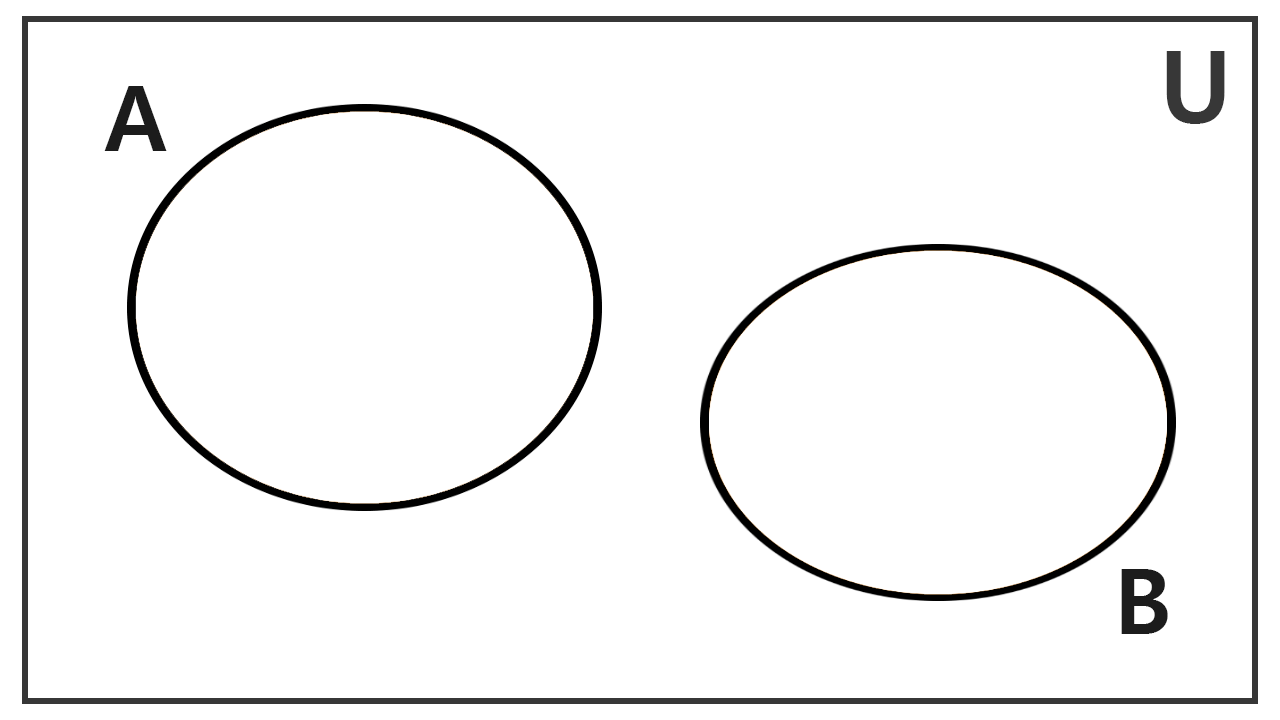
Table of Contents
Examples
Below, we analyze different situations in both finite sets and infinite numerical structures:
- Examining the letters of the English alphabet, we can define the set of vowels V = {a, e, i, o, u} and the set of consonants C = {b, c, d,..., z}. Since no letter can belong to both categories simultaneously, it holds that V ∩ C = Ø, making them disjoint subsets within the alphabet.
- When classifying single-digit numbers in the decimal system, we find the even numbers E = {0, 2, 4, 6, 8} and the odd numbers O = {1, 3, 5, 7, 9}. The intersection between both groups contains no elements, so E ∩ O = Ø.
- In plane geometry, consider the set of triangles T = {x | x is a 3-sided polygon} and the set of quadrilaterals Q = {x | x is a 4-sided polygon}. Because a polygon cannot have both three and four sides at the same time, both sets are disjoint from each other.
- Within the domain of integers, we define strictly positive integers Z+ = {x ∈ Z | x > 0} and strictly negative integers Z- = {x ∈ Z | x < 0}. No number carries both signs at the same time, ensuring that Z+ ∩ Z- = Ø, with zero excluded from both sets as well.
- Studying the real line, we examine the set of rational numbers Q and the set of irrational numbers I. Since a real number can either be expressed as a ratio of integers or possesses non-repeating infinite decimals, it can never satisfy both conditions, verifying that Q ∩ I = Ø.
Pairwise Disjoint Sets
When working with more than two sets, the concept of disjointness can be extended to the entire collection. A family of sets is called pairwise disjoint, or mutually disjoint, if taking any two distinct sets from the collection results in them having no elements in common.
In formal terms, given a finite or infinite collection of sets {A1, A2,..., An}, they are pairwise disjoint if they satisfy the condition:
Ai ∩ Aj = Ø for all i ≠ j
For example, consider the following three sets: A = {1, 2}, B = {3, 4}, and C = {5, 6}. Examining every possible pair, we verify that A ∩ B = Ø, A ∩ C = Ø, and B ∩ C = Ø. Since no pair shares any elements, the entire collection is pairwise disjoint.
It is essential not to confuse this condition with having an empty overall intersection. The fact that the intersection of all sets taken together is empty does not guarantee that they are pairwise disjoint.
To illustrate this distinction, consider the following three sets: A = {1, 2}, B = {2, 3}, and C = {3, 4}. If we calculate the simultaneous intersection of all three, we observe that no single element belongs to all three sets at once, yielding A ∩ B ∩ C = Ø.
However, these sets are not pairwise disjoint, because comparing them in pairs reveals that A ∩ B = {2} ≠ Ø and B ∩ C = {3} ≠ Ø. For them to be pairwise disjoint, no pair could share any elements.
Properties
Disjoint sets exhibit algebraic regularities that simplify operations and logical proofs. Below are the most important relationships:
1) Disjointness with the empty set: any set A is disjoint with respect to the empty set, since the latter contains no elements at all.
A ∩ Ø = Ø
2) Difference of disjoint sets: subtracting two sets that have no elements in common leaves the minuend set completely unchanged, as no elements are removed.
A - B = A
Similarly and symmetrically, the reverse condition also holds:
B - A = B
3) Subset of the complement: two sets are disjoint if and only if one of them is entirely contained within the complement of the other.
A ∩ B = Ø ↔ A ⊆ B′
This equivalence can also be stated symmetrically, establishing that B ⊆ A′.
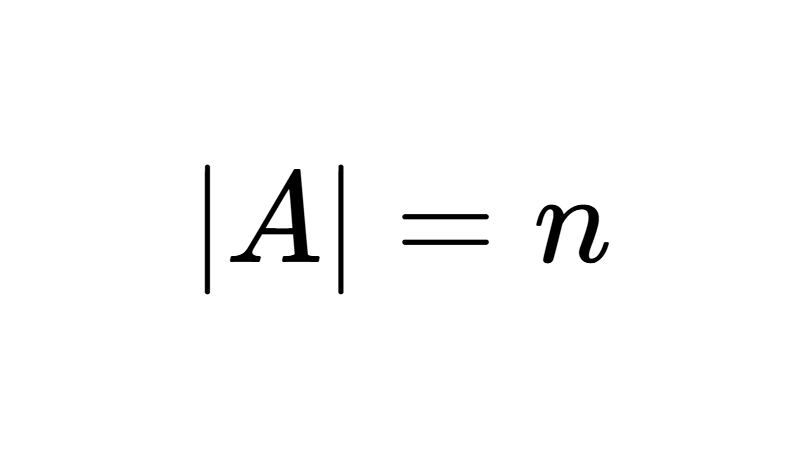
4) Cardinality of the union (addition principle): for finite sets that do not share elements, the total number of elements in the union equals the simple sum of the individual cardinalities.
|A ∪ B| = |A| + |B|
Because the cardinality of the intersection is zero (|A ∩ B| = 0), there is no need to subtract overlapping elements in the count.
5) Symmetric difference identical to the union: the symmetric difference collects elements that belong to one set or the other, but not both. For disjoint sets, it coincides entirely with the union.
A Δ B = A ∪ B
6) Intersection with subsets: if two sets are disjoint, any subset taken from one of them will also remain disjoint from the other original set.
(A ∩ B = Ø ∧ C ⊆ A) → C ∩ B = Ø
Solved Practice Problems
To determine whether two or more sets are disjoint, the fundamental procedure consists of finding their intersection. If there are no common elements between them, we formally confirm that they are disjoint. Below, we solve four practical scenarios applying these criteria and their algebraic properties.
Problem 1
Consider the sets given in roster form A = {2, 4, 6, 8} and B = {1, 3, 5, 7, 9}. Determine whether A and B are disjoint sets, justifying the answer using their intersection.
Solution
To check whether the sets are disjoint, we look for any element that belongs simultaneously to both sets.
Comparing the elements of A with those of B, we see that none match, since all values in A are even and all values in B are odd. We calculate their intersection:
A ∩ B = Ø
Since the intersection between both sets results in the empty set, we conclude that A and B are indeed disjoint sets.
Problem 2
Let sets be defined in set-builder notation as A = {x ∈ N | x is a multiple of 5 ∧ x ≤ 20} and B = {x ∈ N | x is a factor of 18}. Express each set in roster form and determine whether they are disjoint.
Solution
We begin by listing the elements of each set in roster form based on the given conditions.
For set A, we identify the natural multiples of 5 less than or equal to 20:
A = {5, 10, 15, 20}
For set B, we find all positive integer factors of 18:
B = {1, 2, 3, 6, 9, 18}
We proceed to calculate the intersection between both sets to check if they share any elements:
A ∩ B = Ø
Sharing no common factor or multiple within this range, we confirm that A and B are disjoint sets.
Problem 3
Given the collection of sets A = {1, 2, 3}, B = {4, 5}, and C = {3, 6, 7}, determine whether they form a pairwise disjoint family of sets by testing every possible pair.
Solution
For a collection to be pairwise disjoint, every distinct pair of sets must have an intersection equal to the empty set.
First, we analyze the pair formed by A and B:
A ∩ B = Ø
Next, we evaluate the intersection between B and C:
B ∩ C = Ø
Finally, we calculate the intersection between set A and set C:
A ∩ C = {3} ≠ Ø
Although the pairs (A, B) and (B, C) are disjoint, the pair (A, C) shares the element 3. Therefore, we conclude that the collection is not pairwise disjoint.
Problem 4
In a universal set U with |U| = 30 elements, there are two disjoint sets A and B with cardinalities |A| = 11 and |B| = 13. Calculate the cardinality of the union |A ∪ B| and the cardinality of its complement |(A ∪ B)′|.
Solution
Since sets A and B are disjoint, we know that A ∩ B = Ø, which directly implies that |A ∩ B| = 0.
We apply the addition principle for disjoint sets by adding their cardinalities directly:
|A ∪ B| = |A| + |B| = 11 + 13 = 24
Next, to determine the cardinality of the complement (A ∪ B)′, we subtract the cardinality of the union from the cardinality of the universal set:
|(A ∪ B)′| = |U| - |A ∪ B| = 30 - 24 = 6
Thus, the union contains a total of 24 elements, and outside of it, exactly 6 elements remain within the universal set.
Did you find this useful? Rate it!
0.0 / 5 — 0 votes

HOW TO CITE THIS ARTICLE
Machado, D. (2026, October 1). Disjoint Sets. Flamath. https://en.flamath.com/disjoint-sets
Leave a Reply
Related Articles