
Exponential Equations
Exponential equations are equations in which the variable appears only in the exponent of one or more powers with constant bases.
For example:
- \(2^x=32\)
- \(3^{2x+1}=27\)
- \(3^{x+2}+9^{x+1}=810\)
- \(9^{x+2}=50\)
Equations such as \(x^2=4,~ x^3+3=5~\) or \(~\sqrt{x}=4\) are not exponential equations, since the variable is in the base rather than in an exponent.
Table of Contents
Methods for Solving Exponential Equations
To solve exponential equations, we rely on the properties of exponents, radicals, and logarithms. Below, we explain three methods for solving them with step-by-step examples.
Properties of Exponents:
- Product of powers with the same base: \(a^m\cdot a^n=a^{m+n}\)
- Quotient of powers with the same base: \(\dfrac{a^m}{a^n}=a^{m-n}\)
- Power of a power: \((a^m)^n=a^{m\cdot n}\)
- Negative exponent: \(a^{-m}=\dfrac{1}{a^m}\)
- Negative exponent in the denominator: \(\dfrac{1}{a^{-m}}=a^m\)
- Power of a quotient: \(\left(\dfrac{a}{b}\right)^{n}=\dfrac{a^n}{b^n}\)
- Reciprocal of a fraction: \(\left(\dfrac{a}{b}\right)^{-1}=\dfrac{b}{a}\)
- Radicals: \(\sqrt[n]{a}=a^{1/n}\)
- Rational exponents: \(\sqrt[n]{a^m}=a^{m/n}\)
Equating Exponents (Same-Base Method)
This method is based on the One-to-One Property of Exponents: if two powers with the same positive base \(b \neq 1\) are equal (\(b^x = b^y\)), then their exponents must be equal (\(x = y\)). Follow these steps to solve an exponential equation:
- Isolate the exponential term containing the variable on one side of the equation.
- Rewrite the other side as a power with the same base.
- Set the exponents equal to each other and solve for the variable.
Example 1
Solve the equation \(2^x=32\)
Solution: the exponential term has a base of 2, so we want to rewrite the other side as a power of 2. The number 32 can be factored as \(2^5.\) Substituting this into the equation:
$$2^x=2^5$$
Since the bases are equal, the exponents must also be equal, so:
$$x=5$$
Check: if \(x=5,\) then
$$2^5=32$$
$$32=32$$
Example 2
Solve the exponential equation \(3^x-3=240\)
Solution: first, isolate the exponential term on one side of the equation.
$$3^x-3=240$$
$$3^x=240+3$$
$$3^x=243$$
The value 243 can be factored as \(3^5.\) Substituting this into the equation:
$$3^x=3^5$$
By equating exponents of the same base, we get:
$$x=5$$
Example 3
Solve \(3^{2x+1}=27\)
Solution: the right-hand side can be written as a power of 3, since \(3^3=27.\) Substituting into the equation:
$$3^{2x+1}=27$$
$$3^{2x+1}=3^3$$
Now, set the exponents equal to each other:
$$2x+1=3$$
$$2x=3-1$$
$$2x=2$$
$$x=1$$
Example 4
Solve \(-40+7^{3x-1}=9\)
Solution: start by isolating the exponential term on one side of the equation:
$$-40+7^{3x-1}=9$$
$$7^{3x-1}=9+40$$
$$7^{3x-1}=49$$
Now, since \(49=7^2,\) substitute this expression into the equation:
$$7^{3x-1}=7^2$$
Equating the exponents of the same base:
$$3x-1=2$$
$$3x=2+1$$
$$3x=3$$
$$x=1$$
Example 5
Solve the equation \(4^x=2^{x+2}\)
Solution: both sides of the equation contain variables in the exponent. Since 4 can be rewritten as \(2^2,\) we can express both sides with the same base.
$$4^x=2^{x+2}$$
$$(2^2)^x=2^{x+2}$$
Using the power of a power property, multiply the exponents:
$$2^{2x}=2^{x+2}$$
Now we can equate the exponents just as in the previous examples:
$$2x=x+2$$
$$2x-x=2$$
$$x=2$$
Example 6
Solve \(\sqrt[x]{25}=5\)
Solution: in this equation, the variable is in the index of a radical, which can be rewritten using a rational exponent:
$$\sqrt[x]{25}=5$$
$$25^{1/x}=5$$
Since \(25=5^2,\) substitute this into the equation and apply the power of a power property:
$$(5^2)^{1/x}=5$$
$$5^{2/x}=5$$
Now equate the exponents, keeping in mind that the right-hand side has an implied exponent of 1:
$$\dfrac{2}{x}=1$$
$$x=2$$
Example 7
Solve \(\left(\dfrac{1}{2}\right)^{x+3}=\left(\dfrac{1}{8}\right)\)
Solution: here the bases are fractions. We know that \(2^3=8,\) so we can rewrite the right-hand side as \(\dfrac{1}{2^3}.\) Since \(1^3=1,\) this is equivalent to \(\dfrac{1^3}{2^3}.\) Because both numerator and denominator share the same exponent, we can write the entire fraction as \(\left(\dfrac{1}{2}\right)^3.\) Substituting into the equation:
$$\left(\dfrac{1}{2}\right)^{x+3}=\left(\dfrac{1}{8}\right)$$
$$\left(\dfrac{1}{2}\right)^{x+3}=\left(\dfrac{1}{2}\right)^3$$
Now set the exponents equal and solve for the variable:
$$x+3=3$$
$$x=3-3$$
$$x=0$$
Example 8
Solve \(7^{2x}=\dfrac{1}{49}\)
Solution: this case is similar to the previous one; we want to express the fraction on the right-hand side as a power of 7. Note that \(7^2=49,\) so the right-hand side is \(\dfrac{1}{7^2}.\) Using the negative exponent property, we can write \(7^{-2}=\dfrac{1}{7^2}.\) Substituting into the equation:
$$7^{2x}=\dfrac{1}{49}$$
$$7^{2x}=7^{-2}$$
Equating the exponents:
$$2x=-2$$
$$x=-1$$
Example 9
Solve the exponential equation \(3^x\cdot (3^2)^x=9^3\)
Solution: we can apply the power of a power property and the product of powers property to simplify the left-hand side. On the right-hand side, we substitute \(9=3^2.\)
$$3^x\cdot (3^2)^x=9^3$$
$$3^x\cdot 3^{2x}=(3^2)^3$$
$$3^{x+2x}=3^{2\cdot 3}$$
$$3^{3x}=3^6$$
Now set the exponents equal and solve for \(x\):
$$3x=6$$
$$x=\dfrac{6}{3}$$
$$x=2$$
Example 10
Solve the equation \(100\cdot 10^x=\sqrt[x]{1000^5}\)
Solution: in this case, the radical on the right-hand side can be written as a rational exponent. Moreover, every term can be expressed as a power of 10.
$$100\cdot 10^x=\sqrt[x]{1000^5}$$
$$10^2\cdot 10^x=\sqrt[x]{(10^3)^5}$$
$$10^{2+x}=\sqrt[x]{10^{15}}$$
$$10^{2+x}=10^{15/x}$$
Now we can equate the exponents:
$$2+x=\dfrac{15}{x}$$
$$x(2+x)=15$$
$$2x+x^2=15$$
$$x^2+2x-15=0$$
Using the quadratic formula to solve this quadratic equation yields \(x=3~\) or \(~x=-5.\) Checking both values in the original equation, \(x=-5\) is an extraneous solution because the index of a radical must be a positive integer. Therefore, the only valid solution is \(x=3.\)
Limitations of This Method: equating exponents can only be used when both sides of the equation can be written as powers with the same base. For instance, in equations like \(2^x=5\) or \(2^{x-3}=3^{x+1},\) the same-base method cannot be applied.
Substitution Method (Quadratic Form)
This method consists of defining the exponential expression as a new variable, solving the resulting algebraic equation, and finally substituting back. Follow these steps:
- Rewrite all exponential terms so they share the same base and variable exponent.
- Define a new variable equal to that common exponential expression.
- Solve the resulting algebraic equation for the new variable.
- Back-substitute to solve for the original variable.
Example 11
Solve the equation \(3^{x+2}+9^{x+1}=810\)
Solution: the equation has two exponential terms with different bases, but using exponent properties we can rewrite both in terms of base 3. Our goal is to express both terms using \(3^x.\)
$$3^{x+2}+9^{x+1}=810$$
$$3^x\cdot 3^2+9^x\cdot 9^1=810$$
$$9\cdot 3^x+9\cdot (3^2)^x=810$$
$$9\cdot 3^x+9\cdot (3^x)^2=810$$
Now let \(y=3^x\) and substitute it into the equation:
$$9\cdot y+9\cdot y^2=810$$
$$9\cdot y^2+9\cdot y-810=0$$
Divide both sides by 9:
$$y^2+y-90=0$$
Now solve the equation for \(y\). Using the quadratic formula gives \(y=9~\) or \(~y=-10.\) Since \(y=3^x\) and \(3^x > 0\) for all real numbers \(x,\) the equation \(3^x=-10\) has no real solution, so we discard \(y=-10\) and keep \(y=9.\)
Substituting back, since \(3^x=y→3^x=9,\) equating exponents gives \(x=2.\)
Example 12
Solve \(9^x+2\cdot 3^{x+1}=27\)
Solution: this case is similar to the previous one; we rewrite the exponential terms using base 3.
$$9^x+2\cdot 3^{x+1}=27$$
$$(3^2)^x+2\cdot 3^x\cdot 3^1=27$$
$$(3^x)^2+6\cdot 3^x=27$$
Substitute \(y=3^x\):
$$y^2+6y=27$$
$$y^2+6y-27=0$$
Solving this quadratic equation yields \(y=-9~~\) or \(~~y=3.\) Since \(3^x > 0\) for any real \(x,\) \(3^x=-9\) has no real solution, so we take \(y=3.\)
Since \(3^x=y,\) we have \(3^x=3,\) which gives \(x=1.\)
Example 13
Solve \(3^{x-1}+3^{x+1}-3^x=63\)
Solution: applying the properties of exponents, we can rewrite the left-hand side in terms of \(3^x.\)
$$3^{x-1}+3^{x+1}-3^x=63$$
$$3^x\cdot 3^{-1}+3^x\cdot 3^1-3^x=63$$
By the negative exponent property, \(3^{-1}=\dfrac{1}{3}.\) Letting \(y=3^x\) and substituting:
$$\dfrac{1}{3}y+3y-y=63$$
Solve for \(y\):
$$\dfrac{1}{3}y+3y-y=63$$
$$\dfrac{7}{3}y=63$$
$$y=27$$
Back-substituting \(3^x=y,\) we get \(3^x=27,\) and equating exponents gives \(x=3.\)
Example 14
Solve \(e^{2x}-2e^{x+1}+e^2=0 \)
Solution: this problem is similar to the previous ones, except the base is the irrational number \(e\). We use exponent properties to rewrite the left-hand side.
$$e^{2x}-2e^{x+1}+e^2=0$$
$$(e^x)^2-2e^x\cdot e^1+e^2=0$$
$$(e^x)^2-2e\cdot e^x+e^2=0$$
Let \(y=e^x:\)
$$y^2-2e\cdot y+e^2=0$$
The left-hand side is a perfect square trinomial that factors as the square of a binomial:
$$(y-e)^2=y^2-2e\cdot y+e^2$$
Substituting into the equation and solving:
$$(y-e)^2=0$$
$$y-e=0$$
$$y=e$$
Substituting back: \(y=e^x→e^x=e,\) from which we get \(x=1.\)
Example 15
Solve the exponential equation \(2^{x+2}+2^{x+3}+2^{x+4}+2^{x+5}+2^{x+6}=31\)
Solution: using the properties of exponents, rewrite each term on the left-hand side in terms of \(2^x.\)
$$2^{x+2}+2^{x+3}+2^{x+4}+2^{x+5}+2^{x+6}=31$$
$$2^x\cdot 2^2+2^x\cdot 2^3+2^x\cdot 2^4+2^x\cdot 2^5+2^x\cdot 2^6=31$$
$$4\cdot 2^x+8\cdot 2^x+16\cdot 2^x+32\cdot 2^x+64\cdot 2^x=31$$
Let \(y=2^x\) and solve the resulting linear equation:
$$4\cdot y+8\cdot y+16\cdot y+32\cdot y+64\cdot y=31$$
$$124y=31$$
$$y=\dfrac{31}{124}$$
$$y=\dfrac{1}{4}$$
Since \(y=2^x,\) we have \(2^x=\dfrac{1}{4}.\) Equating exponents gives \(x=-2.\)
Example 16
Solve \(5^{x-1}=2+\dfrac{3}{5^{x-2}}\)
Solution: start by moving all terms with variables to one side and rewriting them using \(5^x.\)
$$5^{x-1}=2+\dfrac{3}{5^{x-2}}$$
$$5^{x-1}-\dfrac{3}{5^{x-2}}=2$$
$$5^x\cdot 5^{-1}-\dfrac{3}{5^x\cdot 5^{-2}}=2$$
$$\dfrac{1}{5}~5^x-\dfrac{3\cdot 5^2}{5^x}=2$$
$$\dfrac{1}{5}~5^x-\dfrac{75}{5^x}=2$$
Make the substitution \(y=5^x:\)
$$\dfrac{1}{5}~ y-\dfrac{75}{y}=2$$
Combine the rational expressions on the left-hand side:
$$\dfrac{y^2-375}{5y}=2$$
$$y^2-375=2(5y)$$
$$y^2-375=10y$$
$$y^2-10y-375=0$$
Solving this quadratic equation yields \(y=-15~\) or \(~y=25.\) Since \(5^x > 0\) for all real \(x,\) we discard the negative value and take \(y=25.\)
Back-substituting: \(y=5^x→5^x=25,\) and equating exponents gives \(x=2.\)
Using Logarithms
When the previous methods cannot be used to isolate the variable, logarithms provide a general solution. Logarithms have properties that allow us to "bring down" exponents containing variables so we can solve for them. Follow these steps:
- Isolate the exponential term on one side of the equation.
- Take a suitable logarithm of both sides of the equation.
- Solve for the variable using the properties of logarithms.
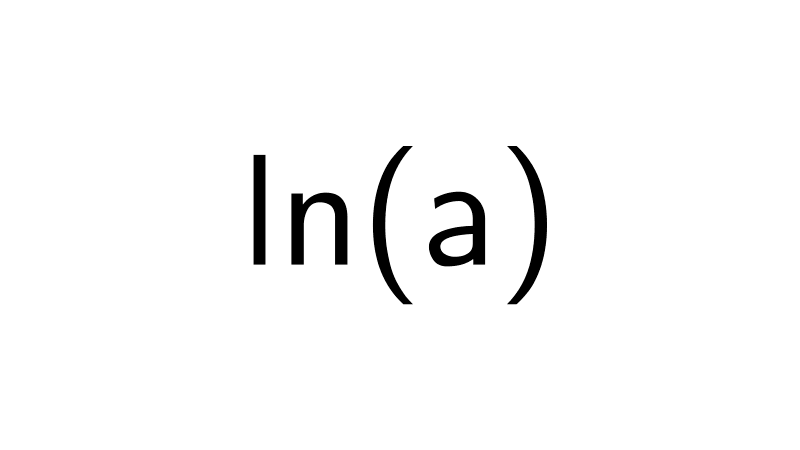
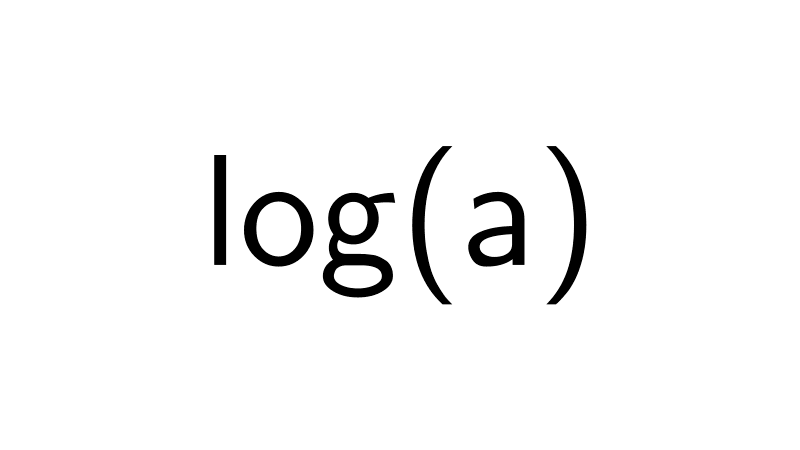
Although it is convenient to choose a logarithm with the same base as the exponential term (for example, base 2 when the power has base 2), any logarithm will work. Most scientific calculators have keys for common logarithms (base 10, written \(\log\)) and natural logarithms (base \(e\), written \(\ln\)). Using either one will yield the exact same answer.
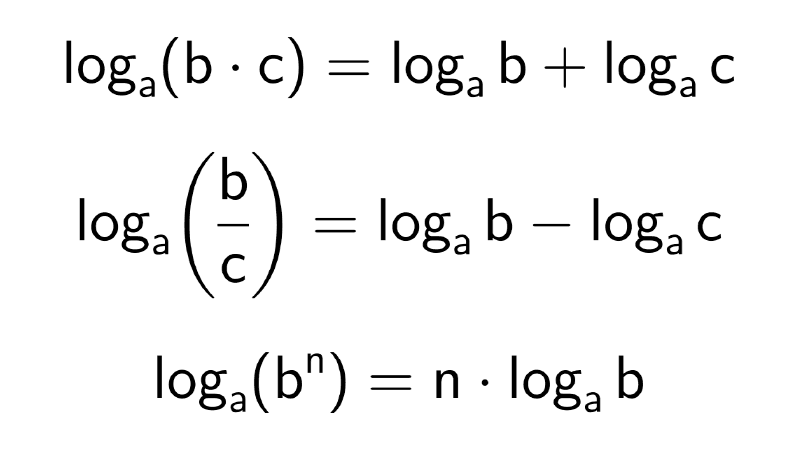
Properties of Logarithms:
- Logarithm of 1: \(\log_b(1)=0\)
- Logarithm of the base: \(\log_b(b)=1\)
- Inverse property (exponential form): \(b^{\log_b{a}}=a\)
- Inverse property (logarithmic form): \(\log_b(b^n)=n\)
- Product rule: \(\log_b (xy)=\log_b(x)+\log_b(y)\)
- Quotient rule: \(\log_b (x/y)=\log_b(x)-\log_b(y)\)
- Power rule: \(\log_b (a^n)=n\cdot \log_b(a)\)
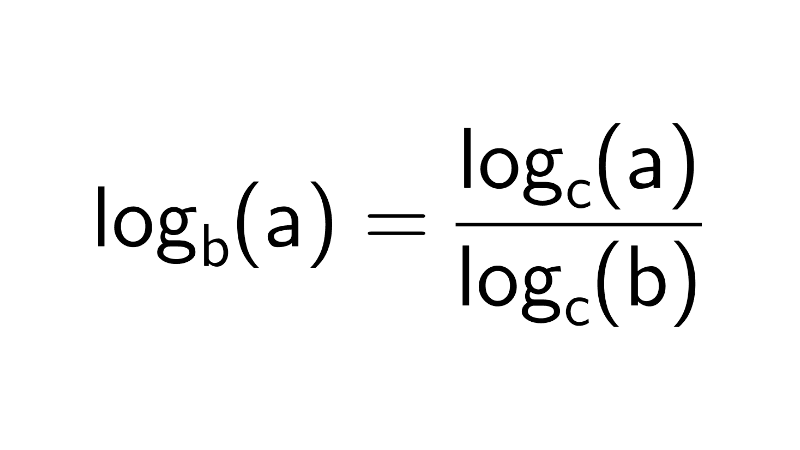
- Change of base formula: \(\log_b(a)=\dfrac{\log_k(a)}{\log_k(b)}\)
The most frequently used rule for solving exponential equations is the power rule of logarithms: given an equation of the form \(a^x=b,\) taking the common logarithm of both sides gives \(x\cdot \log (a)=\log(b),\) which solves to \(x=\dfrac{\log(b)}{\log (a)}.\)
Example 17
Solve \(2^x=5\)
Solution: since 5 cannot be written as a rational power of 2, we must use logarithms. Take the common logarithm of both sides of the equation:
$$2^x=5$$
$$\log (2^x)=\log(5)$$
Using the power rule of logarithms, bring the exponent to the front as a multiplier and solve for \(x\). We use a calculator to approximate the result:
$$x\cdot \log (2)=\log(5)$$
$$x=\dfrac{\log(5)}{\log (2)}$$
$$x≈2.32$$
Example 18
Solve the equation \(e^{2x}=7\)
Solution: this case is similar to the previous one, except we use the natural logarithm instead of the common logarithm because the base is \(e\).
$$e^{2x}=7$$
$$\ln (e^{2x})=\ln(7)$$
$$2x\cdot \ln(e)=\ln(7)$$
$$2x\cdot 1=\ln(7)$$
$$x=\dfrac{\ln(7)}{2}$$
$$x≈0.97$$
Note: using common logarithms or any other base would yield the exact same numerical answer, though it would not simplify via \(\ln(e)=1.\)
Example 19
Solve the exponential equation \(9^{x+2}=50\)
Solution: take the common logarithm of both sides and isolate \(x\) as in a standard linear equation.
$$9^{x+2}=50$$
$$\log (9^{x+2})=\log(50)$$
$$(x+2) \log (9)=\log(50)$$
$$x+2=\dfrac{\log(50)}{\log(9)}$$
$$x=\dfrac{\log(50)}{\log(9)}-2$$
$$x≈-0.22$$
Example 20
Solve \(2^{x+1}+4=80\)
Solution: isolate the exponential term on one side before taking logarithms.
$$2^{x+1}+4=80$$
$$2^{x+1}=80-4$$
$$2^{x+1}=76$$
$$\log (2^{x+1})=\log(76)$$
$$(x+1) \log (2)=\log(76)$$
$$x+1=\dfrac{\log(76)}{\log(2)}$$
$$x=\dfrac{\log(76)}{\log(2)}-1$$
$$x≈5.25$$
Example 21
Solve the equation \(e^{x-9}=\sqrt{73}\)
Solution: taking the natural logarithm of both sides allows us to isolate \(x\).
$$e^{x-9}=\sqrt{73}$$
$$\ln (e^{x-9})=\ln \sqrt{73}$$
$$(x-9)\ln (e)=\ln \sqrt{73}$$
$$x-9=\ln \sqrt{73}$$
$$x=\ln \sqrt{73}+9$$
$$x≈11.15$$
Example 22
Solve the equation \(2^{x-3}=3^{x+1}\)
Solution: here both sides have exponential terms with variables in the exponents, so we take logarithms of both sides to solve for \(x\).
$$2^{x-3}=3^{x+1}$$
$$\log (2^{x-3})=\log (3^{x+1})$$
$$(x-3)\log (2)=(x+1)\log (3)$$
Apply the distributive property:
$$x\log (2)-3\log (2)=x\log (3)+\log (3)$$
$$x\log (2)-x\log (3)=\log (3)+3\log (2)$$
$$x(\log (2)-\log (3))=\log (3)+\log (2^3)$$
By the properties of logarithms:
$$x(\log (2/3))=\log (3\cdot 2^3)$$
$$x\log (2/3)=\log (24)$$
$$x=\dfrac{\log (24)}{\log (2/3)}$$
$$x≈-7.84$$
Example 23
Solve \(2^x-10\cdot 2^x+16=0\)
Solution: in this equation, we can first use substitution by letting \(y=2^x\) and solving for \(y\):
$$2^x-10\cdot 2^x+16=0$$
$$y-10y+16=0$$
$$-9y=-16$$
$$y=\dfrac{16}{9}$$
Back-substituting: \(y=2^x→2^x=\dfrac{16}{9}.\) Since \(16/9\) cannot be written as a rational power of 2, we must use logarithms. Taking the common logarithm of both sides and applying the power rule:
$$\log (2^x)=\log\left(\dfrac{16}{9}\right)$$
$$x\cdot \log(2)=\log\left(\dfrac{16}{9}\right)$$
$$x=\dfrac{\log (16/9)}{\log(2)}$$
$$x≈0.83$$
Example 24
Solve the exponential equation \(4^x-2\cdot 2^{x-1}=6\)
Solution: we can apply substitution after rewriting both exponential terms in terms of \(2^x.\)
$$4^x-2\cdot 2^{x-1}=6$$
$$(2^2)^x-2\cdot 2^x\cdot 2^{-1}=6$$
$$(2^x)^2-2^x=6$$
Let \(y=2^x:\)
$$y^2-y=6$$
$$y^2-y-6=0$$
Solving this quadratic equation yields \(y=-2~\) or \(~y=3.\) Since \(2^x > 0\) for all real \(x,\) the negative value gives no real solution, so we take \(y=3.\)
Back-substituting \(y=2^x→2^x=3,\) and taking the common logarithm of both sides:
$$\log (2^x)=\log(3)$$
$$x\log (2)=\log(3)$$
$$x=\dfrac{\log(3)}{\log (2)}$$
$$x≈1.58$$
Did you find this useful? Rate it!
0.0 / 5 — 0 votes

HOW TO CITE THIS ARTICLE
Machado, D. (2026, November 26). Exponential Equations. Flamath. https://en.flamath.com/exponential-equations
Logarithmic Equations
Natural Logarithms
Common Logarithms
Change of Base Formula for Logarithms
Properties of Logarithms
Leave a Reply
Related Articles