
Necessary and Sufficient Conditions
In mathematical logic, necessary and sufficient conditions describe the relationship of dependence between two statements connected by an implication (p → q) or an equivalence (p ↔ q). Determining what type of condition a statement represents makes it possible to know whether the presence of one element guarantees another, or whether its absence completely invalidates it.
Depending on the direction in which the logical implication operates, we distinguish three types of conditions:
- Sufficient condition (but not necessary): guarantees the truth of the conclusion on its own, although it is not the only way to reach it. For example, scoring 100% on a final exam is sufficient to pass a course, but it is not necessary, since a student can also pass with a score of 75% or 80%.
- Necessary condition (but not sufficient): is a mandatory requirement whose absence prevents the outcome, although its presence alone does not guarantee it. For example, being 18 years old is necessary to vote in a presidential election, but it is not sufficient, as one must also be registered to vote and provide valid identification.
- Necessary and sufficient condition: guarantees the outcome mutually and simultaneously, linking both statements in a biconditional (p ↔ q). For example, a polygon having exactly three sides is necessary and sufficient for it to be a triangle.
Table of Contents
Comparison Table of Logical Conditions
To distinguish how logical dependence operates between two statements according to the direction of the implication, we compare their structures, standard readings, and truth criteria in the following table:
| Condition Type | Structure | Common Readings | Truth Criterion | Example |
|---|---|---|---|---|
| Sufficient condition (not necessary) | p → q (with q → p false) | "p is a sufficient condition for q" "q is a necessary condition for p" | The occurrence of p guarantees that of q, but q can occur due to other reasons. | Being in Chicago guarantees being in Illinois, but it is not the only city in Illinois. |
| Necessary condition (not sufficient) | q with respect to p in p → q | "q is a necessary condition for p" "p only if q" | Without q, it is impossible for p to occur, although having q does not guarantee p. | Having an internet connection is essential to browse the web, but not enough if the device does not turn on. |
| Necessary and sufficient condition | p ↔ q | "p is a necessary and sufficient condition for q" "p if and only if q" | Both statements occur together or neither occurs; their truth values are identical. | Being alive in a human organism is biologically equivalent to exhibiting vital signs. |
Sufficient Condition
In a true conditional statement p → q (commonly read as "if p, then q"), the antecedent p is called a sufficient condition for the consequent q. In everyday and mathematical language, this relationship is also stated as "p is sufficient for q" or "p is enough for q."
A common source of confusion is questioning why the truth of p guarantees q when the truth table includes a row where the antecedent is true and the consequent is false. The key is that designating a statement as a sufficient condition assumes that the implication p → q is true as a whole; under that certainty, the only row with a true antecedent that preserves the validity of the implication requires the consequent to be true as well.
We say that p is sufficient because its presence alone is enough to ensure that q holds, without requiring any additional verification. However, it is usually not necessary because other antecedents could lead to the same result; that is, the converse implication q → p does not have to be true.
Examples
- Geographical location: being in the city of Paris is sufficient for being in France. Verifying one's presence in that city is enough to guarantee being in French territory, but it is not a necessary condition, since a person could be in Marseille or Lyon and still be in France.
- Quadrilaterals: a geometric figure being a square is sufficient to state that it is a rectangle. Satisfying the properties of a square guarantees that all four interior angles are right angles, but being a square is not necessary to be a rectangle, as rectangles can have unequal adjacent sides.
- Integer divisibility: an integer ending in 00 is a sufficient condition for it to be divisible by 4. Any integer whose last two digits are zeros is a multiple of 4, but ending in 00 is not necessary, since numbers like 12, 16, or 28 are also divisible by 4 without ending in double zero.
- Algebraic equations: the variable satisfying x = 5 is sufficient to ensure that x2 = 25. The value 5 directly satisfies the quadratic equation, but it is not necessary, since x = −5 also satisfies it.
- Triangle classification: a triangle being equilateral is a sufficient condition for it to be isosceles. Having three sides of equal length readily satisfies having at least two equal sides, but being equilateral is not necessary to be isosceles, since a triangle can have only two congruent sides.
Necessary Condition
Given the conditional statement p → q, the consequent q acts as a necessary condition for the antecedent p. This logical dependence is typically phrased in natural language as "q is necessary for p," "p only if q," or "without q, there is no p."
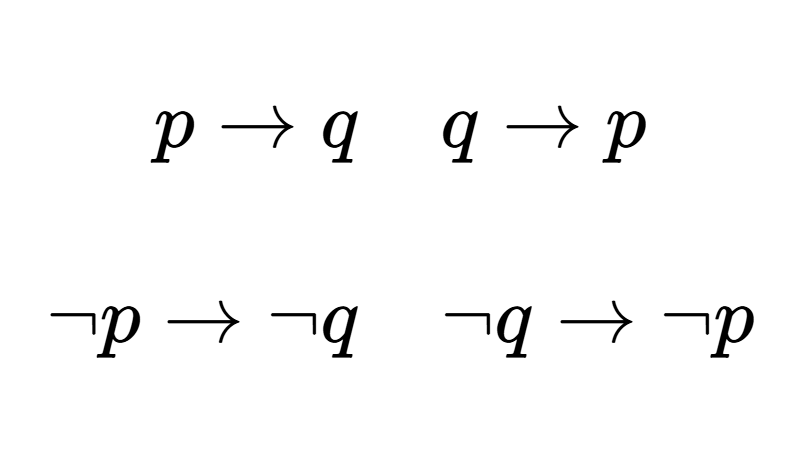
It often causes confusion that the term necessary is assigned to the consequent q when it seems that p is the trigger. This is best understood through logical equivalence with the contrapositive statement, p → q ≡ ¬q → ¬p: if condition q is not met (¬q), it is impossible for p to hold (¬p). Consequently, the presence of q is a mandatory requirement without which the situation described by p cannot occur.
That a condition is necessary does not mean it is sufficient. Fulfilling the requirement demanded by the consequent does not guarantee on its own that the antecedent takes place, which formally reflects that the converse q → p is not established by the truth of the original conditional statement.
Examples
- Chemical combustion: the presence of oxygen is a necessary condition for fire to exist. If there is no oxygen (¬q), it is impossible to produce a flame (¬p); however, the presence of oxygen alone is not sufficient to start a fire, as fuel and a heat source are also required.
- Divisibility arithmetic: an integer being even is a necessary condition for it to be divisible by 6. If a number is not even, it can never be divisible by 6; however, being even is not sufficient, as shown by the number 8, which is even but not a multiple of 6.
- Algebraic inequalities: the condition x > 0 is necessary for x > 5 to hold. If a value is not positive, it cannot possibly exceed 5; but a number being positive is not enough to ensure it is greater than 5, as seen with the number 2.
- Plane figures: having four sides is a necessary condition for a geometric figure to be a rhombus. A figure lacking four sides cannot be a rhombus; however, having four sides is not sufficient, as trapezoids and scalene quadrilaterals do not have four equal sides.
- Angle relationships: two angles adding up to 90° is necessary for them to be complementary and adjacent. If two angles do not sum to 90°, they cannot be complementary; but summing to 90° is not sufficient to ensure they are adjacent, since they could be in separate positions without sharing a common vertex or side.
Necessary and Sufficient Condition
When two statements p and q mutually imply each other, such that p → q and q → p are simultaneously true, we say that p is a necessary and sufficient condition for q (and conversely, q is for p). This bidirectional relationship constitutes a biconditional, formally denoted as p ↔ q, and commonly read as "p if and only if q."
Both properties combine in this structure: p is sufficient for q because p occurring is enough to guarantee q, and at the same time p is necessary for q because without p, q cannot occur. From a logical standpoint, both statements are equivalent, meaning they share identical truth values under all circumstances.
In mathematics, the vast majority of formal definitions and equivalence theorems function as necessary and sufficient conditions, establishing an exact correspondence without exceptions between a concept and its core properties.
Examples
- Annual calendar: the date being December 25 is a necessary and sufficient condition for it to be Christmas Day. If it is December 25, it is necessarily Christmas; and if it is Christmas, the date corresponds indisputably to December 25 in the Gregorian calendar.
- Decimal divisibility: the last digit of an integer being 0 or 5 is a necessary and sufficient condition for that number to be divisible by 5. If it ends in 0 or 5, it is divisible by 5; and if it is divisible by 5, it necessarily ends in one of those two digits.
- Solving equations: the equality 3x − 9 = 0 holds if and only if x = 3 in the set of real numbers. Solving the equation leads directly to x = 3, and substituting x = 3 satisfies the equation with no other possible alternatives.
- Triangle geometry: a triangle having all three sides of equal length is a necessary and sufficient condition for its three interior angles to be congruent (measuring 60° each). Every equilateral triangle is equiangular, and every equiangular triangle is equilateral.
- Rectangular parallelograms: a parallelogram having at least one right angle is a necessary and sufficient condition for it to be a rectangle. The presence of a single right angle in a parallelogram forces the remaining three to be right angles as well, satisfying the geometric definition in both directions.
Practice Problems with Solutions
Determine what type of condition statement p represents with respect to statement q in each of the following cases:
- p: "An object is on planet Earth" and q: "An object is inside the solar system."
- p: "An integer is a multiple of 12" and q: "An integer is a multiple of 3."
- p: "A parallelogram has four sides of equal length" and q: "A parallelogram is a rhombus."
- p: "x > 3" and q: "x2 > 9" (in the set of real numbers).
- p: "A quadrilateral has perpendicular diagonals" and q: "A quadrilateral is a rectangle."
Solution 1
First, we analyze the direct implication p → q: if an object is on planet Earth, it is necessarily inside the solar system, making this implication true.
Next, we evaluate the converse q → p: if an object is inside the solar system, it is not necessarily on Earth, as it could be located on Mars, Jupiter, or in lunar orbit; therefore, the converse is false.
Because p → q is true but q → p is false, we conclude that p is a sufficient but not necessary condition for q.
Solution 2
We evaluate the direct implication p → q: if an integer is a multiple of 12, it can be written as 12k = 3(4k), which ensures it is also divisible by 3; consequently, the implication is true.
We analyze the converse relationship q → p: if a number is divisible by 3, it is not guaranteed to be divisible by 12. Taking 15 as a counterexample: it is a multiple of 3 but not of 12, which makes the converse false.
Since the implication p → q is true, p is sufficient for q, which is equivalent to stating that q acts as a necessary but not sufficient condition for p.
Solution 3
We check the forward direction p → q: by geometric definition, any parallelogram that has four congruent sides belongs to the family of rhombuses, resulting in a true implication.
We examine the reverse direction q → p: if a figure is a rhombus, one of its defining properties requires all four sides to have equal length, so this implication is also true.
Because both statements imply each other (p ↔ q), we determine that p is a necessary and sufficient condition for q.
Solution 4
We verify the implication p → q: considering positive real numbers, if we take any value x > 3 and square both sides of the inequality, we directly obtain x2 > 9, which makes this statement true.
We evaluate the converse q → p: if x2 > 9 holds, the solution set over the real numbers is (−∞, −3) ∪ (3, +∞). If we choose x = −5, we see that (−5)2 = 25 > 9, but −5 is not greater than 3, which invalidates the converse.
Therefore, condition p is sufficient but not necessary for q to hold.
Solution 5
We analyze the direct implication p → q: having perpendicular diagonals does not guarantee that the figure is a rectangle; a non-square rhombus has perpendicular diagonals, but its angles are not right angles, making the implication false.
We test the converse q → p: being a rectangle does not require the diagonals to intersect at 90°. As a counterexample, consider a rectangle with side lengths of 4 cm and 2 cm, whose diagonals are equal in length but not perpendicular, making the converse false.
Because the implication fails in both directions, we establish that p is neither necessary nor sufficient with respect to q.
Did you find this useful? Rate it!
0.0 / 5 — 0 votes

HOW TO CITE THIS ARTICLE
Machado, D. (2026, October 12). Necessary and Sufficient Conditions. Flamath. https://en.flamath.com/necessary-and-sufficient-conditions
Converse, Inverse, and Contrapositive
Commutative Laws in Logic
Associative Laws in Logic
Propositional Logic Practice Problems
Propositional Variables
Leave a Reply
Related Articles