
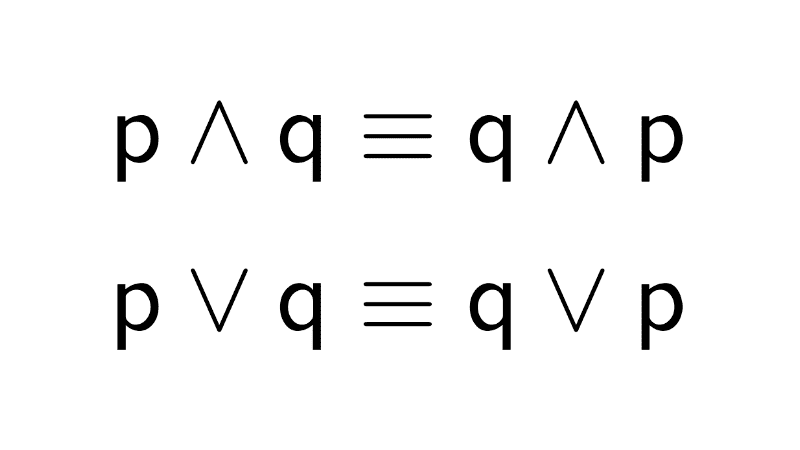
Associative Laws in Logic
The associative laws in propositional logic state that when the same logical operator (conjunction or disjunction) is applied repeatedly, the grouping of the components does not alter the truth value of the result. This means that parentheses can be rearranged or removed without changing the logical meaning of the expression.
The laws are expressed by the following formulas, where the symbol ≡ denotes logical equivalence:
p ∧ (q ∧ r) ≡ (p ∧ q) ∧ r
p ∨ (q ∨ r) ≡ (p ∨ q) ∨ r
It is also valid to include or drop parentheses:
p ∧ q ∧ r ≡ (p ∧ q) ∧ r ≡ p ∧ (q ∧ r)
p ∨ q ∨ r ≡ (p ∨ q) ∨ r ≡ p ∨ (q ∨ r)
We can draw a connection to the associative properties of addition and multiplication in algebra, such as in (a + b) + c = a + (b + c).
Table of Contents
Proofs
The logical equivalence of the associative laws can be verified using truth tables.
For the associativity of conjunction, p ∧ (q ∧ r) ≡ (p ∧ q) ∧ r, we construct the truth table:
| p | q | r | p ∧ q | q ∧ r | p ∧ (q ∧ r) | (p ∧ q) ∧ r |
|---|---|---|---|---|---|---|
| T | T | T | T | T | T | T |
| T | T | F | T | F | F | F |
| T | F | T | F | F | F | F |
| T | F | F | F | F | F | F |
| F | T | T | F | T | F | F |
| F | T | F | F | F | F | F |
| F | F | T | F | F | F | F |
| F | F | F | F | F | F | F |
The columns for p ∧ (q ∧ r) and (p ∧ q) ∧ r are identical, which proves the equivalence.
For the associativity of disjunction, p ∨ (q ∨ r) ≡ (p ∨ q) ∨ r, the truth table is:
| p | q | r | p ∨ q | q ∨ r | p ∨ (q ∨ r) | (p ∨ q) ∨ r |
|---|---|---|---|---|---|---|
| T | T | T | T | T | T | T |
| T | T | F | T | T | T | T |
| T | F | T | T | T | T | T |
| T | F | F | T | F | T | T |
| F | T | T | T | T | T | T |
| F | T | F | T | T | T | T |
| F | F | T | F | T | T | T |
| F | F | F | F | F | F | F |
Again, the final columns match across all rows.
The associative laws have a practical application in manipulating and simplifying logical formulas. It is important not to confuse this property with distributivity: associativity requires that all main connectives be of the same type (all conjunctions or all disjunctions), whereas distributivity involves a mix of both connectives.
Associativity in Set Theory
The associative laws of propositional logic extend naturally to set theory, since the conjunction (∧) and disjunction (∨) operators directly correspond to intersection (∩) and union (∪) operations, respectively.
Given three sets A, B, and C, the following hold:
- Intersection is associative: A ∩ (B ∩ C) = (A ∩ B) ∩ C.
- Union is associative: A ∪ (B ∪ C) = (A ∪ B) ∪ C.
Did you find this useful? Rate it!
0.0 / 5 — 0 votes

HOW TO CITE THIS ARTICLE
Machado, D. (2026, October 3). Associative Laws in Logic. Flamath. https://en.flamath.com/associative-laws-in-logic
Commutative Laws in Logic
Propositional Logic Practice Problems
Propositional Variables
Translating Statements into Symbolic Form
Simple and Compound Statements
Leave a Reply
Related Articles