
Common Logarithms
Common logarithms, also known as Briggsian logarithms or base-10 logarithms, are a special case of logarithms where the base is 10. They represent the exponent to which 10 must be raised to obtain a given argument. They are denoted simply as log, without explicitly writing the base.
Definition: The common logarithm of a positive real number a (\(a > 0\)) is the exponent to which 10 must be raised to equal a. In symbols:
\(\log{a}=x\) if and only if \(10^x=a\)
Examples:
\(\log{100}=2\) because \(10^2=100\)
\(\log{1000}=3\) because \(10^3=1000\)
\(\log{0.1}=\log{\dfrac{1}{10}}=-1\) because \(10^{-1}=\dfrac{1}{10}\)
\(\log{\dfrac{1}{100}}=-2\) because \(10^{-2}=\dfrac{1}{100}\)
\(\log{50}\approx 1.6990\) because \(10^{1.6990}\approx 50\) (since \(50\) is not an exact power of \(10,\) its value lies between \(1\) and \(2\) and is found using the log key on a scientific calculator)
Common logarithms have wide-ranging applications in mathematics, physics, engineering, computer science, and related fields. They are especially useful for working with quantities that vary across exponential scales, such as pH levels, sound intensity (decibels), and earthquake magnitudes. They also allow us to simplify equations and solve exponential problems.
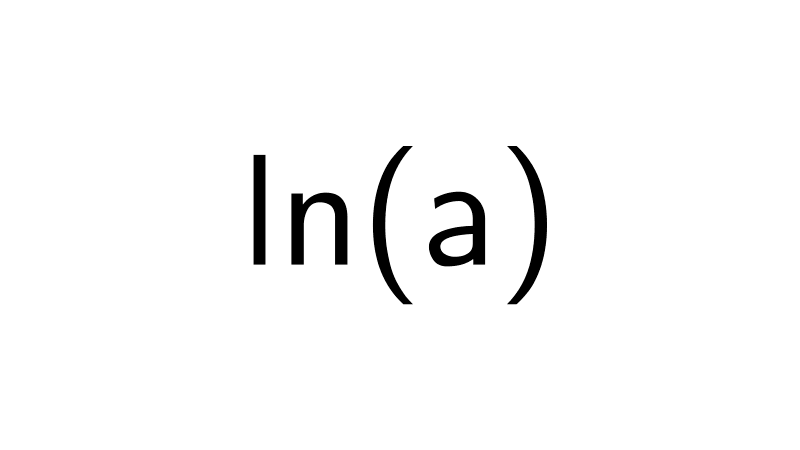
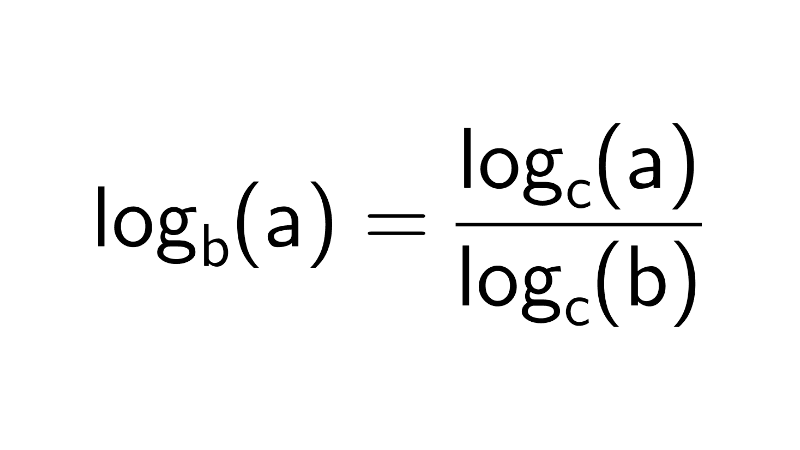
The difference between common logarithms and natural logarithms lies in the base they use. While common logarithms use base \(10\), natural logarithms use the irrational number \(e\) (approximately \(2.71828\)) as their base. Both types of logarithms are related through the change of base formula, which allows you to convert from one to the other:
$$\log{a}=\dfrac{\ln{a}}{\ln{10}}$$
$$\ln{a}=\dfrac{\log{a}}{\log{e}}$$
Properties of Common Logarithms
Below are the main properties of base-10 logarithms for positive real numbers \(a > 0\) and \(b > 0\):
- The common logarithm of one is zero: \(\log{1}=0\) because \(10^0=1\)
- The common logarithm of ten is one: \(\log{10}=1\) because \(10^1=10\)
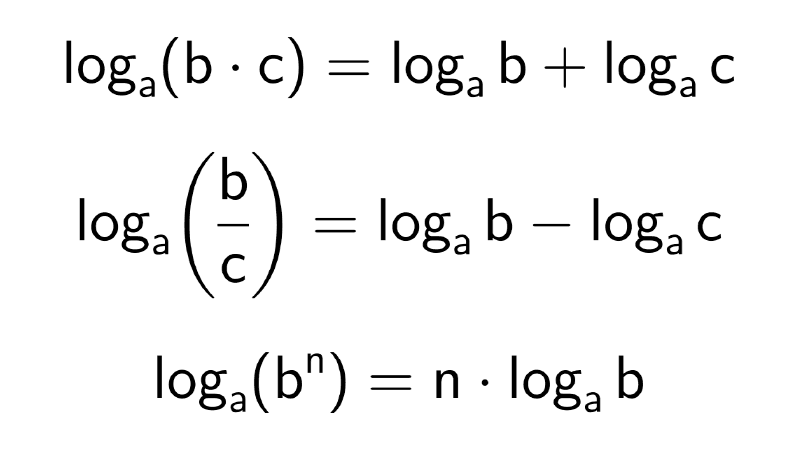
- Product Rule: The common logarithm of a product is equal to the sum of the common logarithms of the factors: \(\log(ab)=\log{a}+\log{b}\)
- Quotient Rule: The common logarithm of a quotient is equal to the difference of the common logarithms of the numerator and denominator: \(\log\left(\dfrac{a}{b}\right)=\log{a}-\log{b}\)
- Power Rule: The common logarithm of a power is equal to the exponent times the common logarithm of the base: \(\log(a^n)=n\cdot \log{a}\)
- Change of Base Formula: The common logarithm of a number can be found by dividing the logarithm of that number in another base \(k\) (\(k > 0,\ k \neq 1\)) by the logarithm of 10 in that same base: \(\log{a}=\dfrac{\log_k{a}}{\log_k{10}}\)
Did you find this useful? Rate it!
0.0 / 5 — 0 votes

HOW TO CITE THIS ARTICLE
Machado, D. (2026, November 26). Common Logarithms. Flamath. https://en.flamath.com/common-logarithms
Exponential Equations
Logarithmic Equations
Natural Logarithms
Change of Base Formula for Logarithms
Properties of Logarithms
Leave a Reply
Related Articles