
Logarithmic Equations
Logarithmic equations are equations in which the variable is inside the argument of one or more logarithms.
We can find different types of logarithmic equations: simple ones, where there is only one logarithm in the equation; compound ones, where there is more than one logarithm; equations with logarithms of the same base; and equations with logarithms of different bases.
Some examples are:
- \(\log_2(x+3)=2\)
- \(\log_4(4x-3)-3=0\)
- \(\log_4 x=2+\log_{16} x\)
- \(2\log_3 (x)=2+2 \log_9 (2x-9)\)
The equations shown in the examples, along with others, will be solved in this article. If you are looking for equations where the variable is in the base of a logarithm, check out the following article:
Table of Contents
Methods for Solving Logarithmic Equations
Solving a logarithmic equation consists of finding the value of the variable that makes the equality true. To isolate the variable inside the logarithm, we can use the properties of logarithms to rewrite the expression until it becomes a standard algebraic equation.
Once the possible value or values for the variable are found, you must check that the solution does not make the argument of any logarithm negative or zero. It is important to know the definition of a logarithm and its properties:
Definition of a logarithm: \(\log_b{a}=x\) if and only if \(b^x=a\)
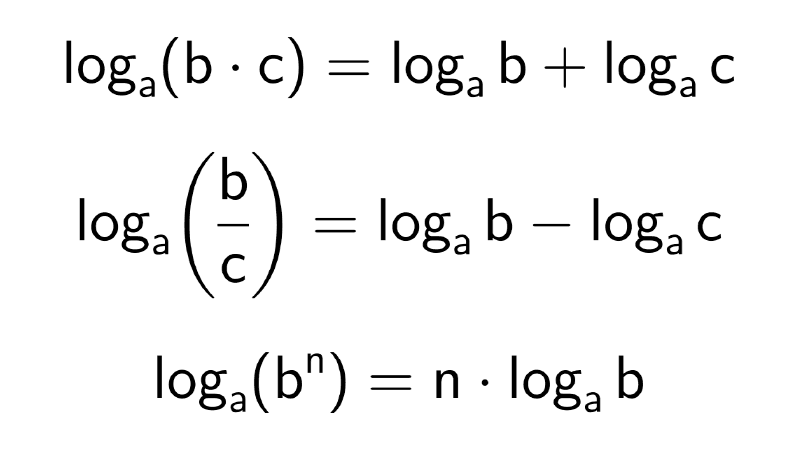
Properties:
- Logarithm of 1: \(\log_b(1)=0\)
- Logarithm of the base: \(\log_b(b)=1\)
- Logarithm as an exponent: \(b^{\log_b{a}}=a\)
- Logarithm of a power of the base: \(\log_b(b^n)=n\)
- Product rule: \(\log_b (xy)=\log_b(x)+\log_b(y)\)
- Quotient rule: \(\log_b (x/y)=\log_b(x)-\log_b(y)\)
- Power rule: \(\log_b (a^n)=n\cdot \log_b(a)\)
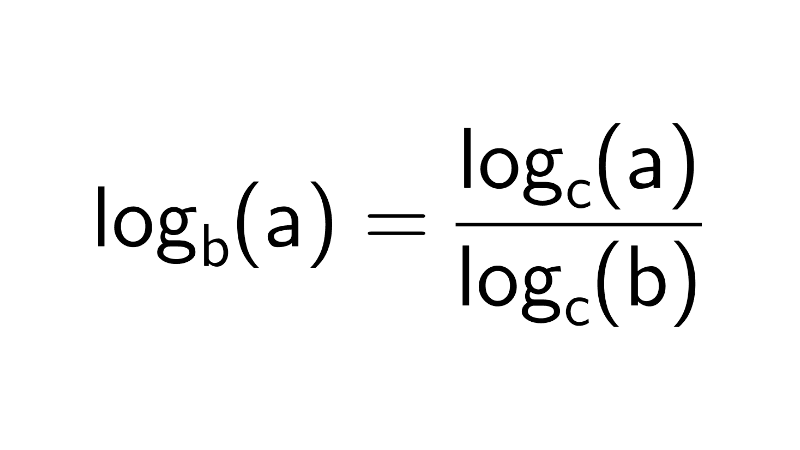
- Change of base formula: \(\log_b(a)=\dfrac{\log_k(a)}{\log_k(b)}\)
Worked Examples
Below, we will solve several logarithmic equations step by step, going from the simplest to the most advanced. Remember that when no base is written, it is a common logarithm (base 10), and ln stands for natural logarithm (its base is e).
Logarithms with the Same Base
The following equations contain one or more logarithms with equal bases and are solved step by step.
Example 1
Solve the equation \(\log_2(x+3)=2\)
Solution: We can isolate x from the logarithm using the property \(b^{\log_b{a}}=a.\) To do this, we treat both sides of the equation as exponents with a base of 2, since we have a base-2 logarithm. This eliminates the logarithm and leaves an algebraic equation.
$$\log_2(x+3)=2$$
$$2^{\log_2(x+3)}=2^2$$
$$x+3=2^2$$
$$x+3=4$$
$$x=4-3$$
$$x=1$$
Check:
If x=1, then:
$$\log_2(1+3)=2$$
$$\log_2(4)=2$$
$$2=2$$
Example 2
Solve the logarithmic equation \(\log_4(4x-3)-3=0\)
Solution: This equation is set equal to zero. To solve it, we first isolate the logarithm on one side and follow the same process as in the previous example, keeping in mind that we must now use base 4.
$$\log_4(4x-3)-3=0$$
$$\log_4(4x-3)=3$$
$$4^{\log_4(4x-3)}=4^3$$
$$4x-3=4^3$$
$$4x-3=64$$
$$4x=64+3$$
$$4x=67$$
$$x=\dfrac{67}{4}$$
Check:
If \(x=\dfrac{67}{4},\) then:
$$\log_4\left(4\cdot \dfrac{67}{4}-3\right)-3=0$$
$$\log_4(67-3)-3=0$$
$$\log_4(64)-3=0$$
$$3-3=0$$
$$0=0$$
Example 3
Solve the equation \(\log_5(x^2-11)=2\)
Solution: We apply the same method as before. The resulting algebraic equation will be quadratic and will have two possible solutions. We need to check whether both are valid or only one of them is.
$$\log_5(x^2-11)=2$$
$$5^{\log_5(x^2-11)}=5^2$$
$$x^2-11=25$$
$$x^2=25+11$$
$$x^2=36$$
$$x=±\sqrt{36}$$
$$x=±6$$
The possible solutions are \(x=6\) and \(x=-6.\)
Check:
1) If x=6, then:
$$\log_5((6)^2-11)=2$$
$$\log_5(36-11)=2$$
$$\log_5(25)=2$$
$$2=2$$
2) If x=-6, then:
$$\log_5((-6)^2-11)=2$$
$$\log_5(36-11)=2$$
$$\log_5(25)=2$$
$$2=2$$
Therefore, both solutions are valid.
Example 4
Find the value of x in \(\log_6(5x-9)^2=4\)
Solution: We apply the same process as before using powers with base 6 due to the base of the logarithm.
$$\log_6(5x-9)^2=4$$
$$6^{\log_6(5x-9)^2}=6^4$$
$$(5x-9)^2=6^4$$
$$(5x-9)^2=1296$$
At this point we have several possible paths: we can first expand the binomial and then use the quadratic formula, or carefully isolate the square on the left-hand side. We will take the second approach:
$$5x-9=±\sqrt{1296}$$
$$5x-9=±36$$
$$5x=9±36$$
$$x=\dfrac{9±36}{5}$$
Now we find the two possible solutions considering +36 and -36:
$$x_1=\dfrac{9+36}{5}=\dfrac{45}{5}=9$$
$$x_2=\dfrac{9-36}{5}=-\dfrac{27}{5}$$
Check:
1) If \(x=9,\) then:
$$\log_6(5(9)-9)^2=4$$
$$\log_6(36)^2=4$$
$$\log_6(1296)=4$$
$$4=4$$
2) If \(x=-\dfrac{27}{5},\) then:
$$\log_6(5(-\frac{27}{5})-9)^2=4$$
$$\log_6(-27-9)^2=4$$
$$\log_6(-36)^2=4$$
$$\log_6(1296)=4$$
$$4=4$$
Conclusion: Both values found for x are valid solutions to the logarithmic equation.
Example 5
Solve the equation \(\log_5(2x+4)=\log_5(3x-6)\)
Solution: In this case, we have an equality of logarithms. If two logarithms with the same base are equal, then their arguments must be equal. Based on this fact, we rewrite the equation.
$$\log_5(2x+4)=\log_5(3x-6)$$
$$2x+4=3x-6$$
$$2x-3x=-6-4$$
$$-x=-10$$
$$x=10$$
Check: If \(x=10,\) then
$$\log_5(2(10)+4)=\log_5(3(10)-6)$$
$$\log_5(24)=\log_5(24)$$
Example 6
Find the solution to the equation \(\log_4 \sqrt{15x+1}=2\)
Solution: This logarithmic equation contains radicals, and the method for solving it is the same as the one applied previously.
$$\log_4 \sqrt{15x+1}=2$$
$$4^{\log_4 \sqrt{15x+1}}=4^2$$
$$\sqrt{15x+1}=4^2$$
$$\sqrt{15x+1}=16$$
To eliminate the square root, we square both sides of the equation:
$$(\sqrt{15x+1})^2=16^2$$
$$15x+1=256$$
$$15x=256-1$$
$$15x=255$$
$$x=\dfrac{255}{15}$$
$$x=17$$
Check: If \(x=17,\) then
$$\log_4 \sqrt{15 (17)+1}=2$$
$$\log_4 \sqrt{256}=2$$
$$\log_4 16=2$$
$$2=2$$
Example 7
Solve \(\log \sqrt{x^2+19}=1\)
Solution: This equation also contains a square root in the argument. To isolate the variable, we follow a similar process to the previous example. In this case, since it is a common logarithm (log), we use 10 as the base.
$$\log \sqrt{x^2+19}=1$$
$$10^{\log \sqrt{x^2+19}}=10^1$$
$$\sqrt{x^2+19}=10$$
$$(\sqrt{x^2+19})^2=10^2$$
$$x^2+19=100$$
$$x^2=100-19$$
$$x^2=81$$
$$x=±\sqrt{81}$$
$$x=±9$$
Check: Since the variable is squared, the result is the same whether we use the positive or negative value.
$$\log \sqrt{(±9)^2+19}=1$$
$$\log \sqrt{81+19}=1$$
$$\log \sqrt{100}=1$$
$$\log 10=1$$
$$1=1$$
Example 8
Solve the equation \(\dfrac{\log(16-x^2)}{\log (3x-4)}=2\)
Solution: This equation contains a fractional expression that we can rewrite by multiplying both sides by the denominator, isolating the numerator.
$$\dfrac{\log(16-x^2)}{\log (3x-4)}=2$$
$$\log(16-x^2)=2\log (3x-4)$$
This is not yet an equality of single logarithms, but we can convert it into one by applying the power rule of logarithms. Thus, the 2 multiplying the right-hand side moves up as an exponent. Then, we proceed as usual by setting the arguments equal to each other.
$$\log(16-x^2)=\log (3x-4)^2$$
$$16-x^2=(3x-4)^2$$
$$16-x^2=(3x)^2+2\cdot 3x\cdot (-4)+(-4)^2$$
$$16-x^2=9x^2-24x+16$$
$$-x^2-9x^2+24x=0$$
$$-10x^2+24x=0$$
At this point we could use the quadratic formula, but we can also factor out x and apply the zero product property.
$$-10x^2+24x=0$$
$$x(-10x+24)=0$$
The possible solutions are: \(x=0~~\) or \(~~-10x+24=0→-10x=-24→x=\dfrac{12}{5}\)
The value \(x=0\) is an extraneous solution because substituting it into the equation gives \(\dfrac{\log(16)}{\log (-4)}=2,\) and the logarithm of a negative number is undefined.
Substituting the solution \(x=\dfrac{12}{5}\) gives:
$$\dfrac{\log(16-(\frac{12}{5})^2)}{\log (3(\frac{12}{5})-4)}=2$$
$$\dfrac{\log(10.24)}{\log (3.2)}=2$$
$$2=2$$
Therefore, \(x=\dfrac{12}{5}\) is the solution to the equation.
Example 9
Solve \(\log_7 (x+9)+\log_7 (49)=4\)
Solution: In this case, we can apply the product rule of logarithms to rewrite the sum of logarithms as the logarithm of a product. Then, we solve as usual.
$$\log_7 (x+9)+\log_7 (49)=4$$
$$\log_7((x+9)\cdot 49)=4$$
$$\log_7(49x+441)=4$$
$$7^{\log_7(49x+441)}=7^4$$
$$49x+441=2401$$
$$49x=2401-441$$
$$49x=1960$$
$$x=40$$
Check: If \(x=40,\) then
$$\log_7 (40+9)+\log_7 (49)=4$$
$$\log_7 (49)+\log_7 (49)=4$$
$$2+2=4$$
$$4=4$$
Example 10
Solve the equation \(\log x=\log 102-\log 34\)
Solution: The logarithmic equation can be rewritten using the quotient rule to convert the subtraction of logarithms into the logarithm of a quotient. Then, we set the arguments equal to each other.
$$\log x=\log 102-\log 34$$
$$\log x=\log\left(\dfrac{102}{34}\right)$$
$$\log x=\log 3$$
$$x=3$$
Example 11
Find the solution to the equation \(\log x=3 \log 2-2\log 3\)
Solution: This case is similar to the previous one, but we also need to use the power rule to move the coefficients up as exponents.
$$\log x=3 \log 2-2\log3$$
$$\log x=\log 2^3-\log3^2$$
$$\log x=\log 8-\log9$$
$$\log x=\log\left(\dfrac{8}{9}\right)$$
$$x=\dfrac{8}{9}$$
Example 12
Solve \(\ln(x+3)+\ln(x+1)=\ln(8)\)
Solution: We can use the product rule of logarithms to rewrite the left-hand side. In this case, we are working with natural logarithms (base e).
$$\ln(x+3)+\ln(x+1)=\ln(8)$$
$$\ln((x+3)(x+1))=\ln(8)$$
$$(x+3)(x+1)=8$$
We apply the distributive property to expand the left-hand side.
$$x^2+x+3x+3=8$$
$$x^2+4x+3-8=0$$
$$x^2+4x-5=0$$
Now we can apply the quadratic formula to solve the quadratic equation.
$$x=\dfrac{-4±\sqrt{4^2-4\cdot 1\cdot (-5)}}{2}$$
$$=\dfrac{-4±\sqrt{36}}{2}$$
$$=\dfrac{-4±6}{2}$$
Then, \(x=\dfrac{-4+6}{2}=1~~\) or \(~~x=\dfrac{-4-6}{2}=-5.\)
The value \(x=-5\) is an extraneous solution because substituting it into the equation yields \(\ln(0)+\ln(-4)=\ln(8),\) and logarithms of negative numbers or zero are undefined.
If \(x=1,\) then:
$$\ln(1+3)+\ln(1+1)=\ln(8)$$
$$\ln(4)+\ln(2)=\ln(8)$$
\(\ln(8)=\ln(8)\) (by properties of logarithms).
Therefore, \(x=1\) is the solution to the logarithmic equation.
Example 13
Solve the equation \(\ln(x^2-1)=0\)
Solution: In this case, we have a logarithm set equal to zero. We can use the property of logarithms stating that only the logarithm of 1 is equal to zero. Therefore, the expression inside the argument must equal 1:
$$\ln(x^2-1)=0$$
$$x^2-1=1$$
$$x^2=1+1$$
$$x^2=2$$
$$x=±\sqrt{2}$$
You can check that both the positive and negative solutions are valid because the variable is squared.
Example 14
Solve the equation \(\log 3^x=2\)
Solution: The variable is in the exponent of the argument. We could solve it like the first examples, but an easier path is to use the power rule to "bring down" that exponent and isolate it:
$$\log 3^x=2$$
$$x\log 3=2$$
$$x=\dfrac{2}{\log3}≈4.19$$
Example 15
Solve the equation \(\log_{1/2}(5(x-1))=3\)
Solution: This case is no different from the first ones except for the fractional base. To eliminate the logarithm, we use 1/2 as the base.
$$\log_{1/2}(5(x-1))=3$$
$$(1/2)^{\log_{1/2}(5(x-1))}=(1/2)^3$$
$$5(x-1)=\dfrac{1}{2^3}$$
$$5x-5=\dfrac{1}{8}$$
$$5x=\dfrac{1}{8}+5$$
$$x=\dfrac{41/8}{5}$$
$$x=\dfrac{41}{40}$$
Logarithms with Different Bases
The following examples correspond to equations containing several logarithms with different bases. The solution method consists of using the change of base formula so that all bases are the same, and then solving as in the previous examples.
Example 16
Solve the equation \(\log_4 x=2+\log_{16} x\)
Solution: We can start by gathering the logarithms on one side of the equation.
$$\log_4 x=2+\log_{16} x$$
$$\log_4 x-\log_{16} x=2$$
We cannot apply the quotient rule of logarithms yet because they do not have the same base. However, we can make them have the same base, whether both have base 4, base 2, or another number. For convenience, we will convert the base-16 logarithm to base 4 using the change of base formula:
$$\log_{16} x=\dfrac{\log_4x}{\log_4 16}=\dfrac{\log_4x}{2}$$
Substituting this back into the original equation:
$$\log_4 x-\dfrac{\log_4x}{2}=2$$
The 2 dividing the second term can be moved up as an exponent of the logarithm's argument:
$$\log_4 x-\dfrac{1}{2}\log_4 x=2$$
$$\log_4 x-\log_ 4 x^{1/2}=2$$
Now we can use the quotient rule of logarithms because both share the same base.
$$\log_4 \left(\dfrac{x}{x^{1/2}}\right)=2$$
Now we apply exponent rules to rewrite the argument and then eliminate the logarithm using base 4.
$$\log_4 (x^{1-1/2})=2$$
$$\log_4 (x^{1/2})=2$$
$$4^{\log_4 (x^{1/2})}=4^2$$
$$x^{1/2}=16$$
Keeping in mind that an exponent of 1/2 is equivalent to a square root, we can isolate the variable by squaring both sides.
$$\sqrt{x}=16$$
$$x=16^2$$
$$x=256$$
Check: If \(x=256,\) then,
$$\log_4 256=2+\log_{16} 256$$
$$4=2+2$$
$$4=4$$
Example 17
Solve the logarithmic equation \(2\log_3 (x)=2+2 \log_9 (2x-9)\)
Solution: We begin by moving all logarithmic terms to one side of the equation, then we use the change of base formula to convert the base-9 logarithm into base 3.
$$2\log_3 (x)=2+2 \log_9 (2x-9)$$
$$2\log_3 (x)-2 \log_9 (2x-9)=2$$
By the change of base formula, \(\log_9 (2x-9)=\dfrac{\log_3 (2x-9)}{\log_3 9}=\dfrac{\log_3 (2x-9)}{2}.\) Substituting this into the equation:
$$2\log_3 (x)-2 \dfrac{\log_3 (2x-9)}{2}=2$$
$$2\log_3 (x)-\log_3 (2x-9)=2$$
Now, by the power rule and quotient rule of logarithms, we can rewrite the left-hand side and then eliminate the logarithm.
$$\log_3 (x^2)-\log_3 (2x-9)=2$$
$$\log_3 \left(\dfrac{x^2}{2x-9}\right)=2$$
$$3^{\log_3 \left(\dfrac{x^2}{2x-9}\right)}=3^2$$
$$\dfrac{x^2}{2x-9}=9$$
$$x^2=9(2x-9)$$
$$x^2=18x-81$$
$$x^2-18x+81=0$$
Using the quadratic formula:
$$x=\dfrac{18±\sqrt{(-18)^2-4\cdot 1\cdot 81}}{2}$$
$$x=\dfrac{18±0}{2}$$
$$x=9$$
Check: If \(x=9,\) then
$$2\log_3 (9)=2+2 \log_9 (2(9)-9)$$
$$2\cdot 2=2+2\log_9 (9)$$
$$4=2+2$$
$$4=4$$
Example 18
Solve the equation \(2 \log_2(x+1)-\log_4(x+1)=1\)
Solution: We use the change of base formula, the power rule, and the quotient rule to rewrite the left-hand side of the equation.
By the change of base formula: \(\log_4(x+1)=\dfrac{\log_2 (x+1)}{\log_2 4}=\dfrac{1}{2}\log_2 (x+1).\) Substituting this into the equation:
$$2 \log_2(x+1)-\dfrac{1}{2}\log_2 (x+1)=1$$
$$\log_2 (x+1)^2-\log_2 (x+1)^{1/2}=1$$
$$\log_2 \left(\dfrac{(x+1)^2}{(x+1)^{1/2}}\right)=1$$
$$\log_2 (x+1)^{2-1/2}=1$$
$$\log_2 (x+1)^{3/2}=1$$
$$2^{\log_2 (x+1)^{3/2}}=2^1$$
$$(x+1)^{3/2}=2$$
We can remove the exponent on the left-hand side by raising both sides to the 2/3 power.
$$((x+1)^{3/2})^{2/3}=2^{2/3}$$
$$(x+1)^{\frac{3}{2}\cdot \frac{2}{3}}=2^{2/3}$$
$$x+1=2^{2/3}$$
$$x=2^{2/3}-1$$
Since \(2^{2/3}\) is an irrational number equivalent to \(\sqrt[3]{2^2}=\sqrt[3]{4},\) it is best to leave it in exact form. We can also approximate the result as:
$$x=2^{2/3}-1≈0.59$$
Example 19
Solve the logarithmic equation \(\log_2(x+1)=\log_4(x+3)\)
Solution: We have an equality of logarithms with different bases. To set the arguments equal to each other, we first need to convert both to the same base.
By the change of base formula: \(\log_4(x+3)=\dfrac{\log_2 (x+3)}{\log_2 4}=\dfrac{\log_2 (x+3)}{2}.\) Substituting this into the original equation:
$$\log_2(x+1)=\dfrac{\log_2 (x+3)}{2}$$
$$2\log_2(x+1)=\log_2 (x+3)$$
$$\log_2(x+1)^2=\log_2 (x+3)$$
$$(x+1)^2=x+3$$
$$x^2+2x+1=x+3$$
$$x^2+2x+1-x-3=0$$
$$x^2+x-2=0$$
By the quadratic formula:
$$x=\dfrac{-1±\sqrt{1^2-4\cdot 1\cdot (-2)}}{2}$$
$$x=\dfrac{-1±\sqrt{9}}{2}$$
$$x=\dfrac{-1±3}{2}$$
Thus: \(x=\dfrac{-1+3}{2}=1~~\) or \(~~x=\dfrac{-1-3}{2}=-2\)
We test both solutions in the original equation and conclude that \(x=-2\) is an extraneous solution because it would give \(\log_2(-1)=\log_4(1),\) and logarithms of negative numbers are undefined. Therefore, the solution is \(x=1.\)
Example 20
Solve \(\ln(x-2)=3-\log(x-2)\)
Solution: First we move all the logarithms to the same side, then we use the change of base formula and proceed to isolate the variable as in the previous examples.
$$\ln(x-2)=3-\log(x-2)$$
$$\ln(x-2)+\log(x-2)=3$$
By the change of base formula: \(\log(x-2)=\dfrac{\ln (x-2)}{\ln 10}=\dfrac{1}{\ln 10}\ln (x-2).\) Substituting this into the equation:
$$\ln(x-2)+\dfrac{1}{\ln 10}\ln (x-2)=3$$
$$\ln(x-2)+\ln (x-2)^{1/\ln 10}=3$$
$$\ln[(x-2)(x-2)^{1/\ln 10}]=3$$
$$e^{\ln[(x-2)(x-2)^{1/\ln 10}]}=e^3$$
$$(x-2)(x-2)^{\frac{1}{\ln 10}}=e^3$$
$$(x-2)^{1+\frac{1}{\ln 10}}=e^3$$
$$x-2=(e^3)^{\frac{1}{1+\frac{1}{\ln 10}}}$$
$$x-2=e^{\frac{3}{1+\frac{1}{\ln 10}}}$$
$$x=e^{\frac{3}{1+\frac{1}{\ln 10}}}+2$$
$$x≈10.1$$
Did you find this useful? Rate it!
0.0 / 5 — 0 votes

HOW TO CITE THIS ARTICLE
Machado, D. (2026, November 26). Logarithmic Equations. Flamath. https://en.flamath.com/logarithmic-equations
Exponential Equations
Natural Logarithms
Common Logarithms
Change of Base Formula for Logarithms
Properties of Logarithms
Leave a Reply
Related Articles