
Change of Base Formula for Logarithms
The change of base formula for logarithms is a mathematical property that allows you to convert a logarithm from one base to another. Specifically, it states that to rewrite a logarithm given in one base in terms of a new base, you divide the logarithm of the argument in the new base by the logarithm of the original base in the new base:
$$\log_b (a)=\dfrac{\log_c (a)}{\log_c (b)}$$
In this formula:
- b is the original base.
- a is the argument of the logarithm.
- c is the new base.
This theorem is especially useful for evaluating logarithms on a scientific calculator. Since most calculators only have dedicated keys for common logarithms (base 10) and natural logarithms (base e), the change of base formula lets you rewrite a logarithm of any base as a common or natural logarithm to find its value.
Table of Contents
Examples
Below are several step-by-step examples showing how to apply the change of base formula.
Example 1: Evaluate log2(512).
Solution: We use the formula to convert from a base-2 logarithm to a common logarithm (base 10), which can be evaluated on a calculator. Identifying that the original base is 2, the new base is 10, and the argument is 512, we get:
$$\log_2(512)=\dfrac{\log_{10}(512)}{\log_{10}(2)}$$
$$\log_2(512)=9$$
We could have chosen any other base, such as a natural logarithm, and obtained the exact same result. It is important to always use the same base in both the numerator and the denominator.
$$\log_2(512)=\dfrac{\ln(512)}{\ln(2)}$$
$$\log_2(512)=9$$
We can verify that the result is correct because \(2^9=512.\)
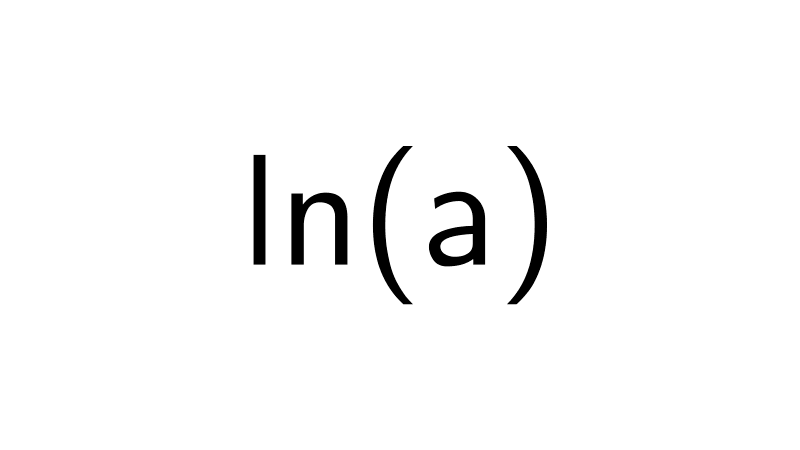
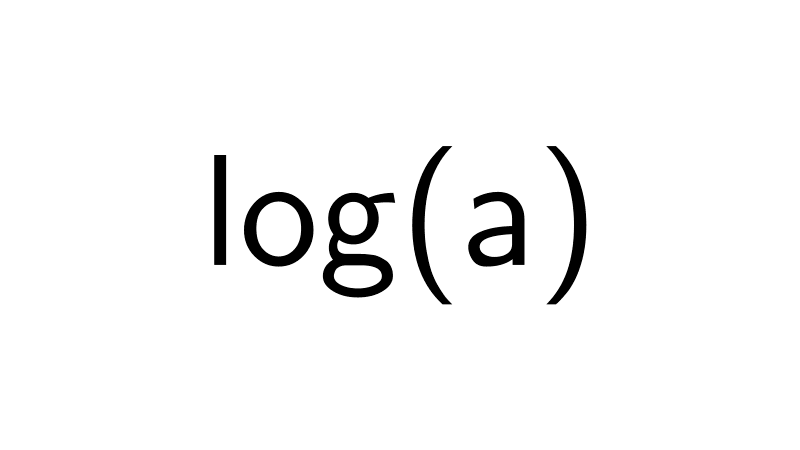
Note: On scientific calculators, the key for common logarithms (base 10) is labeled "log", and the key for natural logarithms (base e) is labeled "ln".
Example 2: Evaluate the base-8 logarithm of 15.
Solution: We want to find log8(15). Using the change of base formula to rewrite this expression as a common logarithm, we have:
$$\log_8(15)=\dfrac{\log_{10}(15)}{\log_{10}(8)}$$
$$\log_8(15)≈1.3023$$
Example 3: Evaluate log5(40) using natural logarithms.
Solution: Identifying that the original base is 5 and the argument is 40, we apply the change of base formula using the natural logarithm (base e):
$$\log_5(40)=\dfrac{\ln(40)}{\ln(5)}$$
$$\log_5(40)≈2.2920$$
We can check that this approximation is accurate since \(5^{2.2920}≈40.\)
Example 4: Find log6(216).
Solution: Converting the base-6 logarithm to a base-10 logarithm gives:
$$\log_6(216)=\dfrac{\log_{10}(216)}{\log_{10}(6)}$$
$$\log_6(216)=3$$
We verify that the answer is correct because \(6^3=216.\)
Example 5: Solve the equation \(3^x=1/9.\)
Solution: This exponential equation can be written in logarithmic form as \(x=\log_3(1/9),\) meaning we are looking for the exponent to which 3 must be raised to obtain 1/9. Since we cannot enter a base-3 logarithm directly on a standard calculator, we apply the change of base formula to rewrite it as a common logarithm:
$$\log_3(1/9)=\dfrac{\log_{10}(1/9)}{\log_{10}(3)}$$
$$\log_3(1/9)=-2$$
Therefore, \(x=-2.\) We confirm this is correct because \(3^{-2}=\dfrac{1}{9}.\)
Special Cases: Converting Between Specific Bases
The change of base formula is also handy for converting directly between natural logarithms, common logarithms, and base-2 (binary) logarithms. The following conversion formulas are particularly useful:
- Natural logarithm to common logarithm: \(\ln(a)=\dfrac{\log_{10}(a)}{\log_{10}(e)}\)
- Common logarithm to natural logarithm: \(\log_{10}(a)=\dfrac{\ln(a)}{\ln(10)}\)
- Base-2 logarithm to common logarithm: \(\log_2(a)=\dfrac{\log_{10}(a)}{\log_{10}(2)}\)
- Base-2 logarithm to natural logarithm: \(\log_2(a)=\dfrac{\ln(a)}{\ln(2)}\)
Proof of the Change of Base Formula
To prove that the change of base formula holds true, we begin with the definition of a logarithm:
\(\log_b(a)=x\) if and only if \(b^x=a\)
Next, we take the logarithm with a positive base c (where \(c \neq 1\)) of both sides of the exponential equation:
$$\log_c (b^x)=\log_c (a)$$
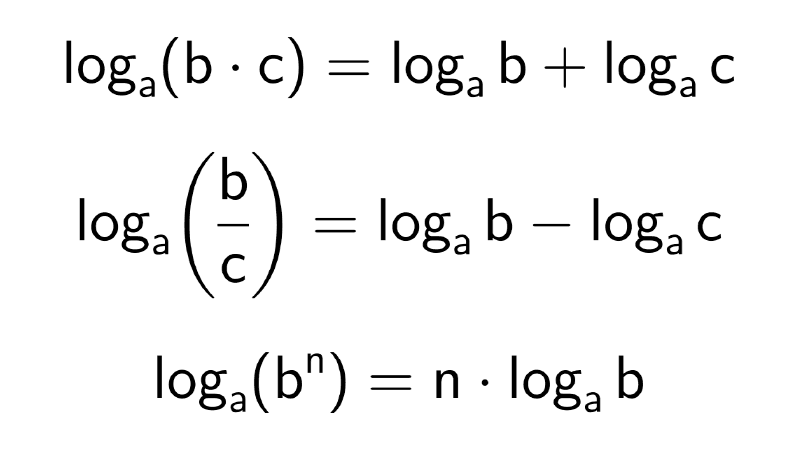
Applying the power rule of logarithms on the left side gives:
$$x\cdot \log_c (b)=\log_c (a)$$
Solving for x, we get:
$$x=\dfrac{\log_c (a)}{\log_c (b)}$$
Since we initially defined \(x=\log_b (a),\) substituting this back into the equation yields:
$$\log_b (a)=\dfrac{\log_c (a)}{\log_c (b)}$$
This completes the proof.
Did you find this useful? Rate it!
0.0 / 5 — 0 votes

HOW TO CITE THIS ARTICLE
Machado, D. (2026, November 26). Change of Base Formula for Logarithms. Flamath. https://en.flamath.com/logarithm-change-base-formula
Exponential Equations
Logarithmic Equations
Natural Logarithms
Common Logarithms
Properties of Logarithms
Leave a Reply
Related Articles