
Properties of Logarithms
The properties of logarithms are:
- The logarithm of a product is equal to the sum of the logarithms of its factors.
- The logarithm of a quotient is equal to the difference of the logarithms of the numerator and the denominator.
- The logarithm of a power is equal to the exponent times the logarithm of the base.
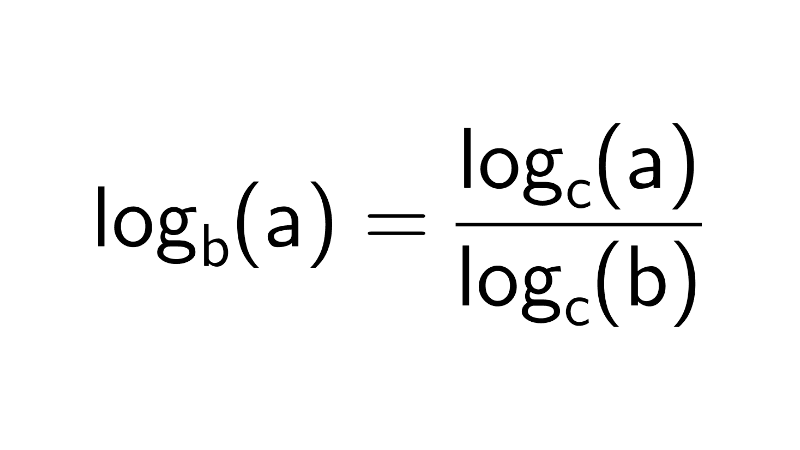
- A logarithm in any base can be expressed as a quotient of logarithms in another base.
- The logarithm of 1 in any base is always 0.
- The logarithm of the base is always 1.
Table of Contents
General Properties
Assuming that the base \(a > 0\) with \(a \neq 1\), and all arguments (\(b, c, x, y\)) are positive real numbers, the following fundamental laws follow directly from the definition of a logarithm:
- The logarithm of the base is equal to 1: \(\log_a{a}=1\)
- The logarithm of 1 in any base is 0: \(\log_a{1}=0\)
- Since the base-\(a\) logarithm of \(b\) is the exponent to which \(a\) must be raised to obtain \(b,\) it follows that: \(a^{\log_a{b}}=b\)
Logarithm of a Product and a Quotient
The logarithm of a product (Product Rule) is equal to the sum of the logarithms of its factors in the same base:
$$\log_a(b\cdot c)=\log_a{b}+\log_a{c}$$
Examples
\(\log_2(8\cdot 16)=\log_2{8}+\log_2{16}=3+4=7\)
\(\log_{10}\left(100\cdot \dfrac{1}{1000}\right)=\log_{10}{100}+\log_{10}{\dfrac{1}{1000}}=2-3=-1\)
The logarithm of a quotient (Quotient Rule) is equal to the difference of the logarithms of the dividend and the divisor:
$$\log_a\left(\dfrac{b}{c}\right)=\log_a{b}-\log_a{c}$$
Examples
\(\log_6\left(\dfrac{36}{1296}\right)=\log_6{36}-\log_6{1296}=2-4=-2\)
\(\log_2\left(\dfrac{64}{4}\right)=\log_2{64}-\log_2{4}=6-2=4\)
Condensing Logarithms (Sum and Difference of Logarithms)
From the previous properties, it follows that the sum or difference of logarithms with the same base can be condensed into the logarithm of a single product or quotient, respectively:
$$\log_a{b}+\log_a{c}=\log_a{(b\cdot c)}$$
$$\log_a{b}-\log_a{c}=\log_a\left(\dfrac{b}{c}\right)$$
Examples
\(\log_{10}{50}+\log_{10}{2}=\log_{10}(50\cdot 2)=\log_{10}{100}=2\)
\(\log_2{16}-\log_2{4}=\log_2\left(\dfrac{16}{4}\right)=\log_2{4}=2\)
Note: The logarithm of a sum or difference is not equal to the sum or difference of the logarithms:
$$\log_a(x+y)≠\log_a{x}+\log_a{y}$$
$$\log_a(x-y)≠\log_a{x}-\log_a{y}$$
Logarithm of a Power
The logarithm of a power (Power Rule) is equal to the product of the exponent and the logarithm of the base:
$$\log_a(b^n)=n\cdot \log_a{b}$$
Examples
\(\log_2(16^6)=6\cdot \log_2{16}=6\cdot 4=24\)
\(\log(100^{-7})=-7\cdot \log{100}=-7\cdot 2=-14\)
In addition to simplifying logarithmic expressions, the power rule is also very useful for solving exponential equations. When the unknown variable appears in an exponent, we can use this property to bring the exponent down and then isolate the variable.
Example
Solve \(2^x=1024\)
Using the property above, we can rewrite this equation by taking the logarithm of the same base on both sides. In this case, we will use common logarithms (base 10):
$$\log(2^x)=\log(1024)$$
$$x\cdot \log(2)=\log(1024)$$
At this point, the variable is no longer in the exponent, so we can solve for \(x\) to find its value:
$$x=\dfrac{\log(1024)}{\log(2)}$$
$$x=10$$
Logarithm of a Root
The logarithm of a root is equal to the logarithm of the radicand divided by the index of the root:
$$\log_a\sqrt[n]{b}=\dfrac{\log_a{b}}{n}$$
This rule follows directly from the power rule. Since \(\sqrt[n]{b}=b^{1/n},\) we have:
$$\log_a(\sqrt[n]{b})=\log_a(b^{1/n})=\dfrac{1}{n}\cdot \log_a{b}=\dfrac{\log_a{b}}{n}$$
Examples
\(\log_3{\sqrt{243}}=\dfrac{\log_3{243}}{2}=\dfrac{5}{2}\)
\(\log_5{\sqrt[3]{125}}=\dfrac{\log_5{125}}{3}=\dfrac{3}{3}=1\)
Change of Base Formula
The logarithm of a number in any base can be calculated from the logarithm of the same number in a different base by dividing it by the logarithm of the original base in the new base:
\(\log_a{b}=\dfrac{\log_k{b}}{\log_k{a}}\) where \(k\) is the new base
This property is especially useful when evaluating logarithms with scientific calculators, which typically only compute natural or common logarithms. The conversions are as follows:
$$\log_a{b}=\dfrac{\log{b}}{\log{a}}$$
$$\log_a{b}=\dfrac{\ln{b}}{\ln{a}}$$
Similarly, natural and common logarithms can be expressed in terms of each other:
$$\log{b}=\dfrac{\ln{b}}{\ln{10}}$$
$$\ln{b}=\dfrac{\log{b}}{\log{e}}$$
Examples
\(\log_2{512}=\dfrac{\log{512}}{\log{2}}=9\)
\(\log_5{125}=\dfrac{\ln{125}}{\ln{5}}=3\)
Did you find this useful? Rate it!
0.0 / 5 — 0 votes

HOW TO CITE THIS ARTICLE
Machado, D. (2026, November 25). Properties of Logarithms. Flamath. https://en.flamath.com/logarithm-properties
Exponential Equations
Logarithmic Equations
Natural Logarithms
Common Logarithms
Change of Base Formula for Logarithms
Leave a Reply
Related Articles