
Logarithms
In mathematics, a logarithm is the exponent to which a positive real number, called the base, must be raised to produce a given number, called the argument.
If we have an equation like x2 = 16, we can solve it using standard algebraic methods and find that x = ±4. However, when we encounter an expression such as 4x = 16, standard algebraic methods are no longer enough to isolate x. By trial and error, we can see that x equals 2, but with a more complicated equation, guessing is no longer practical.
To solve these situations, we use the concept of a logarithm, which consists of finding the exponent to which a base must be raised to obtain a given number.
Given an equation ax = b, where a and b are known numbers, the power to which a must be raised to get b is the logarithm base a of b. Symbolically:
loga b = x
This is read as "the logarithm base a of b is equal to x." The parts of a logarithm are the base (the number a), the argument (b), and the logarithm (x), which is also called the value or output of the logarithm. For example, log5 (125) is the exponent to which 5 must be raised to get 125; here, 5 is the base, 125 is the argument, and the value of the logarithm is 3, because 53 = 125.
However, a and b cannot be just any numbers; they have specific restrictions to avoid mathematical contradictions. The base a must be positive and not equal to 1. The argument b must be a positive number.
The first restriction exists because if the base were negative, we might try to use logarithms to solve an equation like (-2)x = 8, which has no solution in the real numbers. The base cannot be 1 either, since an expression like 1x = 18 has no solution—1 raised to any exponent always equals 1.
The second restriction follows directly from the first: with a positive base, there is no real exponent that can produce a negative result or zero. For instance, the equation 2x = -50 has no real solution.
Table of Contents
Formal Definition
The logarithm with a given base a (where a is positive and not equal to 1) of a positive number b is the exponent to which a must be raised to equal b. In symbols:
loga b = x if and only if ax = b
The equations ax = b and x = loga b are equivalent. Here, ax = b is called the exponential form, and x = loga b is called the logarithmic form. Because of this direct relationship, every property of exponents corresponds to a property of logarithms.
Converting between exponential and logarithmic forms is essential for evaluating expressions and solving equations. Notice how the base stays the same in both forms, while the exponent and the result switch places:
- From exponential to logarithmic form: Since 43 = 64, we can rewrite this as log4 64 = 3.
- From logarithmic to exponential form: Since log10 100 = 2, we can rewrite this as 102 = 100.
The value of a logarithm can be positive, negative, or zero. Let's look at a few examples:
To what power must 2 be raised to get 32? This question corresponds to the expression log2 32. The answer is 5, because 25 = 32. Therefore, log2 32 = 5.
To what exponent must 3 be raised to get 1/9? This is written as log3 (1/9). The result is -2, because 3-2 = 1/32 = 1/9. Therefore, log3 (1/9) = -2.
To what value must 5 be raised to get 1? That is, log5 1. The answer is zero, because any positive number raised to the zero power equals 1. Therefore, log5 1 = 0.
There are special cases where the value of a logarithm is immediate, one of which we just saw in the previous example:
- The logarithm of 1 in any valid base is equal to zero: loga 1 = 0 (since a0 = 1).
- The logarithm of the base itself is equal to 1: loga a = 1 (since a1 = a).
In general, a logarithm is positive when the argument is greater than 1, negative when the argument is between 0 and 1, and zero when the argument is 1. The logarithm of zero does not exist because no exponent can turn a positive base into zero.
More Examples:
- \(\log_3{9}=2\) because \(3^2=9\)
- \(\log_{10}{1000}=3\) because \(10^3=1000\)
- \(\log_2{\dfrac{1}{4}}=-2\) because \(2^{-2}=\dfrac{1}{4}\)
- \(\log_5{25}=2\) because \(5^2=25\)
- \(\log_5{0.04}=\log_5{\dfrac{1}{25}}=-2\) because \(5^{-2}=\dfrac{1}{25}=0.04\)
- \(\log_6{216}=3\) because \(6^3=216\)
- \(\log_2{64}=6\) because \(2^6=64\)
Years ago, finding logarithm values required looking them up in logarithm tables printed at the back of math textbooks. Today, any scientific calculator can compute logarithms instantly.
Applications of Logarithms
Logarithms have wide-ranging applications in mathematics, natural sciences, engineering, and many other fields. Some of their main uses include:
- Simplifying calculations: Logarithms allow us to turn exponentiation into multiplication and multiplication into addition, making it much easier to work with very large or complex numbers.
- Solving exponential equations: When a variable is in the exponent, logarithms can be used to bring it down and solve the equation.
- Logarithmic scales: In fields measuring quantities across vast ranges—such as pH levels, sound intensity (decibels), earthquake magnitude (Richter scale), or star brightness (apparent magnitude)—logarithmic scales are used to represent relationships clearly.
- Growth analysis: Logarithms are widely used to analyze and compare growth rates, especially in economics, finance, and demographics.
Types of Logarithms
Certain logarithms have special names depending on the base they use. The most common types are:
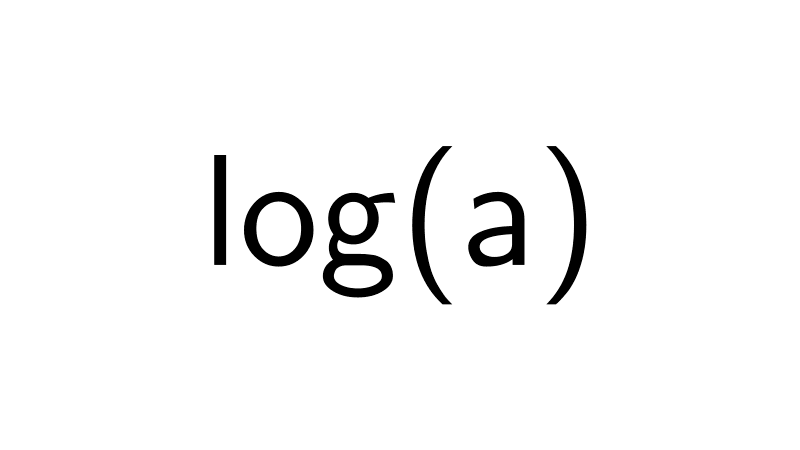
- Common logarithms (log): These have base 10. They are usually written simply as log without specifying the base: \(\log{b}\) is equivalent to \(\log_{10}{b}.\) They are also known as base-10 or decadic logarithms.
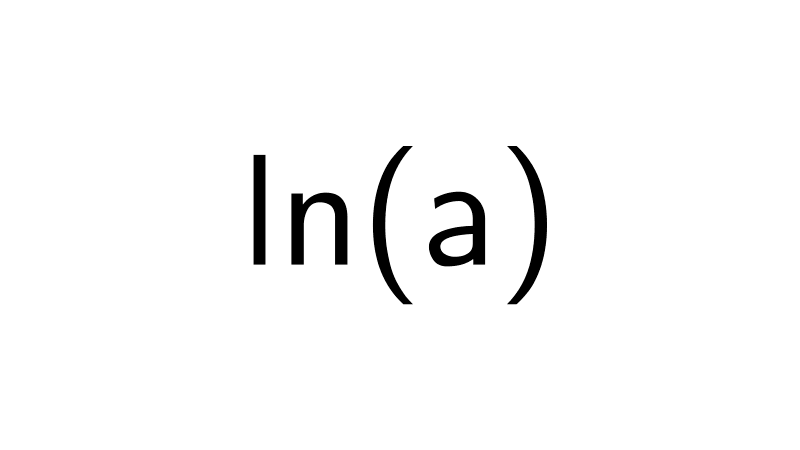
- Natural logarithms (ln): These have the irrational number \(e \approx 2.718281…\) as their base. They are written as ln without writing the base: \(\ln{b}\) is equivalent to \(\log_e{b}.\)
- Binary logarithms: These have base 2 and are written as \(\log_2{b}\) (or \(\lg{b}\) in computer science). They are primarily used in computer science and information theory.
Properties of Logarithms
Logarithms follow a set of rules that make them easier to manipulate and evaluate. Most of these properties come directly from exponent rules, since logarithms are exponents:
- The logarithm of the base is equal to 1: \(\log_a{a}=1\)
- The logarithm of 1 in any base is 0: \(\log_a{1}=0\)
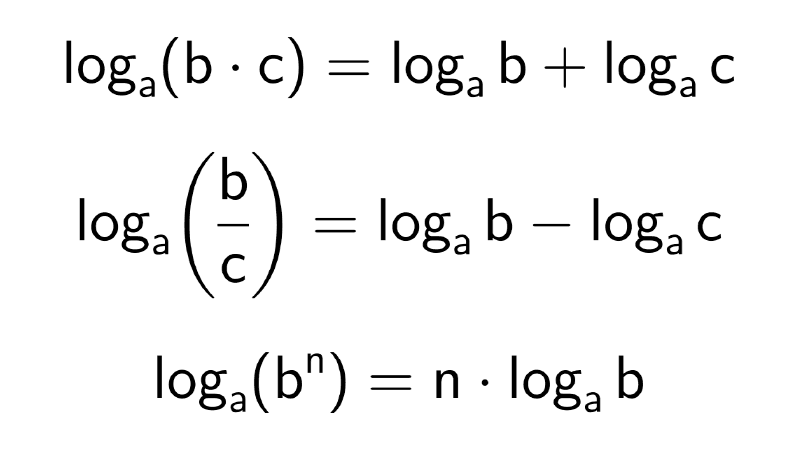
- Product Rule: The logarithm of a product is equal to the sum of the logarithms of its factors: \(\log_a(b\cdot c)=\log_a{b}+\log_a{c}\)
- Quotient Rule: The logarithm of a quotient is equal to the difference of the logarithms: \(\log_a\left(\dfrac{b}{c}\right)=\log_a{b}-\log_a{c}\)
- Power Rule: The logarithm of a power is equal to the exponent times the logarithm of the base: \(\log_a(b^n)=n\cdot \log_a{b}\)
- Since the logarithm base \(a\) of \(b\) is the exponent to which \(a\) must be raised to get \(b,\) it follows that: \(a^{\log_a{b}}=b\)
Change of Base Formula
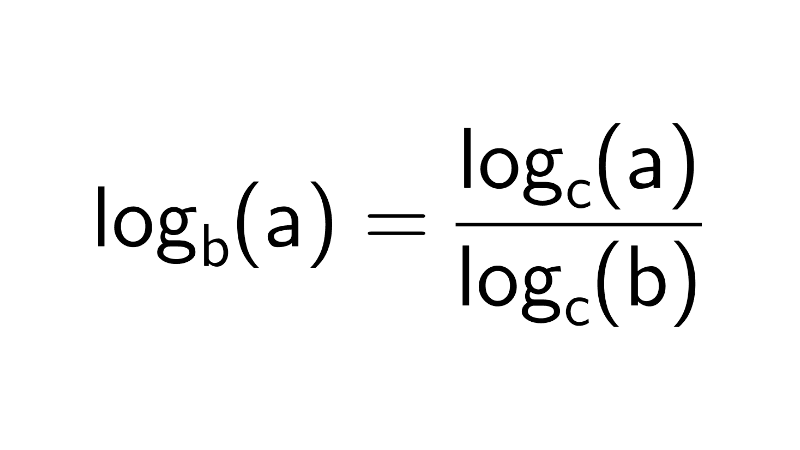
Earlier, we noted that scientific calculators can evaluate logarithms, but most calculators only have dedicated keys for common (base-10) and natural (base-e) logarithms. What if we need to evaluate a logarithm with a different base? The following formula allows us to convert a logarithm from one base into a logarithm of any other base:
\(\log_a{b}=\dfrac{\log_k{b}}{\log_k{a}}\) where \(k\) is the new base
To evaluate a binary logarithm on a calculator, for example, we can rewrite it in terms of common or natural logarithms using this formula:
$$\log_2{b}=\dfrac{\log{b}}{\log{2}}$$
$$\log_2{b}=\dfrac{\ln{b}}{\ln{2}}$$
Content on Logarithms
Did you find this useful? Rate it!
0.0 / 5 — 0 votes

HOW TO CITE THIS ARTICLE
Machado, D. (2026, November 25). Logarithms. Flamath. https://en.flamath.com/logarithms
Exponential Equations
Logarithmic Equations
Natural Logarithms
Common Logarithms
Change of Base Formula for Logarithms
Leave a Reply
Related Articles