
Propositional Logic Practice Problems
Below, we solve step-by-step a collection of propositional calculus practice problems: identifying statements, well-formed formulas (WFFs), translating English sentences into symbolic logic, constructing truth tables, applying logical equivalences, simplifying compound expressions, and testing argument validity.
Table of Contents
Basic Concepts
We recommend reviewing these articles to review the core concepts of propositional logic and see common solved problems:
Compound Propositions and Well-Formed Formulas (WFFs)
Problem 1
Determine which of the following expressions are propositions; for those that are, classify them as simple or compound.
- The capital of France is Paris.
- x + 5 = 10.
- It is not the case that the Sun revolves around the Earth.
- The number 7 is a prime number and 6 is composite.
- How old are you?
- If it rains, then we will have a good harvest.
- Close the door immediately!
- Either you study for the exam or you will fail the class.
- I wish tomorrow would be a sunny day.
- Wash the dishes and dry the silverware.
- 9 < 5.
- Give me a hand with this, please!
- The number 2 is even or the number 3 is odd.
Solutions
a) Analyzing the sentence "The capital of France is Paris", we identify that it is a declarative statement with a definite truth value (true); therefore, it is a simple proposition.
b) The expression "x + 5 = 10" contains a variable (x), so its truth value cannot be determined without assigning a value; consequently, it is not a proposition.
c) The phrase "It is not the case that the Sun revolves around the Earth" is a statement that negates an assertion; it has a definite truth value (true) and is a compound proposition (negation).
d) "The number 7 is a prime number and 6 is composite" is a statement composed of two simple propositions joined by the connective "and"; it has a definite truth value (true) and is a compound proposition (conjunction).
e) The expression "How old are you?" is a question; it neither asserts nor denies anything, so it is not a proposition.
f) "If it rains, then we will have a good harvest" is a conditional statement composed of two propositions; it has a definite truth value (dependent on facts) and is a compound proposition (conditional).
g) "Close the door immediately!" is a command, not a declarative statement with a truth value, so it is not a proposition.
h) "Either you study for the exam or you will fail the class" is a disjunctive statement composed of two propositions; it has a truth value and is a compound proposition (disjunction).
i) "I wish tomorrow would be a sunny day" expresses a wish, not an assertion that can be judged true or false; therefore, it is not a proposition.
j) "Wash the dishes and dry the silverware" is a compound instruction, not a declarative statement, so it is not a proposition.
k) "9 < 5" is a mathematical inequality with a definite truth value (false), and it is a simple proposition.
l) "Give me a hand with this, please!" is a request, not an assertion, so it is not a proposition.
m) "The number 2 is even or the number 3 is odd" is a statement composed of two propositions joined by "or" (inclusive disjunction); its truth value is true and it is a compound proposition.
Problem 2
Identify which of the following are valid formulas in logic (well-formed formulas or WFFs).
- (¬p) ∨ q
- p ∧ ∨ q
- p → (¬q ∨ r)
- ¬¬p
- (p ∧ q ∨) r
- ¬(p → (q ∧ ¬r))
- p → → q
- ((p ∨ q) ∧ (¬p ∨ ¬q))
- (p → (q → r)) → ((p → q) → (p → r))
- p ¬ ∧ q
- p ∧ (q ∨ r
- ¬(p ∧ ¬q) ↔ (p → q)
- p ∨ (q ∧ ∨ r)
Solutions
a) (¬p) ∨ q: is a well-formed formula; the parentheses around ¬p are redundant but not invalid (¬p ∨ q would also be correct).
b) p ∧ ∨ q: is not a well-formed formula because the binary connective ∧ is immediately followed by another binary connective ∨, without an operand between them.
c) p → (¬q ∨ r): is a well-formed formula; the structure follows the formation rules.
d) ¬¬p: is a well-formed formula; it applies negation twice to p.
e) (p ∧ q ∨) r: is not a well-formed formula because the connective ∨ appears after q without an operand to its right inside the subformula, nor is there an operator connecting that subformula to r.
f) ¬(p → (q ∧ ¬r)): is a well-formed formula; negation is properly applied to a compound formula.
g) p → → q: is not a well-formed formula because the connective → appears twice consecutively without an operand between them.
h) ((p ∨ q) ∧ (¬p ∨ ¬q)): is a well-formed formula; the parentheses are correct, though the outermost pair could be considered redundant.
i) (p → (q → r)) → ((p → q) → (p → r)): is a well-formed formula; it is a well-constructed instance of a logical principle.
j) p ¬ ∧ q: is not a well-formed formula because the negation symbol ¬ appears between p and ∧, violating the syntax.
k) p ∧ (q ∨ r: is not a well-formed formula because the closing parenthesis after r is missing, leaving the expression incomplete.
l) ¬(p ∧ ¬q) ↔ (p → q): is a well-formed formula; it is a well-constructed logical equivalence.
m) p ∨ (q ∧ ∨ r): is not a well-formed formula because inside the parentheses ∧ ∨ r appears, placing two consecutive binary connectives without an intervening operand.
Translating English Sentences into Propositional Logic
Problem 1
Translate the following natural language statements into the symbolic language of propositional logic.
- The door is closed, but the window is open.
- It is not true that the exam is tomorrow.
- If you finish your homework, you can go out to play.
- We will go to the mountains or we will stay at the beach.
- I will go to the party if you go as well.
- Either the team wins the game and celebrates, or they lose and are eliminated.
- It is neither cold nor hot.
- The sky is cloudy; however, it is not raining.
- In order for the engine to start, it is necessary to have fuel.
- If the traffic light is red or yellow, the car must stop.
- If you buy the ticket in advance, you will save money; but if you do not, you will pay more.
- In order to pass the course, it is necessary and sufficient that you submit the projects and pass the final exam.
- If you do not work hard, you will not make progress; and if you do not make progress, you will not reach your goals.
- If the witness tells the truth and the jury is impartial, the defendant will be released; however, the defendant will not be released.
- It is not the case that if the sun shines, then it is cold and the snow does not melt.
- If the budget is approved, then the bridge will be built if and only if the materials arrive on time.
Solutions
1) In the statement "The door is closed, but the window is open", we identify a conjunction; assigning p: "The door is closed", q: "The window is open", we symbolize it as p ∧ q, where "but" functions logically as "and".
2) In "It is not true that the exam is tomorrow", we identify a negation; letting p: "The exam is tomorrow", we symbolize it as ¬p.
3) In "If you finish your homework, you can go out to play", we identify a conditional statement; letting p: "You finish your homework", q: "You can go out to play", we symbolize it as p → q, where p is the hypothesis (antecedent) and q is the conclusion (consequent).
4) In "We will go to the mountains or we will stay at the beach", we identify an inclusive disjunction; letting p: "We will go to the mountains", q: "We will stay at the beach", we symbolize it as p ∨ q.
5) In "I will go to the party if you go as well", we identify a conditional statement where the consequent appears first in the sentence; letting p: "You go to the party", q: "I will go to the party", we symbolize it as p → q, since "q if p" is logically equivalent to "If p, then q".
6) In "Either the team wins the game and celebrates, or they lose and are eliminated", we identify an exclusive disjunction ("either... or...") between two conjunctions; letting p: "The team wins the game", q: "The team celebrates", r: "The team loses the game", s: "The team is eliminated", we symbolize it as (p ∧ q) ⊻ (r ∧ s). Note: "losing" is not necessarily equivalent to "not winning" (¬p), as a tie could occur.
7) In "It is neither cold nor hot", we identify a joint negation, equivalent to "It is not cold and it is not hot"; letting p: "It is cold", q: "It is hot", we symbolize it as ¬p ∧ ¬q.
8) In "The sky is cloudy; however, it is not raining", we identify a conjunction with contrast; letting p: "The sky is cloudy", q: "It is raining", we symbolize it as p ∧ ¬q, since "however" is logically equivalent to "and".
9) In "In order for the engine to start, it is necessary to have fuel", we identify a necessary condition; letting p: "The engine starts", q: "The engine has fuel", we symbolize it as p → q, because "q is necessary for p" means "if p, then q".
10) In "If the traffic light is red or yellow, the car must stop", we identify a conditional statement with a disjunctive antecedent; letting p: "The traffic light is red", q: "The traffic light is yellow", r: "The car must stop", we symbolize it as (p ∨ q) → r.
11) In "If you buy the ticket in advance, you will save money; but if you do not, you will pay more", we identify a conjunction of two conditional statements; letting p: "You buy the ticket in advance", q: "You will save money", r: "You will pay more", we symbolize it as (p → q) ∧ (¬p → r).
12) In "In order to pass the course, it is necessary and sufficient that you submit the projects and pass the final exam", we identify a biconditional where the condition is a conjunction; letting p: "You pass the course", q: "You submit the projects", r: "You pass the final exam", we symbolize it as p ↔ (q ∧ r).
13) In "If you do not work hard, you will not make progress; and if you do not make progress, you will not reach your goals", we identify a conjunction of two chained conditional statements; letting p: "You work hard", q: "You make progress", r: "You reach your goals", we symbolize it as (¬p → ¬q) ∧ (¬q → ¬r).
14) In "If the witness tells the truth and the jury is impartial, the defendant will be released; however, the defendant will not be released", we identify a conjunction where the first component is a conditional statement and the second negates its consequent; letting p: "The witness tells the truth", q: "The jury is impartial", r: "The defendant will be released", we symbolize it as ((p ∧ q) → r) ∧ ¬r.
15) In "It is not the case that if the sun shines, then it is cold and the snow does not melt", we identify the negation of a conditional whose consequent is a conjunction; letting p: "The sun shines", q: "It is cold", r: "The snow melts", we symbolize it as ¬(p → (q ∧ ¬r)).
16) In "If the budget is approved, then the bridge will be built if and only if the materials arrive on time", we identify a conditional whose consequent is a biconditional; letting p: "The budget is approved", q: "The bridge will be built", r: "The materials arrive on time", we symbolize it as p → (q ↔ r).
Problem 2
Given the following propositions:
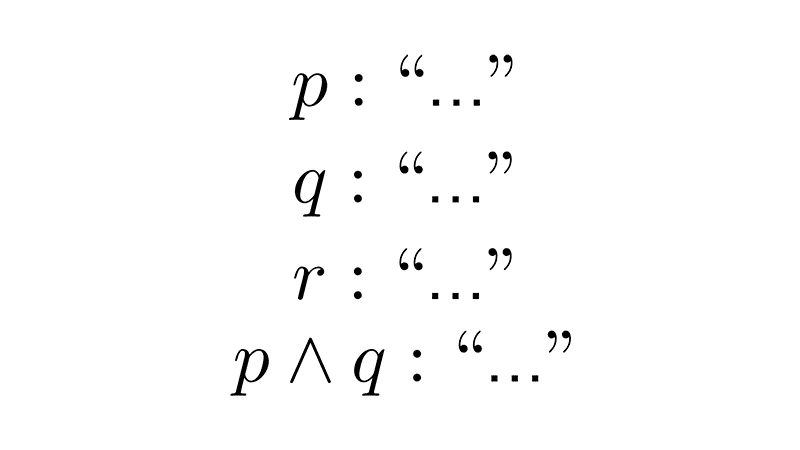
p: "Anna is at the gym"
q: "Brian is swimming"
r: "Claire plays tennis"
Translate each of the following formulas into natural English sentences:
- p ∧ q
- ¬r
- p → q
- q ∨ r
- ¬p ∧ ¬q
- r ↔ ¬p
- ¬(q ∧ r)
- p → (q ∨ r)
- (p ∧ ¬q) → r
- ¬p ↔ (¬q ∧ ¬r)
Solutions
- p ∧ q: "Anna is at the gym and Brian is swimming"
- ¬r: "Claire does not play tennis"
- p → q: "If Anna is at the gym, then Brian is swimming"
- q ∨ r: "Brian is swimming or Claire plays tennis"
- ¬p ∧ ¬q: "Anna is not at the gym and Brian is not swimming"
- r ↔ ¬p: "Claire plays tennis if and only if Anna is not at the gym"
- ¬(q ∧ r): "It is not the case that Brian is swimming and Claire plays tennis"
- p → (q ∨ r): "If Anna is at the gym, then Brian is swimming or Claire plays tennis"
- (p ∧ ¬q) → r: "If Anna is at the gym and Brian is not swimming, then Claire plays tennis"
- ¬p ↔ (¬q ∧ ¬r): "Anna is not at the gym if and only if Brian is not swimming and Claire does not play tennis"
Determining Truth Values
Problem 1
Let p = T, q = F, and r = T. Determine the truth value of each of the following compound propositions:
- p ∧ q
- p ∨ r
- p → q
- ¬r ↔ q
- ¬(q ∨ r)
- (p ∧ ¬q) → r
- q ⊻ p
- (p → q) ∨ (r → q)
- ¬(p ∧ r) → ¬q
- (p ↔ r) ∧ (q → ¬p)
Solutions
1) p ∧ q: With p = T and q = F, the conjunction is false because it requires both components to be true. Result: F.
2) p ∨ r: With p = T and r = T, the inclusive disjunction is true when at least one component is true. Result: T.
3) p → q: With antecedent p = T and consequent q = F, the conditional statement is false. Result: F.
4) ¬r ↔ q: We evaluate ¬r (since r = T, ¬r = F) and evaluate the biconditional with q = F; it is true if both truth values match (F ↔ F). Result: T.
5) ¬(q ∨ r): We evaluate q ∨ r (F ∨ T = T) and negate it: ¬T = F. Result: F.
6) (p ∧ ¬q) → r: We evaluate ¬q (¬F = T), then p ∧ ¬q (T ∧ T = T); with antecedent T and consequent r = T, the conditional T → T is true. Result: T.
7) q ⊻ p: The exclusive disjunction is true when the truth values differ; with q = F and p = T (F ⊻ T), they are different. Result: T.
8) (p → q) ∨ (r → q): We evaluate p → q (T → F = F) and r → q (T → F = F); then the disjunction F ∨ F is false. Result: F.
9) ¬(p ∧ r) → ¬q: We evaluate p ∧ r (T ∧ T = T), then ¬(p ∧ r) = ¬T = F; we evaluate ¬q = ¬F = T; the conditional F → T is true. Result: T.
10) (p ↔ r) ∧ (q → ¬p): We evaluate p ↔ r (T ↔ T = T); we evaluate ¬p = ¬T = F, then q → ¬p (F → F = T); the conjunction T ∧ T is true. Result: T.
Problem 2
- Given that p ∧ q is true, determine the truth value of p → q.
- Assuming that p ∨ q is false, what must be the truth value of ¬p ∧ ¬q?
- When p → q is false, what is the resulting truth value of p ↔ q?
- If p ↔ q is true and p is false, deduce the truth value of q.
- If p ⊻ q (exclusive disjunction) is true, what is the truth value of ¬p ↔ q?
- If ¬(p ∧ q) is true, what is the truth value of ¬p ∨ ¬q?
- Knowing that p → q is true and q is false, what can be concluded about p?
- Given that (p ∧ q) → r is false, infer the truth value of r.
Solutions
1) Given that p ∧ q is true, this implies that p = T and q = T; therefore, p → q is T → T, which is true.
2) If p ∨ q is false, then p = F and q = F; consequently, ¬p = T and ¬q = T, so ¬p ∧ ¬q is T ∧ T, which is true.
3) If p → q is false, this occurs only when p = T and q = F; therefore, p ↔ q is T ↔ F, which is false.
4) If p ↔ q is true and p is false (p = F), for the biconditional to be true, q must match p; that is, q = F.
5) If p ⊻ q is true, it means that p and q have different truth values. If we assume p = T and q = F, then ¬p = F, and ¬p ↔ q is F ↔ F, which is true; if we assume p = F and q = T, then ¬p = T, and T ↔ T is also true; in both cases the equivalence is true, so ¬p ↔ q is true regardless of the assignment.
6) If ¬(p ∧ q) is true, then p ∧ q is false; by De Morgan's laws, ¬p ∨ ¬q is logically equivalent to ¬(p ∧ q), so it is also true.
7) If p → q is true and q is false (q = F), for the conditional to be true, the antecedent p cannot be true (since T → F would be false); therefore, p must be false.
8) If (p ∧ q) → r is false, the only case in which a conditional is false is when the antecedent is true and the consequent is false; therefore, p ∧ q = T and r = F; thus, r is false.
Problem 3
- What condition must p and q satisfy for the formula (p → q) ∧ (q → p) to be false?
- Determine the truth values of p and q that make the formula [(q ↔ p) ∧ ¬q] → (p ∧ ¬q) false.
- Under what combination of truth values for p, q, and r is the proposition (p ∧ q) → (¬r ∧ q) false?
- What logical relationship must hold between p and q for the biconditional p ↔ (p ∧ q) to be true?
- Is there any combination of truth values for p and q that makes the formula ¬(p ∨ q) ↔ (¬p ∧ ¬q) false?
Solutions
1) The formula (p → q) ∧ (q → p) is false if at least one of the two conditionals is false. p → q is false only if p = T and q = F. q → p is false only if q = T and p = F. Therefore, the conjunction is false whenever p and q have different truth values (p = T, q = F or p = F, q = T).
2) For [(q ↔ p) ∧ ¬q] → (p ∧ ¬q) to be false, the antecedent must be true and the consequent must be false. The antecedent (q ↔ p) ∧ ¬q is true only if q ↔ p = T and ¬q = T (that is, q = F). If q = F, then q ↔ p = T implies p = F. With p = F and q = F, the consequent p ∧ ¬q is F ∧ T = F. Therefore, the combination p = F and q = F makes the formula false.
3) The proposition (p ∧ q) → (¬r ∧ q) is false only when the antecedent p ∧ q is true and the consequent ¬r ∧ q is false. For p ∧ q = T, we require p = T and q = T. With q = T, the consequent ¬r ∧ q becomes ¬r ∧ T, which is false only if ¬r is false, meaning r = T. Therefore, the combination that makes the formula false is p = T, q = T, and r = T.
4) For p ↔ (p ∧ q) to be true, p and p ∧ q must share the same truth value. If p is false, p ∧ q is also false, making the biconditional true. If p is true, then p ∧ q is true only if q is true. Therefore, the formula is true whenever p is false, or whenever both p and q are true. Equivalently, it is true as long as it is not the case that p is true and q is false.
5) The formula ¬(p ∨ q) ↔ (¬p ∧ ¬q) is a tautology (one of De Morgan's laws), meaning it is true for every combination of truth values of p and q. Therefore, there is no combination that makes it false.
Truth Tables for Compound Statements
Construct the truth tables for the following propositions and determine whether they are tautologies, contingencies, or contradictions.
- (p ∧ q) → p
- (¬p ∧ q) ↔ (q ∨ ¬q)
- ¬(p ∧ q → p)
- (¬p ∧ q) → r
- (p → q) ∧ (q → r) → (p → r)
Solution 1
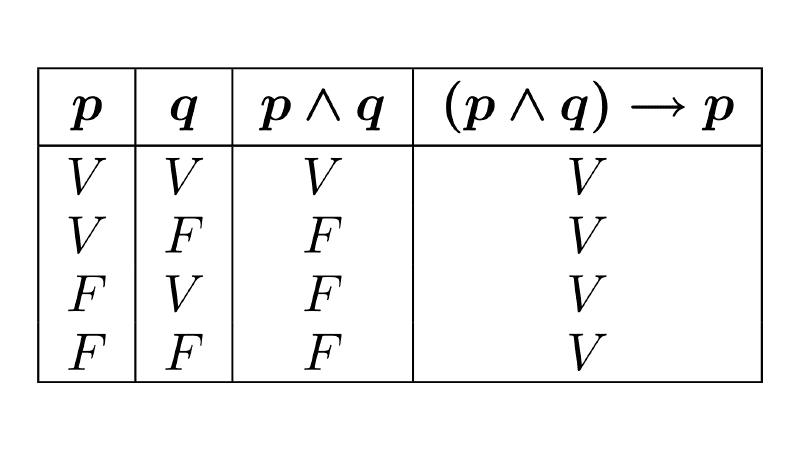
| p | q | p ∧ q | (p ∧ q) → p |
|---|---|---|---|
| T | T | T | T |
| T | F | F | T |
| F | T | F | T |
| F | F | F | T |
This statement is a tautology.
Solution 2
| p | q | ¬p | ¬q | ¬p ∧ q | q ∨ ¬q | (¬p ∧ q) ↔ (q ∨ ¬q) |
|---|---|---|---|---|---|---|
| T | T | F | F | F | T | F |
| T | F | F | T | F | T | F |
| F | T | T | F | T | T | T |
| F | F | T | T | F | T | F |
This statement is a contingency.
Solution 3
| p | q | p ∧ q | p ∧ q → p | ¬(p ∧ q → p) |
|---|---|---|---|---|
| T | T | T | T | F |
| T | F | F | T | F |
| F | T | F | T | F |
| F | F | F | T | F |
This statement is a contradiction.
Solution 4
| p | q | r | ¬p | ¬p ∧ q | (¬p ∧ q ) → r |
|---|---|---|---|---|---|
| T | T | T | F | F | T |
| T | T | F | F | F | T |
| T | F | T | F | T | T |
| T | F | F | F | F | T |
| F | T | T | T | T | T |
| F | T | F | T | T | F |
| F | F | T | T | F | T |
| F | F | F | T | F | T |
This statement is a contingency.
Solution 5
| p | q | r | p → q | q → r | p → r | (p → q) ∧ (q → r) | [(p → q) ∧ (q → r)] → (p → r) |
|---|---|---|---|---|---|---|---|
| T | T | T | T | T | T | T | T |
| T | T | F | T | F | F | F | T |
| T | F | T | F | T | T | F | T |
| T | F | F | F | T | F | F | T |
| F | T | T | T | T | T | T | T |
| F | T | F | T | F | T | F | T |
| F | F | T | T | T | T | T | T |
| F | F | F | T | T | T | T | T |
This statement is a tautology.
Recommended:
Logical Equivalences
Prove the following logical equivalences:
- ¬¬p ≡ p
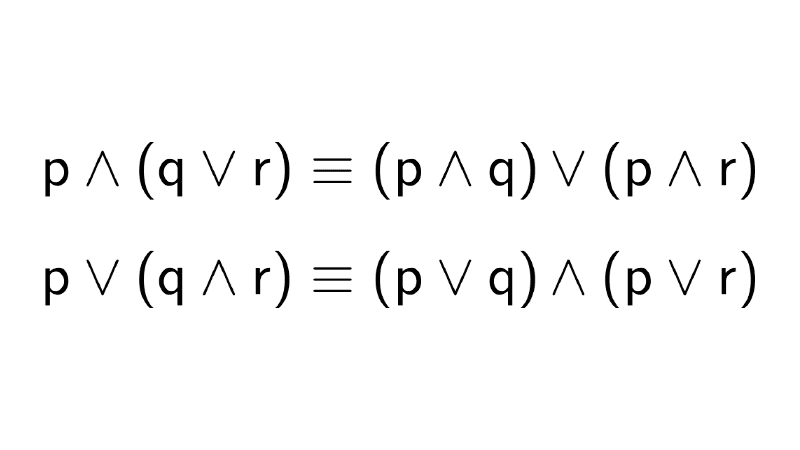
- p ∧ (q ∨ r) ≡ (p ∧ q) ∨ (p ∧ r)
- ¬(p ∧ q) ≡ ¬p ∨ ¬q
- ¬(p ∨ q) ≡ ¬p ∧ ¬q
- p → q ≡ ¬p ∨ q
- p ↔ q ≡ (p → q) ∧ (q → p)
To prove that A ≡ B, we can construct a truth table to verify that A ↔ B is always true (a tautology).
Solution 1
| p | ¬p | ¬¬p | ¬¬p ↔ p |
|---|---|---|---|
| T | F | T | T |
| F | T | F | T |
Solution 2
| p | q | r | q ∨ r | p ∧ (q ∨ r) | p ∧ q | p ∧ r | (p ∧ q) ∨ (p ∧ r) | [p ∧ (q ∨ r)] ↔ [(p ∧ q) ∨ (p ∧ r)] |
|---|---|---|---|---|---|---|---|---|
| T | T | T | T | T | T | T | T | T |
| T | T | F | T | T | T | F | T | T |
| T | F | T | T | T | F | T | T | T |
| T | F | F | F | F | F | F | F | T |
| F | T | T | T | F | F | F | F | T |
| F | T | F | T | F | F | F | F | T |
| F | F | T | T | F | F | F | F | T |
| F | F | F | F | F | F | F | F | T |
Solution 3
| p | q | p ∧ q | ¬(p ∧ q) | ¬p | ¬q | ¬p ∨ ¬q | [¬(p ∧ q)] ↔ [¬p ∨ ¬q] |
|---|---|---|---|---|---|---|---|
| T | T | T | F | F | F | F | T |
| T | F | F | T | F | T | T | T |
| F | T | F | T | T | F | T | T |
| F | F | F | T | T | T | T | T |
Solution 4
| p | q | p ∨ q | ¬(p ∨ q) | ¬p | ¬q | ¬p ∧ ¬q | [¬(p ∨ q)] ↔ [¬p ∧ ¬q] |
|---|---|---|---|---|---|---|---|
| T | T | T | F | F | F | F | T |
| T | F | T | F | F | T | F | T |
| F | T | T | F | T | F | F | T |
| F | F | F | T | T | T | T | T |
Solution 5
| p | q | p → q | ¬p | ¬p ∨ q | (p → q) ↔ (¬p ∨ q) |
|---|---|---|---|---|---|
| T | T | T | F | T | T |
| T | F | F | F | F | T |
| F | T | T | T | T | T |
| F | F | T | T | T | T |
Solution 6
| p | q | p ↔ q | p → q | q → p | (p → q) ∧ (q → p) | [p ↔ q] ↔ [ (p → q) ∧ (q → p)] |
|---|---|---|---|---|---|---|
| T | T | T | T | T | T | T |
| T | F | F | F | V | F | T |
| F | T | F | T | F | F | T |
| F | F | T | T | T | T | T |
Simplifying Propositions Using Logical Equivalences
Simplify the following propositional formulas to their simplest form using the laws of propositional logic.
- (p ∧ p) ∨ q
- ¬(¬p ∧ q) ∧ p
- (p ∨ q) ∧ (p ∨ ¬q)
- p → (p ∧ q)
- (p ∧ q) ∨ (p ∧ ¬q)
- ¬(p → ¬q)
- [p ∧ (q ∨ p)] ∨ q
- ¬(¬p ∨ ¬q)
- (p ∨ q) ∧ ¬(¬p ∧ ¬q)
- (p ∨ T) ∧ (q ∨ F) (Note: T represents a tautology and F represents a contradiction)
Solution 1
(p ∧ p) ∨ q
≡ p ∨ q (Idempotent law: p ∧ p ≡ p)
Solution 2
¬(¬p ∧ q) ∧ p
≡ (¬¬p ∨ ¬q) ∧ p (De Morgan's law)
≡ (p ∨ ¬q) ∧ p (Double negation: ¬¬p ≡ p)
≡ p ∧ (p ∨ ¬q) (Commutative law of ∧)
≡ p (Absorption law: p ∧ (p ∨ ¬q) ≡ p)
Solution 3
(p ∨ q) ∧ (p ∨ ¬q)
≡ p ∨ (q ∧ ¬q) (Distributive law of ∨ over ∧)
≡ p ∨ F (Negation/Complement law: q ∧ ¬q ≡ F)
≡ p (Identity law: p ∨ F ≡ p)
Solution 4
p → (p ∧ q)
≡ ¬p ∨ (p ∧ q) (Conditional/Implication law: p → r ≡ ¬p ∨ r)
≡ (¬p ∨ p) ∧ (¬p ∨ q) (Distributive law of ∨ over ∧)
≡ T ∧ (¬p ∨ q) (Negation/Complement law: ¬p ∨ p ≡ T)
≡ ¬p ∨ q (Identity law: T ∧ r ≡ r)
≡ p → q (Conditional/Implication law)
Solution 5
(p ∧ q) ∨ (p ∧ ¬q)
≡ p ∧ (q ∨ ¬q) (Distributive law of ∧ over ∨)
≡ p ∧ T (Negation/Complement law: q ∨ ¬q ≡ T)
≡ p (Identity law: p ∧ T ≡ p)
Solution 6
¬(p → ¬q)
≡ ¬(¬p ∨ ¬q) (Conditional/Implication law: p → ¬q ≡ ¬p ∨ ¬q)
≡ ¬¬p ∧ ¬¬q (De Morgan's law)
≡ p ∧ q (Double negation law)
Solution 7
[p ∧ (q ∨ p)] ∨ q
≡ [p ∧ (p ∨ q)] ∨ q (Commutative law of ∨)
≡ p ∨ q (Absorption law: p ∧ (p ∨ q) ≡ p, then p ∨ q)
Solution 8
¬(¬p ∨ ¬q)
≡ ¬¬p ∧ ¬¬q (De Morgan's law)
≡ p ∧ q (Double negation law)
Solution 9
(p ∨ q) ∧ ¬(¬p ∧ ¬q)
≡ (p ∨ q) ∧ (¬¬p ∨ ¬¬q) (De Morgan's law)
≡ (p ∨ q) ∧ (p ∨ q) (Double negation law)
≡ p ∨ q (Idempotent law)
Solution 10
(p ∨ T) ∧ (q ∨ F)
≡ T ∧ q (Domination law: p ∨ T ≡ T; Identity law: q ∨ F ≡ q)
≡ q (Identity law: T ∧ q ≡ q)
Rules of Inference & Valid Arguments
Problem 1
Translate the following arguments into symbolic logic and determine whether they are valid or invalid.
- If I cook, I will be able to eat. I cooked. Therefore, I will be able to eat.
- If I study hard, I pass the exam. I do not study hard. Therefore, I do not pass the exam.
- If the team plays well, they win the game. If they win the game, there is a party. Thus, if the team plays well, there is a party.
- Either we go to the movies or to the restaurant. We do not go to the movies. Therefore, we go to the restaurant.
- If the traffic light is red, the cars stop. The cars stop. Therefore, the traffic light is red.
- If it is sunny, I wear sunglasses. I am not wearing sunglasses. Therefore, it is not sunny.
- If I press this button, the light turns on. If the light turns on, I can read. I cannot read. Therefore, I did not press the button.
- If the food is poisoned, the dog does not eat it. The dog does not eat the food. Therefore, the food is poisoned.
- If it is the weekend, I sleep late. If I sleep late, I eat breakfast at noon. I do not eat breakfast at noon. Thus, it is not the weekend.
- If today is Tuesday, tomorrow is Wednesday. Tomorrow is not Wednesday. Therefore, today is not Tuesday.
- If I go to the doctor, then he will prescribe medicine. If he prescribes medicine, I will get better. I will not get better or I must pay the bill. I go to the doctor. Therefore, I must pay the bill.
- Either I study logic or I study mathematics. If I study logic, then I understand arguments. If I study mathematics, then I solve problems. I do not understand arguments. Therefore, I solve problems.
- If it is cold, then I wear a coat. If I wear a coat, then I am not cold or I am fashionable. I am cold. It is cold. Therefore, I am fashionable.
- If I save money, I will travel in the summer. If I travel in the summer, I will learn a language. Either I do not learn a language or I will meet new people. I save money. Therefore, I will meet new people.
Solution 1
Let p: "I cook", q: "I can eat".
The argument is: If I cook, I will be able to eat (p → q). I cooked (p). Therefore, I will be able to eat (q).
Formally: [(p → q) ∧ p] → q.
This corresponds to modus ponens, a valid rule of inference. Therefore, the argument is valid.
Solution 2
Let p: "I study hard", q: "I pass the exam".
The argument is: If I study hard, I pass the exam (p → q). I do not study hard (¬p). Therefore, I do not pass the exam (¬q).
Formally: [(p → q) ∧ ¬p] → ¬q.
This is the fallacy of denying the antecedent, which is not a valid rule of inference. A counterexample: if q is true even when p is false, the premises would be true but the conclusion false. Therefore, the argument is invalid.
Solution 3
Let p: "The team plays well", q: "The team wins the game", r: "There is a party".
The argument is: If the team plays well, then they win the game (p → q). If they win the game, then there is a party (q → r). Thus, if the team plays well, then there is a party (p → r).
Formally: [(p → q) ∧ (q → r)] → (p → r).
This corresponds to the law of hypothetical syllogism, a valid rule of inference. Therefore, the argument is valid.
Solution 4
Let p: "We go to the movies", q: "We go to the restaurant".
The argument is: Either we go to the movies or to the restaurant (p ∨ q). We do not go to the movies (¬p). Therefore, we go to the restaurant (q).
Formally: [(p ∨ q) ∧ ¬p] → q.
This corresponds to disjunctive syllogism, which is valid. Therefore, the argument is valid.
Solution 5
Let p: "The traffic light is red", q: "The cars stop".
The argument is: If the traffic light is red, the cars stop (p → q). The cars stop (q). Therefore, the traffic light is red (p).
Formally: [(p → q) ∧ q] → p.
This is the fallacy of affirming the consequent, which is not valid. A counterexample: the cars could stop for another reason (for example, a pedestrian) even if the light is not red. Therefore, the argument is invalid.
Solution 6
Let p: "It is sunny", q: "I wear sunglasses".
The argument is: [(p → q) ∧ ¬q] → ¬p.
This corresponds to modus tollens, a valid rule of inference. Therefore, the argument is valid.
Solution 7
Let p: "I press this button", q: "The light turns on", r: "I can read".
The argument is: [(p → q) ∧ (q → r) ∧ ¬r] → ¬p.
Applying modus tollens to (q → r) and ¬r yields ¬q. Then, applying modus tollens to (p → q) and ¬q yields ¬p. This chain of inferences is valid. Therefore, the argument is valid.
Solution 8
Let p: "The food is poisoned", q: "The dog does not eat the food".
The argument is: [(p → q) ∧ q] → p.
This is the fallacy of affirming the consequent, which is invalid. The dog might not eat for other reasons. Therefore, the argument is invalid.
Solution 9
Let p: "It is the weekend", q: "I sleep late", r: "I eat breakfast at noon".
The argument is: [(p → q) ∧ (q → r) ∧ ¬r] → ¬p.
Applying modus tollens to (q → r) and ¬r yields ¬q. Then, applying modus tollens to (p → q) and ¬q yields ¬p. This inference is valid. Therefore, the argument is valid.
Solution 10
Let p: "Today is Tuesday", q: "Tomorrow is Wednesday".
The argument is: [(p → q) ∧ ¬q] → ¬p.
This is modus tollens, a valid rule. Therefore, the argument is valid.
Solution 11
Let p: "I go to the doctor", q: "He will prescribe medicine", r: "I will get better", s: "I must pay the bill".
The argument is: [(p → q) ∧ (q → r) ∧ (¬r ∨ s) ∧ p] → s.
From p and p → q, we infer q (modus ponens). From q and q → r, we infer r (modus ponens). From r and ¬r ∨ s, we infer s (by disjunctive syllogism, since r makes the first disjunct (¬r) false, forcing s to be true). Therefore, the argument is valid.
Solution 12
Let p: "I study logic", q: "I study mathematics", r: "I understand arguments", s: "I solve problems".
The argument is: [(p ∨ q) ∧ (p → r) ∧ (q → s) ∧ ¬r] → s.
From ¬r and p → r, by modus tollens, we infer ¬p. From ¬p and p ∨ q, by disjunctive syllogism, we infer q. From q and q → s, by modus ponens, we infer s. Therefore, the argument is valid.
Solution 13
Let p: "It is cold", q: "I wear a coat", r: "I am cold", s: "I am fashionable".
The argument is: [(p → q) ∧ (q → (¬r ∨ s)) ∧ r ∧ p] → s.
From p and p → q, we infer q. From q and q → (¬r ∨ s), we infer ¬r ∨ s. From r, we have that ¬r is false; therefore, for ¬r ∨ s to be true, s must be true. This is a valid application of disjunctive syllogism. Therefore, the argument is valid.
Solution 14
Let p: "I save money", q: "I will travel in the summer", r: "I will learn a language", s: "I will meet new people".
The argument is: [(p → q) ∧ (q → r) ∧ (¬r ∨ s) ∧ p] → s.
This argument has the exact same logical structure as Problem 11; therefore, it is valid.
Problem 2
Deduce the conclusion of the following arguments.
- If John studies every day, then he will pass the exam. If he passes the exam, his parents will give him a bicycle. John studies every day. What will John receive from his parents?
- The will is in the study or it is in the safe. If it were in the study, the secretary would have seen it. The secretary states that she did not see any document. Where is the will?
- If the suspect escaped through the window, there are footprints in the garden. If there are footprints in the garden, the dog would have barked. The dog remained completely silent all night. Did the suspect escape through the window?
- The problem with the car is the battery or it is the alternator. If it were the battery, the headlights would be dim. The headlights shine at full brightness. What is the problem with the car?
- If the clinic is open, Dr. Garcia is in his office. If Dr. Garcia is in his office, his car is in the parking lot. The parking lot is completely empty. Is the clinic open?
- Either we cook pasta or we order pizza. If we cook pasta, it will take an hour. We are starving and cannot wait an hour. What will we end up eating?
- If the planet has liquid water, it could support life. If it could support life, it is a high-priority target for NASA. Telescopes confirm that the planet has liquid water. Is the planet a high-priority target?
- If a triangle is equilateral, then it has three 60° angles. Triangle ABC has a 90° angle. Is triangle ABC equilateral?
Solution 1
By modus ponens, since John studies every day (confirmed), he will pass the exam. Then, applying modus ponens again, if he passes the exam, his parents will give him a bicycle. Therefore, we conclude that John will receive a bicycle from his parents. Hypothetical syllogism could also have been applied directly.
Solution 2
The will is either in the study or in the safe. If it were in the study, the secretary would have seen it; but the secretary states she did not see it, so by modus tollens, it is not in the study. Then, by disjunctive syllogism, the will is in the safe.
Solution 3
If the suspect escaped through the window, then there would be footprints in the garden. If there were footprints, the dog would have barked. The dog remained silent, so by modus tollens applied to the second conditional, there are no footprints in the garden. Then, applying modus tollens to the first conditional, the suspect did not escape through the window.
Solution 4
The problem is either the battery or the alternator. If it were the battery, the headlights would be dim. The headlights shine brightly, so by modus tollens, it is not the battery. By disjunctive syllogism, the problem with the car is the alternator.
Solution 5
If the clinic is open, Dr. Garcia is in his office. If he is in his office, his car is in the parking lot. The parking lot is empty, so by modus tollens applied to the second conditional, Dr. Garcia is not in his office. Then, applying modus tollens to the first conditional, the clinic is not open.
Solution 6
Either we cook pasta or we order pizza. If we cook pasta, it will take an hour. We cannot wait an hour, so by modus tollens, we will not cook pasta. By disjunctive syllogism, we will end up ordering pizza.
Solution 7
If the planet has liquid water, it could support life. If it could support life, it is a high-priority target. Telescopes confirm that it has liquid water, so by modus ponens applied to the first conditional, it could support life. Then, by modus ponens applied to the second conditional, we conclude that the planet is a high-priority target for NASA.
Solution 8
If a triangle is equilateral, then it has three 60° angles. Triangle ABC has a 90° angle, which implies it does not have three 60° angles. By modus tollens, we conclude that triangle ABC is not equilateral.
Did you find this useful? Rate it!
0.0 / 5 — 0 votes

HOW TO CITE THIS ARTICLE
Machado, D. (2026, October 2). Propositional Logic Practice Problems. Flamath. https://en.flamath.com/propositional-logic-practice-problems
Propositional Variables
Translating Statements into Symbolic Form
Simple and Compound Statements
Distributive Laws in Logic
Law of Identity
Leave a Reply
Related Articles