
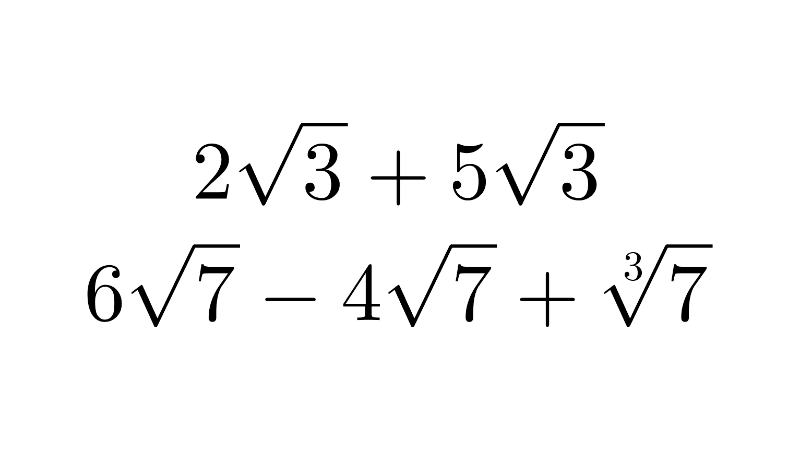
Operations with Radicals
In this article, we explain the basic operations with radical expressions—addition, subtraction, multiplication, division, powers, and roots—along with worked examples. We will also cover how to simplify radicals and rationalize denominators, working with roots of any index, such as square roots and cube roots.
Table of Contents
Adding and Subtracting Radicals
To add or subtract radicals, they must be like radicals—meaning they have the exact same index and radicand. The procedure consists of adding or subtracting the coefficients and keeping the common radical.
$$a\sqrt[n]{k}+b \sqrt[n]{k}=(a+b) \sqrt[n]{k}$$
If the radicals are not like radicals, try simplifying them first to see if they can be rewritten with the same radicand.
Examples:
\(5\sqrt{5}+4\sqrt{5}=(5+4)\sqrt{5}=9\sqrt{5}\)
\(4\sqrt[3]{14}-10\sqrt[3]{14}=(4-10)\sqrt[3]{14}=-6\sqrt[3]{14}\)
You can see more examples and learn how to handle unlike radicals in this article:
Multiplying Radicals
To multiply two radicals, they must have the same index. The procedure consists of multiplying the coefficients and the radicands separately, placing the product of the radicands inside a single radical with the same index.
$$\sqrt[n]{a}\cdot \sqrt[n]{b}=\sqrt[n]{a\cdot b}$$
$$p\sqrt[n]{a}\cdot q\sqrt[n]{b}=p\cdot q\sqrt[n]{a\cdot b}$$
If the radicals have different indices, you must first rewrite them as equivalent radicals with a common index.
Examples:
\(-4\sqrt[3]{5}\cdot 6\sqrt[3]{4}=(-4\cdot 6)\sqrt[3]{5\cdot 4}=-24\sqrt[3]{20}\)
\(3\sqrt{5}\sqrt{2}\sqrt{2}=3\sqrt{5\cdot 2\cdot 2}=3\sqrt{20}=3\sqrt{4\cdot 5}=3\cdot 2\sqrt{5}=6\sqrt{5}\)
See more examples and learn how to multiply radicals with different indices in this article:
Dividing Radicals
To divide two radicals, they must have the same index. You keep the common index and combine the radicands into a single fraction under one radical, while dividing the coefficients outside.
$$\dfrac{a\sqrt[n]{p}}{b\sqrt[n]{q}}=\dfrac{a}{b}\sqrt[n]{\dfrac{p}{q}}$$
If the radicals have different indices, you must rewrite them with a common index first.
Examples:
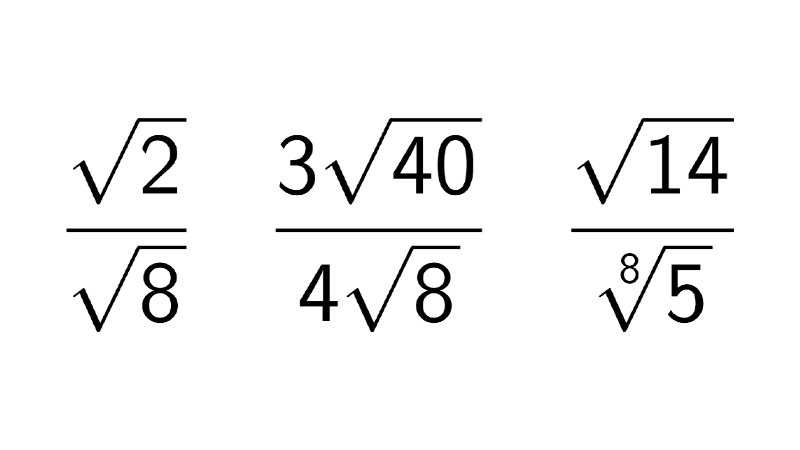
\(\dfrac{3\sqrt{48}}{4\sqrt{8}}=\dfrac{3}{4}\sqrt{\dfrac{48}{8}}=\dfrac{3}{4}\sqrt{6}\)
\(\dfrac{6\sqrt{20}}{4\sqrt{5}}=\dfrac{6}{4}\sqrt{\dfrac{20}{5}}=\dfrac{3}{2}\sqrt{4}=\dfrac{3}{2}\cdot 2=3\)
You can view more examples and learn how to divide radicals with different indices in this article:
Mixed Operations with Radicals
Mixed operations with radicals are expressions that combine addition, subtraction, multiplication, and division involving roots. To simplify them accurately, it is helpful to follow the standard order of operations.
The order of operations for simplifying radical expressions is:
- Simplify expressions inside parentheses, brackets, and braces first.
- Evaluate exponents and simplify radicals whenever possible.
- Perform multiplication and division from left to right.
- Perform addition and subtraction from left to right.
Before operating, always simplify each radical as much as possible to work with smaller numbers, and rationalize any denominators in the final answer.
Example 1
$$\dfrac{\sqrt{2}\sqrt[3]{3}}{\sqrt{5}}$$
This expression involves both multiplication and division. Although they share the same priority, it is convenient to rewrite all three radicals with a common index first so we can combine them easily.
\(\text{LCM}(2,3,2)=6\)
For \(\sqrt{2}:\)
\(\dfrac{6}{2}=3 \implies \sqrt{2}=\sqrt[2\cdot 3]{2^{3}}=\sqrt[6]{8}\)
For \(\sqrt[3]{3}:\)
\(\dfrac{6}{3}=2 \implies \sqrt[3]{3}=\sqrt[3\cdot 2]{3^2}=\sqrt[6]{9}\)
For \(\sqrt{5}:\)
\(\dfrac{6}{2}=3 \implies \sqrt{5}=\sqrt[2\cdot 3]{5^3}=\sqrt[6]{125}\)
Now, substitute the equivalent radicals and simplify by rationalizing the denominator:
$$\dfrac{\sqrt{2}\sqrt[3]{3}}{\sqrt{5}}=\dfrac{\sqrt[6]{8}\sqrt[6]{9}}{\sqrt[6]{125}}$$
$$=\dfrac{\sqrt[6]{8\cdot 9}}{\sqrt[6]{125}}$$
$$=\dfrac{\sqrt[6]{72}}{\sqrt[6]{125}}$$
$$=\dfrac{\sqrt[6]{72}}{\sqrt[6]{5^3}}\cdot\dfrac{\sqrt[6]{5^3}}{\sqrt[6]{5^3}}$$
$$=\dfrac{\sqrt[6]{72\cdot 125}}{\sqrt[6]{5^6}}$$
$$=\dfrac{\sqrt[6]{9000}}{5}$$
Example 2
$$5\sqrt{3}\cdot(9\sqrt{2}+7\sqrt{18})$$
This problem contains a product and a sum inside parentheses. Following the order of operations, we simplify inside the parentheses first and then multiply. Alternatively, you can apply the distributive property to reach the same result.
Using the order of operations:
$$5\sqrt{3}\cdot(9\sqrt{2}+7\sqrt{18})=5\sqrt{3}\cdot(9\sqrt{2}+7\sqrt{3^2\cdot 2})$$
$$=5\sqrt{3}\cdot(9\sqrt{2}+21\sqrt{2})$$
$$=5\sqrt{3}\cdot(30\sqrt{2})$$
$$=5\cdot 30\sqrt{3}\sqrt{2}$$
$$=150\sqrt{6}$$
Using the distributive property:
$$5\sqrt{3}\cdot(9\sqrt{2}+7\sqrt{18})=5\sqrt{3}\cdot 9\sqrt{2}+5\sqrt{3}\cdot 7\sqrt{3^2\cdot 2}$$
$$=45\sqrt{6}+105\sqrt{6}$$
$$=150\sqrt{6}$$
Example 3
$$\dfrac{6\sqrt{3}}{\sqrt[3]{6}}-\sqrt[6]{\dfrac{3}{4}}$$
By the order of operations, we perform the division first and then the subtraction. To divide the radicals in the first term, we rewrite them with a common index.
\(\text{LCM}(2,3)=6\)
\(\sqrt{3}=\sqrt[2\cdot 3]{3^3}=\sqrt[6]{27}\)
\(\sqrt[3]{6}=\sqrt[3\cdot 2]{6^2}=\sqrt[6]{36}\)
Substitute these back into the original expression, combine the like radicals, and rationalize the denominator:
$$\dfrac{6\sqrt{3}}{\sqrt[3]{6}}-\sqrt[6]{\dfrac{3}{4}}=\dfrac{6\sqrt[6]{27}}{\sqrt[6]{36}}-\sqrt[6]{\dfrac{3}{4}}$$
$$=6\sqrt[6]{\dfrac{27}{36}}-\sqrt[6]{\dfrac{3}{4}}$$
$$=6\sqrt[6]{\dfrac{3}{4}}-\sqrt[6]{\dfrac{3}{4}}$$
$$=5\sqrt[6]{\dfrac{3}{4}}$$
$$=\dfrac{5\sqrt[6]{3}}{\sqrt[6]{2^2}}\cdot\dfrac{\sqrt[6]{2^4}}{\sqrt[6]{2^4}}$$
$$=\dfrac{5\sqrt[6]{3\cdot 16}}{\sqrt[6]{2^6}}$$
$$=\dfrac{5\sqrt[6]{48}}{2}$$
Example 4
$$\sqrt{2}\sqrt{8}-(7\sqrt{5}+2\sqrt{3})\div(4\sqrt{3})$$
This expression includes multiplication, addition, subtraction, and division. The terms inside the first set of parentheses are not like radicals and cannot be simplified further, while the second set of parentheses represents the divisor. We start by computing the product at the beginning:
$$\sqrt{2}\sqrt{8}-(7\sqrt{5}+2\sqrt{3})\div(4\sqrt{3})=\sqrt{2\cdot 8}-(7\sqrt{5}+2\sqrt{3})\div(4\sqrt{3})$$
$$=\sqrt{16}-(7\sqrt{5}+2\sqrt{3})\div(4\sqrt{3})$$
$$=4-(7\sqrt{5}+2\sqrt{3})\div(4\sqrt{3})$$
Next, rewrite the division using a fraction bar and distribute the denominator to each term. Because of the negative sign in front of the fraction, the signs of both terms change. Finally, combine the constants and rationalize the denominator:
$$4-(7\sqrt{5}+2\sqrt{3})\div(4\sqrt{3})=4-\dfrac{7\sqrt{5}+2\sqrt{3}}{4\sqrt{3}}$$
$$=4-\dfrac{7\sqrt{5}}{4\sqrt{3}}-\dfrac{2\sqrt{3}}{4\sqrt{3}}$$
$$=4-\dfrac{7\sqrt{5}}{4\sqrt{3}}\cdot\dfrac{\sqrt{3}}{\sqrt{3}}-\dfrac{1}{2}$$
$$=4-\dfrac{1}{2}-\dfrac{7\sqrt{15}}{4\cdot 3}$$
$$=\dfrac{7}{2}-\dfrac{7\sqrt{15}}{12}$$
Raising Radicals to a Power
Raising a radical to a power is equivalent to raising the radicand to that power while keeping the same index.
$$(\sqrt[n]{a})^m=\sqrt[n]{a^m}$$
Examples:
\((\sqrt{2})^4=\sqrt{2^4}=\sqrt{16}=4\)
\((\sqrt[3]{5})^2=\sqrt[3]{5^2}=\sqrt[3]{25}\)
\((-\sqrt[5]{4})^6=\sqrt[5]{4^6}=\sqrt[5]{4096}=\sqrt[5]{2^{12}}=2^2\sqrt[5]{2^2}=4\sqrt[5]{4}\)
Roots of Radicals
Taking the root of a radical produces a single radical with the same radicand and an index equal to the product of the original indices.
$$\sqrt[m]{\sqrt[n]{a}}=\sqrt[m\cdot n]{a}$$
Examples:
\(\sqrt[4]{\sqrt[6]{7}}=\sqrt[4\cdot 6]{7}=\sqrt[24]{7}\)
\(\sqrt{\sqrt[3]{5}}=\sqrt[2\cdot 3]{5}=\sqrt[6]{5}\)
\(\sqrt{\sqrt[5]{\sqrt{14}}}=\sqrt[2\cdot 5\cdot 2]{14}=\sqrt[20]{14}\)
Simplifying Radicals
Simplifying a radical means writing it in its simplest form so that the index is as small as possible, no perfect power factors remain inside the radicand, and there are no fractions inside the radical or radicals in the denominator.
Examples:
\(\sqrt[3]{7^3}=7\)
\(\sqrt[7]{20^{14}}=20^{\frac{14}{7}}=20^2=400\)
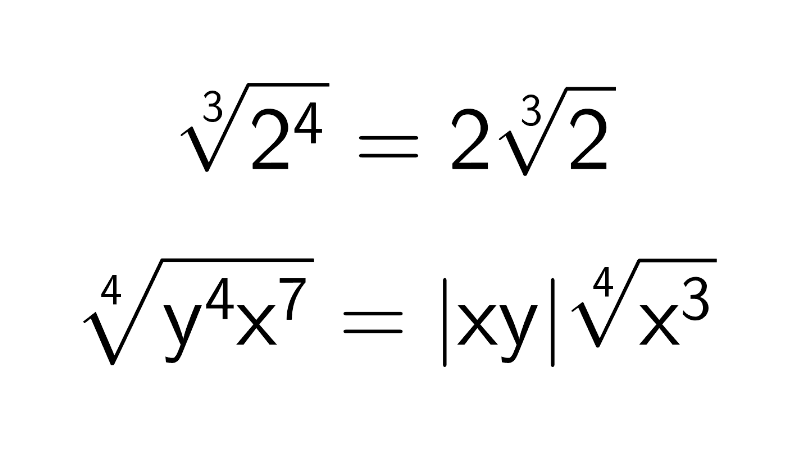
\(\sqrt[3]{2^{11}}=2^3\sqrt[3]{2^2}=8\sqrt[3]{4}\)
See more examples and step-by-step procedures in the following article:
Rationalizing the Denominator
Rationalizing the denominator is the process of rewriting a fraction so that no radicals remain in the denominator.
Examples:
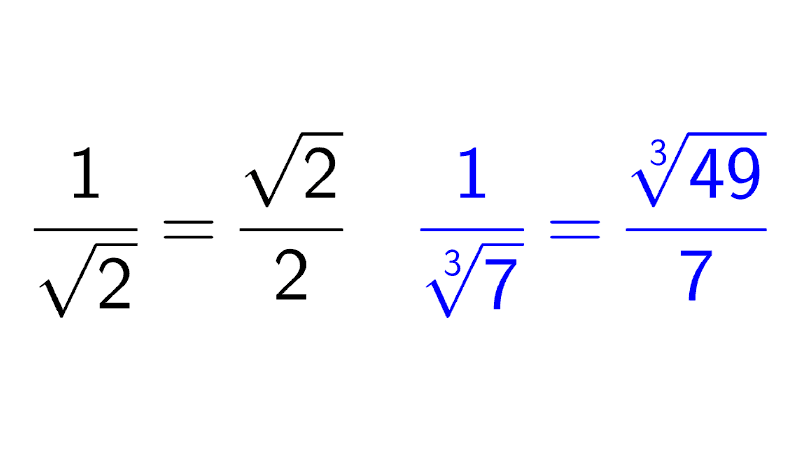
\(\dfrac{1}{\sqrt{2}}=\dfrac{1}{\sqrt{2}}\cdot \dfrac{\sqrt{2}}{\sqrt{2}}=\dfrac{\sqrt{2}}{(\sqrt{2})^2}=\dfrac{\sqrt{2}}{2}\)
\(\dfrac{\sqrt{8}}{\sqrt{3}}=\dfrac{2\sqrt{2}}{\sqrt{3}}\cdot \dfrac{\sqrt{3}}{\sqrt{3}}=\dfrac{2\sqrt{6}}{3}\)
\(\dfrac{1}{\sqrt[3]{7}}=\dfrac{1}{\sqrt[3]{7}}\cdot \dfrac{\sqrt[3]{7^2}}{\sqrt[3]{7^2}}=\dfrac{\sqrt[3]{7^2}}{\sqrt[3]{7^3}}=\dfrac{\sqrt[3]{49}}{7}\)
See more examples and special cases in the following article:
See more examples of all the operations in these articles:
Did you find this useful? Rate it!
0.0 / 5 — 0 votes

HOW TO CITE THIS ARTICLE
Machado, D. (2026, November 24). Operations with Radicals. Flamath. https://en.flamath.com/radical-operations
Radical Expressions
Properties of Radicals
Rationalizing the Denominator
Simplifying Radicals
Dividing Radicals
Leave a Reply
Related Articles