
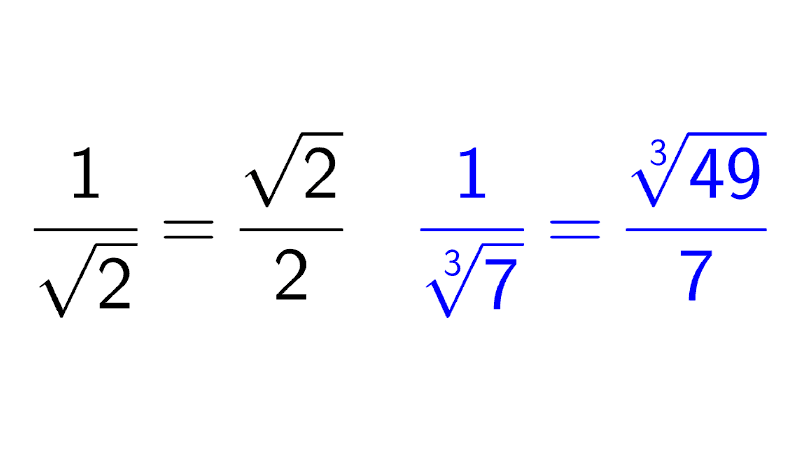
Dividing Radicals
In this article, we explain how to divide radicals, whether they have the same index or different indices, with step-by-step worked examples.
Table of Contents
Dividing Radicals with the Same Index
To divide two radicals that share the same index, you need to identify their parts. The number multiplying the radical is called the coefficient, and the expression inside the radical symbol is the radicand. For example, in \(\sqrt{8}\) and \(4\sqrt{11}\), both radicals have an index of 2, and their coefficients are 1 and 4, respectively.
According to the Quotient Rule for Radicals, to divide radicals with the same index, keep the common index and combine the radicands under a single radical. The coefficients are divided outside the radical.
$$\dfrac{a\sqrt[n]{p}}{b\sqrt[n]{q}}=\dfrac{a}{b}\sqrt[n]{\dfrac{p}{q}}$$
The quotient of two radicals can also be written using a division sign as \(\sqrt[n]{p} \div \sqrt[n]{q},\) though in our examples we will use a fraction bar for convenience.
Note: In standard algebra courses, a radical expression is usually not considered fully simplified if a radical remains in the denominator. In the examples below, we focus strictly on applying the quotient rule without rationalizing the denominator.
Example 1
$$\dfrac{\sqrt{2}}{\sqrt{8}}$$
The coefficients of both radicals are 1. To find the quotient, we combine both radicands under a single radical.
$$\dfrac{\sqrt{2}}{\sqrt{8}}=\sqrt{\dfrac{2}{8}}$$
$$=\sqrt{\dfrac{1}{4}}$$
$$=\dfrac{1}{2}$$
Whenever possible, it is best practice to simplify the resulting radical.
Example 2
$$\dfrac{3\sqrt{40}}{4\sqrt{8}}$$
We follow the same procedure as before, dividing the radicands inside a single radical and dividing the coefficients outside.
$$\dfrac{3\sqrt{40}}{4\sqrt{8}}=\dfrac{3}{4}\sqrt{\dfrac{40}{8}}$$
$$=\dfrac{3}{4}\sqrt{5}$$
Example 3
$$\dfrac{-\sqrt[3]{4}}{3\sqrt[3]{-9}}$$
The rules of signs apply to both the coefficients and the radicands, and we proceed in the same way as before.
$$\dfrac{-\sqrt[3]{4}}{3\sqrt[3]{-9}}=-\dfrac{1}{3}\sqrt[3]{\dfrac{4}{-9}}$$
$$=-\dfrac{1}{3}\sqrt[3]{-\dfrac{4}{9}}$$
Since the index is odd, we can pull the negative sign out of the cube root:
$$=\dfrac{1}{3}\sqrt[3]{\dfrac{4}{9}}$$
Example 4
If variables appear in the coefficients or radicands, we follow the exact same rules. Here are two examples:
$$\dfrac{a\sqrt{6}}{b\sqrt{n}}=\dfrac{a}{b}\sqrt{\dfrac{6}{n}}$$
\(\dfrac{4\sqrt[5]{w}}{2\sqrt[5]{k}}=\dfrac{4}{2}\sqrt[5]{\dfrac{w}{k}}=2\sqrt[5]{\dfrac{w}{k}}\)
Example 5
$$\dfrac{\sqrt[3]{56}+\sqrt[3]{189}}{-5\sqrt[3]{7}}$$
In this example, the numerator is a sum of radicals. To solve it, we can first distribute the denominator across each term in the numerator and then proceed as usual.
$$\dfrac{\sqrt[3]{56}+\sqrt[3]{189}}{-5\sqrt[3]{7}}=\dfrac{\sqrt[3]{56}}{-5\sqrt[3]{7}}+\dfrac{\sqrt[3]{189}}{-5\sqrt[3]{7}}$$
$$=-\dfrac{1}{5}\sqrt[3]{\dfrac{56}{7}}-\dfrac{1}{5}\sqrt[3]{\dfrac{189}{7}}$$
$$=-\dfrac{1}{5}\sqrt[3]{8}-\dfrac{1}{5}\sqrt[3]{27}$$
$$=-\dfrac{1}{5}\cdot 2-\dfrac{1}{5}\cdot 3$$
$$=-1$$
Dividing Radicals with Different Indices
When two radicals have different indices—for example, \(\sqrt[6]{3}\) and \(\sqrt[3]{5}\)—we cannot combine their radicands directly.
To divide radicals with different indices, you must first rewrite them with a common index. Once the indices match, follow the same division process shown earlier.
To find a common index, follow these steps:
- Find the least common multiple (LCM) of the indices.
- Divide the LCM by each original index.
- Multiply each original index and the exponent of its corresponding radicand by the value obtained in the previous step.
We cover rewriting radicals with a common index in greater detail in our article on multiplying radicals. Check it out for more information.
Example 1
$$\dfrac{\sqrt{14}}{\sqrt[8]{5}}$$
1. Find the LCM of the indices.
\(LCM(2,8)=8\)
2. Divide the LCM by each index.
First radical: \(\dfrac{8}{2}=4\)
Second radical: \(\dfrac{8}{8}=1\)
3. Multiply each index and radicand exponent by the corresponding value obtained.
First radical: \(\sqrt{14}=\sqrt[2\cdot 4]{14^4}=\sqrt[8]{38416}\)
Second radical: \(\sqrt[8]{5}=\sqrt[8\cdot 1]{5^1}=\sqrt[8]{5}\)
Now that the indices are equal, we can divide as usual.
$$\dfrac{\sqrt{14}}{\sqrt[8]{5}}=\dfrac{\sqrt[8]{38416}}{\sqrt[8]{5}}=\sqrt[8]{\dfrac{38416}{5}}$$
Example 2
$$\dfrac{4\sqrt[6]{2}}{5\sqrt[9]{2}}$$
1. Find the LCM of the indices.
\(LCM(6,9)=18\)
2. Divide the LCM by each index.
First radical: \(\dfrac{18}{6}=3\)
Second radical: \(\dfrac{18}{9}=2\)
3. Multiply each index and radicand exponent by the corresponding value obtained.
First radical: \(\sqrt[6]{2}=\sqrt[6\cdot 3]{2^3}=\sqrt[18]{8}\)
Second radical: \(\sqrt[9]{2}=\sqrt[9\cdot 2]{2^2}=\sqrt[18]{4}\)
Now we proceed to divide:
$$\dfrac{4\sqrt[6]{2}}{5\sqrt[9]{2}}=\dfrac{4\sqrt[18]{8}}{5\sqrt[18]{4}}$$
$$=\dfrac{4}{5}\sqrt[18]{\dfrac{8}{4}}$$
$$=\dfrac{4}{5}\sqrt[18]{2}$$
Did you find this useful? Rate it!
0.0 / 5 — 0 votes

HOW TO CITE THIS ARTICLE
Machado, D. (2026, November 24). Dividing Radicals. Flamath. https://en.flamath.com/dividing-radicals
Rationalizing the Denominator
Simplifying Radicals
Multiplying Radicals
Radical Equations
Adding and Subtracting Radicals
Leave a Reply
Related Articles