
Denying the Antecedent
Denying the antecedent is a formal fallacy in propositional logic. This deductive error occurs when one assumes that, given a true conditional statement, negating or rejecting the initial hypothesis necessarily forces the consequent to be false as well.
In formal language, the horizontal expression representing the associated conditional of this argument is written as follows:
[(p → q) ∧ ¬p] → ¬q
In vertical premise notation, the deductive schema is structured with the initial premises followed by the conclusion separated by a horizontal line:
p → q
¬p
—————
∴ ¬q
The root of this reasoning error lies in treating the antecedent as the only possible factor capable of producing the consequent. In an implication p → q, the term p serves as a sufficient condition but not a necessary condition for q. Therefore, denying p merely eliminates one potential cause of the event, without preventing q from occurring through other independent mechanisms.
It is crucial not to confuse this fallacious inference with modus tollens (or denying the consequent), a valid deductive method whose formal structure is [(p → q) ∧ ¬q] → ¬p. While modus tollens reasons from the absence of the necessary outcome to reject the premise, denying the antecedent attempts to negate the outcome by targeting only one specific cause.
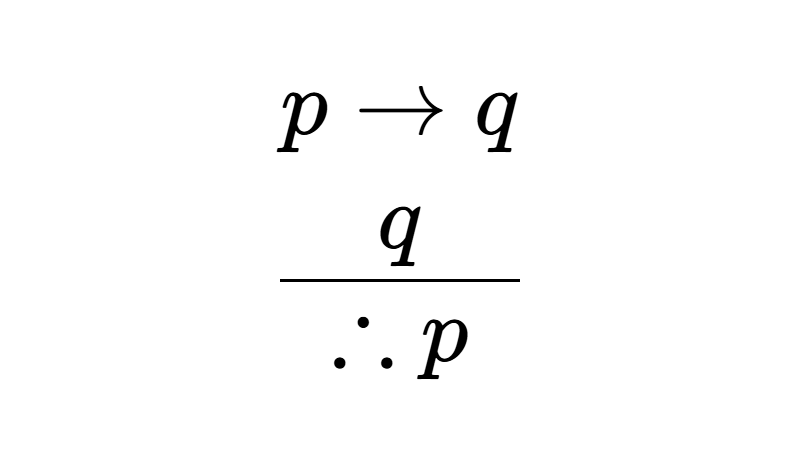
Similarly, this argument is closely related to affirming the consequent, expressed as [(p → q) ∧ q] → p. Both fallacies arise when a simple, one-directional implication is mistakenly treated as a material equivalence or biconditional statement (p ↔ q).
To identify these logical patterns and clearly differentiate valid deductive arguments from formal conditional fallacies, consider the following comparison table:
| Deductive Form | Associated Conditional | Logical Validity | Common Designation |
|---|---|---|---|
| Denying the antecedent | [(p → q) ∧ ¬p] → ¬q | Formal fallacy (invalid) | Inverse error |
| Affirming the consequent | [(p → q) ∧ q] → p | Formal fallacy (invalid) | Converse error |
| Modus ponens | [(p → q) ∧ p] → q | Valid rule (tautology) | Affirming the antecedent |
| Modus tollens | [(p → q) ∧ ¬q] → ¬p | Valid rule (tautology) | Denying the consequent |
Table of Contents
Examples
To examine the mechanics of this fallacy and practice identifying it across different fields, consider the following real-world and formal cases:
Example 1
Premise 1: If it rains, then the yard gets wet (p → q).
Premise 2: It is not raining (¬p).
Fallacious conclusion: Therefore, the yard does not get wet (¬q).
In this statement, the deductive leap is easy to spot. Although the absence of rain removes the cause mentioned in the first premise, the yard could still become wet from a sprinkler system or washing down the patio with a garden hose. Negating the antecedent does not rule out the occurrence of the consequent through alternative means.
Example 2
Premise 1: If an integer ends in zero, then it is divisible by five (p → q).
Premise 2: The given integer does not end in zero (¬p).
Fallacious conclusion: Therefore, the number is not divisible by five (¬q).
The starting premise is arithmetically true. However, the derived conclusion is false if we take the integer 35: it does not end in zero, yet it is divisible by five because its last digit is five.
Example 3
Premise 1: If a quadrilateral is a square, then its diagonals are perpendicular (p → q).
Premise 2: The given quadrilateral is not a square (¬p).
Fallacious conclusion: Therefore, its diagonals are not perpendicular (¬q).
Having perpendicular diagonals is a property of squares, but not exclusively so. A rhombus with non-right angles is not a square, yet its diagonals are still perpendicular.
Example 4
Premise 1: If an applicant does not submit a physical clearance certificate, then they are disqualified from the athletic tryout (¬p → ¬q).
Premise 2: The applicant submits a physical clearance certificate (p).
Fallacious conclusion: Therefore, they are not disqualified from the athletic tryout (q).
In this formal structure where both the antecedent and consequent contain negations, submitting the certificate negates the initial condition (¬¬p ≡ p). However, this does not guarantee qualification, as the candidate could still be disqualified for missing the registration deadline or exceeding an age requirement.
Proof of Invalidity
To demonstrate that this deductive pattern lacks formal validity, we evaluate the truth behavior of its associated conditional: [(p → q) ∧ ¬p] → ¬q. In propositional logic, an inference rule is considered valid if and only if its corresponding conditional statement is a tautology—that is, true for every possible truth assignment of its variables.
We construct the truth table by evaluating the intermediate negations, the conditional premise, the conjunction of the premises, and the main implication step by step:
| p | q | ¬p | ¬q | p → q | (p → q) ∧ ¬p | [(p → q) ∧ ¬p] → ¬q |
|---|---|---|---|---|---|---|
| T | T | F | F | T | F | T |
| T | F | F | T | F | F | T |
| F | T | T | F | T | T | F |
| F | F | T | T | T | T | T |
Inspecting the final column shows that the statement is not a tautology, as a false evaluation occurs in the third row, where p is false and q is true.
This third row constitutes the critical row of the argument form, where the following truth values occur simultaneously:
- The conditional premise p → q is true, since a conditional with a false antecedent is vacuously true.
- The second premise ¬p is true, because p is false.
- The conjunction of both premises (p → q) ∧ ¬p is therefore true.
- The conclusion ¬q is false, because q is true by initial assignment.
Because true premises lead to a false conclusion, the associated conditional evaluates to false under this truth assignment. The resulting formula is a contingency, confirming that denying the antecedent is a formally invalid argument.
Confusion between Sufficient and Necessary Conditions
The tendency to commit the fallacy of denying the antecedent stems largely from how we interpret natural language. In everyday speech, statements phrased as "if... then" are often implicitly understood as excluding all other possibilities.
If a parent tells a child, "If you finish your homework, you can go to the movies," the conversational context suggests that if homework is not finished, going to the movies is off the table. In formal logic, however, stating this promise as a simple conditional p → q leaves open the possibility that the child might go to the movies for an entirely different reason. Everyday reasoning often turns an implication into an equivalence without noticing it.
To eliminate this confusion in deductive analysis, we must separate the function of each connective:
- Material conditional (p → q): Represents an asymmetric relationship where p is sufficient to ensure q, but does not exhaust all possible causes of q. Denying the antecedent only closes that specific route, leaving the validity of the consequent open to alternative conditions.
- Biconditional or equivalence (p ↔ q): Represents a symmetric relationship where each proposition serves as both a necessary and sufficient condition for the other. This structure is formally equivalent to the conjunction (p → q) ∧ (q → p), requiring both statements to share the same truth value.
In a logical equivalence, deducing ¬q from ¬p is completely valid. Denying the antecedent occurs when this symmetry is mistakenly forced onto a simple conditional, assuming that eliminating one factor automatically invalidates the outcome.
Did you find this useful? Rate it!
0.0 / 5 — 0 votes

HOW TO CITE THIS ARTICLE
Machado, D. (2026, October 14). Denying the Antecedent. Flamath. https://en.flamath.com/denying-the-antecedent
Leave a Reply
Related Articles