
Affirming the Consequent
Affirming the consequent is a formal fallacy in propositional logic. This reasoning error occurs when one assumes that, given a true conditional statement whose consequent is verified, the antecedent of that implication must also be true.
In formal language, the horizontal structure or associated conditional of this argument is expressed as:
[(p → q) ∧ q] → p
In standard deductive form, the argument is represented vertically with ordered premises and a conclusion preceded by the deduction symbol:
p → q
q
—————
∴ p
The flaw in this reasoning lies in confusing a sufficient condition with a necessary condition. In a conditional relationship p → q, the truth of antecedent p is sufficient to guarantee consequent q, but it does not preclude other independent factors from producing the same outcome. Therefore, verifying that q has occurred does not justify concluding that p preceded it.
It is important not to confuse this fallacy with the valid inference rule known as modus ponens (or affirming the antecedent), whose structure is [(p → q) ∧ p] → q. While modus ponens begins by verifying the hypothesis to confirm the consequence, affirming the consequent improperly reverses the direction of deduction.
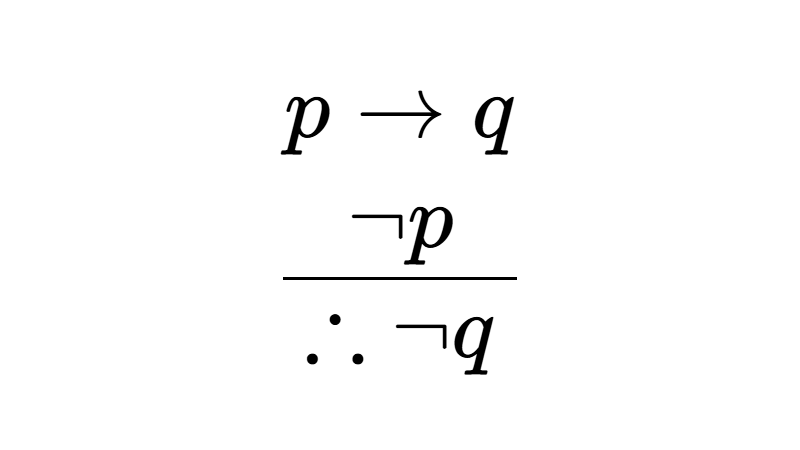
Similarly, it should be distinguished from its sister fallacy, denying the antecedent, whose structure is [(p → q) ∧ ¬p] → ¬q. In both cases, the error arises from treating a one-way conditional statement (p → q) as if it were a logical equivalence or biconditional statement (p ↔ q).
To visualize how these argument forms relate and to distinguish valid deductive rules from formal conditional fallacies, consider the following comparison table:
| Argument Form | Formal Structure | Classification |
|---|---|---|
| Modus ponens (affirming the antecedent) | [(p → q) ∧ p] → q | Valid rule of inference |
| Modus tollens (denying the consequent) | [(p → q) ∧ ¬q] → ¬p | Valid rule of inference |
| Affirming the consequent (converse error) | [(p → q) ∧ q] → p | Formal fallacy (invalid) |
| Denying the antecedent (inverse error) | [(p → q) ∧ ¬p] → ¬q | Formal fallacy (invalid) |
Table of Contents
Examples
To understand how this fallacy operates across different contexts and how to identify it, we examine several everyday and mathematical cases below.
Example 1
Premise 1: If it rains, then the street gets wet (p → q).
Premise 2: The street is wet (q).
Fallacious conclusion: Therefore, it is raining (p).
In this first case, the deductive flaw is apparent. The street may be wet because of a street cleaner, a municipal sprinkler, or someone washing a car. Confirming that the consequent occurred does not prove that rain was the cause.
Example 2
Premise 1: If an integer is divisible by four, then it is an even number (p → q).
Premise 2: The given integer is even (q).
Fallacious conclusion: Therefore, the number is divisible by four (p).
The initial implication states a valid arithmetic property. However, the derived conclusion is clearly false. For instance, considering the number 14, this integer is even but not divisible by four.
Example 3
Premise 1: If a polygon is a square, then it has four right angles (p → q).
Premise 2: The polygon has four right angles (q).
Fallacious conclusion: Therefore, the polygon is a square (p).
Having four right angles is a necessary condition for being a square, but it is not sufficient to rule out other parallelograms, such as a non-equilateral rectangle.
Example 4
Premise 1: If the student does not pass the placement exam, then they attend tutoring sessions (¬p → q).
Premise 2: The student attends tutoring sessions (q).
Fallacious conclusion: Therefore, the student did not pass the placement exam (¬p).
In this scenario with a negated antecedent, verifying attendance at tutoring sessions does not allow one to conclude that the student failed the test, as attending tutoring may have other causes.
Proof of Invalidity
To formally demonstrate that this argument form lacks deductive validity, we evaluate the truth behavior of its associated conditional: [(p → q) ∧ q] → p. In propositional logic, an argument is valid if and only if the conditional statement connecting the conjunction of its premises to its conclusion is a tautology.
We construct the truth table by evaluating each connective step by step for all possible truth value assignments of the simple propositions:
| p | q | p → q | (p → q) ∧ q | [(p → q) ∧ q] → p |
|---|---|---|---|---|
| T | T | T | T | T |
| T | F | F | F | T |
| F | T | T | T | F |
| F | F | T | F | T |
Examining the final column reveals that the statement is not always true: a false value occurs in the third row, corresponding to the case where antecedent p is false and consequent q is true.
This third row represents the critical row of the inference, as all of the following conditions hold simultaneously:
- The first premise p → q is true, since an implication with a false antecedent is vacuously true.
- The second premise q is true by assumption.
- The conjunction of both premises (p → q) ∧ q is therefore true.
- However, conclusion p is false.
Because the truth of the premises does not preserve the truth of the conclusion, the associated conditional evaluates to false under this assignment. The logical formula is not a tautology but a contingency, which formally proves that affirming the consequent is an invalid argument form.
Difference Between Conditionals and Biconditionals
The frequency with which the fallacy of affirming the consequent occurs is largely due to habits of everyday language. In ordinary conversation, we frequently interpret "if... then" statements as though they establish an exclusive, reversible correspondence between both parts.
For example, if an online store states: "If you are a premium member, you receive free shipping," a customer who receives an order with free shipping might immediately infer: "Then my account must be premium." In practice, the shopper assumes this correspondence without considering that free shipping may have resulted from a seasonal promotion, a discount code, or meeting a minimum order total. Intuitive thinking automatically reverses the conditional, treating a possible outcome as definitive proof of a single cause.
To understand why this deduction is invalid in deductive logic, we distinguish between the functions of these two logical connectives:
- Simple conditional (p → q): Establishes a unidirectional relationship where antecedent p is a sufficient condition for q to occur, while q is merely a necessary condition. The truth of the consequent does not guarantee the antecedent, as other independent paths can lead to the same result.
- Biconditional (p ↔ q): Establishes a bidirectional relationship where each statement is both a necessary and sufficient condition for the other. Under this structure, p and q must share the same truth value, which is formally equivalent to the conjunction (p → q) ∧ (q → p).
In a biconditional, deducing p from q is valid because the converse implication q → p is an explicit part of its formal definition. The fallacy of affirming the consequent occurs when this distinction is overlooked, inappropriately applying the symmetry of a biconditional to an implication that is valid in only one direction.
Did you find this useful? Rate it!
0.0 / 5 — 0 votes

HOW TO CITE THIS ARTICLE
Machado, D. (2026, October 14). Affirming the Consequent. Flamath. https://en.flamath.com/affirming-the-consequent
Leave a Reply
Related Articles