
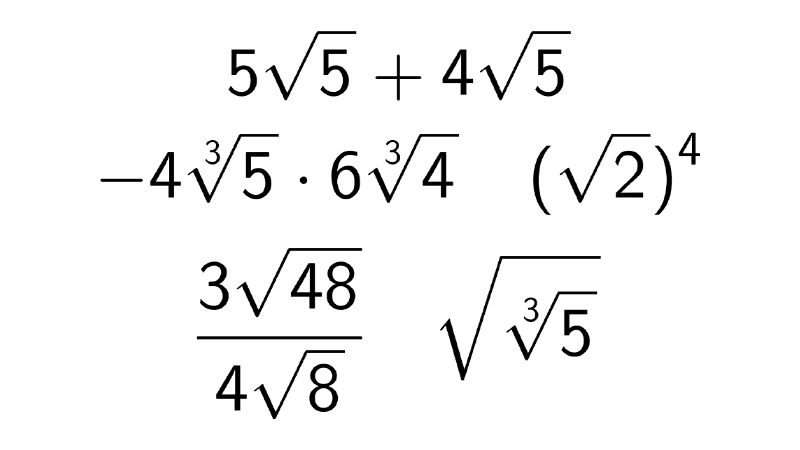
Radical Expressions
In mathematics, radicals are a notation used to represent the roots of a number or an algebraic expression. The most common symbol used to represent a radical is √, which is used for the square root. For example, \(\sqrt{9}\) represents the principal square root of 9, which is equal to 3, since 32 = 9.
The parts of a radical are:
- Index: the number that indicates which type of root is being taken. For example, in a square root, the index is 2; in a cube root, the index is 3, and so on.
- Radical symbol: the symbol √ that represents the operation of finding the root.
- Radicand: the number or expression under the radical symbol whose root is being found.
Radical expressions can be simple, such as the square root or cube root of a specific number, or they can be more complex, involving algebraic expressions. For example, \(\sqrt{x^2 + 2x + 1}\) represents the square root of the expression \(x^2+2x+1.\)
Generally, the types of radicals are determined by their indices, giving us:
- Square roots, where the index is 2; for example, \(\sqrt{5},\) \(~\sqrt{11},\) \(\sqrt{x+6}.\)
- Cube roots, where the index is 3; for example, \(\sqrt[3]{6},\) \(~\sqrt[3]{y+4},\) \(~\sqrt[3]{x^2+3}.\)
- nth roots, where the index is any positive integer n; for example, \(\sqrt[5]{8},\) \(~\sqrt[8]{9x},\) \(~\sqrt[10]{x^3-1}.\)
Radicals can be used to represent a variety of quantities, such as lengths, areas, and volumes. For example, the square root of an area is the side length of a square with that area. The cube root of a volume is the side length of a cube with that volume.
Table of Contents
Examples of Radical Expressions
Below are ten examples of radical expressions: \(\sqrt{7};\) \(~\sqrt[3]{-13};\) \(~\sqrt{x^2 + 2x + 1};\) \(~\sqrt[3]{5};\) \(~\sqrt[4]{\dfrac{x^3 +3x^2}{x-1}};\) \(~\sqrt[7]{6};\) \(~\sqrt{9x};\) \(~\sqrt[4]{-3x+1};\) \(~\sqrt[3]{\dfrac{-6z}{x}};\) \(~\sqrt{16x^2-9y^2}.\)
It is important to note that even roots of negative numbers do not exist in the real number system; for example, \(\sqrt{-1}\) is not a real number. On the other hand, odd roots of negative numbers do exist; for example, \(\sqrt[3]{-8}.\)
Operations with Radicals
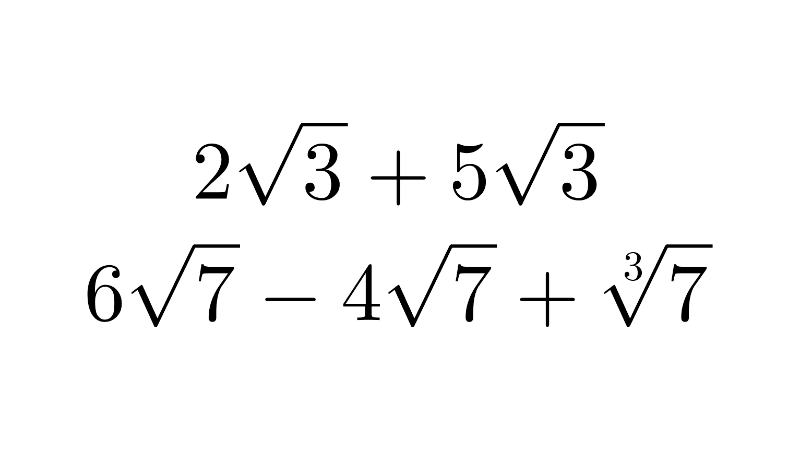
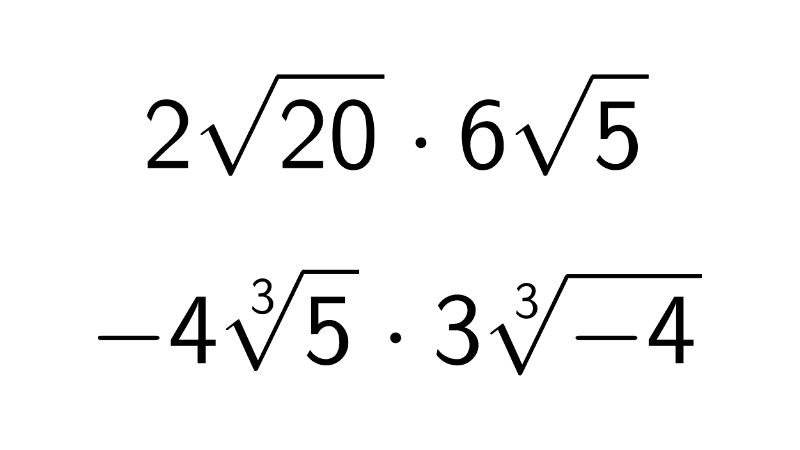
Basic operations with radical expressions can be performed as long as certain conditions are met. Knowing the properties of radicals is useful because they allow you to solve problems more easily.
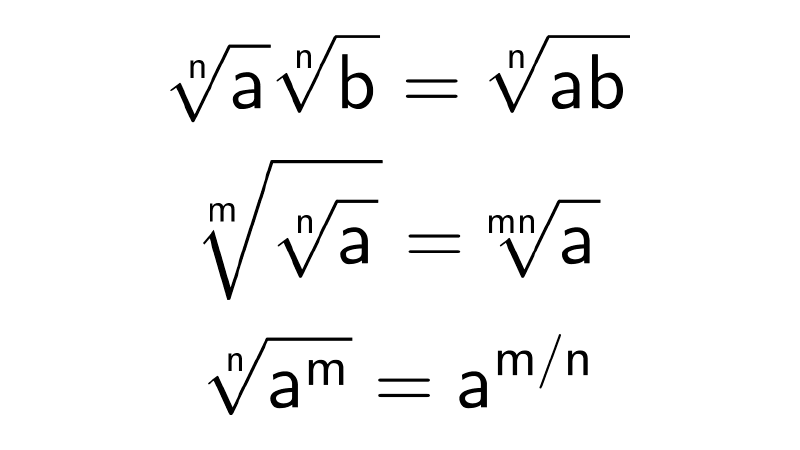
Simplifying and Rationalizing Radicals
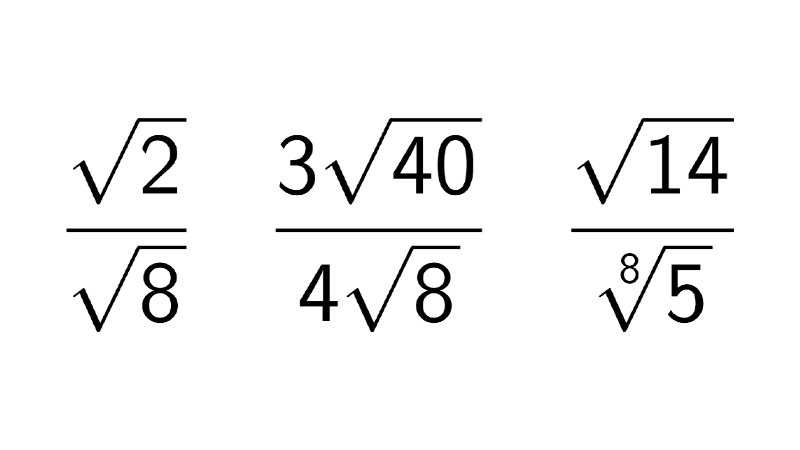
Rationalization is a process that consists of removing radical expressions from either a numerator or a denominator. Simplification consists of finding the simplest form to write a given radical.
Did you find this useful? Rate it!
0.0 / 5 — 0 votes

HOW TO CITE THIS ARTICLE
Machado, D. (2026, November 24). Radical Expressions. Flamath. https://en.flamath.com/radical-expressions
Properties of Radicals
Operations with Radicals
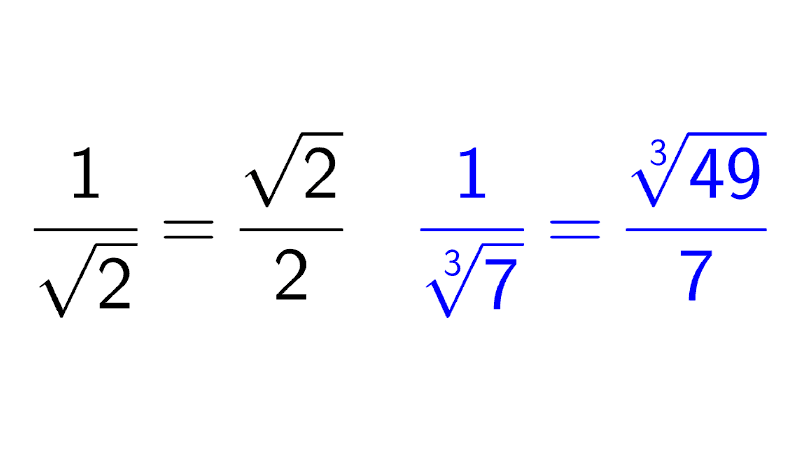
Rationalizing the Denominator
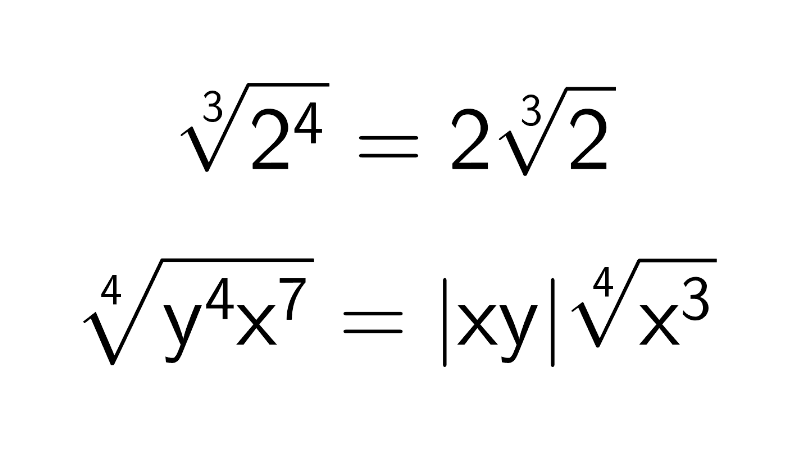
Simplifying Radicals
Dividing Radicals
Leave a Reply
Related Articles