
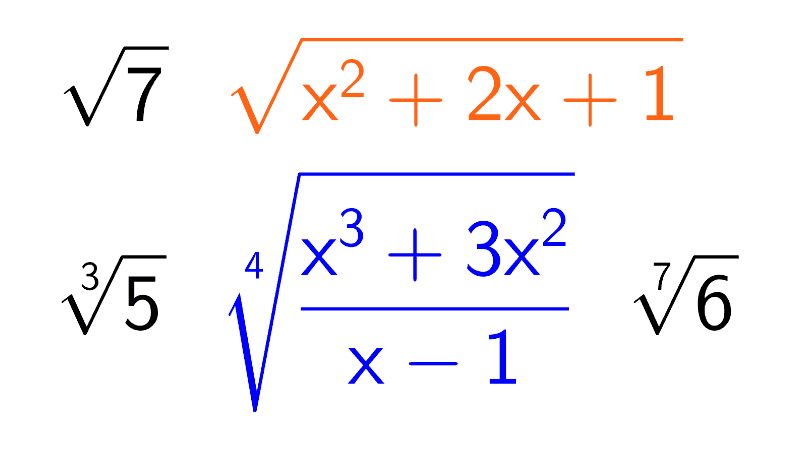
Properties of Radicals
The nth root of a real number is defined as a real number that, when raised to the nth power, gives the original number as a result. In symbols:
\(\sqrt[n]{a}=b\quad \) if and only if \(\quad b^n=a\)
where n is a positive integer greater than or equal to 2 and a is a real number.
The symbol \(\sqrt[n]{a}\) for the nth root of a is called a radical; the integer n is called the index, and a is the radicand.
If the index of a radical is 2, \(\sqrt[2]{a}\) is called the square root of \(a\), and the index 2 is omitted by writing simply \(\sqrt{a}.\) The square root of a number a is a number b that, when squared, results in a:
\(\sqrt{a}=b\quad \) if and only if \(\quad b^2=a\)
If the index is 3, \(\sqrt[3]{a}\) is called the cube root of \(a.\) The cube root of a number a is defined as the number b that, when cubed, results in a:
\(\sqrt[3]{a}=b\quad \) if and only if \(\quad b^3=a\)
Evaluating roots consists of finding a number that, when raised to the index of the root, yields the radicand. For example:
\(\sqrt{4}=2\) because \(2^2=4\)
\(\sqrt{16}=4\) because \(4^2=16\)
\(\sqrt[3]{-8}=-2\) because \((-2)^3=-8\)
\(\sqrt[5]{\dfrac{1}{32}}=\dfrac{1}{2}\) because \(\left(\dfrac{1}{2}\right)^5=\dfrac{1}{32}\)
Keep in mind that you cannot take an even-indexed root of a negative number within the set of real numbers. For example, \(\sqrt{-1};~\sqrt[4]{-16};~\sqrt[8]{-3}\) cannot be evaluated using real numbers. In the case of odd-indexed roots of negative numbers, this limitation does not exist; that is why, for example, \(\sqrt[3]{-8}\) could be evaluated.
Important: When evaluating even-indexed roots, it is common to find two numbers that satisfy the definition of a root, one positive and one negative. For example, for \(\sqrt{4},\) \(2\) is a solution because \(2^2=4;\) however, \(-2\) is also a solution because \((-2)^2=4.\)
This might lead you to think that \(\sqrt{4}=±2.\) However, to avoid operational confusion, the square root symbol is reserved for the positive solution—that is, we define \(\sqrt{4}=2,\) which is called the principal root. To indicate the negative solution, a minus sign is placed in front of the radical: \(-\sqrt{4}=-2.\)
If you want to indicate both solutions in a single expression, you must place the plus-minus sign in front of the radical: \(±\sqrt{4}=±2.\) This same convention applies to all even-indexed roots.
Table of Contents
Fundamental Properties of Radicals
Radicals follow a set of rules that allow us, among other things, to perform operations and simplify expressions. All of these properties are listed in the box below. We will examine the most important ones in detail.
Let \(a\) and \(b\) be real numbers, and let \(m\) and \(n\) be positive integers. Assuming that all indicated radicals represent real numbers, the following properties hold:
- \(\sqrt[n]{a}\sqrt[n]{b}=\sqrt[n]{ab}\)
- \(\dfrac{\sqrt[n]{a}}{\sqrt[n]{b}}=\sqrt[n]{\dfrac{a}{b}}\quad (b≠0)\)
- \(\sqrt[m]{\sqrt[n]{a}}=\sqrt[mn]{a}\)
- \((\sqrt[n]{a})^n=a\) if \(\sqrt[n]{a}\) is a real number
- \(\sqrt[n]{a^n}=a\) if n is odd
- \(\sqrt[n]{a^n}=|a|\) if n is even
- \(\sqrt[n]{a^m}=(\sqrt[n]{a})^m\)
- \(\sqrt[n]{a^m}=a^{m/n}\)
Radicals as Rational Exponents
This is sometimes treated as a fundamental identity: radicals are simply another way of writing rational exponents:
If \(a\) is a real number and \(m\) and \(n\) are positive integers, then:
\(\sqrt[n]{a^m}=a^{m/n}\) whenever \(\sqrt[n]{a}\) is a real number
In other words, a number raised to a fraction is equal to a radical whose index is the denominator of the fraction and whose radicand is the base raised to the numerator of the fraction.
A special case occurs when \(m=1:\)
$$\sqrt[n]{a}=a^{1/n}$$
Note that if \(n\) is even and \(a<0\), then \(\sqrt[n]{a}\) and \(a^{1/n}\) are not real numbers. Applying this property to square roots gives the formula: \(\sqrt{a}=a^{1/2}\)
Examples:
$$\sqrt{4}=4^{1/2}$$
$$\sqrt[3]{11}=11^{1/3}$$
$$\sqrt[5]{4^3}=4^{3/5}$$
$$\sqrt[4]{20^6}=20^{6/4}$$
Taking property 7 into account, we also have:
$$\sqrt[n]{a^m}=a^{m/n}=(a^{1/n})^m=(a^m)^{1/n}$$
This identity is useful when simplifying radicals and proving properties, since all radicals obey the laws of exponents.
Canceling Radicals and Exponents
If \(\sqrt{a}=b\), then \(b^2=a;\) that is, \((\sqrt{a})^2=a.\) Similarly, if \(\sqrt[3]{a}=b,\) then \(b^3=a\) or \((\sqrt[3]{a})^3=a.\) Generalizing this pattern gives properties 5 and 6, which allow us to cancel radicals when the index equals the exponent, taking special care when the index is even.
Let \(a\) be a real number and \(n\) be a positive integer, then:
\(\sqrt[n]{a^n}=a\) if \(n\) is odd
\(\sqrt[n]{a^n}=|a|\) if \(n\) is even
In other words, the nth root of an nth power equals the base when n is odd, and it equals the absolute value of the base when n is even.
For the specific case of square roots, this property tells us that the square root of a squared number equals the absolute value of that number: \(\sqrt{a^2}=|a|\)
Examples:
$$\sqrt{4^2}=4$$
$$\sqrt[3]{(-8)^3}=-8$$
$$(\sqrt[5]{-27})^5=-27$$
Remember that \(\sqrt[n]{a^m}=(\sqrt[n]{a})^m,\) so the exponent can be either inside or outside the radical.
When the index is odd, you can cancel directly; when the index is even, you must take the absolute value of the radicand. This is because of what happens with negative numbers:
$$\sqrt{(-2)^2}=|-2|=2$$
It is incorrect to cancel the radical directly with the exponent here, since:
$$\sqrt{(-2)^2}=\sqrt{4}=2≠-2$$
Product Property of Radicals
Let \(a\) and \(b\) be real numbers, \(n\) be a positive integer, and \(a≥0\) and \(b≥0\) if \(n\) is even, then:
$$\sqrt[n]{ab}=\sqrt[n]{a}\sqrt[n]{b}$$
In other words, the root of a product is the product of the roots of each factor, keeping the same index.
Examples:
$$\sqrt{3\cdot 5}=\sqrt{3}\cdot \sqrt{5}$$
$$\sqrt[3]{(-20)\cdot 6}=\sqrt[3]{-20}\cdot \sqrt[3]{6}$$
$$\sqrt[8]{5^2\cdot 3^3}=\sqrt[8]{5^2}\cdot \sqrt[8]{3^3}$$
It is important to make sure that each individual root exists as a real number, because otherwise a case like the following can occur where the property fails:
$$\sqrt{(-2)(-5)}≠\sqrt{-2}\sqrt{-5}$$
Notice that the radicals on the right-hand side are not real numbers. That is why the theorem requires the factors to be non-negative when the index is even.
We can use this same property in reverse to multiply two radicals with the same index: keep the common index and multiply the radicands.
$$\sqrt[n]{a}\sqrt[n]{b}=\sqrt[n]{ab}$$
Quotient Property of Radicals
Let \(a\) and \(b\) be real numbers, \(n\) be a positive integer, and \(a≥0\) and \(b>0\) if \(n\) is even, then:
$$\sqrt[n]{\dfrac{a}{b}}=\dfrac{\sqrt[n]{a}}{\sqrt[n]{b}}\quad (b≠0)$$
In other words, the root of a quotient is the quotient of the roots of the numerator and denominator.
Examples:
$$\sqrt{\dfrac{4}{9}}=\dfrac{\sqrt{4}}{\sqrt{9}}$$
$$\sqrt[5]{\dfrac{-5}{8}}=\dfrac{\sqrt[5]{-5}}{\sqrt[5]{8}}$$
Just as in the previous case, each individual root must exist as a real number.
This property can also be used to divide radicals with the same index: keep the common index and divide the radicands.
$$\dfrac{\sqrt[n]{a}}{\sqrt[n]{b}}=\sqrt[n]{\dfrac{a}{b}}$$
Root of a Root
Let \(a\) be a real number, and let \(m\) and \(n\) be positive integers. Assuming all indicated roots are real numbers, then:
$$\sqrt[m]{\sqrt[n]{a}}=\sqrt[mn]{a}$$
In other words, the root of a root is equal to a single radical whose index is the product of the original indices.
Rewriting the radicals with rational exponents gives a straightforward proof using the power of a power rule:
$$\sqrt[m]{\sqrt[n]{a}}=(\sqrt[n]{a})^{1/m}=(a^{1/n})^{1/m}=a^{1/(mn)}=\sqrt[mn]{a}$$
Examples:
$$\sqrt[3]{\sqrt{5}}=\sqrt[3\cdot 2]{5}=\sqrt[6]{5}$$
$$\sqrt[5]{\sqrt[4]{9}}=\sqrt[5\cdot 4]{9}=\sqrt[20]{9}$$
$$\sqrt{\sqrt{11}}=\sqrt[2\cdot 2]{11}=\sqrt[4]{11}$$
Root of a Power
Let \(a\) be a real number, and let \(m\) and \(n\) be positive integers. If \(a≥0\) when \(n\) is even, then:
$$\sqrt[n]{a^m}=(\sqrt[n]{a})^m$$
In other words, the root of a power is equal to taking the root of the base first and then raising the result to the exponent.
This rule is useful because sometimes it is easier to take the root first and then raise it to the power, while in other situations it is more convenient to do it the other way around.
Examples:
$$\sqrt[3]{8^4}=(\sqrt[3]{8})^4=2^4=16$$
$$\sqrt{4^2}=\sqrt{16}=4$$
$$\sqrt[5]{(-32)^2}=(\sqrt[5]{-32})^2=(-2)^2=4$$
Simplifying and Rewriting Radicals
Let \(a\) and \(b\) be real numbers, and let \(n\) be a positive integer. Assuming all indicated roots are real numbers, then:
$$b\sqrt[n]{a}=\sqrt[n]{ab^n}$$
$$\sqrt[n]{ab^n}=b\sqrt[n]{a}$$
In other words, a factor multiplying a radical can be moved inside the radicand by raising it to the index of the root. Conversely, if a factor inside the radicand has an exponent equal to the index of the root, it can be factored out of the radical. This second process is used to simplify radicals.
Examples:
$$5\cdot \sqrt[4]{13}=\sqrt[4]{13\cdot 5^4}=\sqrt[4]{8125}$$
$$\sqrt{12}=\sqrt{3\cdot 2^2}=2\cdot \sqrt{3}$$
$$\sqrt[3]{-40}=\sqrt[3]{(-5)\cdot 2^3}=2\sqrt[3]{-5}$$
You can see more examples in this article:
Be careful when there are sums or differences inside the radicand. Below are two specific warnings regarding common mistakes to avoid:
- The square root of a sum of squares cannot be simplified: $$\sqrt{a^2+b^2}≠a+b$$
- The square root of a sum is not equal to the sum of the roots of its terms: $$\sqrt{a+b}≠\sqrt{a}+\sqrt{b}$$
Did you find this useful? Rate it!
0.0 / 5 — 0 votes

HOW TO CITE THIS ARTICLE
Machado, D. (2026, November 24). Properties of Radicals. Flamath. https://en.flamath.com/radical-properties
Radical Expressions
Operations with Radicals
Rationalizing the Denominator
Simplifying Radicals
Dividing Radicals
Leave a Reply
Related Articles