
Commutative Laws in Logic
The commutative laws in propositional logic state that for conjunction and disjunction operations, the order of the components does not affect the final outcome. In other words, swapping the propositions connected by "and" (∧) or by "or" (∨) leaves the truth value of the compound expression unchanged.
These laws are expressed by the following equivalences:
p ∧ q ≡ q ∧ p
p ∨ q ≡ q ∨ p
Table of Contents
Proofs
The validity of the commutative laws can be verified using truth tables. The following table demonstrates the commutativity of conjunction:
| p | q | p ∧ q | q ∧ p |
|---|---|---|---|
| T | T | T | T |
| T | F | F | F |
| F | T | F | F |
| F | F | F | F |
Similarly, the table for disjunction confirms its commutative nature:
| p | q | p ∨ q | q ∨ p |
|---|---|---|---|
| T | T | T | T |
| T | F | T | T |
| F | T | T | T |
| F | F | F | F |
In both cases, the final columns are exactly identical, formally proving logical equivalence.
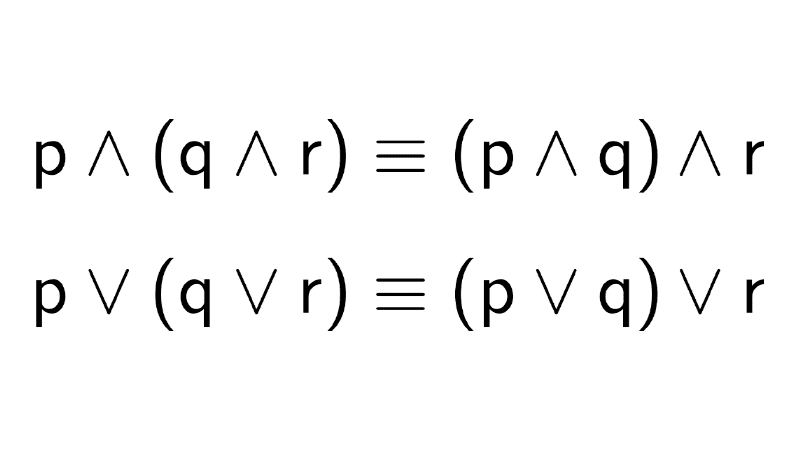
It is important to distinguish this property from associativity and distributivity. Commutativity only swaps the order of two components, whereas associativity changes the grouping of three or more, and distributivity involves a combination of two different connectives.
It is worth noting that not all logical connectives are commutative. The conditional (→) does not satisfy this property in the same simple sense, since the order of its components is essential to its meaning. In contrast, the biconditional (↔) and exclusive disjunction (⊻) are commutative.
Commutativity in Set Theory
This logical property translates naturally to set theory. The operations analogous to conjunction and disjunction are intersection (∩) and union (∪), respectively.
Given two sets A and B, the following identities hold:
- Intersection is commutative: A ∩ B = B ∩ A.
- Union is commutative: A ∪ B = B ∪ A.
Did you find this useful? Rate it!
0.0 / 5 — 0 votes

HOW TO CITE THIS ARTICLE
Machado, D. (2026, October 3). Commutative Laws in Logic. Flamath. https://en.flamath.com/commutative-laws-in-logic
Associative Laws in Logic
Propositional Logic Practice Problems
Propositional Variables
Translating Statements into Symbolic Form
Simple and Compound Statements
Leave a Reply
Related Articles