
Irrational Numbers on a Number Line
We know that irrational numbers are those that fill the gaps left by rational numbers on the number line. Non-perfect square roots of positive integers are irrational. Since these numbers have non-terminating, non-repeating decimal expansions, we often rely on approximations to plot them on a number line.
However, we can use the Pythagorean Theorem to plot the exact location of any square root with a positive integer radicand on a number line. We will look at several examples below. It is important to note that this direct geometric construction applies specifically to square roots rather than cube roots or higher-order roots.
Table of Contents
Square Root of 2
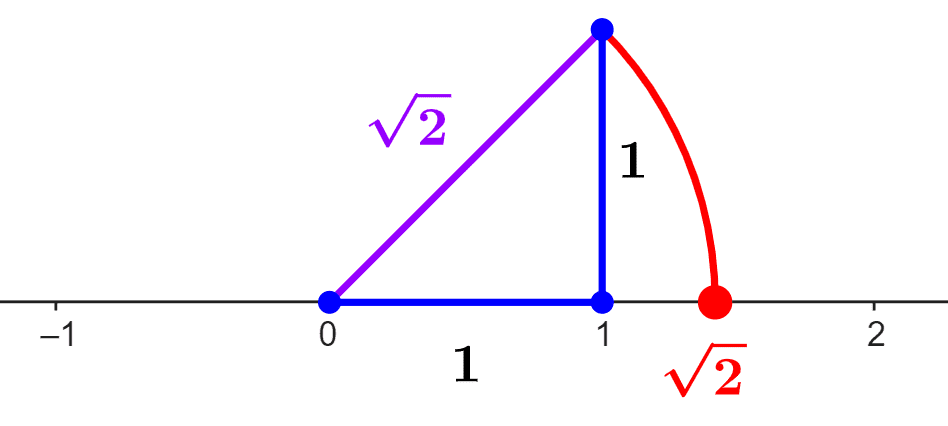
On the number line, we construct a right triangle whose legs are both equal to 1. By the Pythagorean Theorem, its hypotenuse has a length of \(\sqrt{2}.\)
$$a^2=b^2+c^2$$
$$a^2=1^2+1^2$$
$$a^2=2$$
$$a=\sqrt{2}$$

Now that we have a line segment whose length equals the irrational number we want to plot, we need to transfer that exact distance onto the number line.
Using a compass centered at \(0,\) we measure the length of the hypotenuse, swing an arc down onto the number line, and mark the intersection point. This point indicates the exact location of \(\sqrt{2}\) on the number line. The construction is complete.
Square Root of 3
From the previous example, we already have the square root of \(2\) marked on the number line, so we can use that same value to plot \(\sqrt{3}.\) We construct another right triangle with a base of \(\sqrt{2}\) and a height of 1. By the Pythagorean Theorem:
$$a^2=(\sqrt{2})^2+1^2$$
$$a^2=2+1$$
$$a^2=3$$
$$a=\sqrt{3}$$
The hypotenuse of this triangle measures \(\sqrt{3}.\) We transfer this length onto the number line using a compass, following the exact same procedure as before.

Square Root of 5
We need to find two numbers that, when used as the lengths of the legs, yield a hypotenuse equal to the irrational number \(\sqrt{5}.\) For example, \(2\) and \(1,\) since:
$$a^2=2^2+1^2$$
$$a^2=4+1$$
$$a^2=5$$
$$a=\sqrt{5}$$
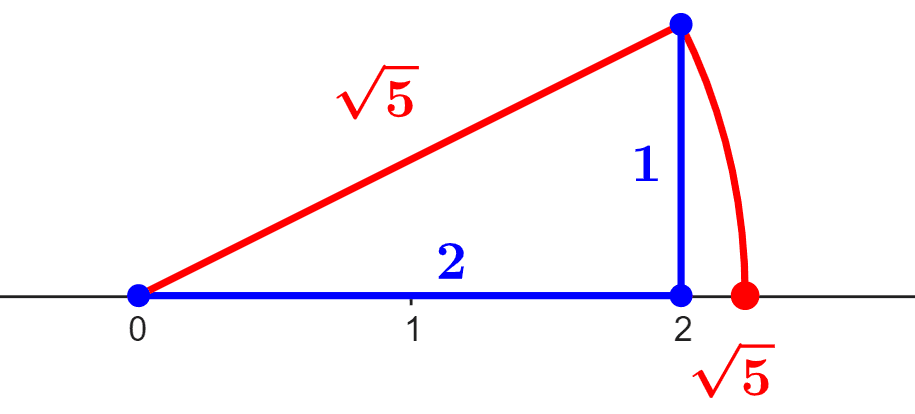
Finding two suitable leg lengths by trial and error can be tricky, so we can follow a systematic method instead. It is important that at least one of the legs has an integer length, since we need to measure and draw it using a ruler.
In the following method, we keep the vertical leg fixed at a length of \(1,\) so we only need to determine the length of the horizontal leg. Assuming \(\sqrt{n}\) is the irrational number we want to plot, the horizontal leg will measure \(\sqrt{n-1}\) (the square root of the preceding positive integer). By the Pythagorean Theorem:
$$(\sqrt{n})^2=(\sqrt{n-1})^2+1^2$$
$$n=n-1+1$$
$$n=n$$
Example: To plot \(\sqrt{5},\) the horizontal leg will measure \(\sqrt{5-1}\) and the vertical leg will measure \(1,\) because:
$$(\sqrt{5})^2=(\sqrt{5-1})^2+1^2$$
$$5=(\sqrt{4})^2+1$$
$$5=4+1$$
$$5=5$$
Steps to Plot a Square Root on a Number Line
- Calculate the value \(\sqrt{n-1},\) where \(\sqrt{n}\) is the irrational number you want to plot.
- Use that value as the length of the horizontal leg of a right triangle constructed on the number line.
- Use 1 as the length of the vertical leg.
- Transfer the length of the hypotenuse onto the number line using a compass.
Square Root of 6
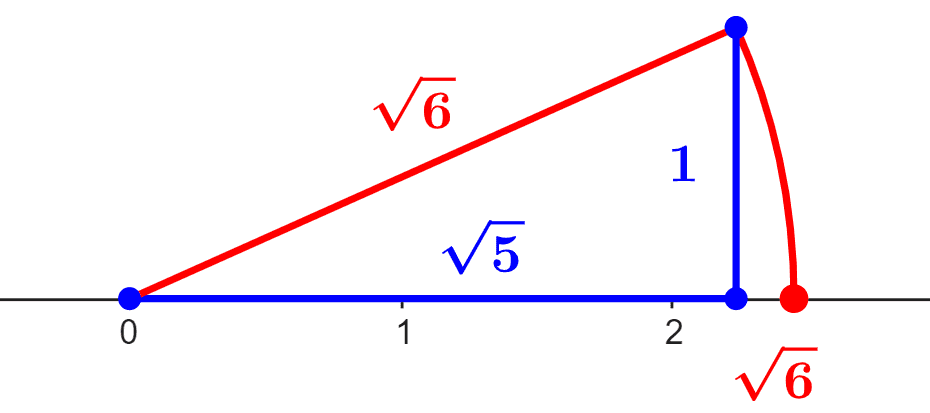
Using the procedure described above, we find the lengths of the two legs:
Vertical leg: \(1\)
Horizontal leg: \(\sqrt{6-1}=\sqrt{5}\)
Clearly, we first need to locate \(\sqrt{5}\) on the number line in order to plot \(\sqrt{6}.\)
Square Root of 7
Following the same procedure:
Vertical leg: \(1\)
Horizontal leg: \(\sqrt{7-1}=\sqrt{6}\)
We first need to have \(\sqrt{6}\) plotted on the number line.

Square Root of 10
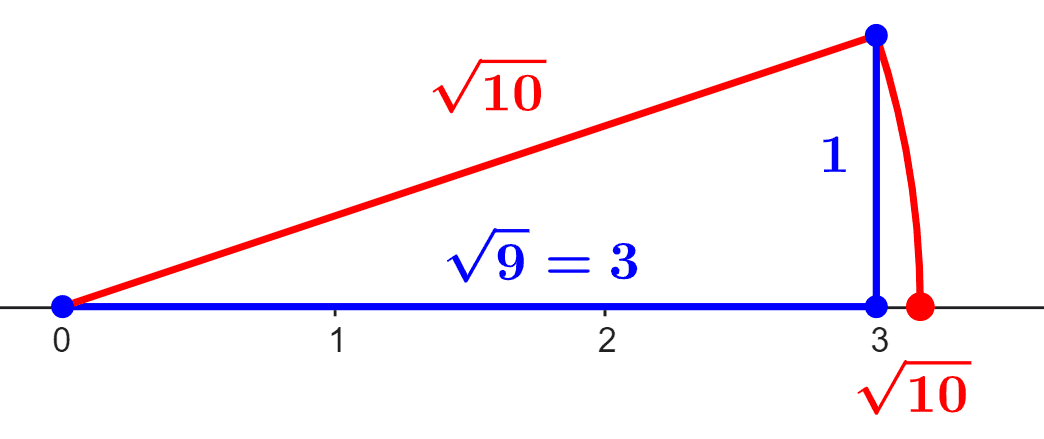
Following the procedure, we first need \(\sqrt{9}\) located on the number line. However, since this number is rational \((\sqrt{9}=3),\) the work is much easier:
Vertical leg: \(1\)
Horizontal leg: \(\sqrt{10-1}=\sqrt{9}=3\)
Negative Irrational Numbers
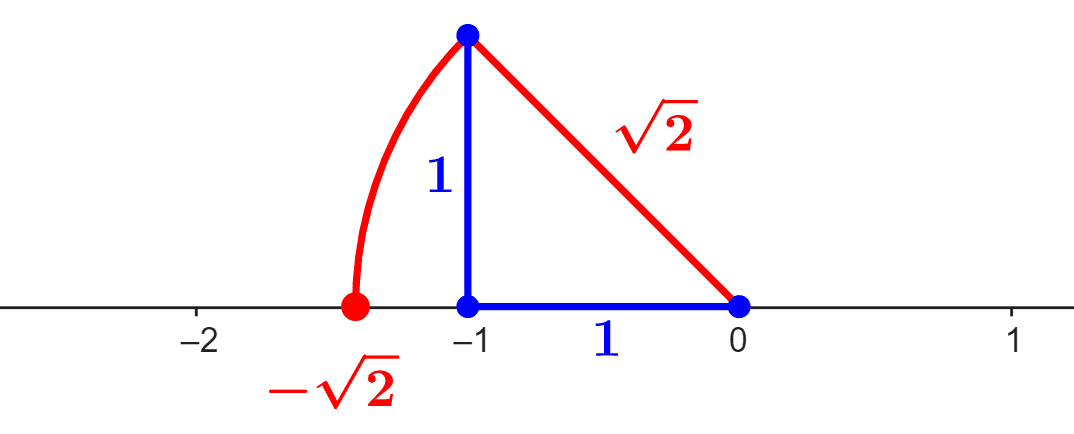
To plot negative irrational numbers on a number line, simply construct the right triangle to the left of zero instead of to the right. The rest of the procedure remains exactly the same.
Did you find this useful? Rate it!

Leave a Reply