
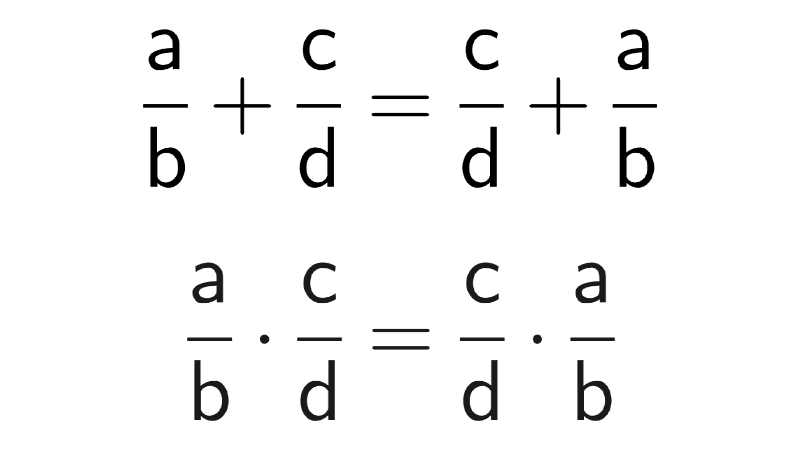
Powers of Fractions
Powers of fractions represent an operation that consists of multiplying a fraction, called the base, by itself as many times as indicated by a number called the exponent.
$$\left( \frac{a}{b} \right)^n = \underbrace{ \frac{a}{b} \cdot \frac{a}{b} \cdot \frac{a}{b} \cdot \cdots \cdot \frac{a}{b} }_{\text{n times}}$$
The fraction \(\dfrac{a}{b}\) (where \(b \neq 0\)) is called the base, and the integer \(n\) is the exponent.
Therefore, we can think of exponentiation as repeated multiplication. Since we multiply fractions by multiplying the numerators together and the denominators together, we get:
$$\left( \frac{a}{b} \right)^n = \frac{a}{b} \cdot \frac{a}{b} \cdot \frac{a}{b} \cdots \frac{a}{b} = \frac{\overbrace{a \cdot a \cdot a \cdots a}^{\textsf{n times}}}{\underbrace{b \cdot b \cdot b \cdots b}_{\textsf{n times}}} = \frac{a^n}{b^n}$$
The numerator of the result is the original numerator multiplied by itself \(n\) times, which is \(a^n.\) The denominator is the original denominator multiplied by itself \(n\) times, which is \(b^n.\) This gives us a rule for raising a fraction to a power: raise both the numerator and the denominator to that exponent.
Note: When raising a fraction to an exponent, it is essential to place parentheses around the base; otherwise, the exponent will only apply to the numerator (or denominator). In other words, writing \(\left(\dfrac{a}{b}\right)^n\) is not the same as \(\dfrac{a}{b}^n\) or \(\dfrac{a}{b^n}.\)
Table of Contents
How to Solve Powers of Fractions
To raise a fraction to a power, raise both the numerator and the denominator to that exponent.
$$\left(\dfrac{a}{b}\right)^n=\dfrac{a^n}{b^n} \quad (b \neq 0)$$
A special case occurs when the exponent is 2. When squaring a fraction, raise both the numerator and the denominator to the second power.
$$\left(\dfrac{a}{b}\right)^2=\dfrac{a^2}{b^2}$$
When cubing a fraction, raise both the numerator and the denominator to the third power.
$$\left(\dfrac{a}{b}\right)^3=\dfrac{a^3}{b^3}$$
Working in reverse, when we have a fraction where both the numerator and the denominator have the same exponent, we can rewrite the expression by enclosing the entire fraction in parentheses and raising it to that single exponent:
$$\dfrac{a^n}{b^n}=\left(\dfrac{a}{b}\right)^n$$
Fractions with Positive Exponents
Powers of fractions follow the exact same sign rules as integers:
- If the base is positive, the result is positive.
- If the base is negative and the exponent is even, the result is positive.
- If the base is negative and the exponent is odd, the result is negative.
Examples:
\(\left(\dfrac{3}{4}\right)^2=\dfrac{3^2}{4^2}=\dfrac{9}{16}\)
\(\left(\dfrac{5}{9}\right)^3=\dfrac{5^3}{9^3}=\dfrac{125}{729}\)
\(\left(-\dfrac{4}{15}\right)^{2}=+\dfrac{4^2}{15^2}=\dfrac{16}{225}\)
\(\left(\dfrac{5}{6}\right)^{4}=\dfrac{5^4}{6^4}=\dfrac{625}{1296}\)
\(\left(-\dfrac{4}{3}\right)^{5}=-\dfrac{4^5}{3^5}=-\dfrac{1024}{243}\)
It can be helpful to use the property of fractions stating that placing the negative sign in the numerator, the denominator, or in front of the fraction yields the same value. For instance, the fraction \(-\dfrac{2}{9}\) is equal to \(\dfrac{-2}{9}\) and \(\dfrac{2}{-9}.\) By moving the negative sign to either the numerator or the denominator, it becomes easier to see whether the final power will be positive or negative.
Here are some specific examples of raising negative fractions to a power:
\(\left(-\dfrac{2}{9}\right)^2=\dfrac{(-2)^2}{9^2}=\dfrac{4}{81}\)
\(\left(-\dfrac{1}{2}\right)^5=\dfrac{(-1)^5}{2^5}=-\dfrac{1}{32}\)
\(\left(-\dfrac{6}{8}\right)^{3}=\dfrac{6^3}{(-8)^3}=-\dfrac{216}{512}=-\dfrac{27}{64}\)
\(\left(-\dfrac{3}{2}\right)^{2}=\dfrac{(-3)^2}{2^2}=\dfrac{9}{4}\)
Fractions with Negative Exponents
To raise a fraction to a negative exponent, take the reciprocal of the base fraction (flip it) and change the exponent to positive.
$$\left(\dfrac{a}{b}\right)^{-n}=\left(\dfrac{b}{a}\right)^{n}=\dfrac{b^n}{a^n} \quad (a \neq 0, \, b \neq 0)$$
where \(-n\) is a negative integer.
Examples:
\(\left(\dfrac{7}{8}\right)^{-3}=\left(\dfrac{8}{7}\right)^3=\dfrac{8^3}{7^3}=\dfrac{512}{343}\)
\(\left(\dfrac{2}{5}\right)^{-2}=\left(\dfrac{5}{2}\right)^2=\dfrac{5^2}{2^2}=\dfrac{25}{4}\)
\(\left(-\dfrac{3}{8}\right)^{-2}=\left(-\dfrac{8}{3}\right)^{2}=\dfrac{8^2}{(-3)^2}=\dfrac{64}{9}\)
\(\left(\dfrac{7}{2}\right)^{-4}=\left(\dfrac{2}{7}\right)^4=\dfrac{2^4}{7^4}=\dfrac{16}{2401}\)
\(\left(-\dfrac{3}{2}\right)^{-3}=\left(-\dfrac{2}{3}\right)^3=-\dfrac{2^3}{3^3}=-\dfrac{8}{27}\)
Raising a fraction to the power of -1 results in its reciprocal.
$$\left(\dfrac{a}{b}\right)^{-1}=\left(\dfrac{b}{a}\right)^{1}=\dfrac{b}{a} \quad (a \neq 0, \, b \neq 0)$$
Examples:
\(\left(\dfrac{3}{5}\right)^{-1}=\dfrac{5}{3}\)
\(\left(\dfrac{1}{3}\right)^{-1}=\dfrac{3}{1}=3\)
\(\left(-\dfrac{3}{7}\right)^{-1}=-\dfrac{7}{3}\)
\(\left(\dfrac{8}{4}\right)^{-1}=\dfrac{4}{8}=\dfrac{1}{2}\)
Fractions with a Zero Exponent
Any non-zero fraction raised to the zero power is equal to 1:
$$\left(\dfrac{a}{b}\right)^{0}=1 \quad (a \neq 0, \, b \neq 0)$$
Examples:
\(\left(\dfrac{4}{19}\right)^0=1\)
\(\left(-\dfrac{20}{7}\right)^0=1\)
\(\left(\dfrac{7}{5}\right)^0=1\)
\(\left(-\dfrac{5}{3}\right)^{0}=1\)
Fractions with Fractional Exponents
Fractional exponents are another way of writing radicals (roots). When a fraction is raised to a fractional exponent, take the corresponding root of both the numerator and the denominator.
$$\left(\dfrac{a}{b}\right)^{m/n}=\sqrt[n]{\left(\dfrac{a}{b}\right)^m}=\dfrac{\sqrt[n]{a^m}}{\sqrt[n]{b^m}}$$
Examples:
\(\left(\dfrac{1}{9}\right)^{1/2}=\sqrt[2]{\dfrac{1}{9}}=\dfrac{\sqrt{1}}{\sqrt{9}}=\dfrac{1}{3}\)
\(\left(\dfrac{3}{5}\right)^{2/3}=\sqrt[3]{\left(\dfrac{3}{5}\right)^2}=\dfrac{\sqrt[3]{3^2}}{\sqrt[3]{5^2}}=\dfrac{\sqrt[3]{9}}{\sqrt[3]{25}}\)
Properties of Exponents for Fractions
Powers of rational numbers follow the same exponent rules as other real numbers.
Product of Powers Property: When multiplying two powers with the same base, keep the base and add the exponents. For example:
$$\left(\dfrac{1}{3}\right)^3\cdot \left(\dfrac{1}{3}\right)^6=\left(\dfrac{1}{3}\right)^{3+6}=\left(\dfrac{1}{3}\right)^9$$
Quotient of Powers Property: When dividing two powers with the same base, keep the base and subtract the exponents. For example:
$$\left(\dfrac{1}{2}\right)^5 \div \left(\dfrac{1}{2}\right)^3=\left(\dfrac{1}{2}\right)^{5-3}=\left(\dfrac{1}{2}\right)^2=\dfrac{1}{4}$$
Power of a Power Property: When raising a power to another exponent, keep the base and multiply the exponents. For example:
$$\left[\left(\dfrac{2}{3}\right)^3\right]^2=\left(\dfrac{2}{3}\right)^{3\cdot 2}=\left(\dfrac{2}{3}\right)^6$$
Power of a Product Property: When raising a product to an exponent, raise each factor to that exponent. For example:
$$\left(\dfrac{5}{7}\cdot \dfrac{2}{9}\right)^2=\left(\dfrac{5}{7}\right)^2\cdot \left(\dfrac{2}{9}\right)^2$$
Power of a Quotient Property: When raising a quotient to an exponent, raise both the dividend and the divisor to that exponent. For example:
$$\left(\dfrac{7}{3} \div \dfrac{1}{11}\right)^3=\left(\dfrac{7}{3}\right)^3 \div \left(\dfrac{1}{11}\right)^3$$
Practice Problems with Answers
Problem 1: Evaluate the following powers.
- \(\left(-\dfrac{5}{9}\right)^{2}\)
- \(\left(-\dfrac{4}{7}\right)^{3}\)
- \(\left(-\dfrac{1}{2}\right)^{6}\)
- \(6^{-2}\)
- \(-\left(\dfrac{3}{8}\right)^{-2}\)
- \(\left(\dfrac{1}{4}\right)^{-3}\)
- \(\left(-\dfrac{5}{6}\right)^{-4}\)
Show Solutions
- \(\left(-\dfrac{5}{9}\right)^{2}=\dfrac{25}{81}\)
- \(\left(-\dfrac{4}{7}\right)^{3}=-\dfrac{64}{343}\)
- \(\left(-\dfrac{1}{2}\right)^{6}=\dfrac{1}{64}\)
- \(6^{-2}=\dfrac{1}{6^2}=\dfrac{1}{36}\)
- \(-\left(\dfrac{3}{8}\right)^{-2}=-\left(\dfrac{8}{3}\right)^2=-\dfrac{64}{9}\)
- \(\left(\dfrac{1}{4}\right)^{-3}=4^3=64\)
- \(\left(-\dfrac{5}{6}\right)^{-4}=\left(-\dfrac{6}{5}\right)^{4}=\dfrac{1296}{625}\)
Problem 2: Determine whether the following statements are true or false and justify your answer.
- \(\left(\dfrac{2}{5}\right)^{-1}=\dfrac{2}{5}\)
- \(\dfrac{3^{-1}}{2}=\dfrac{2}{3}\)
- \(\left(-\dfrac{1}{10}\right)^{-2}=100\)
- \((-3)^{-1}=-3\)
- \(\left(-\dfrac{4}{3}\right)^{-1}=-\dfrac{4}{3}\)
- \(-\dfrac{1}{6^{-2}}=-36\)
Show Solutions
- False. Raising a fraction to the power of \(-1\) gives its reciprocal. The correct calculation is \(\left(\dfrac{2}{5}\right)^{-1}=\dfrac{5}{2}\)
- False. The exponent only applies to the numerator. The correct calculation is \(\dfrac{3^{-1}}{2}=\dfrac{1}{2 \cdot 3}=\dfrac{1}{6}\)
- True.
- False. The exponent \(-1\) gives the reciprocal of the number. The correct calculation is \((-3)^{-1}=-\dfrac{1}{3}\)
- False. The exponent \(-1\) gives the reciprocal of the fraction. The correct result is \(\left(-\dfrac{4}{3}\right)^{-1}=-\dfrac{3}{4}\)
- True. Dividing by a fraction is the same as multiplying by its reciprocal: \(-\dfrac{1}{6^{-2}}=-\dfrac{1}{\frac{1}{6^2}}=-1 \cdot 6^2=-36\)
Did you find this useful? Rate it!
0.0 / 5 — 0 votes

HOW TO CITE THIS ARTICLE
Machado, D. (2026, November 23). Powers of Fractions. Flamath. https://en.flamath.com/fraction-powers
Leave a Reply
Related Articles