
Consistent and Independent System
A consistent and independent system (also referred to as a consistent independent system) is a set of linear equations that admits exactly one unique solution for all its variables. In linear algebra, this means that the relationships established among the unknowns contain no algebraic contradictions and allow no degrees of freedom.
The name of this type of system brings together two complementary properties:
- Consistent: Indicates that the system has at least one solution (an assignment of values that satisfies all equations simultaneously).
- Independent: Specifies that this solution is unique, meaning there are no infinitely many alternatives or free parameters.
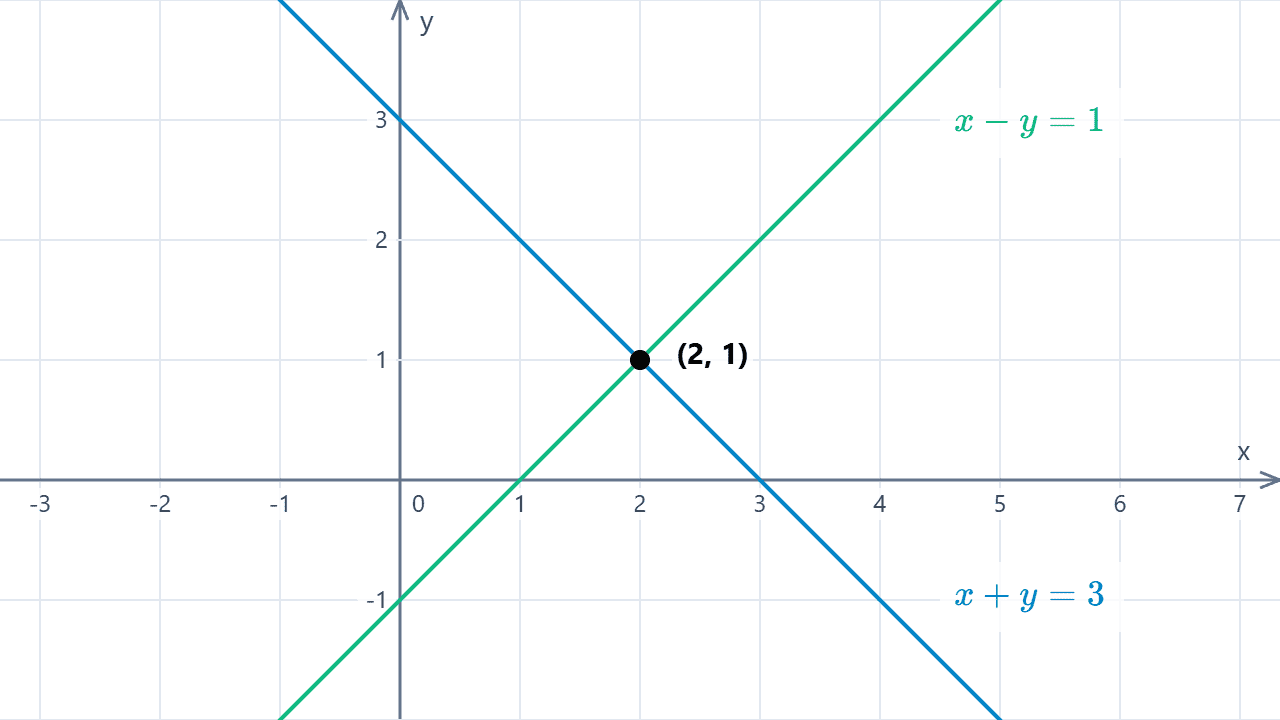
To illustrate this property, consider the following linear system of two equations in two variables:
$$\begin{cases} x + y = 3 \\ x - y = 1 \end{cases}$$
The only solution that satisfies both conditions at once is the ordered pair (x, y) = (2, 1). Substituting these values into the first equation yields \(2 + 1 = 3\), and the second equation holds true as \(2 - 1 = 1\). No other combination of real numbers satisfies both equations simultaneously.
From a geometric perspective, each linear equation in two variables represents a line in the Cartesian plane. A consistent and independent system means that both lines are intersecting lines that cross at a single common point, whose coordinates match the values of the solution.
This condition distinguishes the system from the other two possibilities in the general classification of systems of linear equations:
- Consistent and dependent system: Has infinitely many solutions because the equations represent coincident geometric entities or share infinitely many points of intersection.
- Inconsistent system: Has no solution because its equations impose contradictory conditions, such as distinct parallel lines.
Table of Contents
Geometric Interpretation
The algebraic solution of a system of linear equations has a direct visual correspondence with the relative position of the geometric loci described by each equation. Depending on the number of unknowns involved, the problem is equivalent to determining whether a common intersection exists in the plane, in three-dimensional space, or in higher dimensions.
Systems in the Plane
In two-dimensional space \(\mathbb{R}^2\), each first-degree linear equation in two variables represents a line. In a consistent and independent system, the associated lines intersect at a single point, whose coordinates \((x, y)\) constitute the solution to the system.
The most common case consists of two non-parallel lines intersecting at a single point. However, a system with three or more linear equations can also be consistent and independent if all the lines converge simultaneously at that exact same point of intersection.
Systems in Three-Dimensional Space
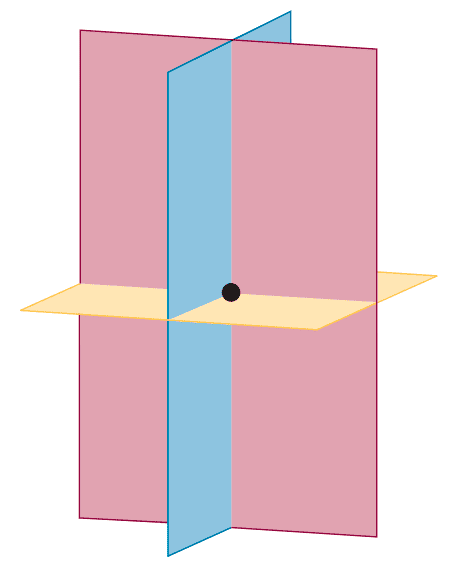
In \(\mathbb{R}^3\) space, each linear equation in three variables describes a geometric plane. For a system to be consistent and independent in this setting, the planes must meet at a single point \((x, y, z)\).
The standard configuration consists of three planes that intersect pairwise along lines, with all three orientations converging at one common vertex. Just as in the plane, if the system includes four or more planes, it remains consistent and independent provided that all of them pass through that same point of intersection without creating contradictions.
Higher Dimensions
When a linear system involves four or more unknowns (\(\mathbb{R}^n\)), direct geometric visualization using traditional graphs is no longer possible. In these cases, each linear equation defines a hyperplane of dimension \(n - 1\).
Such a system is consistent and independent when all the hyperplanes involved intersect at a single point with coordinates \((x_1, x_2, \dots, x_n)\), preserving the same algebraic principle of a unique solution that governs two and three dimensions.
Classification Criteria
To determine whether a linear system admits a unique solution, it is not always necessary to explicitly compute the value of each variable. Algebraic and matrix tools allow you to evaluate the consistency of the system and classify it directly from its coefficients.
Rouché–Frobenius Theorem
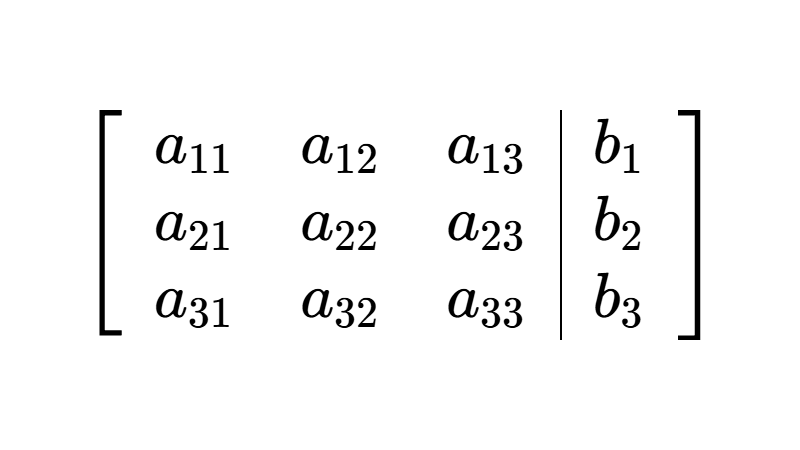
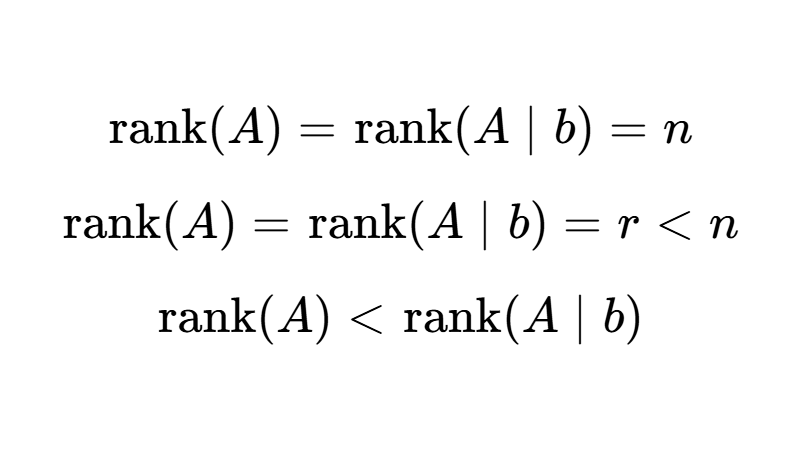
The Rouché–Frobenius theorem (also known as the Rouché–Capelli theorem or the rank condition) provides the general criterion applicable to any system of linear equations, whether square or rectangular. It determines the classification by comparing the rank of the coefficient matrix \(A\) and the rank of the augmented matrix \((A\mid b)\), which includes the column of constant terms.
A system with \(n\) unknowns is consistent and independent if and only if the following equality holds:
$$\text{rank}(A) = \text{rank}(A\mid b) = n$$
When both ranks are equal, the system is consistent; if this common value also equals the total number of unknowns, the solution is guaranteed to be unique.
Determinant Criterion
This criterion applies specifically to square systems—that is, systems with the same number of equations as unknowns (\(n \times n\)). In these cases, the coefficient matrix \(A\) is square and has a well-defined determinant.
A square system is consistent and independent if and only if the determinant of its coefficient matrix is nonzero:
$$\det(A) \neq 0$$
The condition \(\det(A) \neq 0\) algebraically guarantees that the matrix \(A\) is invertible (nonsingular), ensuring that its rows and columns are linearly independent and that the system has a unique solution obtainable via Cramer's rule or the inverse matrix.
Gaussian Elimination
The Gaussian elimination method classifies a system by transforming its augmented matrix into row echelon form using elementary row operations. It is a direct computational procedure that requires no determinant formulas and works in any dimension.
Once in row echelon form, the system is consistent and independent if two conditions are met simultaneously:
- No contradictory row of the form \(0 = c\) (where \(c \neq 0\)) appears, ensuring consistency.
- Every column associated with a variable contains a nonzero pivot, ruling out the existence of free variables.
To compare the practical usefulness of each method depending on the problem structure, review the following summary:
| Method | Type of System | Analytical Condition | Recommended Use |
|---|---|---|---|
| Rouché–Frobenius Theorem | Any system (square or rectangular) | \(\text{rank}(A) = \text{rank}(A\mid b) = n\) | Formal analysis of parametric systems and theoretical proofs. |
| Determinant Criterion | Square systems (\(n \times n\)) | \(\det(A) \neq 0\) | Quick classification of \(2 \times 2\) or \(3 \times 3\) systems before applying Cramer's rule. |
| Gaussian Elimination | Any system (square or rectangular) | Pivot in every variable column with no rows of the form \(0 = c\), where \(c \neq 0\) | Direct step-by-step solving of the system. |
Worked Examples
To reinforce how these theoretical criteria apply to different types of linear systems, let us walk through six step-by-step cases.
Example 1
Determine whether the following linear system of two equations in two variables is consistent and independent:
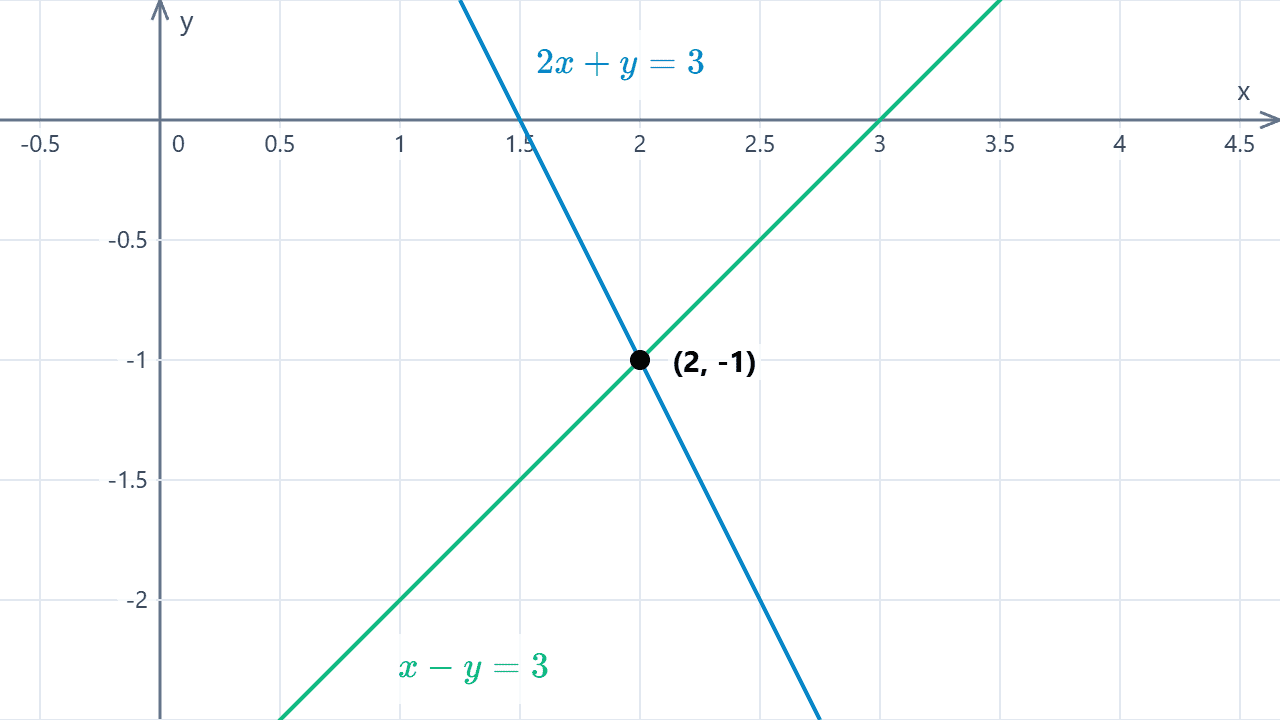
$$\begin{cases} 2x + y = 3 \\ x - y = 3 \end{cases}$$
To classify this square system, we apply the determinant criterion by computing the determinant of its coefficient matrix:
$$\det(A) = \begin{vmatrix} 2 & 1 \\ 1 & -1 \end{vmatrix} = 2(-1) - (1)(1) = -2 - 1 = -3$$
Since \(\det(A) \neq 0\), the system is consistent and independent and admits a unique solution. Solving by any elementary method (such as elimination by adding both equations), we obtain the common intersection point (x, y) = (2, -1).
Example 2
Analyze the consistency of the following system of three equations in three unknowns:
$$\begin{cases} x + y + z = 6 \\ 2y + 5z = -4 \\ 2x + 5y - z = 27 \end{cases}$$
To check whether it admits a unique solution without computing higher-order determinants, we write its augmented matrix \((A \mid b)\):
$$\left[\begin{array}{ccc|c} 1 & 1 & 1 & 6 \\ 0 & 2 & 5 & -4 \\ 2 & 5 & -1 & 27 \end{array}\right]$$
After performing elementary row operations to reduce the matrix to row echelon form (Gaussian elimination), we obtain:
$$\left[\begin{array}{ccc|c} 1 & 1 & 1 & 6 \\ 0 & 2 & 5 & -4 \\ 0 & 0 & -7 & 14 \end{array}\right]$$
Observe that the echelon matrix has no contradictory rows and contains three nonzero pivots (in the columns for \(x\), \(y\), and \(z\)). Therefore, the system is consistent and independent. Using back-substitution, we find \(z = -2\), \(y = 3\), and \(x = 5\), which gives the unique solution (x, y, z) = (5, 3, -2).
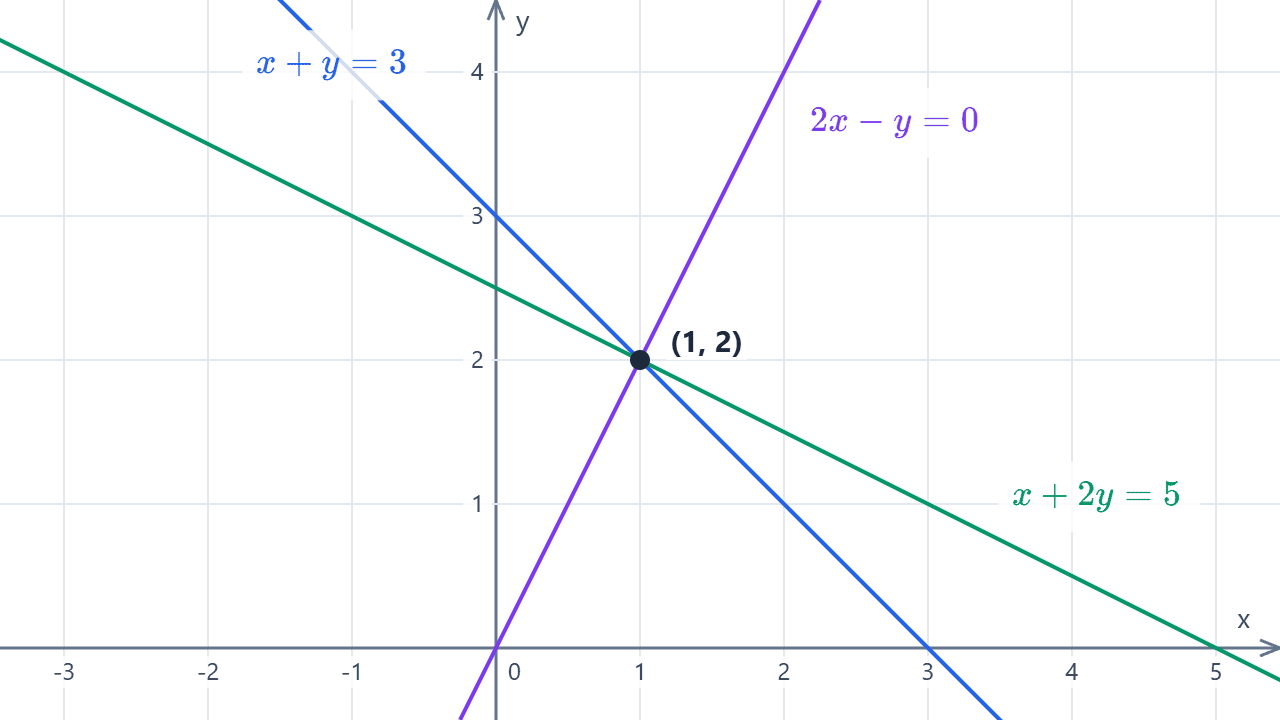
Example 3
Examine whether the following overdetermined system of three equations in two variables has a unique solution:
$$\begin{cases} x + y = 3 \\ 2x - y = 0 \\ x + 2y = 5 \end{cases}$$
Even though the system has more equations than variables, it can be consistent and independent if the third equation is consistent with the first two. To verify this, we set up its augmented matrix \((A \mid b)\):
$$\left[\begin{array}{cc|c} 1 & 1 & 3 \\ 2 & -1 & 0 \\ 1 & 2 & 5 \end{array}\right]$$
After applying elementary row operations to reduce the system to row echelon form, we get:
$$\left[\begin{array}{cc|c} 1 & 1 & 3 \\ 0 & 1 & 2 \\ 0 & 0 & 0 \end{array}\right]$$
The last row reduces completely to zeros, indicating that the third equation introduces no contradictions. Applying the Rouché–Frobenius theorem shows that \(\text{rank}(A) = \text{rank}(A \mid b) = 2\). Because the rank matches the exact number of unknowns (\(n = 2\)), the system is consistent and independent with the unique solution (x, y) = (1, 2).
Example 4
Classify the following rectangular system of four equations in three unknowns:
$$\begin{cases} x - y + z = 2 \\ 2x + y - z = 1 \\ x + 2y - 2z = -1 \\ 3x + y = 4 \end{cases}$$
We write the augmented matrix \((A \mid b)\) corresponding to the system:
$$\left[\begin{array}{ccc|c} 1 & -1 & 1 & 2 \\ 2 & 1 & -1 & 1 \\ 1 & 2 & -2 & -1 \\ 3 & 1 & 0 & 4 \end{array}\right]$$
After performing elementary row reduction operations, we obtain the row echelon matrix:
$$\left[\begin{array}{ccc|c} 1 & -1 & 1 & 2 \\ 0 & 1 & -1 & -1 \\ 0 & 0 & 1 & 2 \\ 0 & 0 & 0 & 0 \end{array}\right]$$
We have three nonzero pivots corresponding to the three variables in the problem, so \(\text{rank}(A) = \text{rank}(A \mid b) = 3 = n\). Consequently, the system is consistent and independent, and its unique solution is (x, y, z) = (1, 1, 2).
Example 5
Verify whether the following homogeneous system of three equations admits only the trivial solution:
$$\begin{cases} x + 2y - z = 0 \\ 2x - y + z = 0 \\ 3x + y + 2z = 0 \end{cases}$$
Every homogeneous linear system (one where all constant terms are zero) is always consistent, since assigning zero to all variables \((0, 0, 0)\) satisfies every equation simultaneously. To determine whether this solution is unique (independent), we evaluate the determinant of its coefficient matrix:
$$\det(A) = \begin{vmatrix} 1 & 2 & -1 \\ 2 & -1 & 1 \\ 3 & 1 & 2 \end{vmatrix}$$
Expanding the determinant along the first row gives:
$$\det(A) = 1 \cdot (-2 - 1) - 2 \cdot (4 - 3) + (-1) \cdot (2 - (-3)) = 1(-3) - 2(1) - 1(5) = -3 - 2 - 5 = -10$$
Because \(\det(A) \neq 0\), the coefficient matrix is invertible and the system has no nontrivial solutions. As a result, it is classified as consistent and independent with a unique solution at the origin (x, y, z) = (0, 0, 0).
Example 6
Find the values of the real parameter \(k\) for which the following system is consistent and independent:
$$\begin{cases} x + y = 2 \\ x + ky = 4 \end{cases}$$
To analyze consistency in terms of \(k\), we subtract the first equation from the second to isolate the variable \(y\):
$$(x + ky) - (x + y) = 4 - 2 \implies (k - 1)y = 2$$
The resulting equation allows us to immediately identify the behavior of the system based on the coefficient of \(y\):
- If k ≠ 1, we can divide both sides by \(k - 1\), obtaining a unique value for \(y = \frac{2}{k - 1}\) and, consequently, a unique value for \(x\). In this case, the system is consistent and independent.
- If k = 1, the equation becomes \(0 \cdot y = 2\), which represents a contradiction (\(0 = 2\)) and makes the system inconsistent.
Therefore, the system is consistent and independent for every real number \(k\) not equal to 1.
Did you find this useful? Rate it!
0.0 / 5 — 0 votes

HOW TO CITE THIS ARTICLE
Machado, D. (2026, November 12). Consistent and Independent System. Flamath. https://en.flamath.com/consistent-independent-system
Augmented Matrix
Rouché-Frobenius Theorem
Systems of Linear Equations
Cramer's Rule
Gauss-Jordan Elimination
Leave a Reply
Related Articles