
Properties of Fractions
In this article, we explain the most important properties of fractions with examples of each. Knowing these rules is essential when solving mathematical problems.
Table of Contents
Fundamental Properties
Let us review some basic concepts about fractional numbers.
Equivalent fractions: Two fractions are said to be equivalent if they represent the same quantity, that is, the same part of a whole. If a fraction \(\dfrac{a}{b}\) is equivalent to another fraction \(\dfrac{c}{d}\), we can write the equality \(\dfrac{a}{b}=\dfrac{c}{d}\), and their cross products are equal: \(a\cdot d=b\cdot c\).
Examples
- \(\dfrac{6}{8}=\dfrac{18}{24}\) because \(6\cdot 24=8\cdot 18=144\)
- \(\dfrac{4}{9}=\dfrac{20}{45}\) because \(4\cdot 45=9\cdot 20=180\)
Simplifying and expanding fractions: Fractional numbers can be simplified or expanded, meaning they can be written in different equivalent forms. To simplify a fraction, divide both the numerator and the denominator by the same common factor. To expand a fraction, multiply both the numerator and the denominator by the same nonzero factor.
Examples
- Simplifying: \(\dfrac{12}{18}=\dfrac{12\div 2}{18\div 2}=\dfrac{6}{9}\)
- Expanding: \(\dfrac{1}{2}=\dfrac{1\cdot 5}{2\cdot 5}=\dfrac{5}{10}\)
It is possible to write a fraction in simplest form (lowest terms), meaning a fraction that cannot be simplified any further. To do this, divide both the numerator and the denominator by their greatest common divisor (GCD).
In a fraction, placing the negative sign in the numerator, in the denominator, or in front of the fraction yields the same value. For example: \(\dfrac{-9}{4}=\dfrac{9}{-4}=-\dfrac{9}{4}\).
Integers can be written as fractions by placing the integer as the numerator and \(1\) as the denominator. For example: \(20=\dfrac{20}{1};\) \(-7=\dfrac{-7}{1};\) \(14=\dfrac{14}{1};\) \(0=\dfrac{0}{1}\).
Properties of Addition
Given two fractions \(\dfrac{a}{b}\) and \(\dfrac{c}{d},\) their sum is expressed as follows:
$$\dfrac{a}{b}+\dfrac{c}{d}=\dfrac{ad+bc}{bd}$$
The addition of fractions satisfies the following properties.
1) Commutative property: The order in which we add the fractions does not change the sum.
$$\dfrac{a}{b}+\dfrac{c}{d}=\dfrac{c}{d}+\dfrac{a}{b}$$
Example: If we have the sum \(\dfrac{2}{3}+\dfrac{5}{4}\), we can solve it either in that order or by swapping the fractions:
\(\dfrac{2}{3}+\dfrac{5}{4}=\dfrac{23}{12}\)
Swapping their positions:
\(\dfrac{5}{4}+\dfrac{2}{3}=\dfrac{23}{12}\)
Therefore, \(\dfrac{2}{3}+\dfrac{5}{4}=\dfrac{5}{4}+\dfrac{2}{3}\).
2) Associative property: Fractions can be grouped in different ways without changing the sum.
$$\dfrac{a}{b}+\left(\dfrac{c}{d}+\dfrac{e}{f}\right)=\left(\dfrac{a}{b}+\dfrac{c}{d}\right)+\dfrac{e}{f}$$
Example: The sum \(\dfrac{1}{2}+\left(\dfrac{1}{6}+\dfrac{4}{3}\right)\) can be regrouped and the result will remain the same.
\(\dfrac{1}{2}+\left(\dfrac{1}{6}+\dfrac{4}{3}\right)=2\)
\(\left(\dfrac{1}{2}+\dfrac{1}{6}\right)+\dfrac{4}{3}=2\)
Therefore:
\(\dfrac{1}{2}+\left(\dfrac{1}{6}+\dfrac{4}{3}\right)=\left(\dfrac{1}{2}+\dfrac{1}{6}\right)+\dfrac{4}{3}\)
3) Additive identity property: There exists a fraction that, when added to any other fraction, does not change its value: the zero fraction, \(\dfrac{0}{1}.\)
$$\dfrac{a}{b}+\dfrac{0}{1}=\dfrac{a}{b}$$
Example: \(\dfrac{3}{4}+\dfrac{0}{1}=\dfrac{3}{4}\)
4) Additive inverse property: For every fraction, there exists another fraction such that their sum equals zero. This fraction is obtained by changing the sign of the original fraction.
$$\dfrac{a}{b}+\left(-\dfrac{a}{b}\right)=\dfrac{0}{1}$$
Example: \(\dfrac{3}{4}+\left(-\dfrac{3}{4}\right)=\dfrac{0}{1}\)
When negative fractions are involved, care must be taken when applying these properties.
Example: \(\dfrac{1}{2}-\dfrac{3}{4}=-\dfrac{3}{4}+\dfrac{1}{2}.\) The negative fraction keeps its sign when using the commutative property, and the same applies to the other properties.
The subtraction or difference of two fractions \(\dfrac{a}{b}\) and \(\dfrac{c}{d}\) can be written as the following addition:
$$\dfrac{a}{b}-\dfrac{c}{d}=\dfrac{a}{b}+\left(-\dfrac{c}{d}\right)$$
Properties of Multiplication
The product of two or more fractions is another fraction whose numerator is the product of the numerators and whose denominator is the product of the denominators.
$$\dfrac{a}{b}\cdot \dfrac{c}{d}=\dfrac{a\cdot c}{b\cdot d}$$
If both fractions have the same sign, the result is positive; if they have different signs, the result is negative. This is known as the sign rules.
Example: \(\dfrac{2}{3}\cdot \dfrac{5}{4}=\dfrac{2\cdot 5}{3\cdot 4}=\dfrac{10}{12}=\dfrac{5}{6}\)
The multiplication of fractions satisfies the following properties.
1) Commutative property: The order of the factors does not change the product of fractions.
$$\dfrac{a}{b}\cdot \dfrac{c}{d}=\dfrac{c}{d}\cdot \dfrac{a}{b}$$
Example: \(\left(-\dfrac{7}{6}\right)\cdot \left(\dfrac{2}{8}\right)=\left(\dfrac{2}{8}\right)\cdot \left(-\dfrac{7}{6}\right)\)
\(\left(-\dfrac{7}{6}\right)\cdot \left(\dfrac{2}{8}\right)=-\dfrac{7}{24}\)
\(\left(\dfrac{2}{8}\right)\cdot \left(-\dfrac{7}{6}\right)=-\dfrac{7}{24}\)
2) Associative property: The way factors are grouped does not change the product.
$$\left(\dfrac{a}{b}\cdot \dfrac{c}{d}\right)\cdot \dfrac{e}{f}=\dfrac{a}{b}\cdot \left(\dfrac{c}{d}\cdot \dfrac{e}{f}\right)$$
Example: \(\dfrac{6}{7}\cdot \left(\dfrac{-4}{3}\cdot \dfrac{5}{8}\right)=\left(\dfrac{6}{7}\cdot \dfrac{-4}{3}\right)\cdot \dfrac{5}{8}\)
\(\dfrac{6}{7}\cdot \left(\dfrac{-4}{3}\cdot \dfrac{5}{8}\right)=-\dfrac{5}{7}\)
\(\left(\dfrac{6}{7}\cdot \dfrac{-4}{3}\right)\cdot \dfrac{5}{8}=-\dfrac{5}{7}\)
3) Distributive property over addition and subtraction: A fraction multiplied by a sum (or difference) of fractions is equal to multiplying that fraction by each term of the sum (or difference).
$$\dfrac{a}{b}\cdot \left(\dfrac{c}{d}±\dfrac{e}{f}\right)=\dfrac{a}{b}\cdot \dfrac{c}{d}±\dfrac{a}{b}\cdot \dfrac{e}{f}$$
Example: \(-\dfrac{6}{8}\cdot \left(\dfrac{3}{6}+\dfrac{20}{9}\right)=-\dfrac{6}{8}\cdot \dfrac{3}{6}-\dfrac{6}{8}\cdot \dfrac{20}{9}=-\dfrac{49}{24}\)
4) Multiplicative identity property: There exists a fraction that, when multiplied by any other fraction, does not change its value: that fraction is \(\dfrac{1}{1}.\)
$$\dfrac{a}{b}\cdot \dfrac{1}{1}=\dfrac{a}{b}$$
Example: \(\dfrac{5}{2}\cdot \dfrac{1}{1}=\dfrac{5}{2}\)
5) Multiplicative inverse property: For every nonzero fraction, there exists another fraction such that their product equals \(\dfrac{1}{1},\) the multiplicative identity. This fraction is called the reciprocal and is obtained by swapping the numerator and denominator.
$$\dfrac{a}{b}\cdot \dfrac{b}{a}=\dfrac{1}{1}$$
Example: \(\dfrac{9}{15}\cdot \dfrac{15}{9}=\dfrac{1}{1}\)
Properties of Division
The division of two fractions is a new fraction obtained by multiplying the dividend by the reciprocal of the divisor.
$$\dfrac{a}{b}\div\dfrac{c}{d}=\dfrac{a}{b}\cdot \dfrac{d}{c}=\dfrac{a\cdot d}{b\cdot c}$$
Dividing a fraction by an integer is solved by rewriting the integer as a fraction with a denominator of \(1\):
$$\dfrac{a}{b}\div k=\dfrac{a}{b}\div\dfrac{k}{1}=\dfrac{a}{bk}$$
Dividing an integer by a fraction is solved by rewriting that integer as a fraction with a denominator of \(1\):
$$k\div\dfrac{a}{b}=\dfrac{k}{1}\div\dfrac{a}{b}=\dfrac{kb}{a}$$
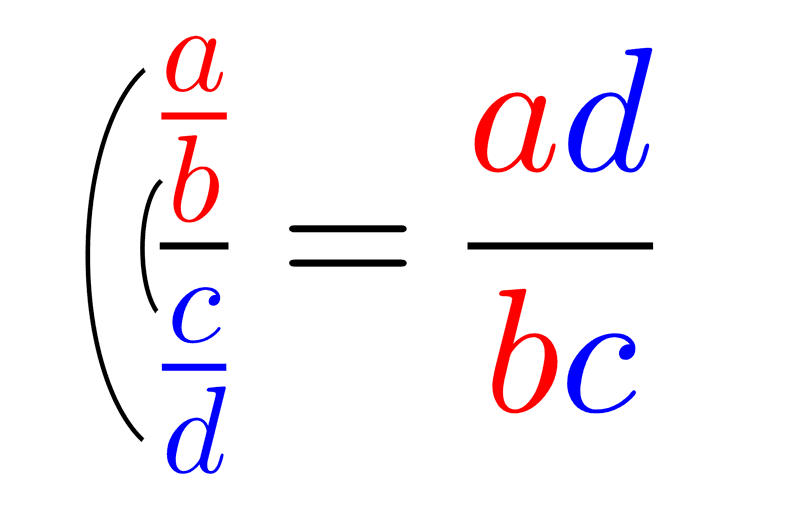
When we have a complex fraction (one fraction over another), we can apply the product of the extremes over the product of the means rule. This rule states that the result is the product of the extremes divided by the product of the means, where the extremes are the outermost numbers (top and bottom) and the means are the innermost numbers.
Example
\(\dfrac{\dfrac{3}{4}}{\dfrac{1}{7}}=\dfrac{3\cdot 7}{4\cdot 1}=\dfrac{21}{4}\)
Division itself does not satisfy standard algebraic properties:
- It is not commutative: Changing the order of the dividend and the divisor changes the quotient.
- It is not associative: The quotient changes depending on how the numbers are grouped.
Exponent Properties of Fractions
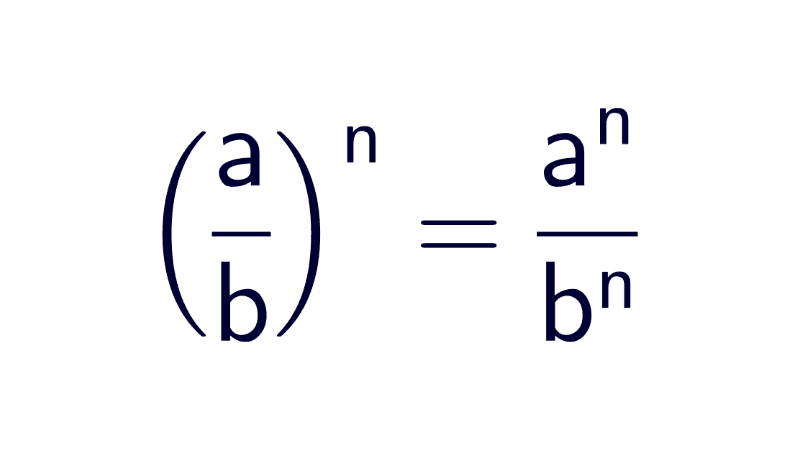
The power of a fraction is found by raising both the numerator and the denominator to the given exponent.
$$\left(\dfrac{a}{b}\right)^n=\dfrac{a^n}{b^n}$$
Example: \(\left(\dfrac{5}{9}\right)^3=\dfrac{5^3}{9^3}=\dfrac{125}{729}\)
To raise a fraction to a negative exponent, take the reciprocal of the base fraction and raise it to the positive exponent.
$$\left(\dfrac{a}{b}\right)^{-n}=\left(\dfrac{b}{a}\right)^{n}=\dfrac{b^n}{a^n}$$
where \(-n\) is a negative exponent.
Example: \(\left(\dfrac{2}{5}\right)^{-2}=\left(\dfrac{5}{2}\right)^2=\dfrac{5^2}{2^2}=\dfrac{25}{4}\)
Special Exponents
- Any fraction raised to the power of \(1\) is equal to the fraction itself: \(\left(\dfrac{a}{b}\right)^{1}=\dfrac{a}{b}\).
- Any nonzero fraction raised to the power of \(-1\) is equal to its reciprocal: \(\left(\dfrac{a}{b}\right)^{-1}=\left(\dfrac{b}{a}\right)^{1}=\dfrac{b}{a}\).
- Any nonzero fraction raised to the power of \(0\) is equal to \(1\): \(\left(\dfrac{a}{b}\right)^{0}=1\).
Powers of fractions follow the same sign rules as all other real numbers. If the base is negative and the exponent is even, the result is positive. If the base is negative and the exponent is odd, the result is negative.
Examples
- \(\left(-\dfrac{2}{9}\right)^2=+\dfrac{2^2}{9^2}=\dfrac{4}{81}\)
- \(\left(-\dfrac{1}{2}\right)^5=-\dfrac{1^5}{2^5}=-\dfrac{1}{32}\)
In addition, the standard laws of exponents apply to fractions.
Product of powers property: To multiply two powers with the same base, keep the base and add the exponents.
$$\left(\dfrac{a}{b}\right)^{m}\cdot \left(\dfrac{a}{b}\right)^{n}=\left(\dfrac{a}{b}\right)^{m+n}$$
Example: \(\left(\dfrac{1}{3}\right)^3\cdot \left(\dfrac{1}{3}\right)^6=\left(\dfrac{1}{3}\right)^{3+6}=\left(\dfrac{1}{3}\right)^9\)
Quotient of powers property: To divide two powers with the same base, keep the base and subtract the exponents.
$$\left(\dfrac{a}{b}\right)^{m}\div \left(\dfrac{a}{b}\right)^{n}=\left(\dfrac{a}{b}\right)^{m-n}$$
Example: \(\left(\dfrac{1}{2}\right)^5\div\left(\dfrac{1}{2}\right)^3=\left(\dfrac{1}{2}\right)^{5-3}=\left(\dfrac{1}{2}\right)^2=\dfrac{1}{4}\)
Power of a power property: To raise a power to another exponent, keep the base and multiply the exponents.
$$\left[\left(\dfrac{a}{b}\right)^{m}\right]^{n}=\left(\dfrac{a}{b}\right)^{m\cdot n}$$
Example: \(\left[\left(\dfrac{2}{3}\right)^3\right]^2=\left(\dfrac{2}{3}\right)^{3\cdot 2}=\left(\dfrac{2}{3}\right)^6\)
Power of a product property: To raise a product to an exponent, raise each factor to that exponent.
$$\left(\dfrac{a}{b}\cdot \dfrac{c}{d}\right)^{m}=\left(\dfrac{a}{b}\right)^{m}\cdot \left(\dfrac{c}{d}\right)^{m}$$
Example: \(\left(\dfrac{5}{7}\cdot \dfrac{2}{9}\right)^2=\left(\dfrac{5}{7}\right)^2\cdot \left(\dfrac{2}{9}\right)^2\)
Power of a quotient property: To raise a quotient to an exponent, raise both the dividend and the divisor to that exponent.
$$\left(\dfrac{a}{b}\div \dfrac{c}{d}\right)^{m}=\left(\dfrac{a}{b}\right)^{m}\div \left(\dfrac{c}{d}\right)^{m}$$
Example: \(\left(\dfrac{7}{3}\div\dfrac{1}{11}\right)^3=\left(\dfrac{7}{3}\right)^3\div\left(\dfrac{1}{11}\right)^3\)
Radical Properties of Fractions
To find the root of a fraction, take the root of the numerator and the root of the denominator separately.
$$\sqrt[n]{\dfrac{a}{b}}=\dfrac{\sqrt[n]{a}}{\sqrt[n]{b}}$$
Fractions follow the same rules as other real numbers. Therefore, an even root of a negative fraction is not a real number, whereas an odd root of a negative fraction does exist as a real number.
Examples
- \(\sqrt{\dfrac{4}{16}}=\dfrac{\sqrt{4}}{\sqrt{16}}=\dfrac{2}{4}=\dfrac{1}{2}\)
- \(\sqrt[3]{\dfrac{27}{125}}=\dfrac{\sqrt[3]{27}}{\sqrt[3]{125}}=\dfrac{3}{5}\)
- \(\sqrt{-\dfrac{3}{11}}\) is not a real number.
Assuming the given radicals represent real numbers, radicals of fractions satisfy the following properties.
Simplifying \(n\)th roots of \(n\)th powers
An odd root and an equal odd exponent cancel each other out:
\(\sqrt[n]{\left(\dfrac{a}{b}\right)^n}=\dfrac{a}{b}\) if \(n\) is an odd integer.
When the index and the exponent are equal and even, the result is the absolute value of the fraction. If the fraction is positive or zero, the result is the fraction itself; if it is negative, the result is its opposite:
\(\sqrt[n]{\left(\dfrac{a}{b}\right)^n}=\dfrac{a}{b}\) if \(n\) is even and \(\dfrac{a}{b}\ge 0\).
\(\sqrt[n]{\left(\dfrac{a}{b}\right)^n}=-\dfrac{a}{b}\) if \(n\) is even and \(\dfrac{a}{b}<0\).
Examples
\(\sqrt[3]{\left(-\dfrac{7}{3}\right)^3}=-\dfrac{7}{3}\)
\(\sqrt{\left(\dfrac{2}{8}\right)^2}=\dfrac{2}{8}\)
\(\sqrt[4]{\left(-\dfrac{10}{11}\right)^4}=-\left(-\dfrac{10}{11}\right)=\dfrac{10}{11}\)
Product property of radicals
The root of a product is equal to the product of the roots of each factor, keeping the same index.
$$\sqrt[n]{\dfrac{a}{b}\cdot \dfrac{c}{d}}=\sqrt[n]{\dfrac{a}{b}}\cdot \sqrt[n]{\dfrac{c}{d}}$$
Example: \(\sqrt{\dfrac{16}{64}\cdot \dfrac{4}{81}}=\sqrt{\dfrac{16}{64}}\cdot \sqrt{\dfrac{4}{81}}\)
Note that each individual radical must exist as a real number; otherwise, the property does not hold (for instance, when one or both fractions are negative under an even root).
Quotient property of radicals
The root of a quotient is equal to the quotient of the roots of the dividend and the divisor.
$$\sqrt[n]{\dfrac{a}{b}\div\dfrac{c}{d}}=\sqrt[n]{\dfrac{a}{b}}\div\sqrt[n]{\dfrac{c}{d}}~~~(b\neq 0,\ c\neq 0,\ d\neq 0)$$
Example: \(\sqrt[3]{\dfrac{3}{5}\div\dfrac{7}{9}}=\sqrt[3]{\dfrac{3}{5}}\div\sqrt[3]{\dfrac{7}{9}}\)
Root of a root property
The root of another root is equal to a single root whose index is the product of the indices, while the radicand remains unchanged:
$$\sqrt[m]{\sqrt[n]{\dfrac{a}{b}}}=\sqrt[m\cdot n]{\dfrac{a}{b}}$$
Example: \(\sqrt[3]{\sqrt[2]{\dfrac{8}{15}}}=\sqrt[3\cdot 2]{\dfrac{8}{15}}=\sqrt[6]{\dfrac{8}{15}}\)
Root of a power property
The root of a fraction raised to an exponent is equal to taking the root of the fraction first and then raising it to that exponent. Let \(\dfrac{a}{b}\) be a real fraction and \(m, n\) be positive integers; if \(\dfrac{a}{b}\ge 0\) whenever \(n\) is even, then:
\(\sqrt[n]{\left(\dfrac{a}{b}\right)^m}=\left(\sqrt[n]{\dfrac{a}{b}}\right)^m\) provided that \(\dfrac{a}{b}\ge 0\) when \(n\) is even.
Example: \(\sqrt[4]{\left(\dfrac{1}{2}\right)^2}=\left(\sqrt[4]{\dfrac{1}{2}}\right)^2\)
Did you find this useful? Rate it!
0.0 / 5 — 0 votes

HOW TO CITE THIS ARTICLE
Machado, D. (2026, November 23). Properties of Fractions. Flamath. https://en.flamath.com/fraction-properties
Leave a Reply
Related Articles