
Inconsistent System of Equations
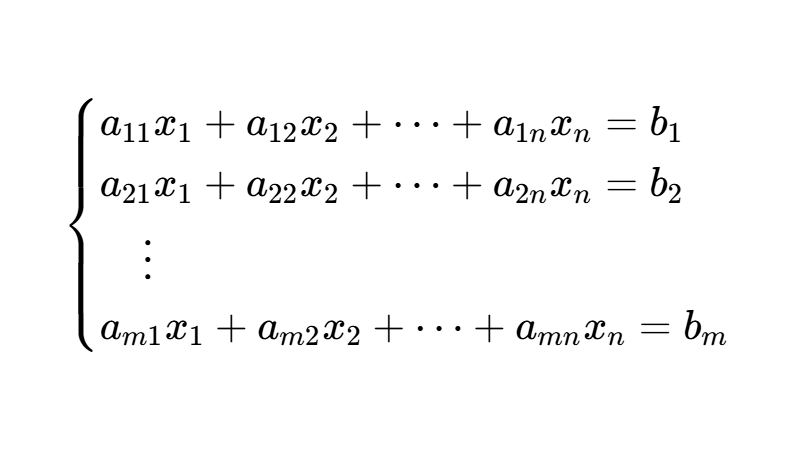
An inconsistent system is a set of linear equations that has no solution. In linear algebra, this means the equations establish contradictory conditions, so no set of numerical values can satisfy all of them simultaneously.
To understand why no solution exists, consider the following linear system of two equations in two variables:
$$\begin{cases} x + y = 5 \\ x + y = 2 \end{cases}$$
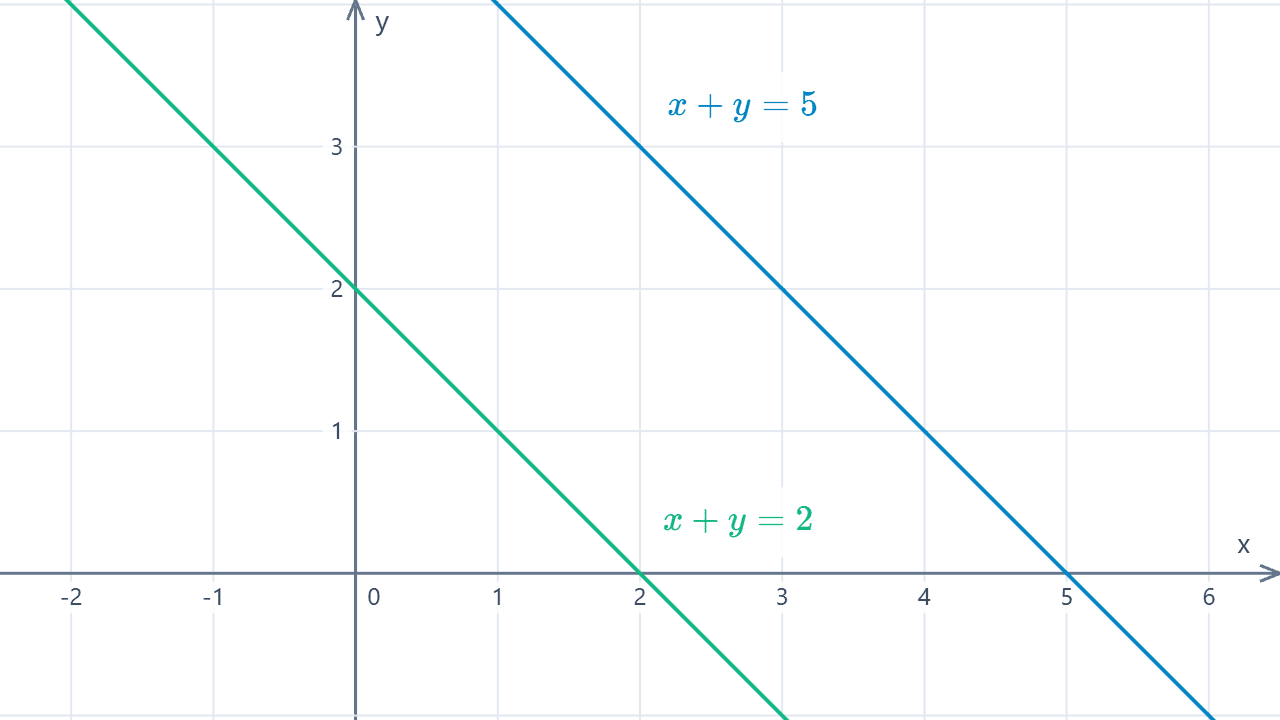
Notice that the left-hand sides of both equations are identical, yet they require the sum \(x + y\) to equal \(5\) and \(2\) at the same time. Subtracting the second equation from the first to eliminate the variables yields \(0 = 3\), a false statement that confirms the solution set of the system is empty (\(S = \emptyset\)).
Geometrically, each linear equation in two variables defines a line in the Cartesian plane. When a system is inconsistent, the two equations represent distinct parallel lines that remain at a constant distance from each other and never intersect.
This property distinguishes an inconsistent system from the other two categories that complete the classification of systems of linear equations:
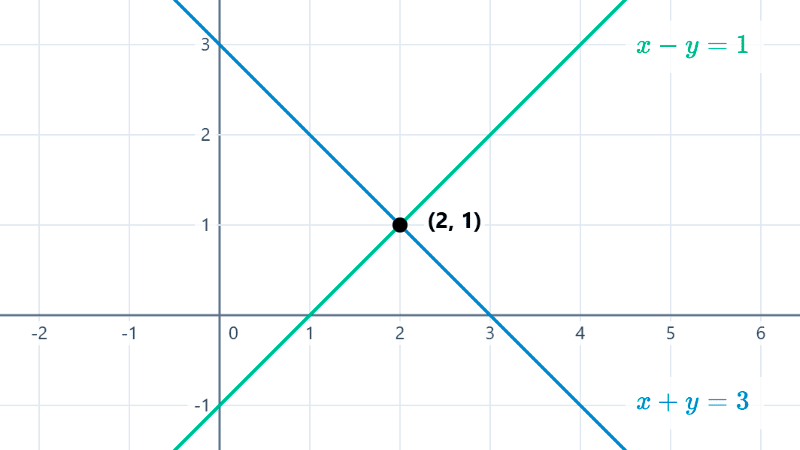
- Consistent independent system: Has a unique solution because its equations describe geometric objects that intersect at a single common point.
- Consistent dependent system: Has infinitely many solutions because its equations share a line, plane, or intersection subspace with one or more degrees of freedom.
Table of Contents
Geometric Interpretation
The absence of solutions in a linear system has a direct visual meaning in the relative positions of the geometric objects represented by each equation. Whereas a consistent system requires all graphs to share at least one point or region in common, an inconsistent system means there is no point where all geometric elements coincide simultaneously.
Systems in the Plane
In two-dimensional space \(\mathbb{R}^2\), each linear equation in two variables defines a line. For a system of two equations to be inconsistent in this setting, the equations must describe non-coincident parallel lines (that is, parallel and separated from one another), which includes both distinct vertical lines and non-vertical lines that share the same slope but have different y-intercepts.
Algebraically, two lines \(a_1x + b_1y = c_1\) and \(a_2x + b_2y = c_2\) with nonzero coefficients are parallel and distinct when the ratios of their variable coefficients are equal, but that common ratio differs from the ratio of their constant terms:
$$\frac{a_1}{a_2} = \frac{b_1}{b_2} \neq \frac{c_1}{c_2}$$
If either variable has a zero coefficient (as in vertical lines \(x = 2\) and \(x = 5\), or horizontal lines \(y = 1\) and \(y = -3\)), we avoid division by zero by directly comparing the coefficients of the remaining variable and their constant terms.
Returning to our initial system, \(\begin{cases} x + y = 5 \\ x + y = 2 \end{cases}\), we see that \(\frac{1}{1} = \frac{1}{1} \neq \frac{5}{2}\). Rewriting both equations in slope-intercept form gives \(y = -x + 5\) and \(y = -x + 2\); both lines have a slope of \(m = -1\) but cross the vertical axis at different points, so they run parallel without ever intersecting.
When a system in the plane includes three or more equations, inconsistency can also occur without the lines being parallel: they may intersect pairwise to form a triangle, or two lines may intersect at a point that does not lie on the third line.
Systems in Three-Dimensional Space
In \(\mathbb{R}^3\), each linear equation in three variables describes a plane. For a system of three equations to be inconsistent, the three planes must not share any common point simultaneously, which happens in four possible geometric configurations:
- Three distinct parallel planes: None of the planes intersects the others; all three maintain a constant separation.
- Two coincident planes and a third parallel plane: Two equations represent the exact same overlapping plane, while the third defines a separate parallel plane.
- Two parallel planes and one intersecting plane: Two planes run parallel without touching, and a third plane cuts across both, creating two parallel lines of intersection that never meet.
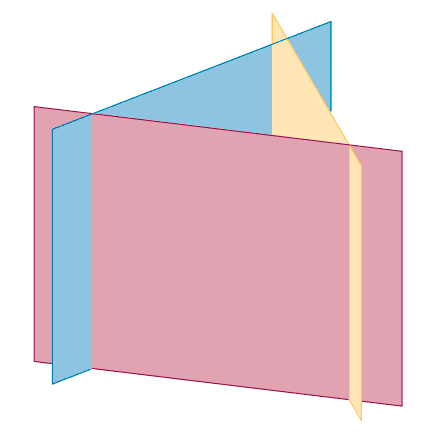
- Three planes intersecting pairwise to form a triangular prism: Each pair of planes intersects along a line, but the three resulting lines are parallel to each other and never converge at a common vertex.
The illustration below shows the fourth case, where three planes intersect in pairs to form an open prismatic surface with no triple point in common. Keep in mind that this is not the only inconsistent configuration in \(\mathbb{R}^3\), as any of the other three parallel arrangements also produces a system with no solution.
Higher Dimensions
When a linear system involves four or more variables (\(\mathbb{R}^n\)), visual representation through standard graphs is no longer possible. In these spaces, each linear equation defines a hyperplane of dimension \(n - 1\).
A system in \(\mathbb{R}^n\) is inconsistent when the overall intersection of all its hyperplanes is the empty set (\(\emptyset\)), either because there are separate parallel hyperplanes or because the partial intersection subspaces fail to meet at any common point.
Classification Criteria
To verify whether a system of linear equations lacks a solution, we use algebraic and matrix tools that detect internal contradictions by analyzing its coefficients and constant terms.
Rouché-Frobenius Theorem
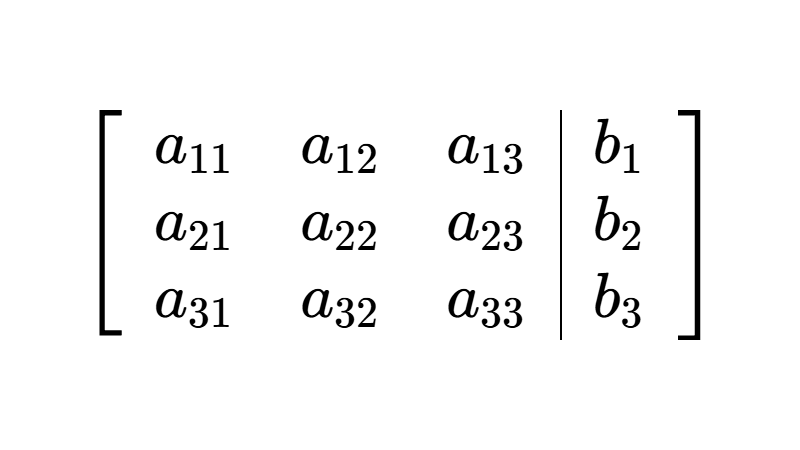
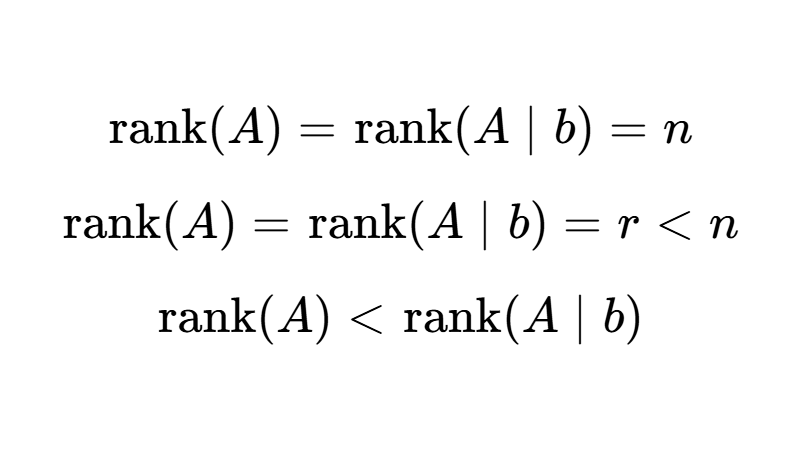
The Rouché-Frobenius theorem (also known as the Rouché–Capelli theorem) provides the general criterion for classifying any linear system, regardless of whether it has the same number of equations as variables or is rectangular. This test compares the rank of the coefficient matrix \(A\) with the rank of the augmented matrix \((A \mid b)\), which includes the column of constant terms.
A system of linear equations is inconsistent if and only if the ranks of both matrices are unequal:
$$\text{rank}(A) \neq \text{rank}(A \mid b)$$
Since appending a column can never decrease the rank of a matrix, this inequality is always equivalent to \(\text{rank}(A) < \text{rank}(A \mid b)\). Conceptually, this indicates that the constant vector \(b\) cannot be expressed as a linear combination of the columns of \(A\), meaning it introduces an external condition that is impossible to satisfy with the available variables.
Determinant Test
This criterion applies only to square systems (\(n \times n\)), where the determinant of the coefficient matrix \(A\) is defined. For a square system to be inconsistent, the determinant of its coefficient matrix must equal zero:
$$\det(A) = 0$$
However, this equality is a necessary but not sufficient condition. Having \(\det(A) = 0\) proves that the equations are linearly dependent in their variables and rules out a unique solution, but by itself it cannot distinguish between an inconsistent system and a consistent dependent system. If the constant terms follow the same proportion, the system has infinitely many solutions; if they break that proportionality, the system is inconsistent.
Furthermore, when \(\det(A) = 0\), the matrix \(A\) has no inverse and Cramer's rule cannot be used to compute a solution, as its formulas would require division by zero. Nevertheless, Cramer's auxiliary determinants (\(\Delta_i\)) provide a helpful test: if \(\det(A) = 0\) and at least one of the determinants obtained by replacing a column with the constant terms is nonzero (\(\Delta_i \neq 0\)), the system is guaranteed to be inconsistent.
Conversely, if both \(\det(A)\) and all auxiliary determinants equal zero, the test remains inconclusive (as happens, for instance, in \(3 \times 3\) systems of distinct parallel planes), making it necessary to row-reduce the system or compute matrix ranks.
Gaussian Elimination and Algebraic Methods
When solving a system through algebraic operations, inconsistency always reveals itself through a false statement or numerical contradiction of the form:
$$0 = c \quad \text{with } c \neq 0$$
Arriving at this expression means the original system is equivalent to one requiring zero to equal a nonzero number. Because no assignment of real values to the variables can make this equation true, we definitively conclude that no solution exists.
The most efficient way to uncover this contradiction depends on the size of the system:
- Substitution and elimination (\(2 \times 2\) systems): For small systems of two equations in two variables, these elementary methods are the most practical. When isolating and substituting one variable into the other equation, or adding equations after matching coefficients, all variables cancel out simultaneously, leaving only a false identity such as \(0 = 4\) or \(-3 = 7\).
- Gaussian elimination (general case): When a system has three or more variables or multiple equations, reducing the augmented matrix \((A \mid b)\) to row echelon form is cleaner and more systematic. The system is inconsistent if, after applying elementary row operations, at least one row appears where all variable coefficients are zero while the constant term remains nonzero: \(\left[\begin{array}{cccc|c} 0 & 0 & \cdots & 0 & c \end{array}\right]\) with \(c \neq 0\).
The table below summarizes the analytical conditions and scope of each criterion covered:
| Method | System Type | Analytical Condition | Scope and Limitations |
|---|---|---|---|
| Rouché-Frobenius theorem | Any system (square or rectangular) | \(\text{rank}(A) < \text{rank}(A \mid b)\) | Definitive criterion for any dimension without requiring a square matrix. |
| Determinant test | Square systems (\(n \times n\)) | \(\det(A) = 0\) | Necessary but not sufficient condition; requires checking the constant terms. |
| Gaussian elimination | Any system (general case) | Row \(\left[\begin{array}{ccc|c} 0 & \cdots & 0 & c \end{array}\right]\) with \(c \neq 0\) | Systematically detects contradictions in large or rectangular systems. |
| Elementary methods | Small systems (\(2 \times 2\)) | False equation \(0 = c\) (\(c \neq 0\)) | Fast for two variables using substitution or elimination. |
Properties and Special Cases
Certain structural configurations make it easy to tell in advance whether a system can be inconsistent or is guaranteed to have at least one solution without performing lengthy calculations.
Homogeneous Systems
A homogeneous linear system is one in which all constant terms are equal to zero. No homogeneous system can ever be inconsistent, because it always admits at least the trivial solution, where every variable equals zero: \((x_1, x_2, \dots, x_n) = (0, 0, \dots, 0)\).
Substituting zero for all variables reduces every equation to \(0 = 0\), a true identity. Under the Rouché-Frobenius theorem, appending a column of zeros to the coefficient matrix does not change its rank, so \(\text{rank}(A) = \text{rank}(A \mid 0)\) always holds. Consequently, every homogeneous system is either consistent independent (if it has only the trivial solution) or consistent dependent (if it also admits infinitely many non-trivial solutions).
Rectangular Systems
When the number of equations \(m\) differs from the number of variables \(n\), common misconceptions often arise when classifying the system by its dimensions:
- Overdetermined systems (\(m > n\)): Have more equations than variables. Because they impose more constraints than free variables, conditions frequently conflict and the system is often inconsistent. However, having more equations than variables does not guarantee inconsistency: if the extra equations are linear combinations of the others, the system can still have a unique solution or infinitely many solutions.
- Underdetermined systems (\(n > m\)): Have more variables than equations. It is a common mistake to assume that having more variables than equations automatically yields infinitely many solutions. This property holds only if the system is consistent; if two equations state contradictory conditions, the system will be inconsistent despite having more variables than equations (for example, two distinct parallel planes in \(\mathbb{R}^3\)).
Worked Examples
To reinforce how these criteria work in practice and see how inconsistency arises across different matrix setups, let us solve six representative examples.
Example 1
Verify that the following square system of two equations in two variables is inconsistent:
$$\begin{cases} 2x - 3y = 5 \\ -4x + 6y = 7 \end{cases}$$
Since this is a system in the plane \(\mathbb{R}^2\), we first check the proportionality ratios between the variable coefficients and the constant terms:
$$\frac{2}{-4} = \frac{-3}{6} = -\frac{1}{2} \neq \frac{5}{7}$$
The equal ratios of the variable coefficients combined with the unequal ratio of the constant terms confirm that these are two distinct parallel lines. We can also verify this by elimination: multiplying the first equation by \(2\) and adding it to the second cancels both variables and gives the false equation \(0 = 17\), proving the system has no solution.
Example 2
Classify the following system of three equations in three variables using Gaussian elimination and the Rouché-Frobenius theorem:
$$\begin{cases} x + y - z = 2 \\ 2x + 3y + z = 7 \\ 3x + 4y = 11 \end{cases}$$
To apply row reduction, we form the augmented matrix associated with the system:
$$\left[\begin{array}{ccc|c} 1 & 1 & -1 & 2 \\ 2 & 3 & 1 & 7 \\ 3 & 4 & 0 & 11 \end{array}\right]$$
Performing the elementary row operations of Gaussian elimination yields the following row echelon form:
$$\left[\begin{array}{ccc|c} 1 & 1 & -1 & 2 \\ 0 & 1 & 3 & 3 \\ 0 & 0 & 0 & 2 \end{array}\right]$$
The third row produces the contradiction \(0 = 2\), which is enough to conclude that the system is inconsistent. Checking the matrix ranks via the Rouché-Frobenius theorem gives \(\text{rank}(A) = 2\) while \(\text{rank}(A \mid b) = 3\), confirming that no solution exists.
Example 3
Analyze the consistency of the following square system in three variables:
$$\begin{cases} x - 2y + z = 3 \\ -2x + 4y - 2z = -6 \\ 3x - 6y + 3z = 4 \end{cases}$$
First, we write the augmented matrix of the system to examine the relationship between its rows:
$$\left[\begin{array}{ccc|c} 1 & -2 & 1 & 3 \\ -2 & 4 & -2 & -6 \\ 3 & -6 & 3 & 4 \end{array}\right]$$
After applying elementary row operations to reduce the matrix, we obtain:
$$\left[\begin{array}{ccc|c} 1 & -2 & 1 & 3 \\ 0 & 0 & 0 & -5 \\ 0 & 0 & 0 & 0 \end{array}\right]$$
This example illustrates two phenomena at once: the zero row \(0 = 0\) shows that two of the equations represent the same coincident plane, whereas the row \(0 = -5\) reveals that the third plane is parallel and separated from them. Since \(\text{rank}(A) = 1 < \text{rank}(A \mid b) = 2\), the system is inconsistent.
Example 4
Determine whether the following overdetermined system of three equations in two variables has a solution:
$$\begin{cases} x + y = 4 \\ x - y = 2 \\ 2x + y = 9 \end{cases}$$
Because there are more equations than variables, we set up the augmented matrix to test whether all three lines intersect at a single point:
$$\left[\begin{array}{cc|c} 1 & 1 & 4 \\ 1 & -1 & 2 \\ 2 & 1 & 9 \end{array}\right]$$
Carrying out elementary row operations to reduce the system results in:
$$\left[\begin{array}{cc|c} 1 & 1 & 4 \\ 0 & -2 & -2 \\ 0 & 0 & 2 \end{array}\right]$$
Although the first two equations intersect at the point \((3, 1)\), substituting those coordinates into the third equation gives \(2(3) + 1 = 7 \neq 9\). This discrepancy appears in the bottom row \(0 = 2\) and in the unequal ranks \(\text{rank}(A) = 2 < \text{rank}(A \mid b) = 3\), showing that the system is inconsistent.
Example 5
Examine the following rectangular system of two equations in three variables to verify that it is inconsistent:
$$\begin{cases} 2x - y + 4z = 1 \\ -6x + 3y - 12z = 5 \end{cases}$$
Even though the system has more variables than equations, we construct its augmented matrix to check whether the conditions are mutually consistent:
$$\left[\begin{array}{ccc|c} 2 & -1 & 4 & 1 \\ -6 & 3 & -12 & 5 \end{array}\right]$$
Row-reducing the matrix through elementary row operations yields:
$$\left[\begin{array}{ccc|c} 2 & -1 & 4 & 1 \\ 0 & 0 & 0 & 8 \end{array}\right]$$
The second row produces the contradiction \(0 = 8\) and confirms that \(\text{rank}(A) = 1 < \text{rank}(A \mid b) = 2\). Geometrically, the two equations define distinct parallel planes in \(\mathbb{R}^3\), demonstrating that having more variables than equations does not guarantee infinitely many solutions when a contradiction is present.
Example 6
Find the values of the real parameter \(k\) for which the following square system is inconsistent:
$$\begin{cases} kx + 3y = 6 \\ 3x + ky = k + 3 \end{cases}$$
We begin by applying the determinant test as a necessary condition to rule out the values of \(k\) that produce a unique solution:
$$\det(A) = \begin{vmatrix} k & 3 \\ 3 & k \end{vmatrix} = k^2 - 9$$
Setting the determinant equal to zero gives the critical values of the parameter:
$$k^2 - 9 = 0 \implies k = 3 \quad \text{or} \quad k = -3$$
Since \(\det(A) = 0\) alone does not distinguish between inconsistency and dependency, we substitute each critical value back into the original system to evaluate the constant terms:
- If k = 3: The system becomes \(\begin{cases} 3x + 3y = 6 \\ 3x + 3y = 6 \end{cases}\). Both equations are identical (proportional), so the system is consistent dependent with infinitely many solutions.
- If k = -3: The system becomes \(\begin{cases} -3x + 3y = 6 \\ 3x - 3y = 0 \end{cases}\). Adding the two equations cancels all variables and leaves the false statement \(0 = 6\), making the system inconsistent.
Therefore, the system is inconsistent only when k = −3.
Did you find this useful? Rate it!
0.0 / 5 — 0 votes

HOW TO CITE THIS ARTICLE
Machado, D. (2026, November 13). Inconsistent System of Equations. Flamath. https://en.flamath.com/inconsistent-system-equations
Consistent and Dependent System
Consistent and Independent System
Augmented Matrix
Rouché-Frobenius Theorem
Systems of Linear Equations
Leave a Reply
Related Articles