
Consistent and Dependent System
A consistent dependent system is a set of linear equations that admits infinitely many solutions. In linear algebra, this type of system is also referred to as a consistent system with infinitely many solutions or, less commonly, a consistent indeterminate system, indicating that the equations do not contradict one another, yet they are insufficient to fix a single numerical value for each unknown.
The name of this system reflects two simultaneous properties:
- Consistent: Indicates that the system has at least one solution—that is, there exist values for the variables that satisfy all equations simultaneously.
- Dependent: Indicates that the solution is not unique; instead, there are infinitely many possible combinations governed by one or more free parameters (called degrees of freedom).
To see how this infinity of solutions arises, consider the following linear system of two equations in two unknowns:
$$\begin{cases} x + y = 4 \\ 2x + 2y = 8 \end{cases}$$
Notice that the second equation is obtained by multiplying the entire first equation by \(2\), meaning both expressions provide the exact same information. Having only one independent condition for two variables, one of them acts as a free variable. If we assign the real parameter \(y = t\) and solve for the remaining unknown, we express the general solution of the system as:
$$(x, y) = (4 - t, \, t) \quad \text{with } t \in \mathbb{R}$$
By assigning different real values to the parameter \(t\), we generate infinitely many particular solutions that satisfy both equations simultaneously.
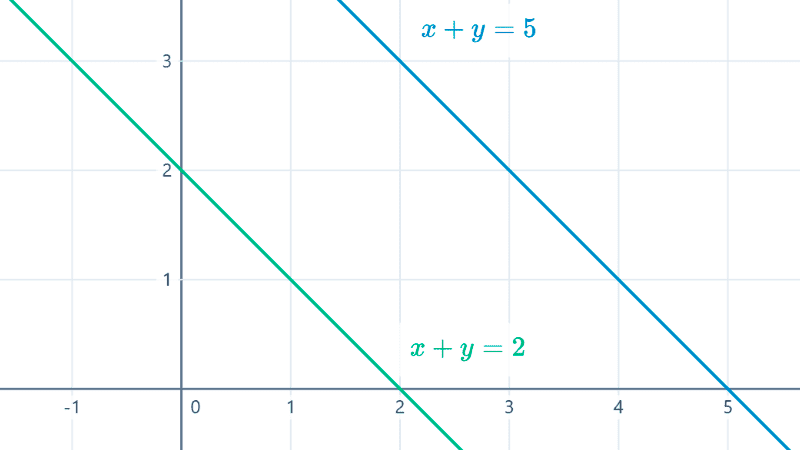
From a geometric standpoint, each linear equation in two variables defines a line in the plane. A consistent dependent system means that both equations represent the same overlapping line, sharing all of their points.
This property distinguishes the system from the other two categories that complete the classification of systems of linear equations:
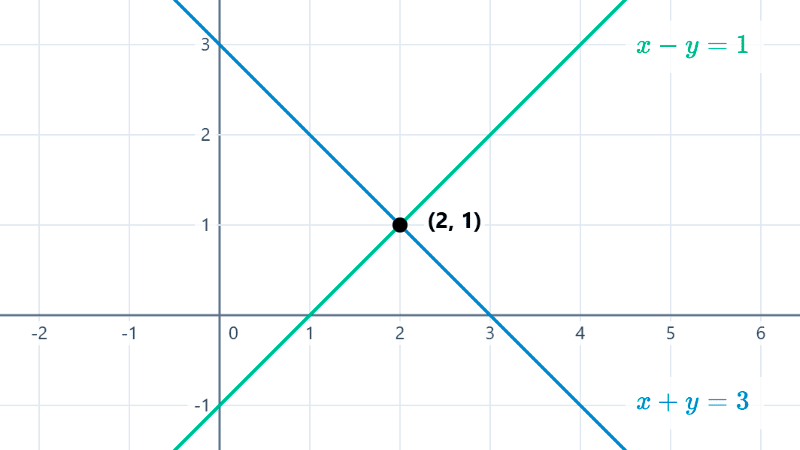
- Consistent independent system: Possesses a unique solution because its equations represent geometric loci that intersect at a single common point.
- Inconsistent system: Has no solution because its equations establish mutually contradictory conditions, such as two distinct parallel lines.
Table of Contents
Geometric Interpretation
The existence of infinitely many solutions in a linear system has a direct visual counterpart in the relative position of the geometric loci described by each equation. While a system with a unique solution corresponds to a single point intersection, a consistent dependent system means that the equations share a line, a plane, or an extended region of intersection.
Systems in the Plane
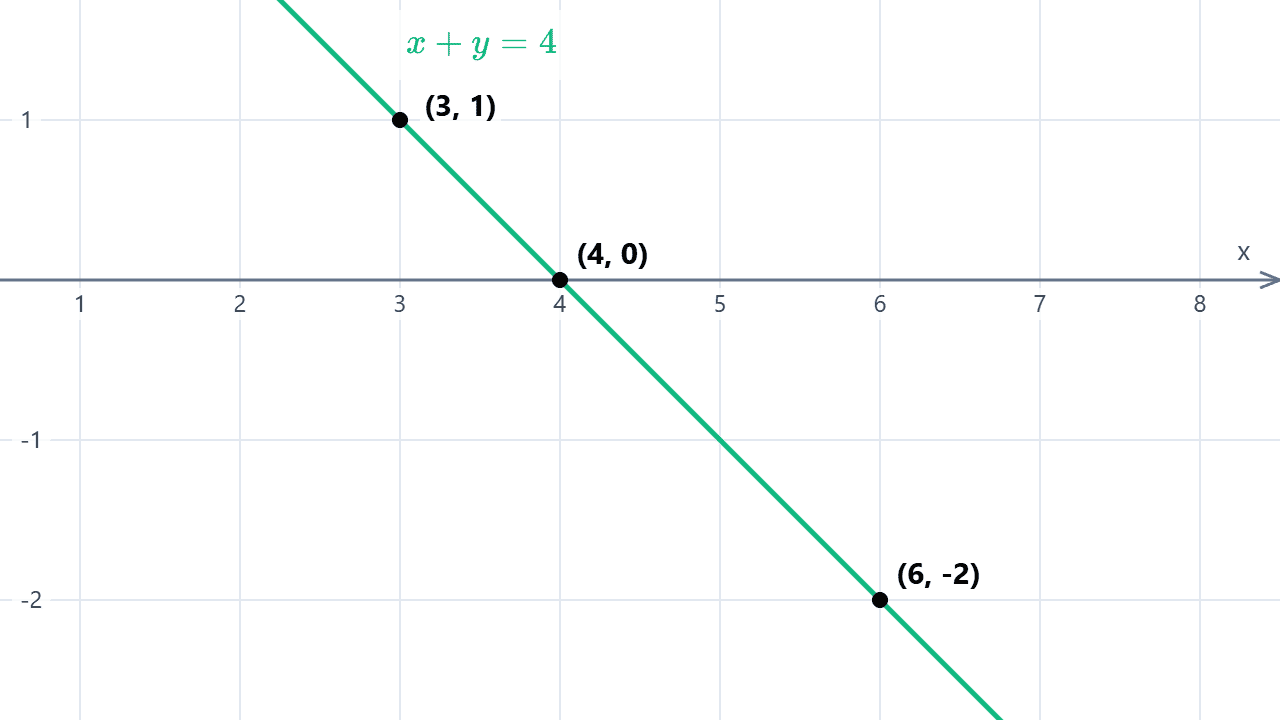
In two-dimensional space \(\mathbb{R}^2\), each linear equation in two unknowns represents a line. For a system to be consistent and dependent in this context, all of its equations must describe coincident lines—that is, overlapping lines that share all of their points.
Algebraically, two lines \(a_1x + b_1y = c_1\) and \(a_2x + b_2y = c_2\) are coincident when all of their coefficients and constant terms (assuming they are nonzero) maintain the same proportionality ratio:
$$\frac{a_1}{a_2} = \frac{b_1}{b_2} = \frac{c_1}{c_2}$$
Returning to the system given earlier, we verify that \(\frac{1}{2} = \frac{1}{2} = \frac{4}{8}\), so both equations trace the exact same line in the plane. From its general solution \((x, y) = (4 - t, \, t)\), we obtain different points on that line by assigning real values to the parameter \(t\): for \(t = 0\) we get the point (4, 0), for \(t = 1\) we obtain (3, 1), and for \(t = -2\) we reach (6, -2), among infinitely many possible locations.
Systems in Three-Dimensional Space
In \(\mathbb{R}^3\) space, each linear equation in three variables defines a geometric plane. Unlike the Cartesian plane, where only one configuration is possible for coincident lines, in three-dimensional space a consistent dependent system can appear in two distinct configurations depending on its degrees of freedom:
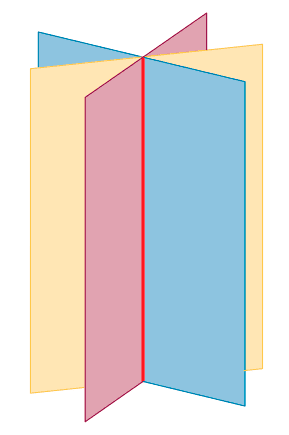
- With 1 degree of freedom (intersection along a line): The planes intersect along a single common line, forming what is known in geometry as a sheaf (or pencil) of planes. This situation also occurs when two planes are coincident and a third plane intersects them along a line.
- With 2 degrees of freedom (coincident planes): All planes in the system are proportional and overlap directly on top of one another, so the solution set encompasses the entire common plane.
The following illustration depicts the case of three planes intersecting along a common line (1 degree of freedom). Notably, this is not the only possible geometric arrangement in \(\mathbb{R}^3\), as the system would also be consistent and dependent if all the planes were coincident.
Higher Dimensions
When a linear system involves four or more unknowns (\(\mathbb{R}^n\)), direct visual representation via standard graphs is no longer feasible. In these spaces, each linear equation defines a hyperplane of dimension \(n - 1\).
A system in \(\mathbb{R}^n\) is consistent and dependent when all of its hyperplanes intersect to form a linear manifold (or affine subspace) of dimension greater than or equal to \(1\)—analogous to a line, a plane, or a shifted subspace—whose dimension matches the degrees of freedom of the system.
Classification Criteria
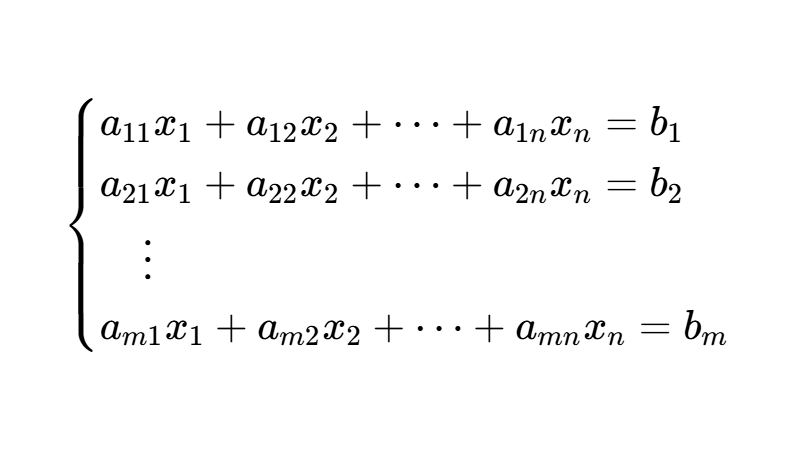
To check whether a linear system has infinitely many solutions, it is not necessary to compute its entire parametric expression beforehand. Algebraic and matrix tools allow us to evaluate its consistency and determine how many free parameters it requires by analyzing its coefficients.
Rouché–Frobenius Theorem and Degrees of Freedom
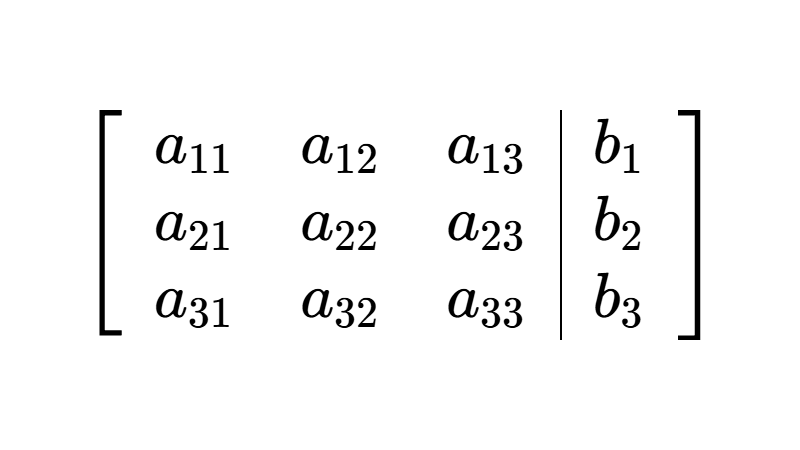
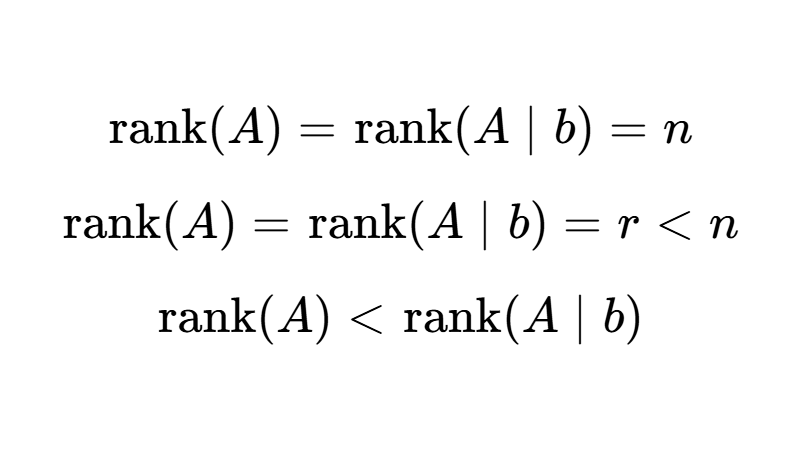
The Rouché–Frobenius theorem (also known as the Rouché–Capelli theorem) provides the general criterion for classifying any system of linear equations, regardless of whether it is square or rectangular. This theorem compares the rank of the coefficient matrix \(A\) with the rank of the augmented matrix \((A \mid b)\), which includes the column of constant terms.
A linear system with \(n\) unknowns is consistent and dependent if and only if the following relation holds:
$$\text{rank}(A) = \text{rank}(A \mid b) = r < n$$
The equality \(\text{rank}(A) = \text{rank}(A \mid b)\) ensures that the system is consistent, while the strict inequality \(r < n\) proves that there are fewer independent equations than unknowns. The difference between both values defines the degrees of freedom (\(g\)) of the system:
$$g = n - r$$
This positive integer indicates how many independent parameters we need to introduce to describe the entire solution set.
Determinant Criterion
This method applies exclusively to square systems (\(n \times n\)), where the coefficient matrix \(A\) admits the calculation of its determinant. For a square system to be consistent and dependent, the determinant of its coefficient matrix must equal zero:
$$\det(A) = 0$$
However, this equality acts as a necessary but not sufficient condition. Having \(\det(A) = 0\) guarantees that the rows of \(A\) are linearly dependent and rules out a unique solution, but on its own it does not distinguish between a consistent dependent system and an inconsistent system. If the constant terms do not share that same linear dependence, the system will have no solution; therefore, we must always supplement this criterion by analyzing ranks or row-reducing the system.
Furthermore, since \(\det(A) = 0\), the coefficient matrix is not invertible. This implies that a consistent dependent system cannot be solved using the inverse matrix method or by directly applying standard Cramer's rule, as the formulas dividing by the determinant of the system would result in division by zero.
Gaussian Elimination
Gaussian elimination allows us to classify a system by reducing its augmented matrix \((A \mid b)\) to row echelon form through elementary row operations. It is a constructive procedure valid for any matrix size.
Once the matrix is in row echelon form, the system is consistent and dependent when two simultaneous requirements are met:
- No contradictory row of the form \(0 = c\) (with \(c \neq 0\)) appears, which confirms that the system has at least one solution.
- The number of nonzero pivots \(r\) is strictly less than the total number of unknowns \(n\), leaving at least one column of unknowns without a pivot.
It is worth paying close attention to the meaning of zero rows of the form \(0 = 0\). The appearance of a row of zeros does not always imply that the system is dependent: in a rectangular system with more equations than unknowns, a redundant equation produces a \(0 = 0\) row, yet the system can still retain pivots in all its variables and remain consistent and independent. Conversely, if the system is square (\(n \times n\)) and contains no contradictory rows, the appearance of at least one \(0 = 0\) row directly guarantees that it is consistent and dependent, as it reduces the number of pivots below \(n\).
The following table summarizes the scope and conditions of each criterion analyzed:
| Method | Type of System | Analytical Condition | Scope and Limitations |
|---|---|---|---|
| Rouché–Frobenius Theorem | Any system (square or rectangular) | \(\text{rank}(A) = \text{rank}(A \mid b) = r < n\) | Definitive criterion for any dimension and for calculating degrees of freedom. |
| Determinant Criterion | Square systems (\(n \times n\)) | \(\det(A) = 0\) | Necessary but not sufficient condition; requires verifying consistency. |
| Gaussian Elimination | Any system (square or rectangular) | No \(0 = c\) rows (\(c \neq 0\)) and \(r < n\) pivots | Classifies the system and prepares it to parameterize the general solution. |
How to Write the General and Particular Solutions
Once we confirm that the system admits infinitely many solutions, the next step is to express its solution set using standard real parameters such as \(t\), \(s\), or \(u\). To do this without making algebraic mistakes, we must distinguish which variables act as free variables and which are determined in terms of them.
Basic Variables vs. Free Variables
When we reduce a system to row echelon form using Gaussian elimination, the columns of the coefficient matrix split into two groups:
- Basic (or leading) variables: Those whose columns contain a nonzero pivot in row echelon form. Their values cannot be chosen freely; instead, they are solved for via back-substitution in terms of the remaining variables.
- Free variables: The unknowns corresponding to columns that lack a pivot. The number of free variables equals the degrees of freedom (\(g = n - r\)), and each is assigned a distinct real parameter (\(t, s, \dots\)).
A direct property follows from this structure: every consistent system with more unknowns than equations (\(n > m\)) is always consistent and dependent. Since the number of pivots can never exceed the total number of equations (\(r \le m\)), having more unknowns than equations inevitably leaves at least \(n - m\) columns without a pivot. For example, in a consistent system of \(2\) equations in \(3\) unknowns, the maximum rank is \(2\), guaranteeing at least one degree of freedom and, consequently, infinitely many solutions.
Rules for Solving Properly
A common mistake is trying to parameterize a system without first row-reducing it, randomly picking which unknown to set equal to the parameter \(t\). Not every choice of free variable or rearrangement is valid, especially when an unknown does not appear in every equation.
Consider the following system of two equations in three unknowns:
$$\begin{cases} x + y + z = 5 \\ x + y = 3 \end{cases}$$
In this system, the variable \(z\) appears in the first equation but is absent from the second (its coefficient is \(0\)). If someone tried to assign \(z = t\) as a free variable and solve for \(x\) in the first equation without accounting for the second, they would get \(x = 5 - y - t\), overlooking the constraint imposed by \(x + y = 3\).
By subtracting both equations to row-reduce the system, we immediately obtain \(z = 2\). This proves that \(z\) is a basic variable with a fixed value, so it can never act as a free parameter. On the other hand, in the equation \(x + y = 3\), both \(x\) and \(y\) participate in the remaining relation: if we take \(y = t\) as a free variable, we solve for \(x = 3 - t\) and write the correct general solution:
$$(x, y, z) = (3 - t, \, t, \, 2) \quad \text{with } t \in \mathbb{R}$$
As a general rule, row-reducing the system first avoids this pitfall completely, as it unambiguously identifies which unknowns have pivots (and must be solved for) and which remain free to receive a parameter.
Finding Particular Solutions
The parametric expression is called the general solution because it condenses all possible answers to the system into a single formula. To obtain a particular solution, simply substitute concrete real numbers for the free parameters.
Returning to the general solution \((x, y, z) = (3 - t, \, t, \, 2)\), we can generate different ordered triples that satisfy the original system:
- If we choose \(t = 0\), we obtain the particular solution (3, 0, 2).
- If we assign \(t = 3\), we get the triple (0, 3, 2).
- If we substitute \(t = -1\), we find (4, -1, 2).
Any of these triples, when substituted back into the initial equations, simultaneously satisfies \(x + y + z = 5\) and \(x + y = 3\).
Note that the way of writing the general solution is not unique. If in the equation \(x + y = 3\) we had chosen \(x = t\) as the free variable instead of \(y\), the parametric expression would have been \((x, y, z) = (t, \, 3 - t, \, 2)\). Although both formulas look different at first glance, they generate the exact same solution triples as \(t\) ranges over all real numbers.
Worked Examples
To solidify the application of theoretical criteria and master parameterization across different matrix structures, we analyze six representative cases.
Example 1
Verify that the following square system of two equations in two unknowns is consistent and dependent, and find its general solution:
$$\begin{cases} 3x - 2y = 6 \\ -6x + 4y = -12 \end{cases}$$
Since this is a system in the plane \(\mathbb{R}^2\), we directly check whether there is proportionality between the coefficients of the unknowns and the constant terms:
$$\frac{3}{-6} = \frac{-2}{4} = \frac{6}{-12} = -\frac{1}{2}$$
Because all three ratios match, both equations represent the same coincident line and the system is consistent and dependent (which also aligns with \(\det(A) = 3(4) - (-2)(-6) = 0\)). To write its general solution, we choose \(y = t\) as the free variable and solve for \(x\) in the first equation:
$$3x - 2t = 6 \implies x = 2 + \frac{2}{3}t$$
Thus, the general solution is (x, y) = (2 + 2t/3, t) with \(t \in \mathbb{R}\). If we wanted to obtain particular solutions, we would simply substitute values for \(t\): for example, \(t = 0\) gives (2, 0) and \(t = 3\) yields (4, 3).
Example 2
Classify and solve the following square system of three equations in three unknowns:
$$\begin{cases} x + y + z = 6 \\ 2x - y + z = 3 \\ 3x + 2z = 9 \end{cases}$$
To avoid calculating determinants and leave the system ready for parameterization, we set up its augmented matrix:
$$\left[\begin{array}{ccc|c} 1 & 1 & 1 & 6 \\ 2 & -1 & 1 & 3 \\ 3 & 0 & 2 & 9 \end{array}\right]$$
After performing the elementary row operations corresponding to Gaussian elimination, we obtain the row echelon matrix:
$$\left[\begin{array}{ccc|c} 1 & 1 & 1 & 6 \\ 0 & -3 & -1 & -9 \\ 0 & 0 & 0 & 0 \end{array}\right]$$
Since this is a square system and a zero row \(0 = 0\) appears with no contradictory rows, we confirm that the system is consistent and dependent. Applying the Rouché–Frobenius theorem, we see that \(\text{rank}(A) = \text{rank}(A \mid b) = 2 < 3\), so there is \(g = 3 - 2 = 1\) degree of freedom. The pivot columns correspond to the basic variables \(x\) and \(y\), while \(z\) acts as a free variable. We assign \(z = t\) and apply back-substitution:
$$-3y - t = -9 \implies y = 3 - \frac{1}{3}t$$
$$x + \left(3 - \frac{1}{3}t\right) + t = 6 \implies x = 3 - \frac{2}{3}t$$
Therefore, the solution set is given by (x, y, z) = (3 − 2t/3, 3 − t/3, t) with \(t \in \mathbb{R}\).
Example 3
Determine the general solution of the following system of three equations in three unknowns:
$$\begin{cases} x - 2y + 3z = 4 \\ 2x - 4y + 6z = 8 \\ -x + 2y - 3z = -4 \end{cases}$$
We construct the augmented matrix associated with the system:
$$\left[\begin{array}{ccc|c} 1 & -2 & 3 & 4 \\ 2 & -4 & 6 & 8 \\ -1 & 2 & -3 & -4 \end{array}\right]$$
After applying elementary row operations to reduce the matrix, we arrive at the following row echelon form:
$$\left[\begin{array}{ccc|c} 1 & -2 & 3 & 4 \\ 0 & 0 & 0 & 0 \\ 0 & 0 & 0 & 0 \end{array}\right]$$
We observe that two entire rows vanish, leaving a single pivot in the first column. Thus, \(\text{rank}(A) = \text{rank}(A \mid b) = 1 < 3\), which indicates that the system is consistent and dependent with \(g = 3 - 1 = 2\) degrees of freedom (geometrically, three coincident planes in \(\mathbb{R}^3\)). The unknown \(x\) is the only basic variable, whereas \(y\) and \(z\) are free variables. Defining \(y = t\) and \(z = s\), we solve for \(x = 4 + 2t - 3s\) and express the general solution as (x, y, z) = (4 + 2t − 3s, t, s) with \(t, s \in \mathbb{R}\).
Example 4
Analyze the consistency of the following rectangular system of three equations in two unknowns:
$$\begin{cases} x - 2y = 1 \\ 2x - 4y = 2 \\ -3x + 6y = -3 \end{cases}$$
Although the system has more equations than variables, it can have infinitely many solutions if the extra equations are redundant. We write its augmented matrix:
$$\left[\begin{array}{cc|c} 1 & -2 & 1 \\ 2 & -4 & 2 \\ -3 & 6 & -3 \end{array}\right]$$
After carrying out the elementary row operations to row-reduce the system, we obtain:
$$\left[\begin{array}{cc|c} 1 & -2 & 1 \\ 0 & 0 & 0 \\ 0 & 0 & 0 \end{array}\right]$$
Unlike an overdetermined system with a unique solution, here the two bottom rows vanish and only one pivot remains. Since \(\text{rank}(A) = \text{rank}(A \mid b) = 1 < 2\), the system is consistent and dependent with \(1\) degree of freedom. Taking \(y = t\) as a free variable, we solve for \(x = 1 + 2t\) and obtain the general solution (x, y) = (1 + 2t, t) with \(t \in \mathbb{R}\).
Example 5
Verify that the following homogeneous system of two equations in three unknowns admits infinitely many nontrivial solutions and find its parametric expression:
$$\begin{cases} x + 2y - z = 0 \\ 2x + 5y + z = 0 \end{cases}$$
A homogeneous system is one in which all constant terms are equal to zero. Every system of this type is always consistent, since the trivial solution \((0, 0, 0)\) satisfies all equations. Moreover, a general property holds: if a homogeneous system has more unknowns than equations (\(n > m\)), it is automatically consistent and dependent and admits infinitely many solutions other than the trivial one, because the rank of its matrix can never reach the number of unknowns.
In this case, we have \(n = 3\) unknowns versus \(m = 2\) equations, so we confirm without prior calculation that it possesses at least one degree of freedom. To find the solutions, we set up the augmented matrix:
$$\left[\begin{array}{ccc|c} 1 & 2 & -1 & 0 \\ 2 & 5 & 1 & 0 \end{array}\right]$$
After performing elementary row operations to reduce the matrix, we arrive at:
$$\left[\begin{array}{ccc|c} 1 & 2 & -1 & 0 \\ 0 & 1 & 3 & 0 \end{array}\right]$$
We identify the pivots in the \(x\) and \(y\) columns (basic variables), leaving \(z\) as a free variable. We assign \(z = t\) and solve by back-substitution:
$$y + 3t = 0 \implies y = -3t$$
$$x + 2(-3t) - t = 0 \implies x - 7t = 0 \implies x = 7t$$
The general solution is defined by (x, y, z) = (7t, −3t, t) with \(t \in \mathbb{R}\). Assigning any nonzero value to the parameter, such as \(t = 1\), yields a concrete nontrivial solution: (7, −3, 1).
Example 6
Determine for which values of the real parameter \(k\) the following square system is consistent and dependent:
$$\begin{cases} kx + 2y = 4 \\ 2x + ky = k + 2 \end{cases}$$
We begin by applying the determinant criterion as a necessary condition to rule out values of \(k\) that produce a unique solution:
$$\det(A) = \begin{vmatrix} k & 2 \\ 2 & k \end{vmatrix} = k^2 - 4$$
We set the determinant equal to zero to find the critical values:
$$k^2 - 4 = 0 \implies k = 2 \quad \text{or} \quad k = -2$$
Since \(\det(A) = 0\) alone does not guarantee that the system is consistent, we substitute each critical value into the original system to distinguish between a consistent dependent system and an inconsistent system:
- If k = 2: The system becomes \(\begin{cases} 2x + 2y = 4 \\ 2x + 2y = 4 \end{cases}\). Both equations are identical (proportional), so the system is consistent and dependent with general solution \((x, y) = (2 - t, \, t)\).
- If k = -2: The system takes the form \(\begin{cases} -2x + 2y = 4 \\ 2x - 2y = 0 \end{cases}\). Adding both equations gives \(0 = 4\), a contradiction that makes the system inconsistent.
In conclusion, the system is consistent and dependent only when k = 2.
Did you find this useful? Rate it!
0.0 / 5 — 0 votes

HOW TO CITE THIS ARTICLE
Machado, D. (2026, November 12). Consistent and Dependent System. Flamath. https://en.flamath.com/consistent-dependent-system
Inconsistent System of Equations
Consistent and Independent System
Augmented Matrix
Rouché-Frobenius Theorem
Systems of Linear Equations
Leave a Reply
Related Articles