
Augmented Matrix
The augmented matrix of a system of linear equations is a rectangular array of numbers that compactly and systematically combines both the numerical coefficients of the variables and the constant terms of the system. This matrix allows you to manipulate and analyze all equations simultaneously without having to rewrite the variables at each step of the algebraic process.
To visualize its basic structure, consider the following linear system of two equations with two variables:
$$\begin{cases} 2x + 3y = 8 \\ 5x - y = 3 \end{cases}$$
When translating this system into its augmented matrix representation, we separate the variable coefficients from the constants using a vertical bar:
$$\left[\begin{array}{cc|c} 2 & 3 & 8 \\ 5 & -1 & 3 \end{array}\right]$$
This layout condenses all the algebraic information of the original system into a single mathematical object, where the position of each entry indicates which variable and equation it belongs to.
To fully understand this tool, it is essential to distinguish between two fundamental matrices associated with any linear system:
- Coefficient matrix \(A\): contains only the numerical factors multiplying the variables. In the example above, this corresponds to the 2×2 matrix formed by the columns of x and y, denoted as \(A = \begin{bmatrix} 2 & 3 \\ 5 & -1 \end{bmatrix}\).
- Augmented matrix \((A \mid b)\): attaches the column matrix of constant terms to the right of the coefficient matrix, separated by a vertical bar.
The primary advantage of an augmented matrix is that it dramatically simplifies calculations for systems of any size. By eliminating variable letters and addition signs, elementary row operations can be applied directly to solve or transform the system using systematic methods such as Gaussian elimination or Gauss-Jordan elimination.
Table of Contents
Structure and Dimensions of an Augmented Matrix
To properly interpret and manipulate an augmented matrix, it is crucial to understand what each element represents within the grid. Every numerical position has a designated role determined by the equation and variable it originated from:
- Rows: each horizontal row corresponds to an individual equation in the linear system. Applying valid algebraic operations to a row is equivalent to transforming that entire equation while preserving the system's solution set.
- Coefficient columns: each vertical column to the left of the bar contains exclusively the coefficients associated with a single variable. The first column holds the values for the first variable, the second column for the second variable, and so on in order.
- Column of constants (augmented column): the final vertical column, located to the right of the bar, contains the constant values from the right side of each equation.
The vertical dividing bar serves a purely visual purpose: it acts as a separator that symbolically replaces the equal signs of the original system. Importantly, this bar does not alter any algebraic properties nor does it affect numerical computations. In fact, many textbooks and computational software omit the bar entirely and display the augmented matrix as a single continuous block, though keeping the bar helps avoid confusing the variable coefficients with the constant terms.
The dimensions of the resulting matrix are directly determined by the number of equations and variables in the linear system:
- If a system has m equations and n variables, its coefficient matrix \(A\) has dimension m × n (m rows and n columns).
- The augmented matrix \((A \mid b)\) adds exactly one additional column for the constants, so its dimension is m × (n + 1) (m rows and n + 1 columns).
For instance, a square system of three equations with three variables produces a 3×4 augmented matrix, whereas a rectangular system of two equations with three variables yields a 2×4 matrix. The number of rows always equals the total number of equations in the system, and the number of columns is always one more than the number of variables.
How to Set up an Augmented Matrix
To write an augmented matrix correctly and prevent common mistakes, avoid rushing through the numbers. Follow this methodical step-by-step procedure to ensure every coefficient is placed in its proper position:
- Write equations in standard form and order the variables: collect all variable terms on the left side of each equation and move all constant terms to the right side. If a constant is on the left side (for example, \(2x - y + 5 = 0\)), transpose it first by reversing its sign (\(2x - y = -5\)). Then, align the variables in the same vertical order across all equations (for example, the x-column first, followed by y, and then z). If the variables are out of order (such as \(3y + 2x = 4\)), rewrite them as \(2x + 3y = 4\) before extracting any data.
- Fill in missing variables with zero: when a variable does not appear in an equation, its numerical coefficient is zero. When starting out, it is helpful to explicitly write \(0x\), \(0y\), or \(0z\) in the corresponding position to maintain visual column alignment and avoid placing coefficients into the wrong spots. With practice, you can easily do this mentally.
- Extract the coefficients and constants: if a variable appears by itself with a positive sign, its coefficient is 1; if preceded by a negative sign, its coefficient is −1. Place the numerical coefficients in the left block and the constant terms in the right column, separated by the vertical bar.
- Verify the dimensions: for a system of m equations and n variables, the resulting matrix must always have m rows and n + 1 columns.
Next, let us apply this process across various types of linear systems, from standard cases to common exam-style traps.
Example 1
Write the augmented matrix for the following linear system:
$$\begin{cases} 4x - 5y = 11 \\ 3x + y = -2 \end{cases}$$
Notice that both equations are already in standard form: the variables are ordered alphabetically on the left side (x and y) and the constant terms are isolated on the right side. In the second equation, the variable y has no written coefficient, which means its coefficient is 1.
Extract the coefficients and constants directly to form the two rows:
$$\left[\begin{array}{cc|c} 4 & -5 & 11 \\ 3 & 1 & -2 \end{array}\right]$$
The system has 2 equations and 2 variables, so the augmented matrix has dimension 2×3 (2 rows and 3 columns).
Example 2
Find the augmented matrix for the following system:
$$\begin{cases} x + 2y - 3z = 4 \\ 2x - y + z = -1 \\ -3x + 4y + 5z = 7 \end{cases}$$
The system contains 3 equations with 3 variables aligned in columns by x, y, and z. Check the signs and unit coefficients: in the first equation, the coefficient of x is 1; in the second, the coefficient of y is −1 and that of z is 1.
Enter each row into the grid according to variable position:
$$\left[\begin{array}{ccc|c} 1 & 2 & -3 & 4 \\ 2 & -1 & 1 & -1 \\ -3 & 4 & 5 & 7 \end{array}\right]$$
With 3 equations and 3 variables, the result is a 3×4 augmented matrix.
Example 3
Write the augmented matrix for the following linear system:
$$\begin{cases} 3x - 2z = 5 \\ 4y + z = -3 \\ 2x - y = 8 \end{cases}$$
Examining the three equations reveals that not all variables are present in every equation: the first equation is missing y, the second is missing x, and the third is missing z. To avoid misaligning coefficients, rewrite the system first by inserting zeros for the missing terms:
$$\begin{cases} 3x + 0y - 2z = 5 \\ 0x + 4y + z = -3 \\ 2x - y + 0z = 8 \end{cases}$$
With the columns aligned, extract the numerical values:
$$\left[\begin{array}{ccc|c} 3 & 0 & -2 & 5 \\ 0 & 4 & 1 & -3 \\ 2 & -1 & 0 & 8 \end{array}\right]$$
The resulting matrix has dimension 3×4.
Example 4
Write the augmented matrix for the following system of linear equations:
$$\begin{cases} 2y - 5 + 3x = 0 \\ 4z - x + 1 = 0 \\ 3y - 2z = 6 \end{cases}$$
This problem combines three common exam difficulties: constant terms located on the left side, variables out of order, and missing variables. Before extracting any values, standardize each equation individually:
- First equation: rearrange the variable terms as \(3x + 2y\) and move the −5 to the right side with a positive sign, giving \(3x + 2y = 5\). Since the variable z is missing, complete it with \(0z\).
- Second equation: place the x variable first as \(-x\), keep \(4z\), and move 1 to the right side as −1, giving \(-x + 4z = -1\). Fill in the missing variable y with \(0y\).
- Third equation: the constant term is already isolated on the right, but the variable x is missing, so write \(0x + 3y - 2z = 6\).
Rewrite the normalized system aligned in \(x, y, z\) order:
$$\begin{cases} 3x + 2y + 0z = 5 \\ -x + 0y + 4z = -1 \\ 0x + 3y - 2z = 6 \end{cases}$$
Now, enter the coefficients and constants into the augmented matrix:
$$\left[\begin{array}{ccc|c} 3 & 2 & 0 & 5 \\ -1 & 0 & 4 & -1 \\ 0 & 3 & -2 & 6 \end{array}\right]$$
The matrix has dimension 3×4, ensuring that no sign or column position is misplaced due to the initial unordered equations.
Example 5
Write the augmented matrix for the following system:
$$\begin{cases} x - 3y = 2 \\ 2x + y = 7 \\ 3x - 5y = 1 \end{cases}$$
Analyze the counts: the system has 3 equations but only 2 variables (x and y). The variables are already ordered and the constants are isolated on the right side of the equations.
Extract the data from each equation to form the rows of the matrix:
$$\left[\begin{array}{cc|c} 1 & -3 & 2 \\ 2 & 1 & 7 \\ 3 & -5 & 1 \end{array}\right]$$
Since there are 3 equations (\(m = 3\)) and 2 variables (\(n = 2\)), the augmented matrix has dimension 3×3 (3 rows and 3 columns). The first two columns represent the variable coefficients, and the last column holds the constant terms.
Example 6
Determine the augmented matrix for the following linear system:
$$\begin{cases} 2x + y - 4z = 9 \\ x - 3y + 2z = -5 \end{cases}$$
In this system, there are 2 equations and 3 variables (x, y, and z). The variables are properly aligned and the constant terms are isolated on the right side.
Transfer the numerical coefficients to the corresponding rows:
$$\left[\begin{array}{ccc|c} 2 & 1 & -4 & 9 \\ 1 & -3 & 2 & -5 \end{array}\right]$$
Because the system has 2 equations (\(m = 2\)) and 3 variables (\(n = 3\)), the augmented matrix is of size 2×4 (2 rows and 4 columns).
Example 7
Find the augmented matrix for the following rectangular system:
$$\begin{cases} 3y - x + 4w - 6 = 0 \\ 2x - 5z = -1 \\ y + 7z - w = 9 \end{cases}$$
The system has 3 equations and 4 variables, but the expressions contain misplaced terms and missing variables that must be rearranged before extracting values:
- First equation: order the variables as \(-x + 3y + 4w\), move the constant −6 to the right side with a positive sign, and fill in the missing variable with \(0z\), giving \(-x + 3y + 0z + 4w = 6\).
- Second equation: missing variables \(y\) and \(w\), so write both placeholders explicitly as \(2x + 0y - 5z + 0w = -1\).
- Third equation: does not contain variable \(x\), so write \(0x + y + 7z - w = 9\).
With all 4 variable columns aligned and the constants isolated on the right, write the matrix:
$$\left[\begin{array}{cccc|c} -1 & 3 & 0 & 4 & 6 \\ 2 & 0 & -5 & 0 & -1 \\ 0 & 1 & 7 & -1 & 9 \end{array}\right]$$
With 3 equations and 4 variables, the resulting matrix has dimension 3×5 (3 rows and 5 columns).
Example 8
Write the augmented matrix associated with the following system of linear equations:
$$\begin{cases} 2x - y + 3z = 0 \\ x + 4y - 2z = 0 \\ 5x - 3y + z = 0 \end{cases}$$
A system where all constant terms are equal to zero is called a homogeneous system. The variables x, y, and z are already aligned across all three equations, and each right-hand side is zero.
Place the numerical coefficients in the left block and the constant zeros to the right of the vertical bar:
$$\left[\begin{array}{ccc|c} 2 & -1 & 3 & 0 \\ 1 & 4 & -2 & 0 \\ 5 & -3 & 1 & 0 \end{array}\right]$$
In a homogeneous system, the augmented column consists entirely of zeros. Since adding zeros or multiplying them by any scalar always produces zero, this column never changes during row reduction. For this reason, many textbooks and courses omit the vertical bar and the zero column altogether, performing row operations directly on the coefficient matrix.
Writing a System of Equations from an Augmented Matrix
To recover the system of equations from a matrix array, follow these steps:
- Assign a variable to each column: designate a variable for each column located to the left of the dividing bar, using a standard order such as x, y, z (or subscripted variables \(x_1, x_2, \dots, x_n\) if specified).
- Multiply and sum each row algebraically: multiply each numerical entry by its corresponding variable across the row to form the left side of the equation.
- Insert the equals sign and constant: replace the vertical dividing bar with an equals sign (=) and place the value in the rightmost column as the constant term.
- Clean up and simplify the expression: omit terms with a coefficient of 0 (since \(0x = 0\)) and write just the variable when the coefficient is 1 or −1 (writing \(x\) instead of \(1x\), and \(-y\) instead of \(-1y\)).
Example 1
Determine the linear system in variables \(x, y, z\) corresponding to the following augmented matrix:
$$\left[\begin{array}{ccc|c} 2 & -1 & 3 & 7 \\ 0 & 4 & -5 & -1 \\ -3 & 0 & 1 & 0 \end{array}\right]$$
Assign the first column to the variable x, the second to y, and the third to z. Next, translate each row into its corresponding algebraic equation:
- First row: \(2x - 1y + 3z = 7\), which simplifies to \(2x - y + 3z = 7\).
- Second row: the coefficient of x is 0, so write \(0x + 4y - 5z = -1\). Omitting the zero term gives \(4y - 5z = -1\).
- Third row: the coefficient of y is 0 and the constant term is 0. This gives \(-3x + 0y + 1z = 0\), which simplifies to \(-3x + z = 0\).
Combining the three equations, the original linear system is:
$$\begin{cases} 2x - y + 3z = 7 \\ 4y - 5z = -1 \\ -3x + z = 0 \end{cases}$$
Example 2
Write the linear system associated with the following augmented matrix, using the variables \(x_1, x_2, x_3\):
$$\left[\begin{array}{ccc|c} 5 & 0 & -2 & 8 \\ 1 & 3 & 0 & -4 \end{array}\right]$$
The matrix has 2 rows and 4 columns, which indicates that the system has 2 equations and 3 variables. Assign the variable \(x_1\) to the first column, \(x_2\) to the second, and \(x_3\) to the third.
Multiply the entries in each row by their corresponding variable and place the constant term after the equals sign:
- First row: \(5x_1 + 0x_2 - 2x_3 = 8\), which simplifies to \(5x_1 - 2x_3 = 8\).
- Second row: \(1x_1 + 3x_2 + 0x_3 = -4\), which simplifies to \(x_1 + 3x_2 = -4\).
The linear system corresponding to this rectangular array is:
$$\begin{cases} 5x_1 - 2x_3 = 8 \\ x_1 + 3x_2 = -4 \end{cases}$$
Interpreting an Augmented Matrix
The primary purpose of constructing an augmented matrix is not merely to store coefficients, but to facilitate the application of elementary row operations to transform the system into an equivalent, much simpler form. Operating directly on numerical rows avoids the algebraic strain of repeatedly rewriting variables, signs, and equal signs at each intermediate step.
There are three valid transformations that preserve the exact solution set of the original system:
- Interchange two rows.
- Multiply all entries of a row by a non-zero real number.
- Add a multiple of one row to another row.
Applying these operations systematically transforms the augmented matrix into row echelon form or reduced row echelon form, allowing you to determine the nature of the solution or even solve the system immediately without complex algebraic steps.
Row Echelon Form and Back-Substitution
When applying Gaussian elimination, the goal is to produce zeros below the main diagonal, reaching an upper triangular row echelon form. At this stage, rather than reading final answers directly from the matrix, we convert back to algebraic form and solve the simplified system using back-substitution.
For example, consider the following augmented matrix that is already in row echelon form:
$$\left[\begin{array}{ccc|c} 1 & 2 & -1 & 3 \\ 0 & 1 & 3 & 5 \\ 0 & 0 & 2 & 4 \end{array}\right]$$
Converting back to the associated system of equations in variables x, y, and z gives a triangular structure where each equation contains one fewer variable than the one before it:
$$\begin{cases} x + 2y - z = 3 \\ y + 3z = 5 \\ 2z = 4 \end{cases}$$
The advantage of this structure is that we can solve the system from the bottom up in three direct steps:
- Solve the third equation directly for the last variable: \(z = \frac{4}{2} = 2\).
- Substitute \(z = 2\) into the second equation to solve for the next variable: \(y + 3(2) = 5\), which gives \(y = 5 - 6 = -1\).
- Substitute both known values (\(y = -1\) and \(z = 2\)) into the first equation: \(x + 2(-1) - 2 = 3\), giving \(x - 4 = 3\), and therefore \(x = 7\).
In this way, row echelon form reduces solving the system to a straightforward sequence of simple numerical back-substitutions.
Reduced Row Echelon Form
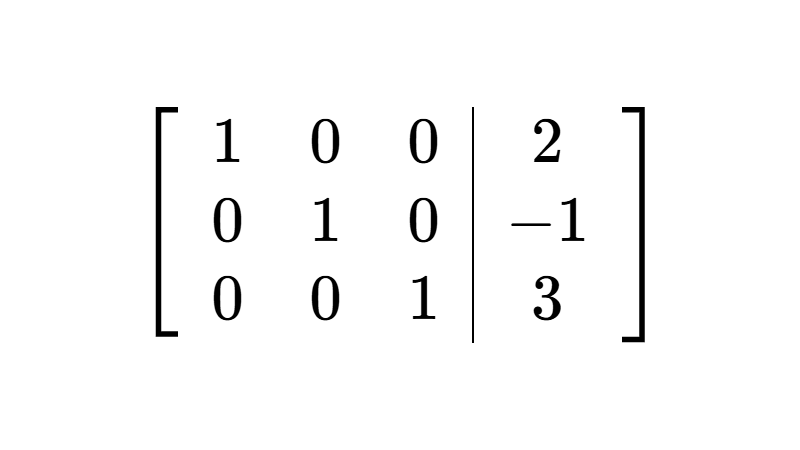
If row operations are continued to create zeros both below and above each pivot, and each leading entry (pivot) is made equal to 1, the matrix reaches reduced row echelon form (the outcome of Gauss-Jordan elimination). In this state, there is no need to write equations or perform back-substitution, because the numerical solutions can be read directly from the column of constants.
Consider the following augmented matrix in reduced row echelon form:
$$\left[\begin{array}{ccc|c} 1 & 0 & 0 & 4 \\ 0 & 1 & 0 & -2 \\ 0 & 0 & 1 & 5 \end{array}\right]$$
The coefficient block to the left of the bar forms the identity matrix. Translating each row back into an equation shows that each variable has been completely isolated:
- First row: \(1x + 0y + 0z = 4 \implies x = 4\).
- Second row: \(0x + 1y + 0z = -2 \implies y = -2\).
- Third row: \(0x + 0y + 1z = 5 \implies z = 5\).
The system is consistent with a unique solution given by the ordered triple \((4, -2, 5)\), obtained directly by inspection without requiring any additional algebraic steps.
Identifying Inconsistent Systems
An augmented matrix also makes it easy to identify when a linear system has no solution. This occurs whenever row reduction produces a row where all entries to the left of the bar are zeros, but the constant term on the right is non-zero.
For example, suppose row operations on a linear system result in the following augmented matrix:
$$\left[\begin{array}{cc|c} 1 & -2 & 3 \\ 0 & 0 & 5 \end{array}\right]$$
Translating the second row into its corresponding algebraic equation with variables x and y yields:
$$0x + 0y = 5 \implies 0 = 5$$
This statement represents a mathematical contradiction: no values assigned to the variables can make zero equal to five. The presence of this inconsistent row immediately indicates that the system is inconsistent (has no solution), allowing us to stop without performing any further calculations.
Zero Rows and Infinitely Many Solutions
Another common scenario arises when an equation in the system is a linear combination of the others or is redundant. Under elementary row operations, that dependent equation cancels out completely, producing a row containing only zeros in both the coefficients and the constant term.
Consider, for instance, the following 3×4 augmented matrix in row echelon form:
$$\left[\begin{array}{ccc|c} 1 & 0 & 2 & 1 \\ 0 & 1 & -1 & 3 \\ 0 & 0 & 0 & 0 \end{array}\right]$$
The third row represents the trivial identity \(0x + 0y + 0z = 0\), or \(0 = 0\). This statement is true for any real values of the variables and imposes no restrictions on the system, so it can be disregarded.
As a result, only 2 meaningful equations remain to determine 3 variables. Because the number of variables exceeds the number of non-zero equations, the system is consistent and dependent, having infinitely many solutions. To express this solution set, solve for the leading variables (x and y) in terms of the free variable (z):
- First row: \(x + 2z = 1 \implies x = 1 - 2z\).
- Second row: \(y - z = 3 \implies y = 3 + z\).
Assigning a real parameter \(t\) to the free variable (\(z = t\)), all possible solutions to the system are described parametrically by \(x = 1 - 2t\), \(y = 3 + t\), and \(z = t\), for any real number \(t\).
Did you find this useful? Rate it!
0.0 / 5 — 0 votes

HOW TO CITE THIS ARTICLE
Machado, D. (2026, November 11). Augmented Matrix. Flamath. https://en.flamath.com/augmented-matrix
Consistent and Independent System
Rouché-Frobenius Theorem
Systems of Linear Equations
Cramer's Rule
Gauss-Jordan Elimination
Leave a Reply
Related Articles