
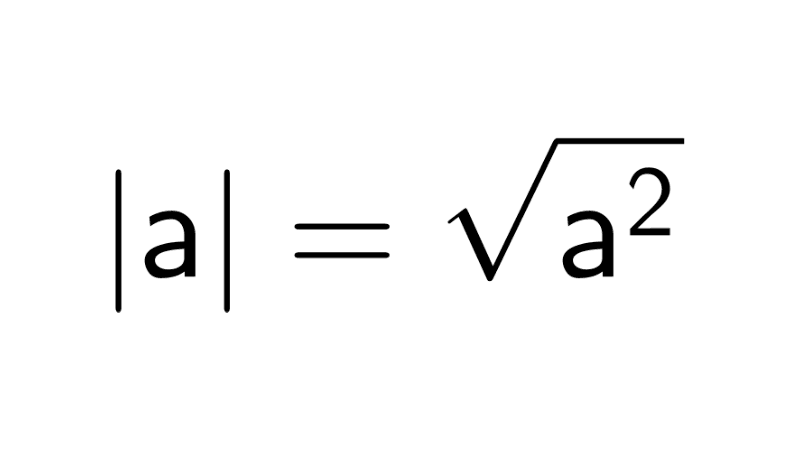
Properties of Absolute Value
Recall that the absolute value of a real number is a non-negative quantity that represents its distance from zero on the number line and is symbolized by two vertical bars around the number. For example: |5| = 5, |-6| = 6, |0| = 0. Its fundamental properties are:
| Property | Description |
|---|---|
| |a| ≥ 0 | The absolute value of a number is always non-negative. |
| |a| = 0 if and only if a = 0 | The absolute value is zero only when the number is zero. |
| If a ≠ 0, then |a| > 0 | The absolute value of any non-zero number is positive. |
| |a| = |-a| | The absolute value of a number and its opposite are equal. |
| |a| ≥ a | The absolute value is always greater than or equal to the original number. It is greater when the original number is negative and equal when the number is non-negative. |
| -|a| ≤ a ≤ |a| | A number is always greater than or equal to the opposite of its absolute value and less than or equal to its absolute value. |
| If |a| ≤ b, then -b ≤ a ≤ b. | If the absolute value of a number a is less than or equal to a non-negative number b, then a lies between b and its opposite. |
| If |a| ≥ b, then a ≥ b or a ≤ -b | If the absolute value of a number a is greater than or equal to a non-negative number b, then a is greater than or equal to b or a is less than or equal to -b. |
| |a| = b if and only if a = ±b. | The absolute value of a number a is equal to b if and only if b is equal to a or its opposite. |
Table of Contents
Properties of Operations
To solve equations or inequalities that contain absolute values, it is often very useful to apply the following rules.
Absolute Value of a Product
The absolute value of a product is equal to the product of the absolute values of the factors:
$$|ab|=|a||b|$$
Examples:
\(|(-2)\cdot 5|=|-2|\cdot |5|=2\cdot 5=10\)
\(|(-7)(-4)|=|-7||-4|=28\)
Absolute Value of a Quotient
The absolute value of a quotient is equal to the quotient of the absolute values of the numerator and the denominator:
\(\left|\dfrac{a}{b}\right|=\dfrac{|a|}{|b|}\) with \(b≠0\)
Examples:
\(\left|\dfrac{-2}{3}\right|=\dfrac{|-2|}{|3|}=\dfrac{2}{3}\)
\(\left|\dfrac{-9}{-3}\right|=\dfrac{|-9|}{|-3|}=\dfrac{9}{3}=3\)
Absolute Value of a Sum
The absolute value of the sum of two real numbers is less than or equal to the sum of the absolute values of those numbers. This is called the triangle inequality.
$$|a+b|≤|a|+|b|$$
If \(a\) and \(b\) have the same sign, equality holds; if \(a\) and \(b\) have opposite signs, the strict less-than inequality holds.
Examples:
\(|2+3|≤|2|+|3|→|5|≤5→5≤5\)
\(|-3-5|≤|-3|+|-5|→|-8|≤8→8≤8\)
\(|7-4|≤|7|+|-4|→3≤11\)
Absolute Value of a Difference
The absolute value of the difference of two numbers is greater than or equal to the difference of the absolute values of the minuend and the subtrahend:
$$|a-b|≥|a|-|b|$$
Examples:
\(|2-5|≥|2|-|5|~→~|-3|≥-3~→~3≥-3\)
\(|-4-1|≥|-4|-|1|~→~|-5|≥3~→~5≥3\)
Absolute Value of a Power
The absolute value of a power is equal to the power of the absolute value of the base:
$$|a^n|=|a|^n$$
Examples:
\(|2^2|=|2|^2=2^2=4\)
\(|(-5)^3|=|-5|^3=5^3=125\)
\(|2^{-3}|=|2|^{-3}=2^{-3}=\dfrac{1}{8}\)
Proofs
Most absolute value rules are proved directly from the definition because they are immediate consequences of it. Below, we prove the product rule as well as the properties for the absolute value of a sum and a difference.
Proof of the Absolute Value of a Product
We want to prove that \(|ab|=|a||b|.\)
1) Suppose that \(ab>0,\) meaning that \(a\) and \(b\) have the same sign. Then, \(|ab|=ab\) by definition. Since \(|a||b|=ab\) as well, it follows that \(|ab|=|a||b|.\)
2) Now suppose that \(ab<0,\) meaning that \(a\) and \(b\) have opposite signs. By definition, \(|ab|=-ab.\) Also, \(|a||b|=-ab\) (because one of the two numbers is negative). Therefore, it follows that \(|ab|=|a||b|.\)
Since the case \(ab=0\) is easily verified, we have proved that \(|ab|=|a||b|.\)
The quotient and power rules are proved in a similar manner to the one used here.
Proof of the Triangle Inequality
We want to prove that \(|a+b|≤|a|+|b|.\) First, suppose that \(a+b≥0.\) Then:
\(|a+b|=a+b\) by the definition of absolute value.
However, since \(a≤|a|\) and \(b≤|b|,\) adding them gives \(a+b≤|a|+|b|.\) Since \(a+b=|a+b|,\) we have:
\(|a+b|≤|a|+|b|\)
Now, suppose that \(a+b<0.\) Then:
\(|a+b|=-(a+b)\) by definition.
However, \(-(a+b)=(-a)+(-b).\) Since \(-a≤|a|\) and \(-b≤|b|,\) it follows that \((-a)+(-b)≤|a|+|b|,\) and from the first equality we deduce that:
\(|a+b|≤|a|+|b|\)
As desired.
Proof of the Absolute Value of a Difference
We want to prove that \(|a-b|≥|a|-|b|.\) Let \(a-b=c,\) so that \(a=b+c.\) By the triangle inequality, we have:
$$|a|=|b+c|≤|b|+|c|$$
Since \(c=a-b,\) we obtain \(|a|≤|b|+|a-b|.\) Rearranging this inequality gives:
\(|a|-|b|≤|a-b|~\) or \(~|a-b|≥|a|-|b|\)
As desired.
Did you find this useful? Rate it!
0.0 / 5 — 0 votes

HOW TO CITE THIS ARTICLE
Machado, D. (2026, November 23). Properties of Absolute Value. Flamath. https://en.flamath.com/absolute-value-properties
Leave a Reply
Related Articles