
Absolute Value
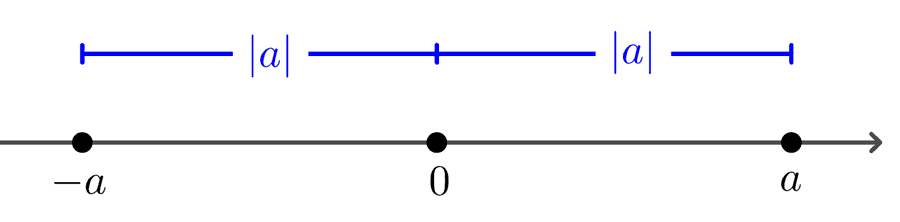
The absolute value of a real number is a non-negative number that represents its distance from zero on the number line. In other words, it is the amount that must be added to or subtracted from the number to reach zero. It is symbolically represented by two vertical bars | | around the number.
Mathematically, the absolute value of a real number is defined as follows:
- If the number is positive or zero, its absolute value is the same number. Symbolically: |a| = a if a ≥ 0.
- If the number is negative, then its absolute value is its opposite, that is, the number with its sign changed. Symbolically: |a| = -a if a < 0.
Table of Contents
How to Find the Absolute Value
To find the absolute value of a real number, we only need to consider the magnitude of the number: if the number is positive or zero, it remains unchanged; if the number is negative, we change its sign. The absolute value is always a non-negative quantity, regardless of the sign of the original number.
Examples
\(|12|=12\) because 12 is a positive number. The distance between 0 and 12 on the number line is twelve units.
\(|-2|=2\) because -2 is a negative number. The distance between -2 and 0 on the number line is two units.
\(|0|=0\) because the distance from 0 to 0 is zero units. The absolute value of zero is zero.
Similarly, we can calculate the absolute value for other integers, rational numbers, decimals, irrational numbers, etc.
\(|7/4|=7/4~\) because \(7/4≥0\)
\(|-3/5|=3/5~\) because \(-3/5<0\)
\(|-9|=9\)
\(|6|=6\)
\(|\sqrt[3]{7}|=\sqrt[3]{7}\)
\(|-6.5|=6.5\)
\(|-2.3|=2.3\)
\(|\sqrt{2}-2|=2-\sqrt{2}\) because \(\sqrt{2}-2\) is a negative expression.
We can also have operations inside the absolute value. Its bars work like parentheses, so we must perform the operations inside first before evaluating it.
\(|2+5|=|7|=7\)
\(|-5-5|=|-10|=10\)
\(|2.5-4|=|-1.5|=1.5\)
\(|\sqrt{2}-\sqrt{2}|=|0|=0\)
\(|(-2)(-3)|=|6|=6\)
\(\left|-\dfrac{5}{3}+\dfrac{2}{4}\right|=\left|-\dfrac{7}{6}\right|=\dfrac{7}{6}\)
Absolute Value on the Number Line
For any real number and its opposite, the distance to the origin is the same. For example, -10 and 10 are both ten units away from zero, meaning \(|10|=|-10|=10.\) In general, if \(a\) is a real number and \(-a\) is its opposite, then \(|a|=|-a|.\) This is one of the properties of absolute value.
Distance Between Two Numbers
If we want to find the distance between, for example, \(6\) and \(15\) on the number line, we can subtract the smaller number from the larger one: \(15-6=9.\) Thus, there are \(9\) units of distance between these numbers. With the concept of absolute value at our disposal, we no longer need to worry about the order of the numbers when subtracting, since the result will always be positive.
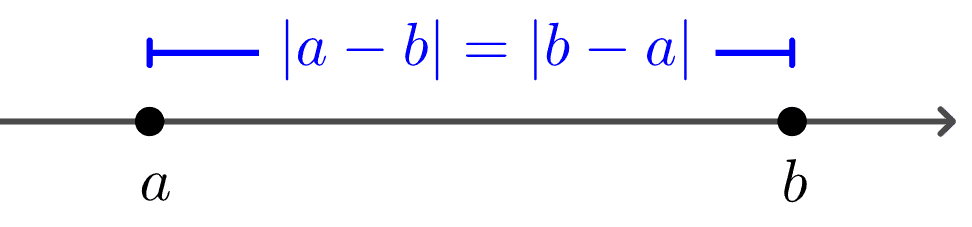
To calculate the distance between two real numbers, we take the absolute value of their difference. If \(a\) and \(b\) are real numbers, the distance between them is:
$$d(a,b)=|a-b|$$
Examples
- The distance between 10 and 7 is \(|10-7|=|3|=3\)
- The distance between 5 and -3 is \(|5-(-3)|=|5+3|=|8|=8\)
- The distance between -3 and -5 is \(|-3-(-5)|=|-3+5|=|2|=2\)
Note that \(|a-b|=|b-a|,\) so the order of subtraction does not matter. We would have reached the same result by swapping the positions of the numbers. The distance between \(0\) and a number \(a\) is: \(|a-0|=|a|,\) which aligns with the geometric interpretation of absolute value we saw earlier.
The concept of absolute value is applied whenever we are interested in the magnitude or numerical value of a real number regardless of its sign. For example:
- In geometry, it is used to calculate distances between points on a line or plane, as we just saw.
- In physics, it can represent physical quantities such as speed, acceleration, or force, where direction is not relevant.
- In programming and algorithm analysis, it can be useful for calculating differences or distances between values.
- In statistics, it is used in measures of dispersion, such as calculating the absolute deviation or the distance between values in a data set.
Absolute Value as a Square Root
Remember that the expression \(\sqrt{~}\) means "the principal (positive) square root of…". Therefore, the equation \(\sqrt{a^2}=a\) is not always true; it only holds when \(a≥0,\) otherwise the radical cannot simply be canceled. If \(a<0,\) then \(-a>0,\) so we have \(\sqrt{a^2}=-a.\)
We can summarize this reasoning as follows:
- \(\sqrt{a^2}=a\) if \(a≥0\)
- \(\sqrt{a^2}=-a\) if \(a<0\)
Notice the striking similarity to the definition of absolute value, which is why this is adopted as an alternative definition of it.
The absolute value of a real number is equal to the square root of its square:
$$|a|=\sqrt{a^2}$$
Examples
\(|-2|=\sqrt{(-2)^2}=\sqrt{4}=2\)
\(|5|=\sqrt{5^2}=\sqrt{25}=5\)
\(|-3.5|=\sqrt{(-3.5)^2}=\sqrt{12.25}=3.5\)
Properties of Absolute Value
Below are some fundamental properties of absolute value.
- The absolute value of a quantity is always non-negative: \(|a|≥0\)
- The absolute value of a number is zero if and only if the number is zero: \(|a|=0\) if and only if \(a=0\)
- The absolute value of a number is equal to that of its opposite: \(|a|=|-a|\)
- The absolute value is always greater than or equal to the original number: \(|a|≥a.\) It is greater when the original number is negative, and equal when the number is non-negative.
- If the absolute value of a number \(a\) is less than \(b,\) then \(a\) lies between \(b\) and its opposite. If \(|a|<b,\) then \(-b<a<b.\)
- If the absolute value of a number \(a\) is greater than \(b,\) then \(a\) is greater than \(b\) or \(a\) is less than \(-b.\) If \(|a|>b,\) then \(a>b\) or \(a<-b\)
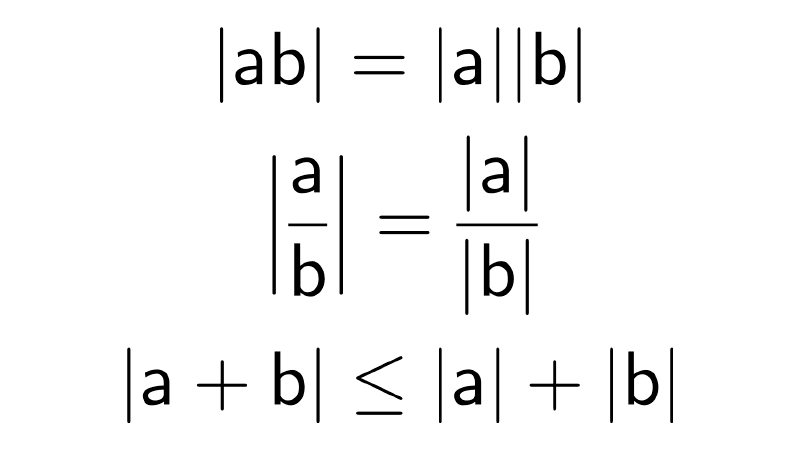
- The absolute value of a product is equal to the product of the absolute values of its factors: \(|ab|=|a||b|\)
- The absolute value of a quotient is equal to the quotient of the absolute values of the numerator and the denominator: \(\left|\dfrac{a}{b}\right|=\dfrac{|a|}{|b|}\) with \(b≠0\)
- The absolute value of a sum is less than or equal to the sum of the absolute values of the terms: \(|a+b|≤|a|+|b|.\) This is known as the triangle inequality.
Did you find this useful? Rate it!
0.0 / 5 — 0 votes

HOW TO CITE THIS ARTICLE
Machado, D. (2026, November 23). Absolute Value. Flamath. https://en.flamath.com/absolute-value
Leave a Reply
Related Articles