
Rouché-Frobenius Theorem
The Rouché–Frobenius theorem (also known as the Rouché–Capelli theorem) is a fundamental tool in linear algebra that classifies a system of linear equations without needing to compute its solutions. By comparing the rank of the coefficient matrix to the rank of the augmented matrix, the theorem determines whether the system has a unique solution, infinitely many solutions, or no solution at all.
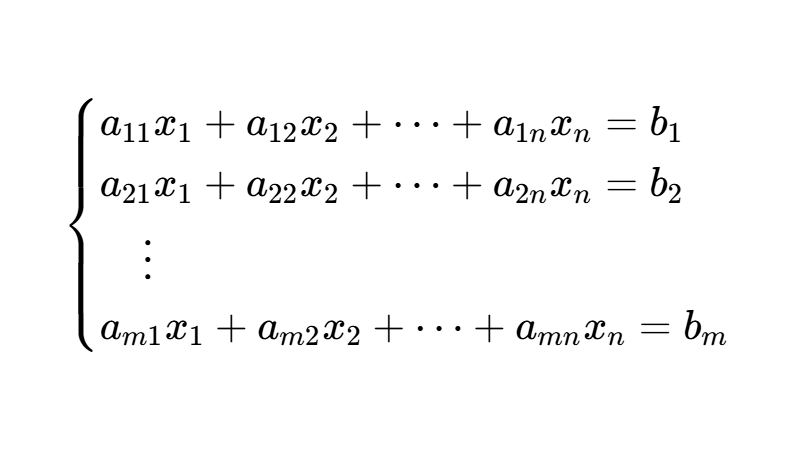
To apply this criterion, recall how a general linear system is represented in matrix form. Consider a system of m linear equations with n variables:
$$\begin{cases} a_{11}x_1 + a_{12}x_2 + \cdots + a_{1n}x_n = b_1 \\ a_{21}x_1 + a_{22}x_2 + \cdots + a_{2n}x_n = b_2 \\ \quad \vdots \\ a_{m1}x_1 + a_{m2}x_2 + \cdots + a_{mn}x_n = b_m \end{cases}$$
From this setup, we identify two fundamental matrix structures:
- Coefficient matrix \(A\): contains only the coefficients multiplying the variables. Its dimension is \(m \times n\):
$$\displaystyle A = \begin{bmatrix} a_{11} & a_{12} & \cdots & a_{1n} \\ a_{21} & a_{22} & \cdots & a_{2n} \\ \vdots & \vdots & \ddots & \vdots \\ a_{m1} & a_{m2} & \cdots & a_{mn} \end{bmatrix}$$ - Augmented matrix \((A \mid b)\): formed by appending the column of constant terms to the right of matrix \(A\). Its dimension is \(m \times (n+1)\):
$$\displaystyle (A \mid b) = \left[\begin{array}{cccc|c} a_{11} & a_{12} & \cdots & a_{1n} & b_1 \\ a_{21} & a_{22} & \cdots & a_{2n} & b_2 \\ \vdots & \vdots & \ddots & \vdots & \vdots \\ a_{m1} & a_{m2} & \cdots & a_{mn} & b_m \end{array}\right]$$
The overall behavior of the system depends entirely on the number of linearly independent rows or columns in \(A\) compared to \((A \mid b)\).
Table of Contents
Statement of the Theorem and System Classification
The Rouché–Frobenius theorem states that the existence and number of solutions of a linear system depend exclusively on the relationship between the rank of the coefficient matrix, the rank of the augmented matrix, and the number of variables.
Consider a system of m linear equations with n variables, with coefficient matrix \(A\) and augmented matrix \((A \mid b)\). Three distinct conditions can occur:
- Consistent system: the system has at least one solution if and only if the rank of the coefficient matrix equals the rank of the augmented matrix, that is, \(\operatorname{rank}(A) = \operatorname{rank}(A \mid b)\).
- Consistent system with a unique solution: the system has exactly one solution if both ranks are equal and match the number of variables, satisfying \(\operatorname{rank}(A) = \operatorname{rank}(A \mid b) = n\).
- Consistent system with infinitely many solutions: the system has infinitely many solutions if both ranks are equal but strictly less than the number of variables, satisfying \(\operatorname{rank}(A) = \operatorname{rank}(A \mid b) = r < n\). In this case, the general solution is expressed in terms of \(n - r\) free variables (or parameters).
- Inconsistent system: the system has no solution if the rank of the coefficient matrix is strictly less than the rank of the augmented matrix, satisfying \(\operatorname{rank}(A) \neq \operatorname{rank}(A \mid b)\) (specifically, \(\operatorname{rank}(A) < \operatorname{rank}(A \mid b)\)).
To summarize these consistency criteria visually, we use the following classification table:
| Rank Condition | System Classification | Number of Solutions | Analytical Interpretation |
|---|---|---|---|
| \(\operatorname{rank}(A) = \operatorname{rank}(A \mid b) = n\) | Consistent (Independent) | Unique solution | Every variable is uniquely determined by a fixed numeric value. |
| \(\operatorname{rank}(A) = \operatorname{rank}(A \mid b) = r < n\) | Consistent (Dependent) | Infinitely many solutions | There are \(n - r\) free variables that generate a family of solutions. |
| \(\operatorname{rank}(A) < \operatorname{rank}(A \mid b)\) | Inconsistent | No solution | The equations impose mutually contradictory constraints. |
To understand what these rank conditions mean, it helps to connect them directly to what happens when row reducing a matrix via Gaussian elimination. The rank of a matrix represents the number of non-zero rows (rows that are not entirely zeros) remaining once the matrix is in row echelon form.
When applying row reduction to the augmented matrix \((A \mid b)\) of a system with 3 equations and 3 variables (\(n = 3\)), three structural scenarios can arise:
- Unique solution case (three non-zero rows): after row reduction, we obtain three non-zero rows in both \(A\) and \((A \mid b)\). No equation vanishes and no contradiction arises, so \(\operatorname{rank}(A) = \operatorname{rank}(A \mid b) = 3\). With as many independent equations as variables, each variable is uniquely determined through back-substitution.
- Infinitely many solutions case (appearance of \(0 = 0\)): during reduction, at least one entire row vanishes on both sides, yielding an equation equivalent to \(0x + 0y + 0z = 0\) (that is, \(0 = 0\)). Because this row vanishes completely, it does not count toward the rank, reducing it to 2 (or 1). Since \(\operatorname{rank}(A) = \operatorname{rank}(A \mid b) = 2 < 3\), one of the three variables cannot be fixed and acts as a free variable, giving rise to infinitely many solutions.
- Inconsistent case (appearance of \(0 = k\)): during row reduction, all coefficients in a row of \(A\) become zero, but the corresponding constant term is a non-zero number \(k \neq 0\). The row takes the form \(\begin{bmatrix} 0 & 0 & 0 & \mid & k \end{bmatrix}\), which translates to the mathematical statement \(0x + 0y + 0z = k\). Because zero cannot equal a non-zero constant, the system is inconsistent. In terms of matrix rank, this row counts as a non-zero row for \((A \mid b)\) but not for \(A\), resulting in \(\operatorname{rank}(A) = 2\) and \(\operatorname{rank}(A \mid b) = 3\).
A particularly important special case is that of homogeneous systems, where all constant terms are zero (\(b_i = 0\)). Because the added column in \((A \mid b)\) contains only zeros, elementary row operations can never produce an additional non-zero row. Consequently, every homogeneous system always satisfies \(\operatorname{rank}(A) = \operatorname{rank}(A \mid b)\), guaranteeing that it is never inconsistent: it always admits at least the trivial solution \(x_1 = x_2 = \cdots = x_n = 0\).
Classification Examples
To apply the theorem in practice, we can determine matrix ranks by evaluating their minors (determinants of square submatrices). The rank of a matrix equals the order of its largest non-zero minor.
Example 1
Let us determine the consistency of the following system of equations:
$$\begin{cases} x + y + z = 6 \\ 2x - y + z = 3 \\ x + 2y - z = 2 \end{cases}$$
We write the coefficient matrix \(A\) and the augmented matrix \((A \mid b)\):
$$\displaystyle A = \begin{bmatrix} 1 & 1 & 1 \\ 2 & -1 & 1 \\ 1 & 2 & -1 \end{bmatrix}, \quad (A \mid b) = \left[\begin{array}{ccc|c} 1 & 1 & 1 & 6 \\ 2 & -1 & 1 & 3 \\ 1 & 2 & -1 & 2 \end{array}\right]$$
To compute the rank of \(A\), we start by looking for a non-zero minor of order 2. Taking the first two rows and columns:
$$\begin{vmatrix} 1 & 1 \\ 2 & -1 \end{vmatrix} = (1)(-1) - (1)(2) = -1 - 2 = -3 \neq 0$$
Since we found a non-zero minor of order 2, the rank of \(A\) is at least 2 (\(\operatorname{rank}(A) \ge 2\)). To check if it reaches rank 3, we calculate the determinant of the full matrix \(A\):
$$\det(A) = \begin{vmatrix} 1 & 1 & 1 \\ 2 & -1 & 1 \\ 1 & 2 & -1 \end{vmatrix} = 1(1 - 2) - 1(-2 - 1) + 1(4 - (-1)) = -1 + 3 + 5 = 7 \neq 0$$
Since \(\det(A) \neq 0\), the largest non-zero order is 3, which means \(\operatorname{rank}(A) = 3\). Because the augmented matrix \((A \mid b)\) has dimension \(3 \times 4\), its maximum possible rank is also 3. Therefore, it necessarily follows that \(\operatorname{rank}(A \mid b) = 3\).
Since \(\operatorname{rank}(A) = \operatorname{rank}(A \mid b) = 3\) and the number of variables is \(n = 3\), the Rouché–Frobenius theorem concludes that the system is consistent with a unique solution.
Example 2
Let us analyze the number of solutions of the following linear system:
$$\begin{cases} x + y - z = 2 \\ 2x - y + z = 1 \\ 3x = 3 \end{cases}$$
We construct the associated matrices:
$$\displaystyle A = \begin{bmatrix} 1 & 1 & -1 \\ 2 & -1 & 1 \\ 3 & 0 & 0 \end{bmatrix}, \quad (A \mid b) = \left[\begin{array}{ccc|c} 1 & 1 & -1 & 2 \\ 2 & -1 & 1 & 1 \\ 3 & 0 & 0 & 3 \end{array}\right]$$
We first find the rank of \(A\). Select a minor of order 2 in the upper-left corner:
$$\begin{vmatrix} 1 & 1 \\ 2 & -1 \end{vmatrix} = -1 - 2 = -3 \neq 0$$
This guarantees that \(\operatorname{rank}(A) \ge 2\). Next, we evaluate the order 3 determinant, expanding along the third row to simplify the calculation:
$$\det(A) = \begin{vmatrix} 1 & 1 & -1 \\ 2 & -1 & 1 \\ 3 & 0 & 0 \end{vmatrix} = 3 \cdot \begin{vmatrix} 1 & -1 \\ -1 & 1 \end{vmatrix} = 3(1 - 1) = 0$$
Since the only minor of order 3 in \(A\) is zero, the rank cannot be 3, leaving \(\operatorname{rank}(A) = 2\).
Now we evaluate the rank of the augmented matrix \((A \mid b)\). Because it shares the same non-zero minor of order 2, we already know that \(\operatorname{rank}(A \mid b) \ge 2\). To verify if the rank increases to 3, we border this minor by adding the third row and the column of constant terms:
$$\begin{vmatrix} 1 & 1 & 2 \\ 2 & -1 & 1 \\ 3 & 0 & 3 \end{vmatrix} = 3 \cdot \begin{vmatrix} 1 & 2 \\ -1 & 1 \end{vmatrix} + 3 \cdot \begin{vmatrix} 1 & 1 \\ 2 & -1 \end{vmatrix} = 3(1 + 2) + 3(-1 - 2) = 9 - 9 = 0$$
All possible minors of order 3 in the augmented matrix vanish, so \(\operatorname{rank}(A \mid b) = 2\).
Since \(\operatorname{rank}(A) = \operatorname{rank}(A \mid b) = 2 < 3\) (where \(n = 3\) is the number of variables), the system is consistent with infinitely many solutions, depending on \(3 - 2 = 1\) free variable.
Example 3
Let us examine the consistency of the following system:
$$\begin{cases} x + 2y - z = 4 \\ 2x - y + z = 1 \\ 3x + y = 3 \end{cases}$$
We write the coefficient matrix and the augmented matrix:
$$\displaystyle A = \begin{bmatrix} 1 & 2 & -1 \\ 2 & -1 & 1 \\ 3 & 1 & 0 \end{bmatrix}, \quad (A \mid b) = \left[\begin{array}{ccc|c} 1 & 2 & -1 & 4 \\ 2 & -1 & 1 & 1 \\ 3 & 1 & 0 & 3 \end{array}\right]$$
We identify a non-zero minor of order 2 in \(A\) using the first two rows and columns:
$$\begin{vmatrix} 1 & 2 \\ 2 & -1 \end{vmatrix} = -1 - 4 = -5 \neq 0$$
This ensures that \(\operatorname{rank}(A) \ge 2\). Next, we compute the determinant of matrix \(A\) by expanding along the third row:
$$\det(A) = \begin{vmatrix} 1 & 2 & -1 \\ 2 & -1 & 1 \\ 3 & 1 & 0 \end{vmatrix} = 3 \cdot \begin{vmatrix} 2 & -1 \\ -1 & 1 \end{vmatrix} - 1 \cdot \begin{vmatrix} 1 & -1 \\ 2 & 1 \end{vmatrix} = 3(2 - 1) - 1(1 + 2) = 3 - 3 = 0$$
Since the determinant is zero, we confirm that \(\operatorname{rank}(A) = 2\).
To analyze the augmented matrix \((A \mid b)\), we border the non-zero minor of order 2 using the third row and the column of constant terms:
$$\begin{vmatrix} 1 & 2 & 4 \\ 2 & -1 & 1 \\ 3 & 1 & 3 \end{vmatrix} = 1(-3 - 1) - 2(6 - 3) + 4(2 + 3) = -4 - 6 + 20 = 10 \neq 0$$
Because we obtained a non-zero minor of order 3 within \((A \mid b)\), we conclude that \(\operatorname{rank}(A \mid b) = 3\).
Given that \(\operatorname{rank}(A) = 2\) and \(\operatorname{rank}(A \mid b) = 3\), the ranks do not match (\(\operatorname{rank}(A) \neq \operatorname{rank}(A \mid b)\)). By the Rouché–Frobenius theorem, the system is inconsistent and has no solution.
Example 4
Let us determine the consistency of an overdetermined system (3 equations and 2 variables):
$$\begin{cases} x + y = 3 \\ 2x - y = 0 \\ 3x + y = 8 \end{cases}$$
We build the coefficient matrix \(A\) and the augmented matrix \((A \mid b)\):
$$\displaystyle A = \begin{bmatrix} 1 & 1 \\ 2 & -1 \\ 3 & 1 \end{bmatrix}, \quad (A \mid b) = \left[\begin{array}{cc|c} 1 & 1 & 3 \\ 2 & -1 & 0 \\ 3 & 1 & 8 \end{array}\right]$$
Since matrix \(A\) has dimension \(3 \times 2\), its maximum possible rank is 2. We calculate a minor of order 2 using the first two rows:
$$\begin{vmatrix} 1 & 1 \\ 2 & -1 \end{vmatrix} = -1 - 2 = -3 \neq 0$$
Finding a non-zero minor of order 2 confirms that \(\operatorname{rank}(A) = 2\).
For the augmented matrix \((A \mid b)\), notice that it is a square matrix of dimension \(3 \times 3\). We calculate its determinant directly by expanding along the second row to take advantage of the zero entry:
$$\det(A \mid b) = \begin{vmatrix} 1 & 1 & 3 \\ 2 & -1 & 0 \\ 3 & 1 & 8 \end{vmatrix} = -2(8 - 3) + (-1)(8 - 9) = -2(5) - 1(-1) = -10 + 1 = -9 \neq 0$$
Since this order 3 determinant is non-zero, it follows that \(\operatorname{rank}(A \mid b) = 3\).
Because \(\operatorname{rank}(A) = 2\) and \(\operatorname{rank}(A \mid b) = 3\), the ranks do not match (\(\operatorname{rank}(A) \neq \operatorname{rank}(A \mid b)\)). By the Rouché–Frobenius theorem, the system is inconsistent and has no solution. In overdetermined systems, this is the typical outcome whenever additional equations introduce conflicting constraints.
Example 5
Let us analyze the consistency of an underdetermined system (2 equations and 3 variables):
$$\begin{cases} x + 2y - z = 4 \\ 2x - y + z = 1 \end{cases}$$
We write the corresponding matrices:
$$\displaystyle A = \begin{bmatrix} 1 & 2 & -1 \\ 2 & -1 & 1 \end{bmatrix}, \quad (A \mid b) = \left[\begin{array}{ccc|c} 1 & 2 & -1 & 4 \\ 2 & -1 & 1 & 1 \end{array}\right]$$
Both matrices have 2 rows, so the maximum rank they can attain is 2. We evaluate the minor of order 2 formed by the first two columns of \(A\):
$$\begin{vmatrix} 1 & 2 \\ 2 & -1 \end{vmatrix} = -1 - 4 = -5 \neq 0$$
This guarantees that \(\operatorname{rank}(A) = 2\). Since the augmented matrix \((A \mid b)\) also has only 2 rows, its rank cannot exceed 2, which forces \(\operatorname{rank}(A \mid b) = 2\).
Comparing this with the number of variables (\(n = 3\)), we have \(\operatorname{rank}(A) = \operatorname{rank}(A \mid b) = 2 < 3\). The system is consistent with infinitely many solutions, depending on \(3 - 2 = 1\) free variable.
This last case highlights a fundamental rule of linear systems: an underdetermined system (fewer equations than variables) can never have a unique solution. Because the rank is bounded by the number of equations (\(\operatorname{rank}(A) \le m < n\)), it can never equal the number of variables. Therefore, a system with more variables than equations can only be either consistent with infinitely many solutions or inconsistent.
Classifying Linear Systems with Parameters
Analyzing a linear system that depends on one or more parameters involves determining for which parameter values the system has a unique solution, infinitely many solutions, or no solution. Rather than solving the system separately for each possible case, we apply a systematic methodology based on determinants and the Rouché–Frobenius theorem (often called the Rouché–Capelli theorem in this context):
- Find the critical values: compute the determinant of the coefficient matrix, \(\det(A)\), as a function of the parameter and set it equal to zero to find the roots of the resulting equation.
- Analyze the general case (\(\det(A) \neq 0\)): if the parameters do not equal any of the critical values found, the determinant is non-zero. Consequently, the rank of \(A\) is maximal (\(\operatorname{rank}(A) = n\)). Because the augmented matrix cannot have more independent rows than \(n\), it immediately follows that \(\operatorname{rank}(A) = \operatorname{rank}(A \mid b) = n\), classifying the system as consistent with a unique solution.
- Study the critical cases (\(\det(A) = 0\)): substitute each critical value individually into the augmented matrix \((A \mid b)\). Since these matrices are now strictly numerical, calculate the rank of \(A\) and border the minor with the column of constant terms to find the rank of \((A \mid b)\).
- Summarize the classification: compile the conclusions into an organized summary detailing the classification according to the specific values or intervals of the parameters.
Example 1
Let us classify the following linear system according to the values of the real parameter \(k\):
$$\begin{cases} x + y + z = 1 \\ 2x + 3y + z = 2 \\ x + y + kz = 3 \end{cases}$$
We set up the coefficient matrix \(A\) and the augmented matrix \((A \mid b)\):
$$\displaystyle A = \begin{bmatrix} 1 & 1 & 1 \\ 2 & 3 & 1 \\ 1 & 1 & k \end{bmatrix}, \quad (A \mid b) = \left[\begin{array}{ccc|c} 1 & 1 & 1 & 1 \\ 2 & 3 & 1 & 2 \\ 1 & 1 & k & 3 \end{array}\right]$$
We calculate the determinant of \(A\) by cofactor expansion along the third row:
$$\det(A) = 1(3k - 1) - 1(2k - 1) + 1(2 - 3) = 3k - 1 - 2k + 1 - 1 = k - 1$$
Setting the determinant equal to zero gives the single critical value of the parameter:
$$k - 1 = 0 \implies k = 1$$
We distinguish the two possible cases:
- Case 1 (\(k \neq 1\)): since the determinant is non-zero (\(\det(A) \neq 0\)), the rank of the coefficient matrix is maximal: \(\operatorname{rank}(A) = 3\). Because the augmented matrix has only 3 rows, its rank cannot be greater, which means \(\operatorname{rank}(A) = \operatorname{rank}(A \mid b) = 3 = n\). The system is consistent with a unique solution.
- Case 2 (\(k = 1\)): substitute this value into the augmented matrix: $$\displaystyle (A \mid b) = \left[\begin{array}{ccc|c} 1 & 1 & 1 & 1 \\ 2 & 3 & 1 & 2 \\ 1 & 1 & 1 & 3 \end{array}\right]$$ Since \(\det(A) = 0\), we know that \(\operatorname{rank}(A) < 3\). Select a minor of order 2 in the upper-left corner: $$\begin{vmatrix} 1 & 1 \\ 2 & 3 \end{vmatrix} = 3 - 2 = 1 \neq 0 \implies \operatorname{rank}(A) = 2$$ To evaluate the rank of \((A \mid b)\), we border this minor with the third row and the column of constants: $$\begin{vmatrix} 1 & 1 & 1 \\ 2 & 3 & 2 \\ 1 & 1 & 3 \end{vmatrix} = 1(9 - 2) - 1(6 - 2) + 1(2 - 3) = 7 - 4 - 1 = 2 \neq 0$$ Since we found a non-zero minor of order 3, it follows that \(\operatorname{rank}(A \mid b) = 3\). Because \(\operatorname{rank}(A) = 2 \neq 3 = \operatorname{rank}(A \mid b)\), the system is inconsistent and has no solution. Notice that this can also be seen directly by observing that the first equation states \(x + y + z = 1\) while the third states \(x + y + z = 3\), an immediate contradiction.
Example 2
Let us classify the following linear system as a function of the real parameter \(k\):
$$\begin{cases} kx + y + z = 1 \\ x + ky + z = 1 \\ x + y + kz = 1 \end{cases}$$
We write the coefficient matrix \(A\) and the augmented matrix \((A \mid b)\):
$$\displaystyle A = \begin{bmatrix} k & 1 & 1 \\ 1 & k & 1 \\ 1 & 1 & k \end{bmatrix}, \quad (A \mid b) = \left[\begin{array}{ccc|c} k & 1 & 1 & 1 \\ 1 & k & 1 & 1 \\ 1 & 1 & k & 1 \end{array}\right]$$
To evaluate \(\det(A)\) cleanly, we apply standard determinant properties. First, add the second and third rows to the first row (\(R_1 \to R_1 + R_2 + R_3\)). Adding a linear combination of other rows to a row does not change the value of the determinant:
$$\det(A) = \begin{vmatrix} k & 1 & 1 \\ 1 & k & 1 \\ 1 & 1 & k \end{vmatrix} = \begin{vmatrix} k+2 & k+2 & k+2 \\ 1 & k & 1 \\ 1 & 1 & k \end{vmatrix}$$
Since all entries in the first row share the common factor \((k+2)\), we factor it out. Next, subtract the first row from the second and third rows (\(R_2 \to R_2 - R_1\) and \(R_3 \to R_3 - R_1\)) to create zeros:
$$\det(A) = (k+2) \begin{vmatrix} 1 & 1 & 1 \\ 1 & k & 1 \\ 1 & 1 & k \end{vmatrix} = (k+2) \begin{vmatrix} 1 & 1 & 1 \\ 0 & k-1 & 0 \\ 0 & 0 & k-1 \end{vmatrix}$$
With only zeros below the main diagonal, we have an upper triangular matrix. The determinant of any triangular matrix is simply the product of its diagonal entries:
$$\det(A) = (k+2) \cdot [1 \cdot (k-1) \cdot (k-1)] = (k+2)(k-1)^2$$
Setting the determinant equal to zero yields the critical values:
$$(k+2)(k-1)^2 = 0 \implies k = -2 \quad \text{or} \quad k = 1$$
We analyze the cases resulting from these values:
- Case 1 (\(k \neq 1\) and \(k \neq -2\)): the determinant is non-zero (\(\det(A) \neq 0\)), so \(\operatorname{rank}(A) = 3\). Because the augmented matrix has 3 rows, its rank cannot exceed 3, giving \(\operatorname{rank}(A) = \operatorname{rank}(A \mid b) = 3 = n\). By the Rouché–Frobenius theorem, the system is a consistent system with a unique solution.
- Case 2 (\(k = 1\)): substitute \(k = 1\) into the augmented matrix: $$\displaystyle (A \mid b) = \left[\begin{array}{ccc|c} 1 & 1 & 1 & 1 \\ 1 & 1 & 1 & 1 \\ 1 & 1 & 1 & 1 \end{array}\right]$$ All three rows are identical, meaning the system reduces to a single equation: \(x + y + z = 1\). Therefore, \(\operatorname{rank}(A) = \operatorname{rank}(A \mid b) = 1 < 3\). The system is a consistent system with infinitely many solutions, depending on \(3 - 1 = 2\) free variables.
- Case 3 (\(k = -2\)): substitute \(k = -2\) into the augmented matrix: $$\displaystyle (A \mid b) = \left[\begin{array}{ccc|c} -2 & 1 & 1 & 1 \\ 1 & -2 & 1 & 1 \\ 1 & 1 & -2 & 1 \end{array}\right]$$ Select a minor of order 2 in the upper-left corner of \(A\): $$\begin{vmatrix} -2 & 1 \\ 1 & -2 \end{vmatrix} = 4 - 1 = 3 \neq 0 \implies \operatorname{rank}(A) = 2$$ Border this minor with the column of constant terms to evaluate \((A \mid b)\): $$\begin{vmatrix} -2 & 1 & 1 \\ 1 & -2 & 1 \\ 1 & 1 & 1 \end{vmatrix} = 1(1 - (-2)) - 1(-2 - 1) + 1(4 - 1) = 3 + 3 + 3 = 9 \neq 0$$ Because there exists a non-zero minor of order 3, \(\operatorname{rank}(A \mid b) = 3\). Since \(\operatorname{rank}(A) = 2 \neq 3 = \operatorname{rank}(A \mid b)\), the system is an inconsistent system and has no solution.
Example 3
Let us analyze the consistency of the following system according to the values of parameter \(a\), which appears both in the coefficients and in the constant term:
$$\begin{cases} x + y + az = 1 \\ x + ay + z = 1 \\ ax + y + z = a \end{cases}$$
We write the matrices of the system:
$$\displaystyle A = \begin{bmatrix} 1 & 1 & a \\ 1 & a & 1 \\ a & 1 & 1 \end{bmatrix}, \quad (A \mid b) = \left[\begin{array}{ccc|c} 1 & 1 & a & 1 \\ 1 & a & 1 & 1 \\ a & 1 & 1 & a \end{array}\right]$$
Calculate the determinant of \(A\) by adding all rows to the first row:
$$\det(A) = \begin{vmatrix} a+2 & a+2 & a+2 \\ 1 & a & 1 \\ a & 1 & 1 \end{vmatrix} = (a+2) \begin{vmatrix} 1 & 1 & 1 \\ 1 & a & 1 \\ a & 1 & 1 \end{vmatrix}$$
Subtract the first column from the other two columns:
$$\det(A) = (a+2) \begin{vmatrix} 1 & 0 & 0 \\ 1 & a-1 & 0 \\ a & 1-a & 1-a \end{vmatrix} = (a+2)(a-1)(1-a) = -(a+2)(a-1)^2$$
Setting this equal to zero gives the critical values:
$$-(a+2)(a-1)^2 = 0 \implies a = 1 \quad \text{or} \quad a = -2$$
We classify the system based on the values of \(a\):
- Case 1 (\(a \neq 1\) and \(a \neq -2\)): since \(\det(A) \neq 0\), it follows directly that \(\operatorname{rank}(A) = \operatorname{rank}(A \mid b) = 3 = n\). The system is consistent with a unique solution.
- Case 2 (\(a = 1\)): substitute \(a = 1\) into the augmented matrix: $$\displaystyle (A \mid b) = \left[\begin{array}{ccc|c} 1 & 1 & 1 & 1 \\ 1 & 1 & 1 & 1 \\ 1 & 1 & 1 & 1 \end{array}\right]$$ Once again all rows are identical, resulting in \(\operatorname{rank}(A) = \operatorname{rank}(A \mid b) = 1 < 3\). The system is consistent with infinitely many solutions, depending on 2 free variables.
- Case 3 (\(a = -2\)): substitute \(a = -2\) into the augmented matrix: $$\displaystyle (A \mid b) = \left[\begin{array}{ccc|c} 1 & 1 & -2 & 1 \\ 1 & -2 & 1 & 1 \\ -2 & 1 & 1 & -2 \end{array}\right]$$ Evaluate the upper-left minor of order 2 in \(A\): $$\begin{vmatrix} 1 & 1 \\ 1 & -2 \end{vmatrix} = -2 - 1 = -3 \neq 0 \implies \operatorname{rank}(A) = 2$$ Border this minor with the column of constants to evaluate the augmented matrix: $$\begin{vmatrix} 1 & 1 & 1 \\ 1 & -2 & 1 \\ -2 & 1 & -2 \end{vmatrix} = 1(4 - 1) - 1(-2 - (-2)) + 1(1 - 4) = 3 - 0 - 3 = 0$$ Since this minor equals zero, let us check whether the entire rows are linearly dependent. Adding all three rows produces zero on the left (\(0x + 0y + 0z\)) and on the right: \(1 + 1 + (-2) = 0\). This indicates that the third equation is a linear combination of the first two across the entire augmented matrix, which implies \(\operatorname{rank}(A \mid b) = 2\). Since \(\operatorname{rank}(A) = \operatorname{rank}(A \mid b) = 2 < 3\), for \(a = -2\) the system is consistent with infinitely many solutions, depending on 1 free variable.
Example 4
Let us study the nature of the solutions of the following system in terms of two real parameters, \(a\) and \(m\):
$$\begin{cases} x + 2y - z = 1 \\ 2x + y + z = 2 \\ x - y + az = m \end{cases}$$
We write the matrices associated with the system, identifying the coefficient matrix \(A\), the column vector of constant terms \(b\), and the augmented matrix \((A \mid b)\):
$$\displaystyle A = \begin{bmatrix} 1 & 2 & -1 \\ 2 & 1 & 1 \\ 1 & -1 & a \end{bmatrix}, \quad b = \begin{bmatrix} 1 \\ 2 \\ m \end{bmatrix}, \quad (A \mid b) = \left[\begin{array}{ccc|c} 1 & 2 & -1 & 1 \\ 2 & 1 & 1 & 2 \\ 1 & -1 & a & m \end{array}\right]$$
We compute the determinant of \(A\), which depends exclusively on \(a\):
$$\det(A) = 1(a + 1) - 2(2a - 1) - 1(-2 - 1) = a + 1 - 4a + 2 + 3 = -3a + 6$$
Setting this equal to zero gives the critical condition for \(a\):
$$-3a + 6 = 0 \implies a = 2$$
We examine the possible scenarios by analyzing both parameters:
- General case (\(a \neq 2\)): regardless of the value taken by \(m\), the determinant of \(A\) never vanishes (\(\det(A) \neq 0\)). As a result, \(\operatorname{rank}(A) = \operatorname{rank}(A \mid b) = 3 = n\). The system is consistent with a unique solution for any \(m \in \mathbb{R}\).
- Critical case (\(a = 2\)): when \(a = 2\), the determinant of the coefficient matrix is zero (\(\det(A) = 0\)). We identify a non-zero minor of order 2 in \(A\): $$\begin{vmatrix} 1 & 2 \\ 2 & 1 \end{vmatrix} = 1 - 4 = -3 \neq 0 \implies \operatorname{rank}(A) = 2$$ To determine the rank of the augmented matrix \((A \mid b)\), we border this minor with the third row and the column of constants, which contains parameter \(m\): $$\begin{vmatrix} 1 & 2 & 1 \\ 2 & 1 & 2 \\ 1 & -1 & m \end{vmatrix} = 1(m + 2) - 2(2m - 2) + 1(-2 - 1) = m + 2 - 4m + 4 - 3 = -3m + 3$$ The value of this determinant depends directly on \(m\), leading to two distinct subcases:
- Subcase 2.1 (\(a = 2\) and \(m = 1\)): the bordered minor evaluates to \(-3(1) + 3 = 0\), which means \(\operatorname{rank}(A \mid b) = 2\). Since \(\operatorname{rank}(A) = \operatorname{rank}(A \mid b) = 2 < 3\), the system is consistent with infinitely many solutions, depending on \(3 - 2 = 1\) free variable.
- Subcase 2.2 (\(a = 2\) and \(m \neq 1\)): the bordered minor is non-zero, meaning \(\operatorname{rank}(A \mid b) = 3\). Because \(\operatorname{rank}(A) = 2 \neq 3 = \operatorname{rank}(A \mid b)\), the system is inconsistent and has no solution.
In summary, parameter \(a\) determines whether the system has a unique solution, whereas at the critical value \(a = 2\), parameter \(m\) marks the boundary between having infinitely many solutions (\(m = 1\)) and being inconsistent (\(m \neq 1\)).
Did you find this useful? Rate it!
0.0 / 5 — 0 votes

HOW TO CITE THIS ARTICLE
Machado, D. (2026, November 11). Rouché-Frobenius Theorem. Flamath. https://en.flamath.com/rouche-frobenius-theorem
Systems of Linear Equations
Cramer's Rule
Gauss-Jordan Elimination
Gaussian Elimination
Solving Systems of Equations by Elimination
Leave a Reply
Related Articles