
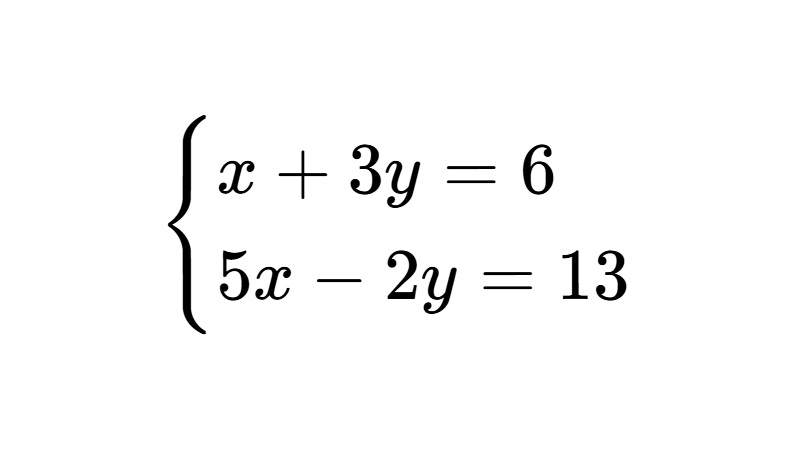
Solving Systems of Equations by Elimination
The elimination method, also known as the addition method or linear combination method, involves manipulating the equations of a linear system algebraically so that the coefficients of one variable become opposites. Adding the equations vertically eliminates that variable, resulting in a single linear equation in one variable that can be solved directly.
This technique is particularly convenient when the coefficients of a variable are multiples of one another or already have opposite signs, allowing you to work with integers and avoid fractions until the final step. While it is most commonly applied to systems of two linear equations in two variables (2×2), this principle of systematic cancellation forms the foundation for solving 3×3 linear systems and higher-dimensional linear models.
Example
To see how transforming equations and adding them vertically works in a 2×2 system, consider the following example:
$$\begin{cases} 2x + 3y = 8 \\ 5x - y = 3 \end{cases}$$
Label the equations to keep track of each step:
$$2x + 3y = 8 \quad (1)$$
$$5x - y = 3 \quad (2)$$
Inspect the coefficients of both variables. For the variable \(y\), equation (1) has a coefficient of 3 and equation (2) has a coefficient of −1. To make these coefficients opposites, multiply all terms of equation (2) by 3:
$$3 \cdot (5x - y) = 3 \cdot 3$$
$$15x - 3y = 9 \quad (3)$$
Add the original equation (1) and the new equivalent equation (3) vertically, aligning like terms:
$$\begin{aligned} 2x + 3y &= 8 \\ +\quad 15x - 3y &= 9 \\ \hline 17x + 0y &= 17 \end{aligned}$$
Solve for \(x\) in the resulting linear equation:
$$17x = 17$$
$$x = \frac{17}{17} = 1$$
With \(x = 1\) determined, substitute this value into either original equation to solve for the remaining variable. Using equation (1):
$$2(1) + 3y = 8$$
$$2 + 3y = 8$$
$$3y = 8 - 2$$
$$3y = 6$$
$$y = \frac{6}{3} = 2$$
The solution is \(x = 1\) and \(y = 2\), which can be written as the ordered pair \((x, y) = (1, 2)\). Geometrically, this represents the point where the two lines intersect on the Cartesian coordinate plane.
To check the solution, substitute \(x = 1\) and \(y = 2\) into both original equations:
In equation (1):
$$2(1) + 3(2) = 2 + 6 = 8$$
In equation (2):
$$5(1) - (2) = 5 - 2 = 3$$
Both statements are true, confirming that the solution is correct.
Table of Contents
Steps to Solve a System by Elimination
To solve any system of two linear equations in two variables using this method, follow these steps:
- Choose which variable to eliminate: Inspect the coefficients of \(x\) and \(y\) to determine which variable requires simpler multiplication or already has opposite signs.
- Multiply equations by suitable constants: Multiply one or both equations by non-zero numbers (typically convenient integers) so that the coefficients of the chosen variable are opposites (equal in absolute value but opposite in sign).
- Add the equations vertically: Add the corresponding \(x\)-terms, \(y\)-terms, and constants. The chosen variable cancels out, producing a coefficient of zero.
- Solve the resulting equation: Solve for the remaining variable in the one-step linear equation obtained after addition.
- Back-substitute to find the second variable: Substitute the numerical value found into either original equation and solve for the other variable.
- Check the solution: Plug both values into the original equations to verify that they satisfy both equations simultaneously.
Types of Solutions
When adding the transformed equations vertically, the relationship between the coefficients and constants reveals the nature of the solutions:
| System Classification | Algebraic Result After Elimination | Number of Solutions | Geometric Interpretation |
|---|---|---|---|
| Consistent and Independent | A unique value is obtained for each variable: \(x = a\), \(y = b\). | Exactly one solution \((a, b)\). | Two intersecting lines that cross at a single point. |
| Consistent and Dependent | Both variables cancel out, leaving a true identity: \(0 = 0\). | Infinitely many solutions. | Coincident lines (the exact same line). |
| Inconsistent | Both variables cancel out, leaving a false statement: \(0 = k\) (where \(k \neq 0\)). | No solution. | Distinct parallel lines that never intersect. |
When an identity such as 0 = 0 occurs, it indicates that one equation is a scalar multiple of the other, meaning both equations describe the exact same line in the coordinate plane. Conversely, if a contradiction such as 0 = 7 arises, the system represents parallel lines that have no common points of intersection.
Worked Examples
Below is a collection of step-by-step examples arranged by algebraic complexity, with the final exercises featuring real-world word problems. In each case, the equations are numbered to help you follow the vertical addition, back-substitution, and check steps.
Example 1
Solve the following system of linear equations using the elimination method:
$$\begin{cases} 3x + y = 7 \\ 2x - y = 8 \end{cases}$$
Solution
Label each equation in the system:
$$3x + y = 7 \quad (1)$$
$$2x - y = 8 \quad (2)$$
Notice that the coefficients of y are already opposites (1 and −1). Therefore, there is no need to multiply either equation by a constant; simply add them vertically:
$$\begin{aligned} 3x + y &= 7 \\ +\quad 2x - y &= 8 \\ \hline 5x + 0y &= 15 \end{aligned}$$
Solve for \(x\):
$$5x = 15$$
$$x = \frac{15}{5} = 3$$
Substitute \(x = 3\) into equation (1) to find the remaining variable:
$$3(3) + y = 7$$
$$9 + y = 7$$
$$y = 7 - 9 = -2$$
The solution is \(x = 3\) and \(y = -2\), written as the ordered pair \((x, y) = (3, -2)\).
Check the solution by plugging both values into the original equations:
In equation (1):
$$3(3) + (-2) = 9 - 2 = 7$$
In equation (2):
$$2(3) - (-2) = 6 + 2 = 8$$
Both equations are satisfied.
Example 2
Solve the following system of linear equations by elimination:
$$\begin{cases} 4x + 3y = 24 \\ 2x + 3y = 12 \end{cases}$$
Solution
Label the equations to organize the steps:
$$4x + 3y = 24 \quad (1)$$
$$2x + 3y = 12 \quad (2)$$
The variable y has the exact same coefficient and sign (+3) in both equations. While you could subtract equation (2) directly from equation (1), direct subtraction often leads to sign errors. A safer, more systematic approach is to multiply equation (2) by −1 to reverse its signs and then add vertically:
$$-1 \cdot (2x + 3y) = -1 \cdot 12$$
$$-2x - 3y = -12 \quad (3)$$
Add equation (1) and the equivalent equation (3) vertically:
$$\begin{aligned} 4x + 3y &= 24 \\ +\quad -2x - 3y &= -12 \\ \hline 2x + 0y &= 12 \end{aligned}$$
Solve for \(x\):
$$2x = 12$$
$$x = \frac{12}{2} = 6$$
Substitute \(x = 6\) into the original equation (2) to find \(y\):
$$2(6) + 3y = 12$$
$$12 + 3y = 12$$
$$3y = 12 - 12$$
$$3y = 0$$
$$y = \frac{0}{3} = 0$$
The solution is \(x = 6\) and \(y = 0\), which gives the ordered pair \((x, y) = (6, 0)\).
Verify the result in both original equations:
In equation (1):
$$4(6) + 3(0) = 24 + 0 = 24$$
In equation (2):
$$2(6) + 3(0) = 12 + 0 = 12$$
Both statements hold true.
Example 3
Solve the following linear system using the addition method:
$$\begin{cases} x + 4y = 9 \\ 3x - 2y = 13 \end{cases}$$
Solution
Identify the starting equations:
$$x + 4y = 9 \quad (1)$$
$$3x - 2y = 13 \quad (2)$$
In equation (1), the coefficient of x is 1, while in equation (2) it is 3. To make these coefficients opposites, multiply all terms of equation (1) by −3:
$$-3 \cdot (x + 4y) = -3 \cdot 9$$
$$-3x - 12y = -27 \quad (3)$$
Add equation (3) and equation (2) vertically:
$$\begin{aligned} -3x - 12y &= -27 \\ +\quad 3x - 2y &= 13 \\ \hline 0x - 14y &= -14 \end{aligned}$$
Solve for \(y\):
$$-14y = -14$$
$$y = \frac{-14}{-14} = 1$$
Substitute \(y = 1\) into the original equation (1) to solve for \(x\):
$$x + 4(1) = 9$$
$$x + 4 = 9$$
$$x = 9 - 4 = 5$$
The solution is \(x = 5\) and \(y = 1\), or \((x, y) = (5, 1)\).
Check the values in both original equations:
In equation (1):
$$5 + 4(1) = 5 + 4 = 9$$
In equation (2):
$$3(5) - 2(1) = 15 - 2 = 13$$
Both equations are verified.
Example 4
Solve the following system of equations:
$$\begin{cases} 2x - 4y = -14 \\ 5x + 2y = 1 \end{cases}$$
Solution
Label the two equations:
$$2x - 4y = -14 \quad (1)$$
$$5x + 2y = 1 \quad (2)$$
Examine the coefficients of y: equation (1) has −4 and equation (2) has +2. Since they already have opposite signs and 4 is a multiple of 2, multiply equation (2) by 2 to match their absolute values:
$$2 \cdot (5x + 2y) = 2 \cdot 1$$
$$10x + 4y = 2 \quad (3)$$
Add equation (1) and equation (3) vertically:
$$\begin{aligned} 2x - 4y &= -14 \\ +\quad 10x + 4y &= 2 \\ \hline 12x + 0y &= -12 \end{aligned}$$
Solve for \(x\):
$$12x = -12$$
$$x = \frac{-12}{12} = -1$$
Substitute \(x = -1\) into equation (2) to solve for \(y\):
$$5(-1) + 2y = 1$$
$$-5 + 2y = 1$$
$$2y = 1 + 5$$
$$2y = 6$$
$$y = \frac{6}{2} = 3$$
The solution is \(x = -1\) and \(y = 3\), giving the ordered pair \((x, y) = (-1, 3)\).
Verify the solution in both equations:
In equation (1):
$$2(-1) - 4(3) = -2 - 12 = -14$$
In equation (2):
$$5(-1) + 2(3) = -5 + 6 = 1$$
Both equalities hold true.
Example 5
Solve the following system of linear equations by elimination:
$$\begin{cases} 2x - 3y = 5 \\ 4x - 6y = 7 \end{cases}$$
Solution
Label the equations:
$$2x - 3y = 5 \quad (1)$$
$$4x - 6y = 7 \quad (2)$$
Aim to eliminate the variable x. Since the coefficient of \(x\) in equation (2) is 4, multiply equation (1) by −2 to create the opposite coefficient:
$$-2 \cdot (2x - 3y) = -2 \cdot 5$$
$$-4x + 6y = -10 \quad (3)$$
Add equation (3) and equation (2) vertically:
$$\begin{aligned} -4x + 6y &= -10 \\ +\quad 4x - 6y &= 7 \\ \hline 0x + 0y &= -3 \end{aligned}$$
Both variables cancel out, resulting in the following numerical statement:
$$0 = -3$$
This statement is a mathematical contradiction (a false statement). This indicates that there is no pair of real numbers \((x, y)\) that can satisfy both equations simultaneously. Therefore, the system is inconsistent and has no solution. Graphically, the equations represent two parallel lines that never intersect.
Example 6
Solve the following system using the linear combination method:
$$\begin{cases} 3x - y = 4 \\ 9x - 3y = 12 \end{cases}$$
Solution
Label the given equations:
$$3x - y = 4 \quad (1)$$
$$9x - 3y = 12 \quad (2)$$
Attempt to eliminate the variable y. Because equation (2) has a coefficient of −3, multiply equation (1) by −3 to obtain the opposite coefficient of +3:
$$-3 \cdot (3x - y) = -3 \cdot 4$$
$$-9x + 3y = -12 \quad (3)$$
Add equation (3) and equation (2) vertically:
$$\begin{aligned} -9x + 3y &= -12 \\ +\quad 9x - 3y &= 12 \\ \hline 0x + 0y &= 0 \end{aligned}$$
Adding the equations cancels both variables, leading to:
$$0 = 0$$
The equation \(0 = 0\) is a true identity for all points on the line. This occurs because equation (2) is simply a scalar multiple of equation (1). Consequently, the system is consistent and dependent and has infinitely many solutions. Geometrically, both equations describe the exact same line (coincident lines).
To express the solution set algebraically, solve for one variable in terms of the other from either equivalent equation. Solving for y in equation (1) yields \(y = 3x - 4\). The solution set can be written in set-builder notation as \(S = \{(x, y) \in \mathbb{R}^2 \mid y = 3x - 4\}\), or in parametric form with a real parameter \(t\) as \((x, y) = (t, 3t - 4)\) for any \(t \in \mathbb{R}\).
Example 7
Solve the following linear system by elimination:
$$\begin{cases} 3x + 4y = 6 \\ 2x - 3y = -13 \end{cases}$$
Solution
Label the equations:
$$3x + 4y = 6 \quad (1)$$
$$2x - 3y = -13 \quad (2)$$
The coefficients of y already have opposite signs (+4 and −3), but neither is an integer multiple of the other. Find the least common multiple of their absolute values: \(\text{LCM}(4, 3) = 12\). To make the coefficients 12 and −12, multiply equation (1) by 3 and equation (2) by 4:
$$3 \cdot (3x + 4y) = 3 \cdot 6 \implies 9x + 12y = 18 \quad (3)$$
$$4 \cdot (2x - 3y) = 4 \cdot (-13) \implies 8x - 12y = -52 \quad (4)$$
Add equations (3) and (4) vertically:
$$\begin{aligned} 9x + 12y &= 18 \\ +\quad 8x - 12y &= -52 \\ \hline 17x + 0y &= -34 \end{aligned}$$
Solve for \(x\):
$$17x = -34$$
$$x = \frac{-34}{17} = -2$$
Substitute \(x = -2\) into equation (1) to determine \(y\):
$$3(-2) + 4y = 6$$
$$-6 + 4y = 6$$
$$4y = 6 + 6$$
$$4y = 12$$
$$y = \frac{12}{4} = 3$$
The solution is \(x = -2\) and \(y = 3\), which gives the ordered pair \((x, y) = (-2, 3)\).
Check the values in both equations:
In equation (1):
$$3(-2) + 4(3) = -6 + 12 = 6$$
In equation (2):
$$2(-2) - 3(3) = -4 - 9 = -13$$
Both statements are verified.
Example 8
Find the solution to the following linear system:
$$\begin{cases} 3x + 5y = 7 \\ 4x + 3y = 13 \end{cases}$$
Solution
Label the equations:
$$3x + 5y = 7 \quad (1)$$
$$4x + 3y = 13 \quad (2)$$
All coefficients are positive. To eliminate x, find the least common multiple of 3 and 4, which is 12. To produce opposite coefficients and add vertically, multiply equation (1) by 4 and equation (2) by −3:
$$4 \cdot (3x + 5y) = 4 \cdot 7 \implies 12x + 20y = 28 \quad (3)$$
$$-3 \cdot (4x + 3y) = -3 \cdot 13 \implies -12x - 9y = -39 \quad (4)$$
Add equations (3) and (4) vertically:
$$\begin{aligned} 12x + 20y &= 28 \\ +\quad -12x - 9y &= -39 \\ \hline 0x + 11y &= -11 \end{aligned}$$
Solve for \(y\):
$$11y = -11$$
$$y = \frac{-11}{11} = -1$$
Substitute \(y = -1\) into equation (1) to solve for \(x\):
$$3x + 5(-1) = 7$$
$$3x - 5 = 7$$
$$3x = 7 + 5$$
$$3x = 12$$
$$x = \frac{12}{3} = 4$$
The solution is \(x = 4\) and \(y = -1\), or the ordered pair \((x, y) = (4, -1)\).
Check the solution in the original equations:
In equation (1):
$$3(4) + 5(-1) = 12 - 5 = 7$$
In equation (2):
$$4(4) + 3(-1) = 16 - 3 = 13$$
Both equations check out correctly.
Example 9
Solve the following system of linear equations by elimination:
$$\begin{cases} 2x = 5y + 4 \\ 3x + 13 = -2y \end{cases}$$
Solution
The equations are not written in standard form (\(Ax + By = C\)). Before applying elimination, rearrange the terms so that variable terms are on the left and constants are on the right:
For the first equation:
$$2x - 5y = 4 \quad (1)$$
For the second equation:
$$3x + 2y = -13 \quad (2)$$
Eliminate y, whose coefficients already have opposite signs. The least common multiple of 5 and 2 is 10. Multiply equation (1) by 2 and equation (2) by 5:
$$2 \cdot (2x - 5y) = 2 \cdot 4 \implies 4x - 10y = 8 \quad (3)$$
$$5 \cdot (3x + 2y) = 5 \cdot (-13) \implies 15x + 10y = -65 \quad (4)$$
Add equations (3) and (4) vertically:
$$\begin{aligned} 4x - 10y &= 8 \\ +\quad 15x + 10y &= -65 \\ \hline 19x + 0y &= -57 \end{aligned}$$
Solve for \(x\):
$$19x = -57$$
$$x = \frac{-57}{19} = -3$$
Substitute \(x = -3\) into standard equation (1) to find \(y\):
$$2(-3) - 5y = 4$$
$$-6 - 5y = 4$$
$$-5y = 4 + 6$$
$$-5y = 10$$
$$y = \frac{10}{-5} = -2$$
The solution is \(x = -3\) and \(y = -2\), giving the ordered pair \((x, y) = (-3, -2)\).
Check the values in the original, unmodified equations:
In the first equation:
$$2(-3) = -6 \quad \text{and} \quad 5(-2) + 4 = -10 + 4 = -6$$
In the second equation:
$$3(-3) + 13 = -9 + 13 = 4 \quad \text{and} \quad -2(-2) = 4$$
Both original equalities are satisfied.
Example 10
Solve the following linear system:
$$\begin{cases} 2(x + y) - 3x = y + 4 \\ 3(x - 2) + 2(y - 1) = 5 \end{cases}$$
Solution
Apply the distributive property to remove parentheses and combine like terms in each equation:
In the first equation:
$$2x + 2y - 3x = y + 4$$
$$-x + 2y - y = 4$$
$$-x + y = 4 \quad (1)$$
In the second equation:
$$3x - 6 + 2y - 2 = 5$$
$$3x + 2y - 8 = 5$$
$$3x + 2y = 5 + 8$$
$$3x + 2y = 13 \quad (2)$$
With the system simplified, observe that in equation (1) the coefficient of x is −1 and in equation (2) it is 3. Multiply equation (1) by 3 to create opposite coefficients:
$$3 \cdot (-x + y) = 3 \cdot 4 \implies -3x + 3y = 12 \quad (3)$$
Add equation (3) and equation (2) vertically:
$$\begin{aligned} -3x + 3y &= 12 \\ +\quad 3x + 2y &= 13 \\ \hline 0x + 5y &= 25 \end{aligned}$$
Solve for \(y\):
$$5y = 25$$
$$y = \frac{25}{5} = 5$$
Substitute \(y = 5\) into the simplified equation (1):
$$-x + 5 = 4$$
$$-x = 4 - 5$$
$$-x = -1 \implies x = 1$$
The solution is \(x = 1\) and \(y = 5\), or \((x, y) = (1, 5)\).
Check by substituting into both sides of the original equations with parentheses:
In the first equation:
$$2(1 + 5) - 3(1) = 2(6) - 3 = 12 - 3 = 9$$
$$y + 4 = 5 + 4 = 9$$
In the second equation:
$$3(1 - 2) + 2(5 - 1) = 3(-1) + 2(4) = -3 + 8 = 5$$
Both statements are true.
Example 11
Solve the following system with fractional coefficients using elimination:
$$\begin{cases} \dfrac{x}{3} + \dfrac{y}{2} = 3 \\ \\ \dfrac{x}{2} - \dfrac{y}{4} = \dfrac{5}{2} \end{cases}$$
Solution
Clear the denominators by multiplying each equation by the least common multiple of its denominators.
In the first equation, \(\text{LCM}(3, 2) = 6\). Multiply both sides by 6:
$$6 \cdot \left(\frac{x}{3} + \frac{y}{2}\right) = 6 \cdot 3$$
$$2x + 3y = 18 \quad (1)$$
In the second equation, \(\text{LCM}(2, 4) = 4\). Multiply both sides by 4:
$$4 \cdot \left(\frac{x}{2} - \frac{y}{4}\right) = 4 \cdot \frac{5}{2}$$
$$2x - y = 10 \quad (2)$$
Notice that the \(x\)-term is 2x in both equations. Multiply equation (2) by −1 to obtain opposite coefficients and add directly:
$$-1 \cdot (2x - y) = -1 \cdot 10 \implies -2x + y = -10 \quad (3)$$
Add equation (1) and equation (3) vertically:
$$\begin{aligned} 2x + 3y &= 18 \\ +\quad -2x + y &= -10 \\ \hline 0x + 4y &= 8 \end{aligned}$$
Solve for \(y\):
$$4y = 8$$
$$y = \frac{8}{4} = 2$$
Substitute \(y = 2\) into equation (2) to solve for \(x\):
$$2x - 2 = 10$$
$$2x = 10 + 2$$
$$2x = 12$$
$$x = \frac{12}{2} = 6$$
The solution is \(x = 6\) and \(y = 2\), written as \((x, y) = (6, 2)\).
Check in the original fractional expressions:
In the first equation:
$$\frac{6}{3} + \frac{2}{2} = 2 + 1 = 3$$
In the second equation:
$$\frac{6}{2} - \frac{2}{4} = 3 - \frac{1}{2} = \frac{5}{2}$$
Both statements are true.
Example 12
Solve the following linear system by elimination:
$$\begin{cases} \dfrac{x - 1}{2} - \dfrac{y + 3}{4} = \dfrac{3}{2} \\ \\ \dfrac{x + y}{2} + \dfrac{x - y}{3} = 4 \end{cases}$$
Solution
Multiply each equation by the least common multiple of its denominators to clear all fractions.
For the first equation, \(\text{LCM}(2, 4) = 4\). Be careful with the minus sign in front of the second fraction by keeping the numerator in parentheses to distribute the negative sign properly:
$$4 \cdot \left(\frac{x - 1}{2}\right) - 4 \cdot \left(\frac{y + 3}{4}\right) = 4 \cdot \frac{3}{2}$$
$$2(x - 1) - (y + 3) = 6$$
$$2x - 2 - y - 3 = 6$$
$$2x - y - 5 = 6$$
$$2x - y = 11 \quad (1)$$
For the second equation, \(\text{LCM}(2, 3) = 6\). Multiply both sides by 6:
$$6 \cdot \left(\frac{x + y}{2}\right) + 6 \cdot \left(\frac{x - y}{3}\right) = 6 \cdot 4$$
$$3(x + y) + 2(x - y) = 24$$
$$3x + 3y + 2x - 2y = 24$$
$$5x + y = 24 \quad (2)$$
Rewrite the simplified system:
$$\begin{cases} 2x - y = 11 \\ 5x + y = 24 \end{cases}$$
Notice that y already has opposite coefficients (−1 and +1). Add equations (1) and (2) vertically:
$$\begin{aligned} 2x - y &= 11 \\ +\quad 5x + y &= 24 \\ \hline 7x + 0y &= 35 \end{aligned}$$
Solve for \(x\):
$$7x = 35$$
$$x = \frac{35}{7} = 5$$
Substitute \(x = 5\) into equation (2) to calculate \(y\):
$$5(5) + y = 24$$
$$25 + y = 24$$
$$y = 24 - 25 = -1$$
The solution is \(x = 5\) and \(y = -1\), which is \((x, y) = (5, -1)\).
Verify by substituting \(x = 5\) and \(y = -1\) into the original equations:
In the first equation:
$$\frac{5 - 1}{2} - \frac{-1 + 3}{4} = \frac{4}{2} - \frac{2}{4} = 2 - \frac{1}{2} = \frac{3}{2}$$
In the second equation:
$$\frac{5 + (-1)}{2} + \frac{5 - (-1)}{3} = \frac{4}{2} + \frac{6}{3} = 2 + 2 = 4$$
Both starting equations are verified.
Example 13
Solve the following system of linear equations by elimination:
$$\begin{cases} 6x + 4y = 5 \\ 9x - 8y = -3 \end{cases}$$
Solution
Label the equations:
$$6x + 4y = 5 \quad (1)$$
$$9x - 8y = -3 \quad (2)$$
The coefficients of y have opposite signs (+4 and −8), and 8 is a multiple of 4. Multiply equation (1) by 2 to match their absolute values without modifying equation (2):
$$2 \cdot (6x + 4y) = 2 \cdot 5 \implies 12x + 8y = 10 \quad (3)$$
Add equation (3) and equation (2) vertically:
$$\begin{aligned} 12x + 8y &= 10 \\ +\quad 9x - 8y &= -3 \\ \hline 21x + 0y &= 7 \end{aligned}$$
Solve for \(x\) and simplify the fraction by dividing the numerator and denominator by 7:
$$21x = 7$$
$$x = \frac{7}{21} = \frac{1}{3}$$
Substitute \(x = \frac{1}{3}\) into equation (1) to solve for \(y\):
$$6\left(\frac{1}{3}\right) + 4y = 5$$
$$2 + 4y = 5$$
$$4y = 5 - 2$$
$$4y = 3$$
$$y = \frac{3}{4}$$
The solution is \(x = \frac{1}{3}\) and \(y = \frac{3}{4}\), giving the ordered pair \((x, y) = \left(\frac{1}{3}, \frac{3}{4}\right)\).
Check both original equations:
In equation (1):
$$6\left(\frac{1}{3}\right) + 4\left(\frac{3}{4}\right) = 2 + 3 = 5$$
In equation (2):
$$9\left(\frac{1}{3}\right) - 8\left(\frac{3}{4}\right) = 3 - 6 = -3$$
Both equalities hold true.
Example 14
Find the solution to the following linear system:
$$\begin{cases} 2x + 6y = -1 \\ 4x - 9y = 5 \end{cases}$$
Solution
Identify each equation:
$$2x + 6y = -1 \quad (1)$$
$$4x - 9y = 5 \quad (2)$$
To eliminate x, observe that equation (2) has a coefficient of 4. Multiply equation (1) by −2 to create the opposite coefficient of −4:
$$-2 \cdot (2x + 6y) = -2 \cdot (-1) \implies -4x - 12y = 2 \quad (3)$$
Add equation (3) and equation (2) vertically:
$$\begin{aligned} -4x - 12y &= 2 \\ +\quad 4x - 9y &= 5 \\ \hline 0x - 21y &= 7 \end{aligned}$$
Solve for \(y\) and simplify by dividing by 7:
$$-21y = 7$$
$$y = \frac{7}{-21} = -\frac{1}{3}$$
Substitute \(y = -\frac{1}{3}\) into equation (1):
$$2x + 6\left(-\frac{1}{3}\right) = -1$$
$$2x - 2 = -1$$
$$2x = -1 + 2$$
$$2x = 1$$
$$x = \frac{1}{2}$$
The solution is \(x = \frac{1}{2}\) and \(y = -\frac{1}{3}\), written as \((x, y) = \left(\frac{1}{2}, -\frac{1}{3}\right)\).
Verify the solution in the original equations:
In equation (1):
$$2\left(\frac{1}{2}\right) + 6\left(-\frac{1}{3}\right) = 1 - 2 = -1$$
In equation (2):
$$4\left(\frac{1}{2}\right) - 9\left(-\frac{1}{3}\right) = 2 + 3 = 5$$
Both equations check out.
Example 15
Solve the following system of three equations in three variables by elimination:
\(\begin{cases} x + y + z = 6 \\ 2x - y + z = 3 \\ x + 2y - z = 2 \end{cases}\)
Solution
Number the three equations in the system:
$$x + y + z = 6 \quad (1)$$
$$2x - y + z = 3 \quad (2)$$
$$x + 2y - z = 2 \quad (3)$$
Choose to eliminate z by pairing different equations, taking advantage of the fact that equation (3) has a coefficient of −1 while equations (1) and (2) have coefficients of +1.
First, add equations (1) and (3) vertically:
$$\begin{aligned} x + y + z &= 6 \\ +\quad x + 2y - z &= 2 \\ \hline 2x + 3y + 0z &= 8 \quad (4) \end{aligned}$$
Next, add equations (2) and (3) vertically:
$$\begin{aligned} 2x - y + z &= 3 \\ +\quad x + 2y - z &= 2 \\ \hline 3x + y + 0z &= 5 \quad (5) \end{aligned}$$
Equations (4) and (5) form a 2×2 sub-system:
$$\begin{cases} 2x + 3y = 8 \quad (4) \\ 3x + y = 5 \quad (5) \end{cases}$$
To eliminate y, multiply equation (5) by −3:
$$-3 \cdot (3x + y) = -3 \cdot 5 \implies -9x - 3y = -15 \quad (6)$$
Add equation (4) and equation (6) vertically:
$$\begin{aligned} 2x + 3y &= 8 \\ +\quad -9x - 3y &= -15 \\ \hline -7x + 0y &= -7 \end{aligned}$$
Solve for \(x\):
$$-7x = -7 \implies x = \frac{-7}{-7} = 1$$
Substitute \(x = 1\) into equation (5) to find \(y\):
$$3(1) + y = 5$$
$$3 + y = 5 \implies y = 5 - 3 = 2$$
With \(x = 1\) and \(y = 2\), find the third variable by substituting into original equation (1):
$$1 + 2 + z = 6$$
$$3 + z = 6 \implies z = 6 - 3 = 3$$
The solution is \(x = 1\), \(y = 2\), and \(z = 3\), written as the ordered triple \((x, y, z) = (1, 2, 3)\).
Check in all three original equations:
In equation (1):
$$1 + 2 + 3 = 6$$
In equation (2):
$$2(1) - 2 + 3 = 2 - 2 + 3 = 3$$
In equation (3):
$$1 + 2(2) - 3 = 1 + 4 - 3 = 2$$
The ordered triple satisfies all three equations.
Example 16
At a school bookstore, 3 notebooks and 4 highlighters cost a total of $24. Meanwhile, 5 notebooks and 2 highlighters of the same type cost $26. Find the individual price of each notebook and each highlighter.
Solution
Define the variables based on the problem statement:
- n: price of one notebook in dollars.
- h: price of one highlighter in dollars.
Set up the system of linear equations by translating the given statements:
$$\begin{cases} 3n + 4h = 24 \quad (1) \\ 5n + 2h = 26 \quad (2) \end{cases}$$
Eliminate h. Since equation (1) has a coefficient of 4 and equation (2) has a coefficient of 2, multiply equation (2) by −2:
$$-2 \cdot (5n + 2h) = -2 \cdot 26 \implies -10n - 4h = -52 \quad (3)$$
Add equation (1) and equation (3) vertically:
$$\begin{aligned} 3n + 4h &= 24 \\ +\quad -10n - 4h &= -52 \\ \hline -7n + 0h &= -28 \end{aligned}$$
Solve for \(n\):
$$-7n = -28$$
$$n = \frac{-28}{-7} = 4$$
Substitute \(n = 4\) into equation (1) to solve for \(h\):
$$3(4) + 4h = 24$$
$$12 + 4h = 24$$
$$4h = 24 - 12$$
$$4h = 12$$
$$h = \frac{12}{4} = 3$$
Check against the original problem conditions:
Cost of the first purchase: \(3(4) + 4(3) = 12 + 12 = 24\) dollars.
Cost of the second purchase: \(5(4) + 2(3) = 20 + 6 = 26\) dollars.
Therefore, each notebook costs $4 and each highlighter costs $3.
Example 17
A chemistry lab has two saline solutions: one with a 15% salt concentration and another with a 40% concentration. How many liters of each solution must be mixed to produce 60 liters of a solution with a final concentration of 25%?
Solution
Define the variables:
- x: volume in liters of the 15% solution.
- y: volume in liters of the 40% solution.
The total volume of the mixture must be 60 liters:
$$x + y = 60 \quad (1)$$
The total amount of pure salt contributed by both solutions must equal 25% of the final volume: \(0.25 \cdot 60 = 15\) liters. Set up the concentration balance equation:
$$0.15x + 0.40y = 15 \quad (2)$$
To work with integer coefficients, multiply all terms in equation (2) by 100:
$$100 \cdot (0.15x + 0.40y) = 100 \cdot 15 \implies 15x + 40y = 1500$$
Simplify this equation by dividing each term by 5:
$$3x + 8y = 300 \quad (3)$$
Write the system with equations (1) and (3):
$$\begin{cases} x + y = 60 \quad (1) \\ 3x + 8y = 300 \quad (3) \end{cases}$$
To eliminate x, multiply equation (1) by −3:
$$-3 \cdot (x + y) = -3 \cdot 60 \implies -3x - 3y = -180 \quad (4)$$
Add equation (4) and equation (3) vertically:
$$\begin{aligned} -3x - 3y &= -180 \\ +\quad 3x + 8y &= 300 \\ \hline 0x + 5y &= 120 \end{aligned}$$
Solve for \(y\):
$$5y = 120 \implies y = \frac{120}{5} = 24$$
Substitute \(y = 24\) into equation (1):
$$x + 24 = 60 \implies x = 60 - 24 = 36$$
Check with the concentration values:
Total volume: \(36 + 24 = 60\) liters.
Pure salt contributed: \(0.15(36) + 0.40(24) = 5.4 + 9.6 = 15\) liters.
You need to mix 36 liters of the 15% solution and 24 liters of the 40% solution.
Example 18
A motorboat travels a distance of 48 miles downstream (with the current) in 2 hours. On the return trip traveling upstream (against the current), it takes 3 hours to cover the same distance. Assuming the boat's speed in still water and the current's speed remain constant, find the speed of the boat in still water and the speed of the river current.
Solution
Define the speed variables:
- r: speed of the boat in still water (in mph).
- c: speed of the river current (in mph).
Use the standard distance relationship \(\text{distance} = \text{rate} \cdot \text{time}\):
When traveling downstream, the current aids the boat, resulting in an effective rate of \((r + c)\):
$$2(r + c) = 48 \implies r + c = \frac{48}{2} \implies r + c = 24 \quad (1)$$
When traveling upstream, the current opposes the boat, resulting in an effective rate of \((r - c)\):
$$3(r - c) = 48 \implies r - c = \frac{48}{3} \implies r - c = 16 \quad (2)$$
Set up the system with both simplified equations:
$$\begin{cases} r + c = 24 \\ r - c = 16 \end{cases}$$
The current terms c already have opposite coefficients (+1 and −1). Add equations (1) and (2) vertically:
$$\begin{aligned} r + c &= 24 \\ +\quad r - c &= 16 \\ \hline 2r + 0c &= 40 \end{aligned}$$
Solve for \(r\):
$$2r = 40 \implies r = \frac{40}{2} = 20$$
Substitute \(r = 20\) into equation (1) to solve for \(c\):
$$20 + c = 24 \implies c = 24 - 20 = 4$$
Check the travel times:
Downstream travel time: \(\dfrac{48}{20 + 4} = \dfrac{48}{24} = 2\) hours.
Upstream travel time: \(\dfrac{48}{20 - 4} = \dfrac{48}{16} = 3\) hours.
The speed of the boat in still water is 20 mph and the speed of the river current is 4 mph.
Did you find this useful? Rate it!
0.0 / 5 — 0 votes

HOW TO CITE THIS ARTICLE
Machado, D. (2026, October 17). Solving Systems of Equations by Elimination. Flamath. https://en.flamath.com/solving-systems-by-elimination
Leave a Reply
Related Articles