
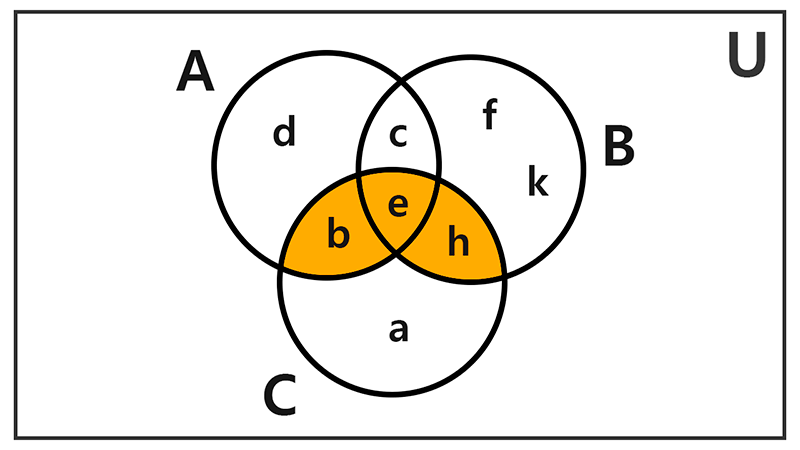
Universal Set
The universal set is the set that contains all elements under consideration in a particular context, framework, or study. It is also commonly known as the reference set or universe of discourse.
In modern set theory, this set is primarily denoted by the letter U, although in various logic and mathematics texts the letter V is also frequently used to symbolize it. Any set analyzed within that framework is necessarily a subset of it.
It is important to emphasize that the universal set does not represent the absolute totality of all conceivable entities, nor does it collect "all possible sets." Establishing a universal notion without a bounded framework leads to formal logical contradictions, such as Russell's paradox; for this reason, the reference set is always defined relative to the specific discipline or problem being analyzed.
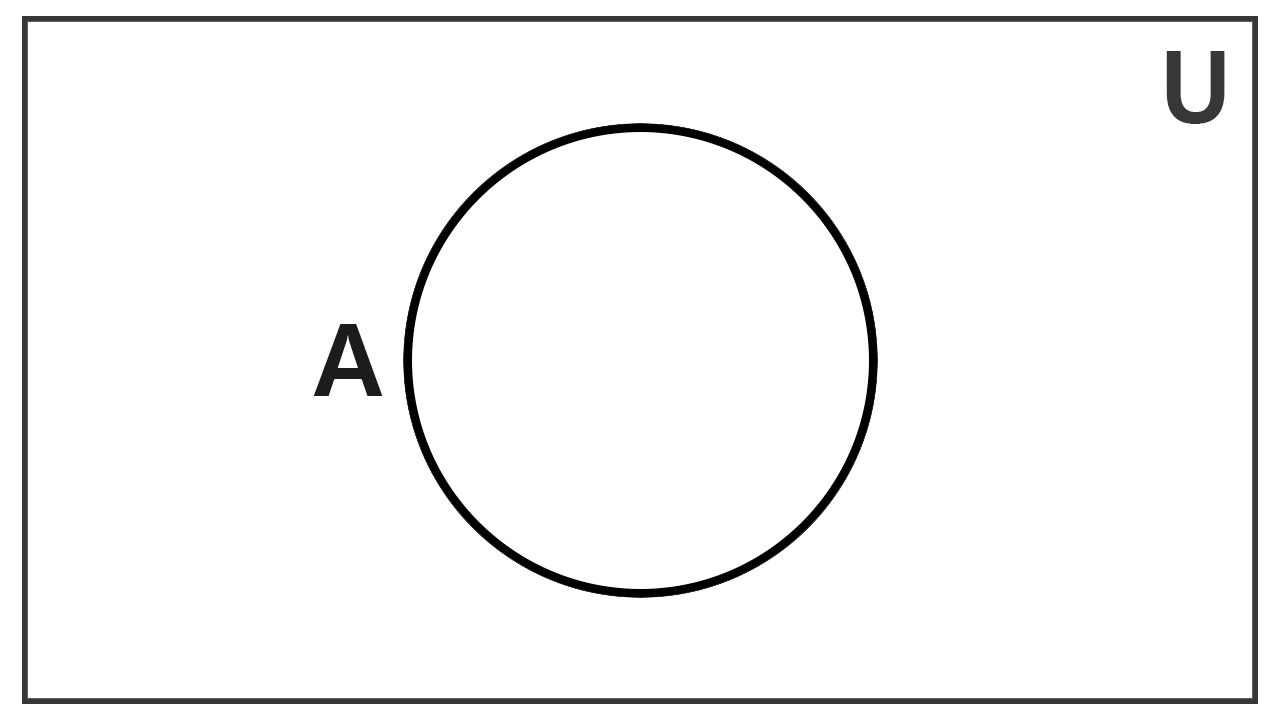
Formally, given a fixed universal set U, for every set A belonging to the same discussion, the subset relation holds:
A ⊆ U
This property ensures that no element of the sets involved is excluded from the previously established working framework.
Table of Contents
Examples
To clearly understand how the universal set functions, it is helpful to examine different contexts where the elements vary depending on the chosen discipline or discussion framework.
- If we consider the subsets formed by the vowels V = {a, e, i, o, u} and by the consonants of our language, the appropriate universal set is the English alphabet, expressed as U = {a, b, c,..., z}. Within this framework, any grouping of letters we analyze will necessarily be a subset of that alphabet.
- In a biological study examining the characteristics of mammals or birds, we can establish the set of all animals on Earth as the universe of discourse. In this way, no species analyzed falls outside the designated reference universe for the research.
- Working in elementary arithmetic with single-digit even numbers E = {0, 2, 4, 6, 8} and odd numbers less than ten O = {1, 3, 5, 7, 9}, the natural universal set is the set of decimal digits: U = {0, 1, 2, 3, 4, 5, 6, 7, 8, 9}. Both sets E and O are proper, disjoint subsets within this finite universe.
- If we define infinite sets such as positive integers or multiples of five, the universal set corresponds to the set of integers Z = {..., -2, -1, 0, 1, 2,...}. Under this universe, we automatically exclude fractions or decimal values, keeping all calculations within the integer domain.
- In algebra, the choice of universe directly dictates whether solutions exist. If we look for solutions to the equation x2 + 1 = 0 within the set of real numbers R, the solution set is the empty set Ø. In contrast, if we expand the universal set to the complex numbers C, the equation has valid solutions given by {i, -i}.
- In mathematical analysis and the study of functions, we often work with continuous intervals such as A = [0, 1] or B = (2, 5). In these situations, the entire real line R serves as the reference set upon which unions, intersections, and complements are evaluated.
Properties
In set algebra, the universal set plays specific roles with respect to the fundamental operations of union, intersection, and complementation. These properties allow us to simplify expressions and complete proofs.
1) Universal inclusion: any set A belonging to the working context is, by definition, a subset of the universal set.
A ⊆ U
2) Absorbing element of the union (domination law): taking the union of any set with the universal set yields the entirety of the universe under study.
A ∪ U = U
3) Identity element of the intersection: the elements shared between any set and the universe correspond exactly to the elements of the original set.
A ∩ U = A
4) Complement of the universal set: since the universal set contains all elements within the framework of analysis, no elements remain outside of it. That is, its complement is the empty set.
U′ = Ø
5) Complement of the empty set: conversely, because the empty set contains no elements, its complement contains all available elements in the universe.
Ø′ = U
6) Union with the complement: taking the union of a set with its complement exactly reconstructs the entire universal set.
A ∪ A′ = U
7) Relative complement with the universe: subtracting a set from the universal set is formally equivalent to determining the complement of that set.
U - A = A′
Solved Practice Problems
To find a universal set that serves as a valid reference for a given collection of sets, the essential requirement is that the set must contain every element under consideration. Strictly speaking, given sets A, B, and C, any set U is a valid universal set as long as A ⊆ U, B ⊆ U, and C ⊆ U hold true.
There is an essential conceptual distinction worth clarifying: the universal set does not have to equal the union of the given sets. The union represents the minimal universal set (or smallest possible universal set)—that is, the set containing exactly the required elements without adding any extra ones.
Any larger superset that includes this union is also a completely valid reference set. Below, we solve several representative cases step by step to reinforce this concept.
Problem 1
Given the sets A = {1, 3}, B = {2, 3, 4}, and C = {4, 5, 6}, find the minimal universal set and propose two larger reference sets that are also valid.
Solution
To find the minimal universal set, we take the union of all the given sets, collecting their elements without repeating shared values like 3 and 4. Thus, we obtain:
Umin = A ∪ B ∪ C = {1, 2, 3, 4, 5, 6}
This result is the smallest possible reference set. However, it is not the only choice; we can define broader frameworks that contain these same values.
For instance, we can choose the set of decimal digits U1 = {0, 1, 2, 3, 4, 5, 6, 7, 8, 9}, or the full set of natural numbers N. In both cases, A, B, and C remain valid subsets.
Problem 2
Consider the geometric sets T = {x | x is a triangle} and Q = {x | x is a quadrilateral}. Determine their minimal universal set in set-builder notation and propose a standard universal set suited for this context.
Solution
To find the minimal universe, we take their union directly. The resulting set contains only three- or four-sided figures:
Umin = T ∪ Q = {x | x is a triangle or x is a quadrilateral}
While this answer is strictly correct from an operational perspective, in mathematics it is often more practical to work within a broader conceptual category.
Therefore, we can define the reference set as the set of all polygons in the plane, or even more broadly, the set of all 2D geometric figures. Both universes naturally encompass the elements of T and Q.
Problem 3
Let the sets of integers defined in set-builder notation be A = {x ∈ Z | -2 ≤ x ≤ 1} and B = {x ∈ Z | 0 ≤ x ≤ 4}. Find the minimal universal set in roster form and discuss the choice of a standard numerical universe.
Solution
We begin by listing the integer elements of each set in roster form. For A we have {-2, -1, 0, 1}, while for B we obtain {0, 1, 2, 3, 4}.
We compute the minimal universal set by taking the union A ∪ B, ensuring we do not duplicate elements 0 and 1 shared by both sets:
Umin = {-2, -1, 0, 1, 2, 3, 4}
If the problem requires placing these sets into a standard algebraic context, we can directly adopt the set of integers Z as the universal set, or even the real numbers R.
The choice depends entirely on the requirements of the situation: while Umin strictly bounds the sample, a universe such as Z allows for broader operations across the entire integer domain.
Did you find this useful? Rate it!
0.0 / 5 — 0 votes

HOW TO CITE THIS ARTICLE
Machado, D. (2026, October 1). Universal Set. Flamath. https://en.flamath.com/universal-set
Leave a Reply
Related Articles