
Destructive Dilemma
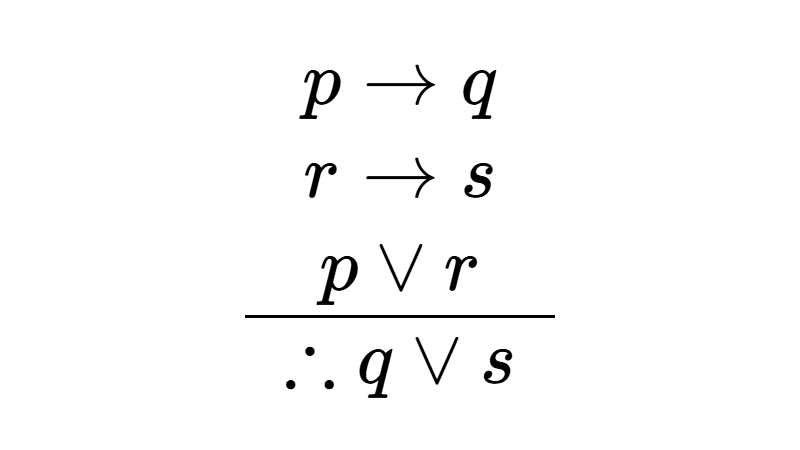
The destructive dilemma is a rule of inference within propositional logic establishing that, given two conditional statements and the disjunctive negation of their consequents, the disjunctive negation of their antecedents is validly and necessarily concluded.
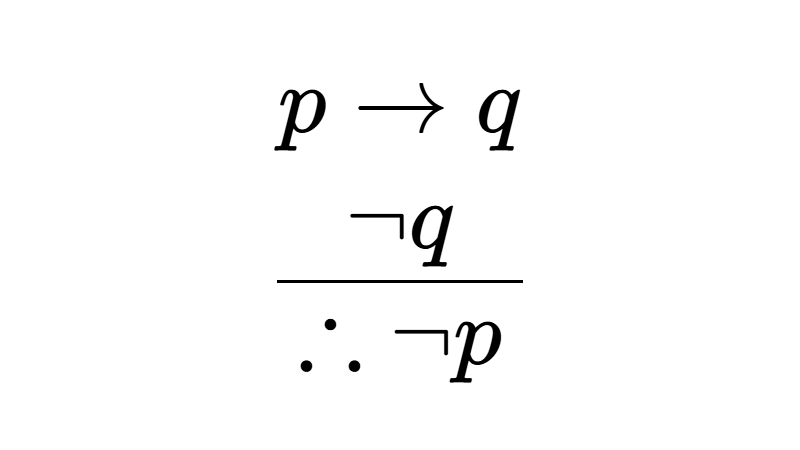
From a logical perspective, this principle constitutes an extension of the modus tollens rule. If we know that at least one of the two resulting effects has not occurred, we can guarantee with complete certainty that the associated initial cause or prior condition did not take place either.
In the formal language of propositional calculus, the structure of the complex destructive dilemma is represented horizontally through the following associated conditional:
[(p → q) ∧ (r → s) ∧ (¬q ∨ ¬s)] → (¬p ∨ ¬r)
When structuring a deduction in standard vertical format, we arrange the three initial premises above the line of inference:
$$ \begin{array}{cl} p \rightarrow q \\ r \rightarrow s \\ \neg q \lor \neg s \\ \hline \therefore \neg p \lor \neg r \end{array} $$
The semantic foundation of this rule rests on the impossibility of maintaining both antecedents when their consequences are ruled out. The premise ¬q ∨ ¬s ensures that at least one of the consequents is false, which forces—by the definition of the conditional—its respective antecedent to also be false.
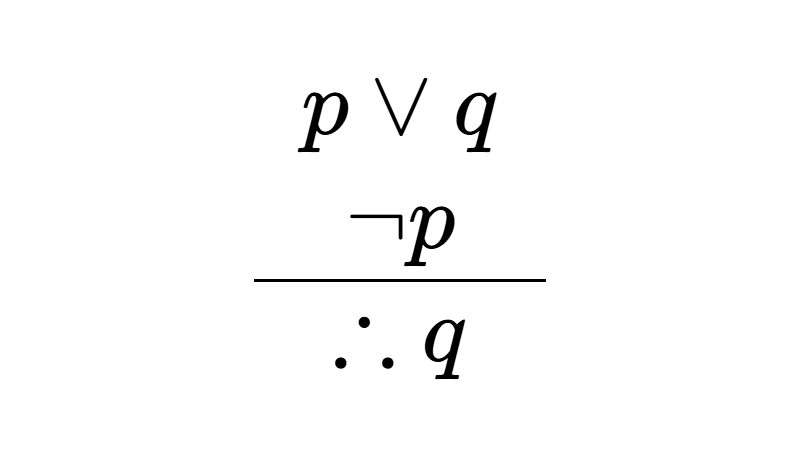
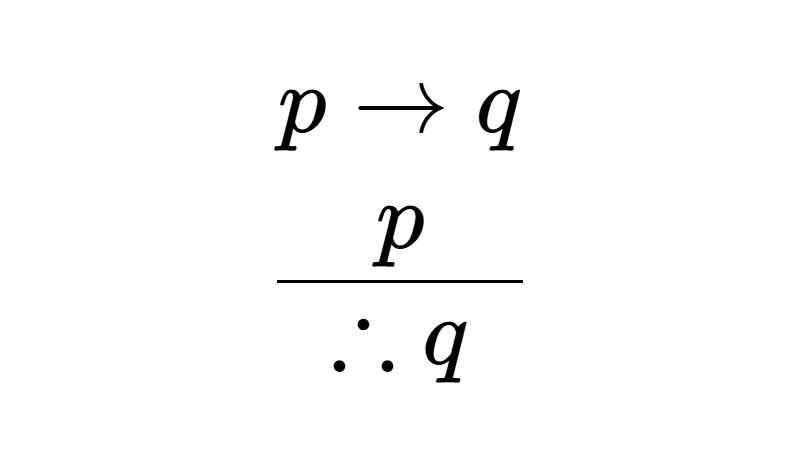
It is worth distinguishing this pattern from the constructive dilemma, as they represent complementary deductive pathways. While the constructive dilemma relies on modus ponens by affirming antecedents to derive consequents, the destructive dilemma employs the refutation characteristic of modus tollens to deny antecedents based on unfulfilled consequents.
Table of Contents
Examples
To analyze how the law of destructive dilemma operates across various areas of reasoning, we will review five scenarios ranging from everyday contexts to analytical and arithmetic properties.
Example 1
Premise 1: If the alarm rings on time, the student arrives punctually for the exam (p → q).
Premise 2: If the bus stops at the regular station, the student avoids walking in the rain (r → s).
Premise 3: The student did not arrive punctually for the exam or did not avoid walking in the rain (¬q ∨ ¬s).
Conclusion: Therefore, the alarm did not ring on time or the bus did not stop at the regular station (¬p ∨ ¬r).
In this first scenario, we establish two causal hypotheses regarding the student's routine. Upon confirming that at least one of the two expected outcomes did not occur, we validly infer that at least one of the two prior conditions failed to take place.
Example 2
Premise 1: If the candidate meets the required years of experience, the candidate qualifies for the technical interview (p → q).
Premise 2: If the candidate presents a valid professional certification, the candidate obtains an exemption from the practical test (r → s).
Premise 3: The candidate did not qualify for the technical interview or did not obtain an exemption from the practical test (¬q ∨ ¬s).
Conclusion: Therefore, the candidate does not meet the required years of experience or did not present a valid professional certification (¬p ∨ ¬r).
Here we analyze two independent job requirements. Because it is verified that at least one of the two benefits in the selection process was not achieved, it follows with logical necessity that the applicant lacks at least one of the two associated qualifications.
Example 3
Premise 1: If the temperature of the sample drops below 0 °C, the water it contains freezes (p → q).
Premise 2: If atmospheric pressure drops drastically, the liquid boils at a lower temperature (r → s).
Premise 3: The water did not freeze or the liquid did not boil at a lower temperature (¬q ∨ ¬s).
Conclusion: Therefore, the temperature did not drop below 0 °C or atmospheric pressure did not drop drastically (¬p ∨ ¬r).
In this physical and experimental context, the observed thermal effects depend on well-defined initial conditions. Noting the absence of at least one of the two physical phenomena in the laboratory, we conclude that the corresponding environmental condition failed to occur.
Example 4
Premise 1: If a quadrilateral is a rhombus, its diagonals are perpendicular to each other (p → q).
Premise 2: If a quadrilateral is a rectangle, its diagonals are equal in length (r → s).
Premise 3: The diagonals are not perpendicular to each other or the diagonals are not equal in length (¬q ∨ ¬s).
Conclusion: Therefore, the quadrilateral is not a rhombus or the quadrilateral is not a rectangle (¬p ∨ ¬r).
In this Euclidean geometry example, we associate two geometric figures with intrinsic properties of their diagonals. By verifying that at least one of these metric characteristics is not satisfied by the given figure, we guarantee that the figure does not classify as a rhombus or does not classify as a rectangle.
Example 5
Premise 1: If an integer n is divisible by 6, then n is an even number (p → q).
Premise 2: If an integer n ends in the digit 5, then n is divisible by 5 (r → s).
Premise 3: The number n is not even or the number n is not divisible by 5 (¬q ∨ ¬s).
Conclusion: Therefore, the number n is not divisible by 6 or does not end in the digit 5 (¬p ∨ ¬r).
Within number theory, we connect arithmetic hypotheses with their direct logical consequences. If basic inspection rules out at least one of the two divisibility properties, the rule allows us to assert the falsity of at least one of the structural premises regarding the number n.
Formal Proof
To verify the deductive validity of the destructive dilemma without resorting to excessively long procedures, we can construct a step-by-step syntactic proof using fundamental rules of inference.
Our objective is to formally derive the conclusion ¬p ∨ ¬r from the following initial set of premises:
1. p → q (Premise 1)
2. r → s (Premise 2)
3. ¬q ∨ ¬s (Premise 3)
To evaluate the disjunction in Premise 3, we use the proof by cases method. We independently analyze the logical consequences that follow from assuming each of the two disjunctive alternatives.
In the first case, we temporarily assume as a hypothesis that the negation of the first consequent holds:
4. ¬q (Case 1 assumption)
5. ¬p (Modus tollens from 1 and 4)
6. ¬p ∨ ¬r (Rule of addition applied to 5)
In the second case, we now assume that the true statement in the disjunction is the negation of the second consequent:
7. ¬s (Case 2 assumption)
8. ¬r (Modus tollens from 2 and 7)
9. ¬p ∨ ¬r (Rule of addition applied to 8)
Because both assumptions lead with absolute necessity to the same formula ¬p ∨ ¬r, we apply the disjunction elimination rule to Premise 3 to conclude the proof:
10. ¬p ∨ ¬r (Disjunction elimination from 3, 4–6, and 7–9)
The argument is proved with complete formal logical rigor, confirming that the conclusion necessarily follows from the structure of the premises.
It is also possible to verify semantic validity using a truth table for the conditional [(p → q) ∧ (r → s) ∧ (¬q ∨ ¬s)] → (¬p ∨ ¬r). Containing four propositional variables (p, q, r, and s), such an analysis would require evaluating 24 = 16 rows to confirm that all truth-value assignments yield a tautology.
Simple Destructive Dilemma
The simple destructive dilemma is a specific variant of this logical law in which a single antecedent is conditionally linked to two distinct consequences.
In this formal schema, if we have two implications that share the same hypothesis and we disjunctively deny their consequents, the negation of that antecedent is directly concluded.
In propositional calculus, the associated conditional for this rule is expressed as follows:
[(p → q) ∧ (p → s) ∧ (¬q ∨ ¬s)] → ¬p
When structuring the formal deduction vertically, we organize the three premises above the line of inference:
$$ \begin{array}{cl} p \rightarrow q \\ p \rightarrow s \\ \neg q \lor \neg s \\ \hline \therefore \neg p \end{array} $$
The algebraic foundation of this simplification lies in the idempotence law of disjunction. Applying the standard destructive dilemma schema yields the intermediate expression ¬p ∨ ¬p, which simplifies directly to ¬p because of the equivalence ¬p ∨ ¬p ≡ ¬p.
It is therefore sufficient to verify that at least one of the two resulting consequences failed to occur in reality to completely discard the validity of the initial cause that produced them.
Example
Premise 1: If the website is correctly hosted on the server, it loads its main content in the browser (p → q).
Premise 2: If the website is correctly hosted on the server, it responds without throwing connection errors (p → s).
Premise 3: The website does not load its main content in the browser or it throws a connection error (¬q ∨ ¬s).
Conclusion: Therefore, the website is not correctly hosted on the server (¬p).
In this practical technology scenario, a single infrastructure condition guarantees two simultaneously observable behaviors. Detecting a failure in at least one of the two expected responses conclusively rules out that the web hosting configuration is in a proper state.
Did you find this useful? Rate it!
0.0 / 5 — 0 votes

HOW TO CITE THIS ARTICLE
Machado, D. (2026, September 30). Destructive Dilemma. Flamath. https://en.flamath.com/destructive-dilemma
Leave a Reply
Related Articles