

Complex Numbers
A complex number is a number defined by two real components associated with the imaginary unit. It is usually written in standard form as \(z = a + bi\), where \(a\) and \(b\) are real numbers and \(i\) satisfies the fundamental property \(i^2 = -1\).
In this expression, the term \(a\) is called the real part of the complex number and is denoted by \(\text{Re}(z) = a\). The real number \(b\) represents the imaginary part and is written as \(\text{Im}(z) = b\). It is important to note that the imaginary part is strictly the real coefficient \(b\) and does not include the unit \(i\).
The imaginary unit, represented by the letter \(i\), is formally defined by the property that its square is equal to \(-1\):
$$i^2 = -1$$
This value is not part of the set of real numbers \(\mathbb{R}\), since multiplying any real number by itself always yields a positive number or zero. Because no real number has a negative square, introducing \(i\) allows us to extend the number system.
The set of all numbers of the form \(a + bi\) is called the set of complex numbers and is denoted by the symbol \(\mathbb{C}\):
$$\mathbb{C} = \{a + bi \mid a \in \mathbb{R},\, b \in \mathbb{R},\, i^2 = -1\}$$
The need for this set arises when trying to solve simple algebraic equations that have no real solutions, such as:
$$x^2 + 1 = 0$$
Isolating the variable gives \(x^2 = -1\), an equation that cannot be satisfied in \(\mathbb{R}\). With the definition of the imaginary unit, this equation has two distinct solutions: \(x = i\) and \(x = -i\).
This same limitation frequently occurs when using the quadratic formula to solve an equation of the form \(ax^2 + bx + c = 0\). When the discriminant is negative (\(\Delta = b^2 - 4ac < 0\)), the formula requires taking the square root of a negative number—an operation only possible within the complex number system.
The primary purpose of complex numbers is that they allow us to evaluate even roots of negative numbers and solve polynomial equations that have no real solutions. Beyond pure algebra, they are essential tools for modeling physical and engineering phenomena involving oscillations and waves, including alternating current (AC) circuit analysis, fluid dynamics, and digital signal processing.
Table of Contents
Identifying and Classifying Complex Numbers
To write a complex number in standard form, take any two real numbers and combine them using the expression \(a + bi\). In this structure, the first value is the real part, and the coefficient attached to the imaginary unit represents the imaginary part.
Consider the following examples to identify the components of different complex numbers:
- \(5 + 3i:\) its real part is \(5\) and its imaginary part is \(3\).
- \(8 - 6i:\) its real part is \(8\) and its imaginary part is \(-6\), keeping the negative sign in front of the term.
- \(-\frac{1}{2} + \sqrt{7}i:\) its real part is \(-\frac{1}{2}\) and its imaginary part is \(\sqrt{7}\).
- \(9i:\) its real part is \(0\) and its imaginary part is \(9\), since it can be written as \(0 + 9i\).
- \(-4:\) its real part is \(-4\) and its imaginary part is \(0\), as it can be expressed as \(-4 + 0i\).
Types of Complex Numbers
Depending on whether the real part or the imaginary part is zero, complex numbers are classified into specific categories:
- Real number: occurs when the imaginary part is zero (\(b = 0\)), leaving only \(z = a\). This confirms that all real numbers are part of the set of complex numbers. For example, \(z = 7\) or \(z = -12\).
- Pure imaginary number: occurs when the real part is zero (\(a = 0\)) and the imaginary part is nonzero (\(b \neq 0\)), resulting in \(z = bi\). For example, \(z = -5i\) or \(z = \frac{3}{4}i\).
- Non-real complex number (or imaginary number): includes any complex number with a nonzero imaginary part (\(b \neq 0\)), regardless of the value of its real part. For example, \(z = 2 + 4i\) or \(z = -3i\).
- The number zero: the special case where both the real and imaginary parts are zero (\(a = 0\) and \(b = 0\)), written as \(z = 0 + 0i = 0\).
Equality of Complex Numbers
Two complex numbers are equal if and only if their real parts are equal and their imaginary parts are equal simultaneously:
$$a + bi = c + di \quad \text{if and only if} \quad a = c \quad \text{and} \quad b = d$$
This condition allows us to find unknown values by setting corresponding parts equal to each other. Consider two application examples:
- Given \(z_1 = 4 + 7i\) and \(z_2 = x + yi\), for both to be equal, we must directly have \(x = 4\) and \(y = 7\).
- Given the equation \(2x + 5i = 8 + (y - 1)i\), equating the real parts yields \(2x = 8\) (so \(x = 4\)), and equating the imaginary parts yields \(5 = y - 1\) (so \(y = 6\)).
The Complex Conjugate
The complex conjugate of a complex number \(z = a + bi\) is another complex number that has the same real part, but with the sign of its imaginary part reversed. It is denoted with a horizontal bar over the variable:
$$\overline{z} = a - bi$$
This transformation is particularly useful for simplifying algebraic expressions and dividing complex numbers. Consider the following examples to find the conjugate of different numbers:
- For \(z = 4 + 7i\), its conjugate is \(\overline{z} = 4 - 7i\).
- For \(z = -3 - 5i\), its conjugate is \(\overline{z} = -3 + 5i\).
- For \(z = 8i\), its conjugate is \(\overline{z} = -8i\).
- For \(z = 6\), its conjugate is \(\overline{z} = 6\), because having a zero imaginary part (\(6 + 0i\)) means changing the sign does not affect the value.
Square Roots of Negative Numbers
Evaluating square roots with negative radicands was the primary motivation behind the development of complex numbers. Within the set of real numbers, no value squared produces a negative quantity, leaving these operations undefined in \(\mathbb{R}\).
For any positive real number \(c > 0\), the principal square root of its negative counterpart is defined as the product of the square root of the positive number and the imaginary unit:
$$\sqrt{-c} = \sqrt{c} \cdot i$$
This relationship is derived by rewriting the radicand as \(-c = c \cdot (-1) = c \cdot i^2\). Taking the square root yields \(\sqrt{c \cdot i^2} = \sqrt{c} \cdot \sqrt{i^2} = \sqrt{c} \cdot i\). Following this convention, the imaginary unit \(i\) represents the principal square root of \(-1\), which is why it is often expressed in mathematical literature as \(i = \sqrt{-1}\).
It is important to distinguish between solving an equation and finding a principal root. A pure quadratic equation such as \(x^2 = -c\) has two solutions (\(x = \sqrt{c}\,i\) and \(x = -\sqrt{c}\,i\)), while the radical symbol \(\sqrt{-c}\) specifically designates the single principal root multiplied by \(i\).
To understand how this definition applies, consider these practical examples:
- \(\sqrt{-1} = \sqrt{1} \cdot i = 1 \cdot i = i\)
- \(\sqrt{-16} = \sqrt{16} \cdot i = 4i\)
- \(\sqrt{-25} = \sqrt{25} \cdot i = 5i\)
- \(\sqrt{-\dfrac{9}{49}} = \sqrt{\dfrac{9}{49}} \cdot i = \dfrac{3}{7}i\)
- \(\sqrt{-12} = \sqrt{12} \cdot i = \sqrt{4 \cdot 3} \cdot i = 2\sqrt{3}\,i\)
Product Rule for Radicals and Its Restriction
The product rule for radicals, expressed as \(\sqrt{a \cdot b} = \sqrt{a} \cdot \sqrt{b}\), is only valid when at least one of the factors \(a\) or \(b\) is a non-negative real number. Applying this rule when both radicands are negative leads to an algebraic contradiction.
Notice the issue in the following chain of equalities:
$$1 = \sqrt{1} = \sqrt{(-1)(-1)} \neq \sqrt{-1} \cdot \sqrt{-1} = i \cdot i = i^2 = -1$$
Applying the product property indiscriminately results in the false statement \(1 = -1\). For this reason, whenever an algebraic expression involves negative numbers under an even radical, always convert each radical into terms of the imaginary unit \(i\) before multiplying or simplifying.
Operations with Complex Numbers
Basic operations with complex numbers combine standard algebraic techniques with the properties of the imaginary unit. To work with them efficiently, we first examine the periodic behavior of powers of \(i\) before moving on to addition, subtraction, multiplication, and division.
Powers of the Imaginary Unit (i)
Evaluating consecutive integer powers of the imaginary unit reveals a repeating four-step cycle:
- \(i^0 = 1\)
- \(i^1 = i\)
- \(i^2 = -1\)
- \(i^3 = i^2 \cdot i = (-1) \cdot i = -i\)
- \(i^4 = i^2 \cdot i^2 = (-1) \cdot (-1) = 1\)
After the fourth power, the values repeat: \(i^5 = i\), \(i^6 = -1\), \(i^7 = -i\), and \(i^8 = 1\). To simplify any power of \(i\) with a large natural exponent, divide the exponent by \(4\) and identify the remainder, since this remainder corresponds to the equivalent power within the fundamental cycle.
Example 1: Simplify \(i^{23}\).
Divide \(23\) by \(4\): the quotient is \(5\) with a remainder of \(3\) (\(23 = 4 \cdot 5 + 3\)). Rewrite the expression using exponent properties:
$$i^{23} = i^{4 \cdot 5 + 3} = (i^4)^5 \cdot i^3 = (1)^5 \cdot (-i) = -i$$
Example 2: Simplify \(i^{102}\).
Dividing \(102\) by \(4\) yields a quotient of \(25\) and a remainder of \(2\) (\(102 = 4 \cdot 25 + 2\)). Evaluate the equivalent power:
$$i^{102} = (i^4)^{25} \cdot i^2 = (1)^{25} \cdot (-1) = -1$$
Adding and Subtracting Complex Numbers
To add two complex numbers, add their real parts together and their imaginary parts together:
$$(a + bi) + (c + di) = (a + c) + (b + d)i$$
Subtraction is defined similarly: subtracting a complex number is equivalent to adding its opposite, which means subtracting component by component:
$$(a + bi) - (c + di) = (a - c) + (b - d)i$$
Example 1: Add \(z_1 = 3 + 5i\) and \(z_2 = 2 - 8i\).
Combine like terms by grouping the real parts and the imaginary parts:
$$(3 + 5i) + (2 - 8i) = (3 + 2) + (5 - 8)i = 5 - 3i$$
Example 2: Subtract \(w_2 = 7 - 2i\) from \(w_1 = -4 + 6i\).
$$(-4 + 6i) - (7 - 2i) = (-4 - 7) + [6 - (-2)]i = -11 + (6 + 2)i = -11 + 8i$$
Multiplying Complex Numbers
To multiply two complex numbers in standard form, apply the distributive property (often using the FOIL method) just as you would when multiplying two binomials, and apply the substitution \(i^2 = -1\):
$$(a + bi)(c + di) = ac + adi + bci + bdi^2 = (ac - bd) + (ad + bc)i$$
There is no need to memorize the general formula; simply distribute the terms directly and combine like terms.
Example 1: Multiply \(z_1 = 2 + 3i\) by \(z_2 = 4 + 5i\).
Expand using the distributive property:
$$(2 + 3i)(4 + 5i) = 2 \cdot 4 + 2 \cdot 5i + 3i \cdot 4 + 3i \cdot 5i$$
$$= 8 + 10i + 12i + 15i^2$$
Substitute \(i^2 = -1\) and combine like terms:
$$= 8 + 22i + 15(-1) = 8 + 22i - 15 = -7 + 22i$$
Example 2: Multiply \(w_1 = 3 - 2i\) by \(w_2 = -1 + 4i\).
Distribute the terms:
$$(3 - 2i)(-1 + 4i) = 3(-1) + 3(4i) - 2i(-1) - 2i(4i)$$
$$= -3 + 12i + 2i - 8i^2 = -3 + 14i - 8(-1)$$
$$= -3 + 14i + 8 = 5 + 14i$$
Dividing Complex Numbers
To divide two complex numbers in standard form, multiply both the numerator and the denominator by the conjugate of the denominator. This process eliminates the imaginary unit from the denominator, resulting in a real divisor:
$$\dfrac{a + bi}{c + di} = \dfrac{(a + bi)(c - di)}{(c + di)(c - di)} = \dfrac{(a + bi)(c - di)}{c^2 + d^2}$$
The denominator expands as a difference of squares: \((c + di)(c - di) = c^2 - (di)^2 = c^2 - d^2i^2 = c^2 + d^2\), which is always a positive real number.
Example 1: Divide \(\dfrac{2 + 3i}{1 - 2i}\).
Multiply the numerator and denominator by the conjugate of the denominator, which is \(1 + 2i\):
$$\dfrac{2 + 3i}{1 - 2i} = \dfrac{(2 + 3i)(1 + 2i)}{(1 - 2i)(1 + 2i)}$$
Expand the numerator using FOIL and simplify the denominator:
$$\dfrac{2 \cdot 1 + 2 \cdot 2i + 3i \cdot 1 + 3i \cdot 2i}{1^2 + 2^2} = \dfrac{2 + 4i + 3i + 6i^2}{1 + 4}$$
Substitute \(i^2 = -1\) and simplify:
$$\dfrac{2 + 7i - 6}{5} = \dfrac{-4 + 7i}{5} = -\dfrac{4}{5} + \dfrac{7}{5}i$$
Example 2: Divide \(\dfrac{5 - i}{2 + 3i}\).
The conjugate of the denominator is \(2 - 3i\). Multiply both parts of the fraction:
$$\dfrac{5 - i}{2 + 3i} = \dfrac{(5 - i)(2 - 3i)}{(2 + 3i)(2 - 3i)}$$
Simplify both the numerator and the denominator:
$$\dfrac{10 - 15i - 2i + 3i^2}{2^2 + 3^2} = \dfrac{10 - 17i + 3(-1)}{4 + 9} = \dfrac{7 - 17i}{13} = \dfrac{7}{13} - \dfrac{17}{13}i$$
Properties of Complex Numbers
Below are the fundamental algebraic properties that govern the set of complex numbers.
Algebraic Properties of Operations
Addition and multiplication in the complex number system satisfy the same field axioms as real numbers. The following table summarizes these properties for any complex numbers \(u\), \(v\), \(w\), and \(z\):
| Property | Expression | Description |
|---|---|---|
| Commutative Property of Addition | \(u + v = v + u\) | Changing the order of the addends does not change the sum. |
| Commutative Property of Multiplication | \(u \cdot v = v \cdot u\) | Changing the order of the factors does not change the product. |
| Associative Property of Addition | \((u + v) + w = u + (v + w)\) | Grouping addends differently does not change the sum. |
| Associative Property of Multiplication | \((u \cdot v) \cdot w = u \cdot (v \cdot w)\) | Grouping factors differently does not change the product. |
| Distributive Property | \(u \cdot (v + w) = u \cdot v + u \cdot w\) | Multiplying a number by a sum distributes the multiplication to each term. |
| Additive Identity | \(z + 0 = z\) | Adding the complex number \(0 = 0 + 0i\) preserves the original number. |
| Multiplicative Identity | \(z \cdot 1 = z\) | Multiplying by \(1 = 1 + 0i\) preserves the original number. |
| Additive Inverse | \(z + (-z) = 0\) | For every \(z = a + bi\), there exists an opposite \(-z = -a - bi\) such that their sum is zero. |
| Multiplicative Inverse (Reciprocal) | \(z \cdot z^{-1} = 1\) | For every \(z = a + bi \neq 0\), there exists a reciprocal \(z^{-1} = \dfrac{a - bi}{a^2 + b^2}\) whose product with \(z\) is one. |
Properties of the Conjugate
The conjugation operation interacts systematically with addition, subtraction, multiplication, and division. Below are the key algebraic relationships for any complex numbers \(z_1\) and \(z_2\):
| Property | Expression | Description |
|---|---|---|
| Involution | \(\overline{\overline{z}} = z\) | Taking the conjugate twice yields the original complex number. |
| Conjugate of Sum and Difference | \(\overline{z_1 \pm z_2} = \overline{z_1} \pm \overline{z_2}\) | The conjugate of a sum or difference equals the sum or difference of the individual conjugates. |
| Conjugate of a Product | \(\overline{z_1 \cdot z_2} = \overline{z_1} \cdot \overline{z_2}\) | The conjugate of a product equals the product of the individual conjugates. |
| Conjugate of a Quotient | \(\overline{\left(\dfrac{z_1}{z_2}\right)} = \dfrac{\overline{z_1}}{\overline{z_2}}\) | The conjugate of a quotient equals the quotient of the individual conjugates (\(z_2 \neq 0\)). |
| Sum with Conjugate | \(z + \overline{z} = 2a\) | Adding a number to its conjugate cancels the imaginary part, yielding twice the real part. |
| Difference with Conjugate | \(z - \overline{z} = 2bi\) | Subtracting the conjugate cancels the real part, yielding twice the imaginary part multiplied by \(i\). |
| Product with Conjugate | \(z \cdot \overline{z} = a^2 + b^2\) | Multiplying a number by its conjugate produces a non-negative real number equal to the sum of the squares of its components. |
Lack of Order in Complex Numbers
Unlike real numbers, where any two values can be compared using inequalities like \(<\) or \(>\), the set of complex numbers has no compatible ordering that preserves the properties of addition and multiplication. Writing inequalities such as \(z_1 > z_2\) or asking which of two imaginary numbers is larger is mathematically undefined.
The only exception is when both numbers have an imaginary part equal to zero (\(b = 0\)). In this case, they are purely real numbers and can be ordered along the standard real number line.
To see why \(\mathbb{C}\) cannot be an ordered field, consider comparing the imaginary unit \(i\) with zero. If an order existed, either \(i > 0\) or \(i < 0\) must hold:
- If we assume \(i > 0\), multiplying both sides by the positive quantity \(i\) must preserve the inequality: \(i \cdot i > 0 \cdot i\), which implies \(i^2 > 0\). Since \(i^2 = -1\), this leads to the false statement \(-1 > 0\).
- If we assume \(i < 0\), adding \(-i\) to both sides yields \(-i > 0\). Multiplying both sides by the positive quantity \(-i\) gives \((-i)(-i) > 0 \cdot (-i)\), which simplifies to \(i^2 > 0\). Substituting again yields \(-1 > 0\), which is equally false.
Both assumptions contradict fundamental field axioms. Therefore, comparing magnitudes using inequalities is not defined for complex numbers with non-zero imaginary parts.
The Fundamental Theorem of Algebra
One of the most powerful properties of the complex number system is that it is algebraically closed. This means that every non-constant polynomial equation with complex coefficients has at least one root within the set of complex numbers.
Specifically, the Fundamental Theorem of Algebra states that every polynomial of degree \(n \ge 1\) with real or complex coefficients has exactly \(n\) roots in \(\mathbb{C}\), counted with multiplicity. Because of this theorem, there is no need to extend to any higher number sets to solve polynomial equations; all solutions exist within the complex numbers.
Consider these two examples of polynomials of different degrees:
- The polynomial \(P(x) = x^2 + 9\) has degree \(2\) and has no real solutions. Over the complex numbers, it has exactly two roots: \(x_1 = 3i\) and \(x_2 = -3i\).
- The polynomial \(Q(x) = x^3 - x^2 + 4x - 4\) has degree \(3\). Factoring gives \((x - 1)(x^2 + 4) = 0\), yielding its three roots: one real root (\(x_1 = 1\)) and two complex conjugate roots (\(x_2 = 2i\), \(x_3 = -2i\)).
Graphing in the Complex Plane
While real numbers are represented along a one-dimensional number line, complex numbers require a two-dimensional coordinate system because they are determined by two independent values: a real part and an imaginary part. To visualize them geometrically, we use the complex plane (also known as an Argand diagram).
In this coordinate system, the horizontal axis is the real axis (Re) and the vertical axis is the imaginary axis (Im). Every complex number \(z = a + bi\) corresponds uniquely to the point \((a, b)\). A position vector can be drawn from the origin \((0, 0)\) to the point \((a, b)\), allowing complex numbers to be interpreted as vectors with both magnitude and direction.
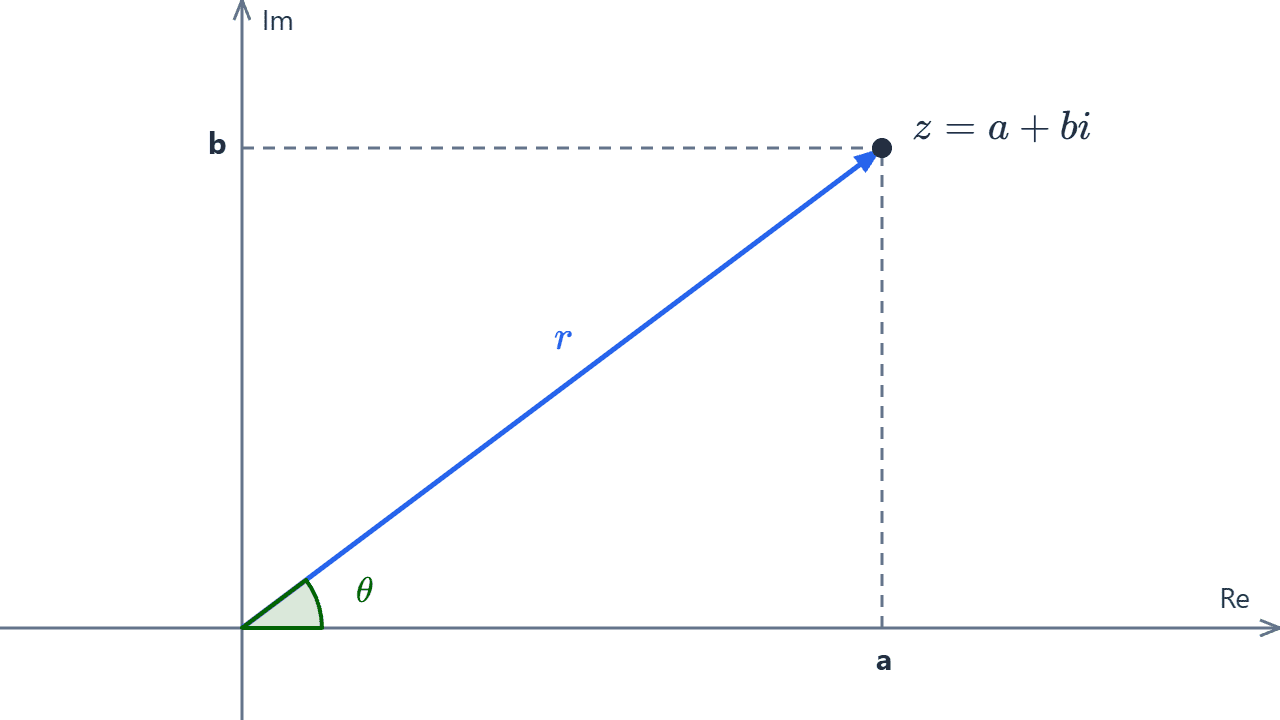
From this geometric interpretation, two key quantities are defined: the modulus and the argument.
The modulus (or absolute value) of a complex number represents the length of its position vector, which is the Euclidean distance from the origin to the point \((a, b)\). It is denoted by \(|z|\) or by the variable \(r\). Applying the Pythagorean theorem to the right triangle formed by its components yields:
$$r = |z| = \sqrt{a^2 + b^2}$$
Because it represents a distance, the modulus is always a non-negative real number (\(r \ge 0\)), and equals zero only for the number \(0 + 0i\). Here are two examples:
- For \(z = 3 + 4i\), calculate its modulus as \(r = \sqrt{3^2 + 4^2} = \sqrt{9 + 16} = \sqrt{25} = 5\).
- For \(w = -1 - \sqrt{3}i\), find its length using \(r = \sqrt{(-1)^2 + (-\sqrt{3})^2} = \sqrt{1 + 3} = \sqrt{4} = 2\).
The argument of a complex number is the angle \(\theta\) formed between the positive real axis and the position vector, measured counterclockwise. Because adding or subtracting full rotations of \(360^\circ\) results in coterminal angles, the principal argument is defined within the interval \([0^\circ, 360^\circ)\) (or \([0, 2\pi)\) in radians).
To calculate this angle, use the trigonometric relation \(\tan\theta = \dfrac{b}{a}\). Because inverse tangent functions return values in the interval \((-90^\circ, 90^\circ)\), identify the quadrant of \((a, b)\) to find the correct angle:
- Quadrant I (\(a > 0, b \ge 0\)): \(\theta = \arctan\left(\dfrac{b}{a}\right)\).
- Quadrant II (\(a < 0, b \ge 0\)): \(\theta = \arctan\left(\dfrac{b}{a}\right) + 180^\circ\).
- Quadrant III (\(a < 0, b < 0\)): \(\theta = \arctan\left(\dfrac{b}{a}\right) + 180^\circ\).
- Quadrant IV (\(a > 0, b < 0\)): \(\theta = \arctan\left(\dfrac{b}{a}\right) + 360^\circ\).
If the real part is zero (\(a = 0\)), the quotient \(\frac{b}{a}\) is undefined, and the tangent formula cannot be used directly. In this case, the point lies on the imaginary axis: if \(b > 0\), the vector points straight up and its principal argument is \(\theta = 90^\circ\); if \(b < 0\), the vector points straight down and its principal argument is \(\theta = 270^\circ\).
When the imaginary part is zero (\(b = 0\)) and \(a \neq 0\), the number lies directly on the real axis. If \(a > 0\), the vector lies along the positive real axis with \(\theta = 0^\circ\); if \(a < 0\), it points along the negative real axis with \(\theta = 180^\circ\).
Example 1: Find the principal argument of \(z = 1 + \sqrt{3}i\).
Here \(a = 1\) and \(b = \sqrt{3}\). Since both components are positive, the point is in Quadrant I:
$$\theta = \arctan\left(\dfrac{\sqrt{3}}{1}\right) = 60^\circ$$
Example 2: Find the principal argument of \(w = -2 + 2i\).
Here \(a = -2\) and \(b = 2\), placing the vector in Quadrant II. Evaluate the arctangent and add \(180^\circ\) to place the angle in the correct quadrant:
$$\theta = \arctan\left(\dfrac{2}{-2}\right) + 180^\circ = -45^\circ + 180^\circ = 135^\circ$$
Forms of Complex Numbers
A complex number can be expressed using different notation systems depending on the algebraic context. While standard rectangular form makes addition and subtraction straightforward, other forms simplify multiplication, division, roots, and powers.
Standard Form (Rectangular Form)
Standard form (or rectangular form) expresses a complex number as the direct sum of its real and imaginary parts using the structure \(z = a + bi\). It is the most practical form for addition and subtraction since like terms combine directly.
Examples in standard form:
- \(z = 3 + 2i\), where the real part is \(3\) and the imaginary part is \(2\).
- \(w = -5 - 4i\), where the real part is \(-5\) and the imaginary part is \(-4\).
Ordered Pair Form (Cartesian Form)
Ordered pair form writes a complex number as a coordinate pair \((a, b)\), directly matching its coordinates in the complex plane. The first entry indicates position along the horizontal real axis, and the second indicates position along the vertical imaginary axis.
Examples in coordinate notation:
- \(z = (4, -1)\), located in Quadrant IV with \(x\)-coordinate \(4\) and \(y\)-coordinate \(-1\).
- \(w = (-2, 6)\), located in Quadrant II with \(x\)-coordinate \(-2\) and \(y\)-coordinate \(6\).
Trigonometric Form
Trigonometric form expresses the real and imaginary parts using the modulus \(r\) and argument \(\theta\), based on right triangle trigonometry: \(a = r \cos\theta\) and \(b = r \sin\theta\). Factoring out \(r\) gives:
$$z = r (\cos\theta + i \sin\theta)$$
Many textbooks also use the shorthand \(z = r \operatorname{cis}\theta\) (standing for cosine + i sine). This form simplifies multiplication and division using angle addition formulas, as well as finding powers and roots using De Moivre's Theorem.
Examples in trigonometric form:
- \(z = 2(\cos 60^\circ + i \sin 60^\circ)\), with modulus \(r = 2\) and argument \(\theta = 60^\circ\).
- \(w = 5(\cos 180^\circ + i \sin 180^\circ)\), with modulus \(r = 5\) and argument \(\theta = 180^\circ\).
Polar Form
Polar form identifies the position of a point using polar coordinates: a radial distance \(r\) from the origin (the pole) and a directed angle \(\theta\) from the positive real axis (the polar axis).
It is commonly written with the angle as a subscript to the modulus, \(z = r_\theta\), or as a polar coordinate pair, \(z = (r, \theta)\). Like trigonometric form, it is ideal for analyzing rotations and dilations in the plane.
Examples in polar form:
- \(z = 4_{30^\circ}\), representing a vector of length \(4\) oriented at an angle of \(30^\circ\).
- \(w = \sqrt{2}_{225^\circ}\), describing a vector of length \(\sqrt{2}\) in Quadrant III at \(225^\circ\).
Exponential Form (Euler's Formula)
Exponential form is based on Euler's formula, which states that \(e^{i\theta} = \cos\theta + i \sin\theta\). Applying this identity, any complex number can be expressed compactly using the natural exponential function:
$$z = r e^{i\theta}$$
For calculations in exponential form, the argument \(\theta\) must be expressed in radians. Its greatest advantage is turning multiplication, division, and exponents into basic applications of exponent rules.
Examples in exponential form:
- \(z = 3 e^{i \frac{\pi}{3}}\), with modulus \(r = 3\) and angle \(\theta = \dfrac{\pi}{3}\text{ rad}\) (\(60^\circ\)).
- \(w = e^{i \pi}\), with modulus \(r = 1\) and angle \(\theta = \pi\text{ rad}\) (\(180^\circ\), which yields Euler's identity \(e^{i\pi} = -1\)).
Summary of Complex Number Forms
The following table summarizes how these five forms relate, where a is the real part, b is the imaginary part, r is the modulus, and θ is the argument:
| Form | General Structure |
|---|---|
| Standard (Rectangular) | a + bi |
| Ordered Pair (Cartesian) | (a, b) |
| Trigonometric | r (cos θ + i sin θ) |
| Polar | rθ |
| Exponential | r eiθ |
Solving Quadratic Equations with Complex Solutions
A direct application of complex numbers is finding all solutions to quadratic equations. In the real number system, an equation has no solutions when the discriminant is negative. With complex numbers, every quadratic equation always has two well-defined solutions.
To solve a general quadratic equation of the form \(ax^2 + bx + c = 0\) (where \(a \neq 0\)), use the quadratic formula:
\(x = \dfrac{-b \pm \sqrt{b^2 - 4ac}}{2a}\)
The nature of the solutions is determined by the discriminant \(\Delta = b^2 - 4ac\). When \(\Delta < 0\), taking the square root involves a negative radicand, resulting in two complex solutions. When the coefficients \(a\), \(b\), and \(c\) are real numbers, these two solutions are always complex conjugates of each other in the form \(p + qi\) and \(p - qi\).
Here is the step-by-step solution to three quadratic equations with negative discriminants:
Example 1: Solve the pure quadratic equation \(x^2 + 25 = 0\).
Isolate the squared variable by subtracting \(25\) from both sides:
$$x^2 = -25$$
Take the square root of both sides, accounting for both positive and negative roots, and simplify the radical using the imaginary unit:
$$x = \pm \sqrt{-25} = \pm \sqrt{25} \cdot i = \pm 5i$$
The two solutions are pure imaginary conjugate numbers: \(x_1 = 5i\) and \(x_2 = -5i\).
Example 2: Solve \(x^2 - 4x + 13 = 0\).
Identify the coefficients: \(a = 1\), \(b = -4\), and \(c = 13\). First, evaluate the discriminant:
$$\Delta = b^2 - 4ac = (-4)^2 - 4(1)(13) = 16 - 52 = -36$$
Substitute these values into the quadratic formula:
$$x = \dfrac{-(-4) \pm \sqrt{-36}}{2(1)} = \dfrac{4 \pm \sqrt{36} \cdot i}{2} = \dfrac{4 \pm 6i}{2}$$
Divide each term in the numerator by the denominator to write the solutions in standard form:
$$x = \dfrac{4}{2} \pm \dfrac{6}{2}i = 2 \pm 3i$$
The two solutions are the complex conjugate pair \(x_1 = 2 + 3i\) and \(x_2 = 2 - 3i\).
Example 3: Solve \(2x^2 + 2x + 5 = 0\).
Identify the coefficients: \(a = 2\), \(b = 2\), and \(c = 5\). Evaluate the discriminant:
$$\Delta = 2^2 - 4(2)(5) = 4 - 40 = -36$$
Apply the quadratic formula:
$$x = \dfrac{-2 \pm \sqrt{-36}}{2(2)} = \dfrac{-2 \pm 6i}{4}$$
Separate the real and imaginary parts and reduce the fractions:
$$x = -\dfrac{2}{4} \pm \dfrac{6}{4}i = -\dfrac{1}{2} \pm \dfrac{3}{2}i$$
The solutions are \(x_1 = -\dfrac{1}{2} + \dfrac{3}{2}i\) and \(x_2 = -\dfrac{1}{2} - \dfrac{3}{2}i\).
Complex numbers ensure that every quadratic equation has exactly two algebraic solutions, completing the solution set where real numbers fall short.
Did you find this useful? Rate it!
0.0 / 5 — 0 votes

HOW TO CITE THIS ARTICLE
Machado, D. (2026, September 28). Complex Numbers. Flamath. https://en.flamath.com/complex-numbers

Leave a Reply
Related Articles